1. Introduction
The contemporary philosophical discussion over scientific progress has structured itself around four main competing approaches: the semantic, the functional, the epistemic, and the understanding approach (cf. Shan Reference Shan2022). Within this discussion, each approach has developed quite independently from the others, conceptualizing scientific progress in a specific way, employing its own terminology, analyzing different case studies, and building its own normative history of scientific inquiry. Due to these differences, it is difficult to systematically compare the different approaches and to understand where exactly the differences between one approach and another lie.
The main aim of this paper is to improve this state of affairs by offering a formal meta-theory of scientific progress that can adequately represent all the different philosophical accounts that have been put forward in the literature. We do this by first focusing on the semantic approach, which conceptualizes progress as increasing truthlikeness (Niiniluoto Reference Niiniluoto, Edward and Nodelman2024). We then abstract the formal core of the theory of truthlikeness (Oddie and Cevolani Reference Oddie, Cevolani, Edward and Nodelman2022) from its usual understanding in terms of theories and hypotheses approaching the whole truth about a target domain. In this way, we obtain what we call a theory of target-likeness, i.e., a general meta-theory of scientific progress that assesses how much an abstract “unit” (possibly interpreted as a theory, as a set of problems, as a knowledge state, or as a state of understanding) approximates a relevant intended target (interpreted as one or the other of the various regulative aims postulated for scientific inquiry by the various approaches). Finally, we show how this general formal theory of target-likeness has the resources to adequately represent all the main approaches to scientific progress, including the non-semantic ones.
Our theory of target-likeness offers a precise way of assessing and comparing the assumptions and predictions of the different philosophical approaches to scientific progress. In this way, we provide all philosophers interested in scientific progress a useful tool for advancing contemporary discussion beyond the clash of different approaches. Moreover, the theory can also be applied beyond the traditional discussion on progress, to formalize intuitive normative ideas about many components of a scientific practice, such as concepts, models, measurement tools, and experimental techniques.
We proceed as follows. In section 2, we present the four main philosophical approaches to scientific progress. Section 3 is dedicated to the formal development of the theory of target-likeness. In section 4, we show how we can represent all the non-semantic approaches to scientific progress as different measures of target-likeness. In section 5, we discuss the philosophical implications of the theory of target-likeness for the comparison of different accounts of scientific progress and for the formalization of normative ideas about the different components of a given scientific practice. Section 6 concludes.
2. Contemporary accounts of scientific progress
Following now-standard terminology (cf. Dellsén Reference Dellsén2018; Shan Reference Shan2022; Bird Reference Bird2022), we can distinguish between the semantic approach, the functional approach, the epistemic approach, and the understanding approach to scientific progress. In what follows, we will briefly discuss these four approaches, one by one. For each of them, we will first describe the main general tenets of the approach, and then we will briefly present its most representative accounts; other details about the different approaches are provided in section 4.Footnote 1
The semantic approach holds that science fundamentally aims at truth. Accordingly, we make (scientific) progress when we get closer to the truth. As such, the semantic approach to progress is predominantly spelled out in terms of increasing verisimilitude of our scientific theories. Following Popper’s (Reference Popper1963) original proposal, the idea of scientific progress as increasing verisimilitude has attracted a lot of attention in twentieth-century philosophy of science, representing one of the most common tools for defending scientific realism. Because of this long history, the semantic approach to scientific progress encompasses many different, often very detailed, accounts and measures of progress.
The most popular account within the semantic approach is the truthlikeness account.Footnote 2 According to it, a scientific change is progressive when a theory gets replaced by another theory that is more truthlike, i.e., closer or more similar to “the whole truth” about the underlying domain, than its predecessor (Niiniluoto Reference Niiniluoto1984, Reference Niiniluoto1999, Reference Niiniluoto, Edward and Nodelman2024; Kuipers Reference Kuipers2000). In the literature, one can find different formal explications of this idea of closeness or similarity between a theory and the truth. Such explications are based on different principles and employ different technical tools (Niiniluoto Reference Niiniluoto1998; Oddie and Cevolani Reference Oddie, Cevolani, Edward and Nodelman2022) while still modeling the common underlying idea of truthlikeness.
The functional approach to progress holds that the aim of science is problem-solving. More exactly, supporters of the functional approach are usually skeptical of whether there is an ultimate aim of science and substitute (what they take to be) the philosophical fiction of the ultimate aim of science with (what they believe to be) a more mundane and pragmatic goal for scientific inquiry: problem-solving. According to supporters of the functional approach, we make progress when we increase the problem-solving effectiveness of our theories. This approach is closely connected with the figures of Kuhn (Reference Kuhn1962) and Laudan (Reference Laudan1977), who developed functional accounts of scientific progress that were meant to disentangle the idea of progress from scientific realism.
The most popular account within the functional approach is Laudan’s problem-solving account. According to Laudan, a scientific change is progressive when a theory gets replaced by another theory that strikes a better trade-off than its predecessor between the empirical problems it solves and the conceptual problems it does not solve or creates ex novo. Importantly, the ultimate arbiter of scientific progressiveness is, for Laudan, the scientific community of the time under focus; this is why Laudan’s account is often dubbed “internalist” by its opponents (cf. Bird Reference Bird2007, Reference Bird2022). Scientific progress is then understood by Laudan as the increasing resolution of empirical problems and the increasing dissolution of conceptual problems. Recently, Shan (Reference Shan2019) has proposed a revised version of Laudan’s problem-solving account that includes some externalist elements in the assessment of the trade-off between empirical and conceptual problems.
The epistemic approach posits that the aim of scientific inquiry is the accumulation of knowledge. Accordingly, scientific progress is equated with the increase of scientific knowledge. The epistemic approach has been outlined and defended by Bird (Reference Bird2007, Reference Bird2022), whose 2007 article also revitalized the philosophical discussion over scientific progress. More recently, Stegenga (Reference Stegenga2024) proposed a (couple of) justification-based account(s) of scientific progress, which can also be considered belonging to the epistemic approach.
The most popular epistemic account of scientific progress is Bird’s account. According to Bird, a certain scientific change is progressive if it encompasses an accumulation of knowledge in the relevant scientific community (Bird Reference Bird2022). Two important features of Bird’s account are its specific account of knowledge, which builds upon Williamson’s influential work (notably, the equation between evidence and knowledge; see Williamson Reference Williamson2000), and its emphasis on the socially distributed nature of scientific knowledge and, therefore, of scientific progress.
Finally, the understanding approach conceptualizes understanding as the ultimate aim of science. Accordingly, scientific progress is nothing but the increase of understanding that science grants us. In the contemporary philosophical discussion over scientific progress, the understanding approach has been put forward and defended as an original, independent account of scientific progress in a series of papers by Dellsén (Reference Dellsén2016, Reference Dellsén2018, Reference Dellsén2021). Kitcher (Reference Kitcher1993) can be seen as a forerunner of this approach to scientific progress.
Dellsén dubbed his understanding-based account of scientific progress the “noetic account.” According to his view, scientific progress is made when a scientific change increases society’s public understanding of a given scientific domain. More precisely, this increase in understanding is explicated by Dellsén (Reference Dellsén2020) through a specific account of objectual understanding via dependency models. According to this account, our understanding of a given domain increases when there is an increase in the accuracy and comprehensiveness of the related dependency model of the domain.
3. From truth-likeness to target-likeness
Up to now, the debate on scientific progress has mainly focused on defending specific accounts of progress or on criticizing competing ones by showing how they fail to meet some adequacy conditions or to make sense of specific episodes in the history of science. This has obscured the fact that, as we argue, the four approaches outlined above actually share a sort of Ur-Struktur which makes them comparable, even if not compatible in general. Uncovering such underlying common structure sheds light on both the similarities and differences between the four approaches, and makes their comparative discussion clearer and more systematic. Moreover, it helps in devising more rigorous and formally clearer versions of the various accounts, which in turn helps in assessing them against their competitors.
With these goals in mind, in this section we focus on the truthlikeness account of scientific progress. The reason is that such an account best exemplifies the Ur-Struktur that we want to study. In part, this is due to the fact that the truthlikeness account is the most formally developed one among those surveyed above; indeed, it will provide us with the main technical tools to discuss the common structure of all these approaches. For historical reasons, such tools have been regarded as only relevant and inextricably associated with the semantic approach to progress. Instead, they provide a useful frame to reason about all other approaches, as we will argue in detail in section 4.
3.1. The truthlikeness account
As recalled above, the truthlikeness account of progress was first articulated by Karl Popper (Reference Popper1963).Footnote 3 After Popper’s definition of truthlikeness failed for technical reasons, the post-Popperian research program on truthlikeness set out to develop an adequate explication of truthlikeness. Various definitions of truthlikeness were proposed which avoided the unwelcome consequences of Popper’s (cf. Niiniluoto Reference Niiniluoto1998; Oddie Reference Oddie1986; Oddie and Cevolani Reference Oddie, Cevolani, Edward and Nodelman2022). Some of the contributors to this program went on to develop realist, truthlikeness-based accounts of scientific progress, thus recovering the spirit of Popper’s original account of progress (Niiniluoto Reference Niiniluoto1984, Reference Niiniluoto1999, Reference Niiniluoto2015, Reference Niiniluoto2014; Kuipers Reference Kuipers2019, Reference Kuipers2000).
The definitions of truthlikeness presently available in the literature are significantly different, especially in terms of the formal tools employed to explicate such a notion. Some of them are even incompatible with each other, in the sense that, say, H may be more truthlike than H′ according to one such explication, but the opposite holds for another (Cevolani Reference Cevolani, Massimi, Romeijn and Schurz2017; Niiniluoto Reference Niiniluoto2020). For our purposes, we don’t need to enter into these debates, since we will focus on one specific account of truthlikeness, the so-called basic feature (BF) approach (Cevolani and Festa Reference Cevolani and Festa2020; Cevolani et al. Reference Cevolani, Crupi and Festa2011), that has the advantage of capturing the main common elements of most accounts on the market. Within this BF approach, one assumes that the target domain (the “world” or, better, the fragment of the world under investigation) is described by a finite set of “basic features.” To use the canonical example in the truthlikeness literature (cf. Oddie and Cevolani Reference Oddie, Cevolani, Edward and Nodelman2022), the relevant domain could be the weather in some location at some time, and “hot,” “rainy,” and “windy” could be the only three relevant basic features used to describe it. At a given moment, “the whole truth” about the world is then represented by the most complete true conjunction of elementary claims about the weather, let us say “it is hot and it is rainy and it is windy.” Here, “elementary” means that each claim affirms or denies one of the basic features. A theory or hypothesis H about the truth is represented by a consistent conjunction of elementary claims about the weather, like, say, “it is hot and it is not rainy.” The truthlikeness or verisimilitude of H is then defined in terms of the true and false information that H provides about the world. More precisely, a claim of H may be a “match,” when it is true, or a “mistake,” when it is false; moreover, H may have a “lacuna” when it fails to state some true claim about the world (for this terminology, see Kuipers Reference Kuipers1999, Reference Kuipers2000; Aliseda Reference Aliseda, Festa, Aliseda and Peijnenburg2005). In the last example above, for instance, H is “it is hot and it is not rainy”; thus, it makes one match (“it is hot” is true), one mistake (“it is not rainy” is false), and one lacuna, since it is silent about whether or not it is windy.
More formally, let
 $T =\!\pm t_1 \land \cdots \land \pm t_n$
be the truth about the world, where n is the total number of basic features and each
 $\pm t_i$
is a true elementary claim about one of them (with “
 $\pm$
” being
 $\neg$
or nothing). Let
 $H = \pm h_1 \land \cdots \land \pm h_m$
be a hypothesis, where each
 $h_i$
is a claim of H (affirming or denying the corresponding basic feature), with
 $m\leq n$
. Suppose t of these m claims are true, and f are false (with
 $t+f=m$
). Then, the degree of truthlikeness
 $vs(H)$
of H can be simply defined as
 $vs(H) = {t \over n} - {f \over n},$
i.e., as the difference between the number of matches and mistakes of H, normalized by n. In other words, each match of H receives a “prize” of 1, each mistake receives a “penalty” of
 $-1$
, and each lacuna receives an (implicit) weight of 0. Note that
 $vs(H)$
varies between a maximum value of 1 (when H is equal to T) and a minimum value of
 $-1$
(when H is the conjunction of the negations of all claims of T). Moreover,
 ${vs}$
satisfies a number of adequacy conditions discussed in the literature (cf. Cevolani and Festa Reference Cevolani and Festa2020). In particular, a false hypothesis H like “it is hot and it is not rainy” can be closer to the truth than another false hypothesis H′ like “it is hot and it is not rainy and it is not windy,” since the latter makes one more mistake than the former, and hence
 $vs(H) = {1 \over 3} - {1 \over 3} = 0$
is greater than
 $vs(H') = {1 \over 3} - {2 \over 3} = - {1 \over 3}$
.Footnote
4
It should be noted that the BF approach is limited to those contexts where the relevant truth and hypotheses can be expressed as conjunctions (or sets) of elementary claims about the domain. Admittedly, not all theories in science are of this kind: for instance, in more quantitative contexts (like, e.g., statistical estimation) one may need to use measures (e.g., geometrical distances) not expressible in terms of matches, mistakes, and lacunae (cf. Niiniluoto Reference Niiniluoto1987). Still, as we shall argue in a moment, the BF approach is sufficiently flexible to formulate a notion of target-likeness applicable to all approaches to scientific progress. Indeed, in all contexts where hypotheses or theories are expressible as conjunctions of elementary claims about the domain, the definition above also provides the basis for a simple truthlikeness account of progress. Following Popper’s original idea, in fact, one obtains that (cf. Niiniluoto Reference Niiniluoto, Edward and Nodelman2024):
The change from H to H′ is progressive just in case
 ${vs}{(}H) \lt {vs}{(}H^\prime)$
.
Within the BF approach, progress is a matter of providing more true, or less false, information, or both, about the world, in line with Popper’s intuitions.Footnote 5 Thus, H′ may improve on H by filling some lacuna of H, i.e., claiming some “new” truth not already entailed by H, or by removing some of the mistakes made by H, or, finally, by correcting some such mistake, i.e., substituting an “old” falsity with a “new” truth.
3.2. Target-likeness
As seen above, the basic feature approach explicates truthlikeness in terms of how well a given theory “matches” the complete true description of the world, expressed in terms of its basic features. More specifically, the
 ${vs}$
measure defines the similarity or closeness between a theory and the truth relative to three possibilities of comparison between them: a match (when a true claim is also a theory’s claim), a mistake (when the negation of a true claim is a theory’s claim), and a lacuna (when neither a true claim nor its negation is a theory’s claim). In this way, the BF approach explicates the idea of truthlikeness as a structural match between the components of a theory and the world.
Within the BF approach, the whole truth about the domain represents, as it were, the “target” of inquiry, to which the different theories and hypotheses aim to come close. The simple formal structure underlying the BF approach, however, is independent from this latter assumption, and can be easily generalized. In particular, we can abstract away from the specific truth-related components of the BF approach. This means that both the understanding of the basic features of the world as elementary truths and the related characterization of hypotheses as (conjunctions of) propositional factual statements can be dispensed with. What is left is a simple formal structure, constituted by a triple
 $\langle T, H, sim\rangle$
, where T is a target, H is a hypothesis (in a very general sense, see below), and
 ${sim}$
is a measure of similarity or closeness between the hypothesis and the target. To identify this structure precisely one needs to make explicit four components, as we shall do systematically in the rest of the paper. They are as follows:
-
• The “universe” is a set of elements defining the relevant basic features of the domain under inquiry.
-
• The target T is a conceptual representation of the ultimate aim of inquiry, expressed as a conjunction of n elementary claims about the basic features.
-
• A “unit” of representation H is the main element of scientific activity, expressed as a conjunction of
 $m\leq n$
elementary claims about the basic features.
-
•
${sim}$
is a measure of similarity or closeness of the unit H to the target T, expressed in terms of H′s matches, mistakes, and lacunae relative to T.


The triple
 $\langle T, H, {sim} {\rangle}$
is the fundamental structure of what we call a theory of target-likeness. As we shall see, it can be applied to different contexts and different conceptualizations of progress. For instance, within the semantic account discussed in section 3.1, the target T is interpreted as the whole truth, a unit H represents a conjunctive hypothesis, and
 ${sim}$
is the measure of verisimilitude
 ${vs}$
defined in eq. (1). The crucial part of the theory of target-likeness is the definition of the similarity measure
 ${sim}$
. We can define it as follows, as a generalization of the basic idea underlying eq. (1). Let
 $T = \pm t_1 \land \cdots \land \pm t_n$
be the target, and
 $H = \pm h_1 \land \cdots \land \pm h_m$
(again, with
 $m\leq n$
) a unit, recalling that now the
 $t_i$
and the
 $h_i$
are uninterpreted elementary claims. For each i, we shall say that
 $\pm h_i$
is a match of H (relative to T) just in case
 $\pm h_i$
and
 $\pm t_i$
coincide;
 $\pm h_i$
is instead a mistake of H if it is the negation of
 $\pm t_i$
; and, finally, H has a lacuna if it neither affirms nor denies
 $t_i$
. Accordingly, we introduce a function
 $\pi$
which, for each
 $t_i$
in T, assigns to H a “payoff”
 $\pi_{i}({H,T})$
depending on whether
 $h_i$
is a match, a mistake, or a lacuna of H, as follows (here, we write “
 $\mp x$
” to denote the negation of
 $\pm x$
, i.e.,
 $\mp x$
is
 $\neg x$
if
 $\pm x$
is x, and
 $\mp x$
is x if
 $\pm x$
is
 $\neg x$
):
 ${\pi _i}(H,T) = \left\{ {\matrix{ v\quad{{\rm if} \;\pm {h_i}\,{\rm is\,a\,match\,of}\,H,{\rm i.e}., \pm {h_i} = \pm {t_i},} \cr { - u}\;\quad\hskip-3pt{{\rm if} \;\pm {h_i}\,{\rm is\,a\,mistake\,of}\,H,i.e., \pm \,\it{h_i} = \mp {t_i},} \cr \hskip-52pt{ - w}\quad{{\rm {if} \;\pm {\it t_i}\;is\,a\,lacuna\,of}\,H,\,\rm i.e.,} \cr \hskip1pt{}{{\rm if\;neither}\,{t_i}\;{\rm nor}\,\neg {t_i}\,{\rm is\,a\,claim}\,{\rm of}\,H.} \cr } } \right.$
Here, v, u, w are real numbers between 0 and 1, and
 $w\leq u$
(more on this in a moment). Then, the similarity or closeness
 $sim(H,T)$
of H to T is defined as the sum of the payoffs received by H, normalized by n, as follows:
 $sim(H,T) = {1 \over n}\sum\limits_{i = 1}^n {{\pi _i}} (H,T).$
Intuitively,
 ${sim}$
assigns a “prize” to each of the matches of H and a “penalty” to both the mistakes and the lacunae of H. Given the intended interpretation, it makes sense to assume that, in general, w is smaller than u (or, in any case, not greater), so that the penalty received by H due to each of its lacunae is typically less serious than the penalty received due to each of its mistakes. This means that, in order to assess the similarity of H to T, an “error of commission” counts more severely than an “error of omission” (cf. Niiniluoto Reference Niiniluoto1987).
We call
 ${sim}$
, as defined in eq. (3), a measure of target-likeness. This is a purely abstract notion, which can be applied in general to many cases of inquiry understood as approximation to a target, once the elements of the triple
 $\langle T, H, {sim}\rangle$
receive an interpretation. For instance, T may be interpreted as a complete conjunction of elementary truths and H as a conjunction of elementary factual claims, as in the BF approach. Then, in the special case where
 $v=u=1$
and
 $w=0$
,
 ${sim}$
becomes formally identical to the truthlikeness measure
 ${vs}$
defined above. Indeed, one could have equivalently defined truthlikeness within the BF approach in terms of eq. (3). However, it is important to recall that, under the generalization of the BF approach proposed here, the basic features are just uninterpreted elements of the domain, the claims of H and T are uninterpreted as well, and
 $sim(H,T)$
is just the structural similarity between H and T. As we will see in the following, this generalized approach can be fruitfully applied to represent all the accounts of scientific progress discussed in section 2.
4. Progress as increasing target-likeness
In this section, we will argue that what we have called target-likeness (section 3.2) provides the formal core structure of a general theory of progress that can be applied to the main approaches to scientific progress discussed in the literature. As we just saw at the end of the last section, the application to the semantic approach is straightforward, given how we developed the notion of target-likeness as a generalization of the notion of truthlikeness. What remains to be done is then to apply the idea of target-likeness outside the semantic approach (from which we derived it in the first place). This is our task for the subsequent three subsections, where we apply the general idea of target-likeness to model the other three contemporary approaches to scientific progress, i.e., the functional approach (section 4.1), the epistemic approach (section 4.2), and the understanding approach (section 4.3).
The recipe to do this will be the same in all cases: first, depending on the selected account, a suitable characterization of the universe, the target T, and the relevant units
 $H, H', \dots$
… is given; then, the measure of target-likeness
 ${sim}$
is applied to the case at issue to deliver comparative assessments of the following form:
The change from H to H′ is progressive
just in case
 ${sim}{(H,T)} \lt {sim}{(}H',T)$
.
In this way, we will show how the idea of target-likeness delivers a sort of “meta-theory” of scientific progress, i.e., a formal account which is common to all different approaches.
4.1. The functional approach
The functional approach to scientific progress understands the cognitive aims of scientific activity as purely instrumental in nature. In Laudan’s account, scientific progress is equated with an increase in the problem-solving efficiency of a given scientific theory.Footnote 6 According to Laudan, this increase in problem-solving efficiency of a scientific theory can be divided into two parts, an empirical and a conceptual part, respectively pertaining to the solution of empirical and conceptual problems. Laudan defines empirical problems as first-order substantive questions about objects in the domain of science (Laudan Reference Laudan1977, 15). Conceptual problems are instead higher-order questions about the well-foundedness of the conceptual and theoretical structures that make up a given theory, such as contradictions, ambiguities, circularities, mutual inconsistencies, and implausibilities within a given theory or between a theory and some other accepted theory, methodology, or worldview of the relevant scientific community (Laudan Reference Laudan1977, 48).
According to Laudan’s account, a scientific change is progressive if it maximizes the number of solved empirical problems while minimizing the number of open conceptual problems.Footnote 7 Schematically, the problem-solving effectiveness of a theory is given by the sum of the empirical problems it solves minus the conceptual problems from which it suffers (Laudan Reference Laudan1977, 68). A scientific change is then progressive when the new theory is more problem-solving efficient than the old one.
In order to represent Laudan’s account of progress as a theory of target-likeness, let us consider how to model its main components in our formal framework. First, we need to understand what the basic features of an approach to scientific progress like Laudan’s are, i.e., what the basic components are that are assessed in order to deem a given scientific change as progressive? The immediate answer seems to be that they are scientific problems, both empirical and conceptual. We can represent this idea within the theory of target-likeness by assuming that our universe contains two kinds of basic features: solutions to empirical problems and conceptual anomalies.
As our second modeling step, we need to understand what the target of our problem-solving theory of target-likeness is, i.e., what is the ideal to which all scientific theories should aim? What is the (unreachable) ideal scientific theory for Laudan? The answer seems clear: a theory that maximizes Laudan’s problem-solving measure, i.e., a theory that solves all the empirical problems, without having any conceptual anomaly. A given theory may fall short of this ideal in two ways: by failing to solve some empirical problem, or by facing some conceptual anomaly. Note that these two features have a sort of intrinsic polarity hardwired in them: solving problems represents the positive dimension of Laudan’s idea of problem-solving effectiveness, whereas having anomalies represents its negative counterpart. We can represent this idea in our theory of target-likeness by assuming that the relevant target amounts to the conjunction of all solutions to all empirical problems and “dissolutions” of all conceptual anomalies (we will define our target more precisely in a moment).
Thirdly, we need to characterize the unit of our problem-solving theory of target-likeness. As our unit, we can take a conjunction of elementary claims about our two kinds of basic features: solutions of empirical problems and dissolutions of conceptual anomalies. Such a unit can be understood as representing the “problem-solving score” of a given scientific theory at a given point in time, a snapshot of the empirical problems solved by the theory, together with the conceptual issues it faces.
Finally, the crucial component of any theory of target-likeness: the similarity measure. How should we judge, in this theory, how closely a given theory matches our ideal target? Laudan’s measure of problem-solving efficacy tells us how to do it: a theory is progressive inasmuch as it maximizes solutions to empirical problems and minimizes conceptual anomalies. Thus, we can see the solved empirical problems of a theory as the matches between a theory and the target, the solved empirical problems in the universe that are not in the theory as the lacunae, and the conceptual anomalies of a theory as its mistakes. In this way, we get the following functional theory of target-likeness
 ${T_f},{H_f},si{m_f}$
, where:
-
• The universe contains two kinds of elements: k solutions to empirical problems and
$\ell$
conceptual anomalies, with
$k+\ell=n$
. -
• The target
$T_{f}=s_1\land \cdots\land s_k \,\land\, \neg c_1\land \cdots\land \neg c_\ell$
is the conjunction of all the relevant elementary claims
$s_1\land \cdots\land s_k$
and
$\neg c_1\land \cdots\land \neg c_\ell$
, where
$s_i$
is the meta-statement claiming that a given theory provides a solution to a given empirical problem and
$\neg c_j$
is the meta-statement claiming that a given theory dissolves a conceptual anomaly that was present in one of its predecessors. -
• A unit
$H_{f}= s_{1_H}\land\cdots\land s_{y_H} \land\, \pm c_{1} \land \cdots \land \pm c_{\ell}$
, with
$0\leq i_H\leq k$
, is a conjunction (with
$m=y_H+\ell$
conjuncts) of elementary claims about empirical problems and conceptual anomalies, representing the problem-solving score of a given theory at a given period of time. -
•
$si{m_f}$
is a measure of similarity defined as in eqs. (2) and (3) with the following interpretation:-
-
$s_{i_H}$
is a match of H
f
iff it is a claim of H
f
, and
$\neg c_{i}$
is a match of H
f
iff it is a claim of H
f
; -
-
$c_{i}$
is a mistake of H
f
iff
$c_{i}$
is a claim of H
f
; -
-
$s_{i}$
is a lacuna of H
f
iff it is not a claim of H
f
.
-


Let us explain certain modeling choices behind this functional measure of target-likeness. First, we have given a sort of intrinsic polarity to our two kinds of elementary claims, s and c, to represent the different roles that the related basic features, i.e., empirical and conceptual problems, play in Laudan’s theory: the s are assumed to be always positive, both in the units and in the target, while the c can be both positive or negative (respectively signifying an existing conceptual anomaly or a dissolved one); we assume that in the target they are all negative because, as we said above, the ideal of problem-solving progressiveness is to have no anomaly. As such, the similarity measure treats differently these two kinds of features, depending on their intrinsic polarities: the s are either matches (when they are present in the unit) or lacunae (when they are absent), while the c are either matches (when they are negative in the theory) or mistakes (when they are positive in the theory). This is consistent with Laudan’s schema of a measure of problem-solving efficacy that treats solved empirical problems as augmenting the efficacy of the theory and unsolved conceptual problems as lowering this efficacy. Also, the fact that the problem-score of a given theory is relative to the issues of its predecessors (a fact represented by our modeling choice of always representing all the conceptual anomalies in the unit) is consistent with Laudan’s emphasis on the relativity of problem-solving effectiveness to a given research tradition. That said, these are modeling choices of a pragmatic character and other alternative choices are indeed possible, as we will see in the next section.
In this way, the theory of target-likeness allows us to formally represent Laudan’s theory of scientific progress as a theory of problem-matching, in which a given theory is similar to the ideal target inasmuch as it solves empirical problems while, at the same time, it minimizes conceptual anomalies.
4.2. The epistemic approach
The epistemic approach wants knowledge to be the ultimate aim of scientific inquiry. In Bird’s account, a scientific change is progressive if and only if it involves an accumulation of knowledge in the relevant community (Bird Reference Bird2022, 39).Footnote 8 Bird’s idea is that science, as a whole, functions as a distributed cognitive system, the main aim of which is the production of knowledge about the world. From this perspective, science progresses insofar as it fulfills its main function as a cognitive system, namely, knowledge production.
In order to represent the epistemic approach as a theory of target-likeness, we must, first, consider the basic features that this approach assumes. Just like the semantic approach, in the epistemic approach true statements are also a fundamental component of scientific progress (since knowledge implies truth). Yet, scientific progress needs more than mere truth, according to the supporters of the epistemic approach. Indeed, as Bird highlights several times in his critique of the semantic approach to scientific progress (Bird Reference Bird2022, 50–62), a given scientific change is progressive according to the epistemic approach only if there is an accumulation of knowledge. An increase in truth or truthlikeness is not enough to constitute progress, according to him, if it lacks an adequate epistemic component. There are, of course, many formal ways to cash out this epistemic component in a formal theory of target-likeness. A simple one that we will employ in what follows is to add a second kind of basic feature to our domain: justifications. In this way, our universe is made of two kinds of elements: propositional statements about the domain (i.e., the traditional basic features of truthlikeness theories) and their justifications.
After we have fixed the basic features of the domain of our epistemic theory of target-likeness, we must fix the target. As we have recalled, the epistemic approach wants the ultimate aim of scientific inquiry to be knowledge. As such, we can assume as our formal target a Peircean end-of-inquiry epistemic state, representing the total scientific knowledge of the world. In such an ideal state, the scientific community would know all the true propositions about the world, and it would possess an adequate justification for each of them. We can formally represent this target as a conjunction of ordered pairs
 $\langle p, j\rangle$
, where every pair represents a true factual statement and its adequate justification. Then, the unit of our epistemic theory of target-likeness will also be a conjunction of ordered pairs of a statement and a justification. Such a unit represents, in our framework, the epistemic state of a scientific community at a given time, including all the statements explicitly or implicitly believed by a given community, with the relevant implicit or explicit justifications.
Finally, the similarity measure between the unit (i.e., the epistemic state of a scientific community) and the target (i.e., the Peircean end-of-inquiry state of total knowledge) is given by whether the ordered pairs composing the unit match, in both the truth of the statement and the appropriateness of the justification, the ones contained in the target. True statements that are appropriately justified are considered matches, while false statements believed by the community or even true believed statements for which the community lacks an adequate justification are considered mistakes. True statements that are not believed by the scientific community are considered lacunae. In this way, we get the following epistemic theory of target-likeness
 ${T_e},{H_e},si{m_e}$
:
-
• The universe contains two kinds of elements: n propositional factual statements and their corresponding n justifications.
-
• The target
${T_e} = \langle \pm t_1, j_1\rangle \land \cdots \land \langle \pm t_n, j_n\rangle$
is the conjunction of all the ordered pairs made of a true factual statement and its “adequate” justification, representing the “total knowledge” of the domain. -
• A unit
${H_e} =\langle \pm h_{1_H}, j_{1_H}\rangle \land \cdots \land \langle \pm h_{m_H}, j_{m_H}\rangle$
, with
$m_H\leq n$
, is a conjunction of ordered pairs (statement, justification) representing the epistemic state of the scientific community at a given time. -
•
$si{m_e}$
is a measure of similarity defined as in eqs. (2) and (3) with the following interpretation:-
-
$\langle \pm h_{i_H}, j_{i_H}\rangle$
is a match of H
e
iff it is a claim of H
e
such that
$\pm h_{i_H}= \pm t_i$
and
$j_{i_H}\!=j_i$
; -
-
$\langle \pm h_{i_H}, j_{i_H}\rangle$
is a mistake of H
e
iff it is a claim of H
e
such that either
$\pm h_{i_H}\neq\pm t_i$
or
$j_{i_H}\neq j_i$
or both; -
-
$\langle\pm t_{i}, j_{i}\rangle$
is a lacuna of H
e
iff neither
$\langle t_{i}, j_{i_H}\rangle$
nor
$\langle \neg t_{i}, j_{i_H}\rangle$
is a claim of H
e
.
-


Let us explain some technicalities of this measure. First, we assumed for simplicity that each truth has exactly one adequate justification, and that a unit can only match or fail to match that justification (in the latter case, by providing a wrong justification for some truth). We also assumed that the mistakes are worse than the lacunae in this measure, i.e., that having an unjustified true belief or a false belief is worse in terms of epistemic target-likeness than suspending belief. This seems consistent with the majority of discussions of knowledge and epistemic risk, but other choices can be defended as well. An important feature of our measure concerns the payoff of mistakes. In the measure above, for simplicity, we have given all kinds of mistakes the same (negative) payoff. This means that it is equally bad for a scientific community to hold a true unjustified belief, a false unjustified belief, and a false justified belief (if such a thing is possible). We chose this equal payoff to keep the measure as simple as possible, but, of course, it is straightforward to diversify the payoffs depending on which kind of mistake a community makes, as we shall discuss in section 5.
For the moment, it will be sufficient to note that the theory of target-likeness allows us to represent the epistemic approach to scientific progress as a revision of the traditional truthlikeness account that adds another level of complexity to the match between a scientific theory and the world, i.e., an epistemic component represented by the justification attached to each possible claim.
4.3. The understanding approach
According to the understanding approach, the ultimate aim of scientific inquiry is understanding. In Dellsén’s (Reference Dellsén2016, Reference Dellsén2018, Reference Dellsén2021) account, a scientific change is progressive if and only if it determines a change in the publicly available information that enables relevant members of the society to increase their understanding of a given domain (Dellsén Reference Dellsén2021, 11258). More specifically, understanding is construed by Dellsén as objective understanding and its increase is explicated via an increase in accuracy and comprehensiveness of the dependency models of a given domain. A dependency model is a model of the dependency relations (e.g., causation, grounding, etc.) between aspects of a given phenomenon or different phenomena within a given domain. Roughly speaking, this is a sort of metaphysical map of a given domain that identifies which kind of fundamental relationships hold between phenomena according to a given scientific theory or practice. Dellsén’s idea is that science, as a whole, progresses when it enhances our understanding of the world, in the sense of making more accurate and more comprehensive its dependency models of the fundamental relations of reality.
As we did for the other two approaches, in order to represent the understanding approach within a theory of target-likeness, we need to recognize the basic features underlying this approach. In the case of Dellsén’s account, this task is relatively straightforward because Dellsén’s account of understanding in terms of dependency models is far more formally spelled out than its competitors. Dellsén postulates that a given scientific domain is made of phenomena (or elements) and dependency relations between them (e.g., causation, grounding, and the like). These will be the two kinds of basic features of our understanding-based theory of target-likeness: phenomena and binary relations.
The target of this understanding theory of target-likeness will be a perfect dependency model of the world, i.e., a complete map of all the dependency relations that hold between the phenomena of the domain, together with the negation of all the relations that do not hold. Consequently, the unit of our understanding theory of target-likeness will consist of a conjunction of dependency relations between some phenomena, representing a certain state of understanding of the relevant public opinion at a given time. This will represent the dependency model that is implicitly or explicitly assumed by the publicly available information related to a given scientific practice at a given time.
Finally, the similarity between the unit (a dependency model) and our target (the ideal dependency model of the world) measures how well the dependency relations within a given dependency model match those of the target, i.e., how much the metaphysical map hypothesized by a given scientific practice resembles that of the actual world. Specifically, a dependency relation in the unit that matches one in the target is a match, a dependency relation that does not match any actually holding relation in the target is a mistake, and a dependency relation of the target not contained in the unit is a lacuna. In this way, we get the following understanding-based theory of target-likeness
 ${T_u},{H_u},si{m_u}$
, where:
-
• The universe contains two kinds of elements: k phenomena and
$\ell$
binary dependency relations defined on these phenomena. -
• The target
${T_u} = (\pm R_{1_1} \land \cdots\land \pm R_{1_{k\times k}})\land \cdots\land (\pm R_{\ell_1} \land \cdots\land \pm R_{\ell_{k\times k}})$
is a complete map of the
$n=\ell\times k\times k$
dependency relations holding among all the phenomena of the domain, representing a “total understanding” of the domain; each conjunct
$\pm R_{i}$
affirms or denies that relation
$R_i$
holds between a pair of phenomena. -
• A unit
${H_u} = (\pm R_{1_1} \land \cdots\land \pm R_{1_{j}})\land \cdots\land (\pm R_{\ell_1} \land \cdots\land \pm R_{\ell_{j}})$
, with
$i_y \leq k\times k$
, is a map of the dependency relations holding among phenomena of the domain, representing a dependency model of the domain encoding the “state of understanding” of the relevant public opinion at a given time. -
•
$si{m_u}$
is a measure of similarity defined as in eqs. (2) and (3) with the following interpretation:-
-
$\pm R_{i_y}$
is a match of H
u
iff it is a claim of both H
u
and T
u
; -
-
$\pm R_{i_y}$
is a mistake of H
u
iff it is a claim of H
u
but not of T
u
; -
-
$\pm R_{i_y}$
is a lacuna of H
u
iff neither
$R_{i_y}$
nor
$\neg R_{i_y}$
is a claim of H
u
.
-


Some modeling choices deserve a brief explanation. First, we considered in our understanding theory of target-likeness only binary dependency relations between the elements. This is solely for reasons of simplicity and a generalization to relationships holding between three or more elements of the domain is straightforward. Moreover, we assumed that the target of our theory contains a specification of all positive and negative instances of a given dependency relation. This is consistent with accounts of understanding that use dependency models such as Dellsén’s (Dellsén Reference Dellsén2020, Reference Dellsén2021). Moreover, just like we did in our example of the epistemic theory of target-likeness, in this measure we have also considered the mistakes worse than the lacunae. This seems consistent both with the reasonable idea that the illusion of understanding something is worse than suspending judgment about it, and with a general norm of scientific caution according to which false scientific statements should be penalized.
This understanding theory of target-likeness can represent the core of Dellsén’s noetic version of the understanding approach, offering a simple formal way to measure the similarity between a certain dependency model and the ideal, total understanding of a domain.
5. Implications and applications of target-likeness
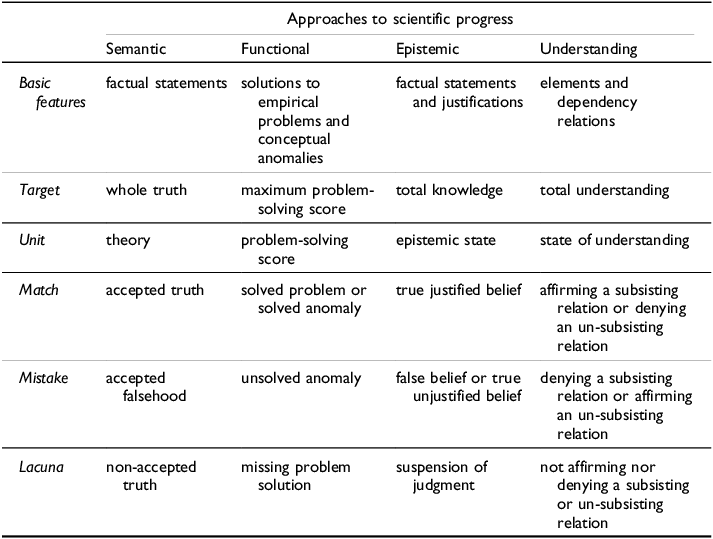
In the previous section, we showed how to apply the theory of target-likeness introduced in section 3.2 to each of the three approaches to scientific progress besides the semantic one. The result is a sort of meta-theory of progress, allowing the expression of the main tenets of the different approaches in a unified framework. Table 1 schematically represents how the four main contemporary approaches to scientific progress can be modeled as specific theories of target-likeness. In the following, we discuss some of the implications and highlight the main advantages of our proposal.
Schematic representation of the four approaches to defining scientific progress discussed in the paper, in terms of the general notion of target-likeness

Table 1. Long description
A table comparing four approaches to defining scientific progress using target-likeness. The table has four columns labeled Semantic, Functional, Epistemic, and Understanding, and five rows labeled Basic, Target, Unit, Match, Mistake, denying a, and Lacuna. Each cell contains specific terms related to the approaches. Row 1: Basic, Semantic features, factual statements, solutions to empirical problems and conceptual anomalies, factual statements and justifications. Row 2: Target, elements and whole truth, dependency relations, maximum problem-solving score, total knowledge, total understanding. Row 3: Unit, theory, problem-solving score, epistemic state, state of understanding. Row 4: Match, accepted truth, solved problem or solved anomaly, true justified belief, affirming a subsisting relation or denying an un-subsisting relation. Row 5: Mistake, accepted, falsehood, unsolved anomaly, false belief or true unjustified belief. Row 6: denying a, subsisting relation or affirming an un-subsisting relation, accepted truth, missing problem solution, suspension of judgment. Row 7: Lacuna, non-, affirming nor denying a subsisting or un-subsisting relation.
5.1. Enhanced comparison among approaches
First, as represented in table 1, the theory of target-likeness makes it easy to express and better appreciate the main conceptual differences among competing approaches to progress. Compare, for instance, the functional approach and the semantic approach. As Laudan himself highlighted, his idea of progress as problem-solving does not need to make strong assumptions on the nature of the external world or on the ultimate aim of scientific inquiry. The target of scientific inquiry is just the resolution of all scientific problems, empirical and conceptual. Moreover, the judgment of progressiveness based on problem-solving is independent from the truth or falsity of the theory under focus. Indeed, our problem-solving theory of target-likeness makes all these points clear, as it does not involve either truth or falsity in its normative judgments, nor does it involve any propositional statement of any form in its framework. Solutions to problems and anomalies are the basic components of the problem-solving approach and, as such, they are also the basic features of our formal representation of it. Because of this independence, a certain scientific theory may be more truthlike than another one and yet be less functional target-like (or vice versa; but see Kuipers Reference Kuipers2000).
Or, consider the epistemic approach to scientific progress. In our framework, this adds to the traditional truthlikeness account another level of complexity to the match between a scientific theory and the world. This level is the epistemic component, the lack of which supporters of the epistemic approach lament in truthlikeness approaches. We represented this epistemic component by adding justifications as a second kind of basic feature in the domain. This second layer of complexity, in the match between a scientific theory (or, more accurately, the epistemic state of a given scientific community) and the world (or, more accurately, the total knowledge over a given domain) also duplicates the variables at play in the similarity measure of our target-likeness theory. In order to count as a match, for an epistemic measure of target-likeness, a statement believed by the scientific community must be true and adequately justified. As such, there is only one way to match the target, while there are three different ways of making mistakes. This simple epistemic theory of target-likeness demonstrates, in this way, a philosophical point that supporters of the epistemic approach to scientific progress have repeatedly highlighted, i.e., that progress in knowledge is harder to come by than progress in mere truth or truthlikeness. Indeed, thanks to our epistemic theory of target-likeness, it is easy to see when and how progress in knowledge and progress in truthlikeness might come apart. Take the toy case, presented by Bird, of a scientific community that, through a series of lucky guesses, produces several true beliefs without possessing an adequate justification. A measure of truthlikeness would consider every lucky guess as improving the truthlikeness of the relevant theory, whereas the epistemic measure of target-likeness would deliver the opposite verdict, diminishing the target-likeness of the theory at every unjustified belief (but see Niiniluoto Reference Niiniluoto2014; Cevolani and Tambolo Reference Cevolani and Tambolo2013). On the other hand, our framework also allows us to recognize the similarities between the epistemic and the semantic approaches, especially when contrasted with the functional approach. As we noted above, the formal representation of the latter eschews completely truth and truth-bearing basic features in favor of solutions to empirical problems and conceptual anomalies, while an adequate formal representation of the epistemic approach involves the usual truth-bearing basic features of truthlikeness measures, while crucially adding an epistemic component to the basic features of the target.
Similar considerations hold for the understanding approach to progress. As already noticed by Dellsén himself in comparing his approach with the traditional truthlikeness account of scientific progress, a theory of truthlikeness elegantly implements the trade-off between accuracy and completeness that a good dependency model has to strike through an adequate setting of payoffs about matches, mistakes, and lacunae. What is more, our understanding theory of target-likeness does this without reducing the understanding approach to scientific progress to a version of the semantic account, but rather by employing the formal abstract core of truthlikeness theory (i.e., what we called target-likeness) directly within the components of the understanding approach, namely, elements and dependency relations. Thanks to this direct representation of the components of the understanding approach, our theory of target-likeness is able to demonstrate the differences between this approach to scientific progress and its competitors. For instance, it is possible that an increase in truthlikeness due to a given scientific change might not always result in an increase of understanding target-likeness, due to the non-propositional nature of the elements and relationships making up the dependency models that are the units of the latter approach. Analogous hypothetical arguments can be made with respect to the epistemic or the functional theories of target-likeness (and the related philosophical approaches to scientific progress upon which these formal theories are based), since they both measure progress with respect to entities that are ontologically and methodologically different from those involved in dependency models.
5.2. Flexibility in fine-tuning the different approaches
A second, important advantage of our theory of target-likeness resides in the flexibility with which one can define and accommodate other interesting accounts of progress within the general framework of a given measure of target-likeness.
For instance, regarding functional target-likeness, an intuitive way to generalize our measure would be to change the payoffs assigned to the matches, mistakes, and lacunae depending on the specific empirical and conceptual problems. In this way, we could mirror Laudan’s idea that certain problems weigh more than others in the assessment of the problem-solving efficacy of a given theory. Moreover, we could modify the polarity of the basic features of our domain, as well as their interpretation, to mirror other functional theories of progress that understand the usefulness of a scientific theory as involving more than just problem-solving, such as the one advanced by Shan (Reference Shan2019). For example, we could relax the intrinsic polarity of the conceptual and empirical problems and tailor the related payoffs in such a way as to reward theories that first pose an empirical problem or communities that recognize a given conceptual anomaly, a type of progressive change not recognized by Laudan’s theory, but highlighted by the practice-based account of Shan.
As for the epistemic theory of target-likeness, one can easily model different ideas of epistemic progress in science, tweaking the measure of epistemic target-likeness we presented in the last section. For instance, one could downsize the significance of the propositional basic features in the domain of the theory, thus obtaining a theory of target-likeness that focuses just on the dynamics of justifications. Such a measure could represent the different justification-based theories of scientific progress proposed by Stegenga (Reference Stegenga2024). Alternatively, one could substitute the propositional basic features with non-propositional problem-related entities, obtaining a kind of functional-epistemic measure of target-likeness that would resemble Kuhnian know-how theories of scientific progress (cf. Kuukkanen Reference Kuukkanen and Shan2024). Moreover, adding structure to the payoffs of the matches and mistakes of our measure could deliver epistemic theories of target-likeness representing more elaborate theories of knowledge and justification that impose structural constraints on the interrelationships between different justifications (such as many coherentist theories of justification) or on the relationship between the epistemic agent and the relevant environment (such as many reliabilist theories of justification). Or, alternatively, we could redefine the mistakes of the epistemic theory of target-likeness, assigning some positive payoff to unjustified truths (i.e., a payoff strictly between 0 and v). This would result in a measure of knowledge-likeness whose verdicts are closer to those of truthlikeness (and further away from Bird’s theory of scientific progress), and that could represent what an epistemic theory of scientific progress based on a Popperian notion of fallible knowledge might look like. Similarly, the simple understanding measure of target-likeness we presented here can be modified and generalized in several directions. A natural one would be to impose more structure on the map of relationships that make up our target (and/or units), to model the many different accounts of understanding and dependency relations that one can find in the philosophical literature. In such a way, we could also get an understanding measure of target-likeness that can represent other versions of the understanding approach to scientific progress, such as Kitcher’s (Reference Kitcher1993) multi-faceted theory of explanatory progress or Thagard’s (Reference Thagard1992) theory of explanatory coherence.
5.3. Generalization to the analysis of scientific practice
A third advantage of our theory of target-likeness is that it offers a simple way of formalizing not just the different approaches to scientific progress, but also other normative ideas about scientific change. In the last decades, many philosophers have eschewed general discussions over scientific progress tout court in favor of more “local” analyses of the step-wise improvements in the different components of a given scientific practice. In particular, in the more historically minded literature in philosophy of science, one can find many informal normative ideas on how different scientific practices in the history of science improved relative to non-propositional components, such as concepts (Thagard Reference Thagard1992; Kitcher Reference Kitcher1993; Brigandt Reference Brigandt2010; De Benedetto Reference De Benedettoforthcoming), models (Morrison Reference Morrison2015; Rodrik Reference Rodrik2015; Boumans and Herfeld Reference Boumans, Herfeld and Shan2022; Grüne-Yanoff and Marchionni Reference Grüne-Yanoff and Marchionni2026), measurement methods (Chang Reference Chang2004; Feest Reference Feest2025), and experimental techniques (Galison Reference Galison1987; Hacking Reference Hacking1983). The theory of target-likeness, thanks to its neutral formal core, offers a blueprint for formalizing (and, thus, assessing and comparing with each other) these philosophical accounts of specific kinds of progress that a given scientific practice can exhibit. In fact, as our understanding-based and problem-solving-based measures of target-likeness show, the formal machinery of the theory can also work smoothly with non-propositional units and targets. One just needs to understand the type(s) of basic features at play, the sort of unit of normative assessment, and the kind of payoffs prescribed by a given philosophical take on how scientific concepts, models, methods, and techniques improve, and then the formal machinery of target-likeness will deliver a measure of such improvement.
6. Conclusion
Let us recap the main steps of this paper. We started by emphasizing the lack of a shared framework for theories of scientific progress, making it difficult to systematically compare and assess the competing philosophical approaches to scientific progress proposed in the literature. Building upon the formal core of truthlikeness theories, we proposed a general meta-theory of progress, which we called target-likeness, in which one can formally assess how much a given abstract unit approximates a relevant intended target. We then showed how the different approaches to scientific progress can be represented as different measures of target-likeness, instantiating the abstract core of target-likeness with different understandings of what the universe, units, target, and matching features of scientific progress are. Finally, we discussed the main philosophical implications and applications of the theory of target-likeness, sketching how it can help us to assess and compare the different approaches and accounts of scientific progress, and also highlighting how it can offer us a blueprint for formalizing many informal ideas about how different components of a scientific practice improve over time.
The theory of target-likeness offers a simple, yet powerful way of formally representing philosophical theories about scientific progress. Thanks to the flexibility of its formal components, supporters of different philosophical approaches can easily make their ideas precise and contrast them with alternative views. We hope this will help the debate over scientific progress move beyond the clash between different philosophical theories. Moreover, as we sketched at the end of the last section, the theory of target-likeness is naturally open to being applied in all the philosophical discussions concerning the epistemic dynamics of different components of a scientific practice. Finally, it might even be possible to apply the theory of target-likeness beyond the scope of science, i.e., to forms of progress in other domains of human activity (such as social, technological, or even moral progress in a given culture, for instance).Footnote 9 Provided that such senses of progress are sufficiently robust to ensure the transitivity and stability of normative judgments needed to instantiate the framework of target-likeness theory, one could try to isolate the basic features, the target, and the unit characterizing the relevant domain of progress. We leave the exploration of this possibility to future research.
Acknowledgments
Both authors contributed equally to the manuscript. We would like to thank Luca Tambolo, audiences in Lucca and Bucharest, and the participants to the MInD seminars in Lucca for helpful discussions. We also thank two anonymous reviewers for their constructive and helpful comments on the manuscript.
Funding statement
None to declare.
Declarations
None to declare.