Introduction
This study is dedicated to exploring the mechanisms and contextual boundaries of the environmental, social, and governance (ESG) performance of focal firms with respect to their own collaborative innovation (co-innovation). Co-innovation is often defined as the act of firms and external entities jointly developing new products or services through the exchange and sharing of resources (e.g., knowledge and technology) (Lv, Zhu, Chen, & Lan, Reference Lv, Zhu, Chen and Lan2021; Shi, Jiang, & Liu, Reference Shi, Jiang and Liu2023). Co-innovation, with innovation as the core goal of cooperation, is an important form of strategic alliance. The goals of a strategic alliance in the broad sense are more diverse and comprehensive and may involve many aspects, such as innovation, the market, and cost.
Co-innovation plays an increasingly important role in today’s rapidly changing business environment (e.g., increasing complexity of innovation) (Al Nuaimi, Singh, & Ahmad, Reference Al Nuaimi, Singh and Ahmad2024; Bertello, De Bernardi, & Ricciardi, Reference Bertello, De Bernardi and Ricciardi2024; Figenschou, Li-Ying, Tanner, & Bogers, Reference Figenschou, Li-Ying, Tanner and Bogers2024; Shi et al., Reference Shi, Jiang and Liu2023). It not only promotes the efficient use of resources and knowledge sharing but also helps enterprises reduce risks, accelerate innovation, and enhance competitiveness (Arora, Athreye, & Huang, Reference Arora, Athreye and Huang2016; Madrid-Guijarro & Garcés-Torres, Reference Madrid-Guijarro and Garcés-Torres2023). For example, through co-innovation, partners with different advantages in capital, technology, and market and human resources can share innovation tasks and reduce redundant work, thereby reducing the potential risk of failure and accelerating time to market for products and technologies (Bertello et al., Reference Bertello, De Bernardi and Ricciardi2024; Brockman, Khurana, & Zhong, Reference Brockman, Khurana and Zhong2018). In addition, many complex technical and social problems (e.g., climate change, public health, etc.) need to be solved successfully by multiple parties. Co-innovation brings together the wisdom of multiple parties to find innovative solutions (Al Nuaimi et al., Reference Al Nuaimi, Singh and Ahmad2024; Figenschou et al., Reference Figenschou, Li-Ying, Tanner and Bogers2024).
Co-innovation offers multiple potential benefits. However, co-innovation also poses high opportunistic risks to firms (e.g., knowledge misappropriation and free-riding problems) (Brockman et al., Reference Brockman, Khurana and Zhong2018; Foege, Lauritzen, Tietze, & Salge, Reference Foege, Lauritzen, Tietze and Salge2019). While a complete and valid formal contract can mitigate opportunistic behavior in co-innovation, complete and valid contracts often do not exist (Brockman, Khurana, & Zhong, Reference Brockman, Khurana and Zhong2018; Hennart, Reference Hennart1988). These problems are particularly acute in emerging economies, such as China, where intellectual property protection is less well developed and where administrative enforcement to protect intellectual property rights is weaker. This double-edged effect of co-innovation is often referred to as the paradox of co-innovation (Arora et al., Reference Arora, Athreye and Huang2016; Langlois, BenMahmoud-Jouini, & Servajean-Hilst, Reference Langlois, BenMahmoud-Jouini and Servajean-Hilst2023; Ritala & Stefan, Reference Ritala and Stefan2021) and has inspired many studies to explore co-innovation antecedents (Al Nuaimi et al., Reference Al Nuaimi, Singh and Ahmad2024).
A part of the research has noted that initiatives by firms to positively enhance social benefits can promote co-innovation (Bereskin, Campbell, & Hsu, Reference Bereskin, Campbell and Hsu2016; Holmes, & Smart, Reference Holmes and Smart2009). In contrast to concepts such as corporate social responsibility (CSR) and corporate philanthropy, which place particular emphasis on social interests, ESG emphasizes the need for firms to balance social, environmental, and shareholder interests (Drempetic, Klein, & Zwergel, Reference Drempetic, Klein and Zwergel2020; Pedersen, Fitzgibbons, & Pomorski, Reference Pedersen, Fitzgibbons and Pomorski2021) without losing sight of each other (Ren, Zeng, & Zhong, Reference Ren, Zeng and Zhong2024). The popularization of the concept of sustainable development has made ESG highly valued in the capital markets of both emerging and developed economies (Chen, Khurram, Gao, Abedin, & Lucey, Reference Chen, Khurram, Gao, Abedin and Lucey2023; Long, Feng, Gong, & Chang, Reference Long, Feng, Gong and Chang2023; Wan, Fu, & Zhong, Reference Wan, Fu and Zhong2024). Research surveys revealed that by the beginning of 2020, global ESG investments had already accounted for more than one-third of the total global assets under management, amounting to USD 35.3 trillion (Meira, Cunha, Orsato, Miralles-Quirós & Miralles-Quirós, Reference Meira, Cunha, Orsato, Miralles-Quirós and Miralles-Quirós2023). Simultaneously, firm ESG performance is believed to provide a valuable opportunity for external entities to assess their value proposition and ethical stance (Giakoumelou, Salvi, Bertinetti, & Micheli, Reference Giakoumelou, Salvi, Bertinetti and Micheli2022; Khan, Reference Khan2019; Lee, Raschke, & Krishen, Reference Lee, Raschke and Krishen2022) and ultimately has a significant effect on corporate strategic choices and outcomes (Broadstock, Matousek, Meyer, & Tzeremes, Reference Broadstock, Matousek, Meyer and Tzeremes2019; Long, Feng, Gong, & Chang, Reference Long, Feng, Gong and Chang2023). However, it is unclear whether and when focal firms’ ESG performance subsequently affects their level of co-innovation. Specifically, it is unclear whether and when focal firms’ ESG performance subsequently affects their level of co-innovation by changing how potential external innovation collaborators (collaborators) perceive and judge them.
Trust is defined as the trustor’s belief in the trustee’s favorable or harmless actions, regardless of the trustor’s ability to oversee these actions (Becerra & Gupta, Reference Becerra and Gupta2003; Mayer, Davis, & Schoorman, Reference Mayer, Davis and Schoorman1995; Schweitzer, Ho, & Zhang, Reference Schweitzer, Ho and Zhang2018). A growing body of research recognizes that trust is a key factor in enabling collaborative activities, particularly co-innovation, to emerge (Brockman et al., Reference Brockman, Khurana and Zhong2018; Wyrwich, Steinberg, Noseleit, & de Faria, Reference Wyrwich, Steinberg, Noseleit and de Faria2022). This is because trust leads collaborators to believe that they will not be threatened by opportunistic behaviors (e.g., free-riding, knowledge theft) in co-innovation, which is an important reason for their refusal to co-innovate (Brockman et al., Reference Brockman, Khurana and Zhong2018). Echoing it, the literature on alliances, especially knowledge-sharing alliances, also emphasizes the key role of trust (Das & Teng, Reference Das and Teng2001; Parkhe, Reference Parkhe1998; Rungsithong & Meyer, Reference Rungsithong and Meyer2020). These related studies suggest that trust is not only the foundation of successful alliance establishment but also an important guarantee for the already established alliance to achieve its intended purpose in a complex and uncertain environment (Li, Eden, Hitt, & Ireland, Reference Li, Eden, Hitt and Ireland2008; Palomeras & Wehrheim, Reference Palomeras and Wehrheim2021). Furthermore, signaling theory provides insight into how focal firms gain external trust. This is because signaling theory profoundly reveals that focal firms can change the attitudes and perceptions (e.g., trust) of outside actors toward them by sending visible signals (messages) to the outside world to communicate their unseen value preferences and ethical standards (Connelly, Certo, Ireland & Reutzel, Reference Connelly, Certo, Ireland and Reutzel2011; Jiang, Jung, & Makino, Reference Jiang, Jung and Makino2020).
In view of this, to fill the knowledge gap in the literature, we attempt to synthesize insights from signaling (Spence, Reference Spence1973, Reference Spence1974) and trust (Mayer et al., Reference Mayer, Davis and Schoorman1995) theories to reveal the underlying mechanisms by which the ESG performance of focal firms can improve their own level of co-innovation. We argue that by demonstrating good ethical intentions, long-term orientation, and increasing information transparency (He, Du, & Yu, Reference He, Du and Yu2022; Ren et al., Reference Ren, Zeng and Zhong2024), high ESG performance can act as a positive signal that motivates collaborators to place more trust in the focal firm (Amiraslani, Lins, Servaes, & Tamayo, Reference Amiraslani, Lins, Servaes and Tamayo2023; Fuente, Ortiz, & Velasco, Reference Fuente, Ortiz and Velasco2022). Furthermore, when collaborators develop trust in the focal firm, they believe that the focal firm will not engage in opportunistic behavior in collaboration, which increases their enthusiasm for co-innovation with focal firms (Brockman et al., Reference Brockman, Khurana and Zhong2018). The above findings ultimately show that the ESG performance of focal firms positively influences their own level of co-innovation.
Guided by signaling (Spence, Reference Spence1973, Reference Spence1974) and trust (Mayer et al., Reference Mayer, Davis and Schoorman1995) theories, we further investigated how these relationships were moderated by heavy polluting firm attributes and historical co-innovation. On the one hand, after receiving ESG signals from focal firms, collaborators may also combine other factors to determine whether the ESG signals truly reflect the focal firm’s values and ethical stances of respecting and safeguarding the interests of others and long-term oriented. Research has shown that heavy polluting firms are more likely to adopt some ESG measures for instrumentalist motives than non-heavy polluting firms due to the strong negative externalities of their behavior (Guo, Li, Song, & Tang, Reference Guo, Li, Song and Tang2024). For example, they may be strategically taken to signal ESG to avoid legal risk, reduce external public pressure, or attract investment (Gu, Liu, & Xu, Reference Gu, Liu and Xu2023; Hong, Jiang, Xu, & Yu, Reference Hong, Jiang, Xu and Yu2024). Compared with non-heavy polluting firms, outsiders are unlikely to attribute the outstanding ESG performance of heavy polluting firms to their values and ethical stances of respecting and safeguarding the interests of others and long-term orientation (Kong, Yang, Liu, & Yang, Reference Kong, Yang, Liu and Yang2020). As a result, we argue that heavy polluting firms are less likely to gain the trust of their collaborators of signaling ESG than non-heavy polluting firms are. In turn, this weakens the positive impact of ESG performance on firms’ co-innovation in heavy polluting firms.
On the other hand, ESG signals contain ‘soft information’ (Elmghaamez, Nwachukwu, & Ntim, Reference Elmghaamez, Nwachukwu and Ntim2024; Lee, Raschke, & Krishen, Reference Lee, Raschke and Krishen2022), which can provide collaborators with only indirect or even inaccurate and inadequate information to reflect the value proposition and good ethical stance of focal firms in co-innovation. Thus, when they have access to ‘hard information’ (e.g., information directly related to the firm’s past engagement in co-innovation) that directly and more fully reflects focal firms’ values and ethical stances in co-innovation activities, collaborators are unlikely to respond to ESG signals. In view of this, we further argue that historical co-innovation leads to collaborators being less likely to rely on ESG signals to develop their trust in the focal firm, as collaborators place substantially less importance on the information embedded in ESG signals at this time. The above situation ultimately leads to a weakening of the positive impact of ESG performance on firms’ co-innovation. Based on empirical data on A-share manufacturing companies listed in China from 2010 to 2021, we obtained empirical evidence to support the above theoretical arguments. Reputation is closely related to trust and is often used in the extant literature to assess the trustworthiness of trustees (Chaudhary, Dhir, Ferraris, & Bertoldi, Reference Chaudhary, Dhir, Ferraris and Bertoldi2021; Norheim-Hansen, Reference Norheim-Hansen2015); in view of this, we further empirically test and indirectly validate the mechanistic role of collaborator trust in the relationship between ESG performance and firms’ co-innovation by using firm reputation as a proxy indicator of collaborator trust.
This study makes three major contributions to the literature. First, much of the literature focuses on why focal firms choose to engage in co-innovation (Brockman et al., Reference Brockman, Khurana and Zhong2018; Lv et al., Reference Lv, Zhu, Chen and Lan2021). In contrast, the literature rarely explores why collaborators are willing or unwilling to engage in co-innovation with focal firms (Hasche, Linton, & Öberg, Reference Hasche, Linton and Öberg2017). Therefore, by focusing on why firms can develop high levels of co-innovation from the perspective of collaborators rather than focal firms, this study extends the co-innovation literature beyond the explanations provided in existing research. Second, this study explores how ESG performance affects synergistic activities across firms (e.g., co-innovation) and is novel in terms of both theoretical and empirical evidence. This study provides new theoretical evidence that trust from external participants is an important mechanism through which firms benefit from outstanding ESG performance. By doing so, this study not only extends the literature on how ESG performance affects independent activities within firms (Broadstock, Matousek, Meyer, & Tzeremes, Reference Broadstock, Matousek, Meyer and Tzeremes2019; Chen et al., Reference Chen, Khurram, Gao, Abedin and Lucey2023; Wang, Ma, Dong, & Zhang, Reference Wang, Ma, Dong and Zhang2023) but also provides us with a more comprehensive and refined understanding of the mechanisms through which ESG performance affects firms’ strategic performance. Finally, by integrating insights from trust theory into signaling theory to develop new insights into how and when ESG signals are more likely to affect firms’ strategic performance, this study also contributes to signaling theory. This is because how signals affect firm behavior and the conditions under which they are applied are two important aspects of signaling theory that remain relatively under-researched to date (Friske, Hoelscher, & Nikolov, Reference Friske, Hoelscher and Nikolov2023; Jiang et al., Reference Jiang, Jung and Makino2020; Ren, Zeng, & Song, Reference Ren, Zeng and Song2022).
Theoretical Background and Hypotheses Development
Signaling theory, introduced by Spence (Reference Spence1973, Reference Spence1974), is very useful for describing or predicting the behavior of actors in an asymmetric information environment (Huang & Li, Reference Huang and Li2019). Signaling aims to reduce the information asymmetry between parties (Brown, Goll, Rasheed, & Crawford, Reference Brown, Goll, Rasheed and Crawford2020; Vasudeva, Nachum, & Say, Reference Vasudeva, Nachum and Say2018). Signaling theory has four basic components: sender, signal, signal environment, and receiver (Connelly et al., Reference Connelly, Certo, Ireland and Reutzel2011; Lee et al., Reference Lee, Raschke and Krishen2022; Ren et al., Reference Ren, Zeng and Song2022). Signal senders (e.g., firms) consider whether and how to send signals and often have information (e.g., information about product quality and firms’ ethical tendencies) that recipients do not have (Brown et al., Reference Brown, Goll, Rasheed and Crawford2020; Kirschbaum, Minardi, Rossoni, & Da Silva, Reference Kirschbaum, Minardi, Rossoni and Da Silva2023). Signalers often deliberately send positive messages to outsiders (Lee et al., Reference Lee, Raschke and Krishen2022), while insiders may inadvertently send negative signals. Signals are information conveyed to the market by a sender (e.g., characteristics or activities of the actor) (Vasudeva, Nachum, & Say, Reference Vasudeva, Nachum and Say2018; Zhong, Chen, & Ren, Reference Zhong, Chen and Ren2022).
Signaling reduces information asymmetry by expanding the information available to external stakeholders (Jiang et al., Reference Jiang, Jung and Makino2020; Lee et al., Reference Lee, Raschke and Krishen2022). Arguably, sending signals is valuable when information asymmetry exists between parties regarding quality, behavioral tendencies, or intentions (Huang & Li, Reference Huang and Li2019; Jiang et al., Reference Jiang, Jung and Makino2020; Lee et al., Reference Lee, Raschke and Krishen2022). Signal receivers are actors (e.g., individuals and firms) who receive signals and decide whether to adjust their decisions (Brown et al., Reference Brown, Goll, Rasheed and Crawford2020; Ren et al., Reference Ren, Zeng and Song2022). The signaling environment affects how signals are transmitted, interpreted, and acted upon (Jiang et al., Reference Jiang, Jung and Makino2020). It is generally accepted that signal receivers are more likely to engage in responsive behavior to a particular signal in two situations: (1) Signal recipients are convinced that the signal accurately reflects the information they seek (Friske et al., Reference Friske, Hoelscher and Nikolov2023). (2) The signal conveys information that cannot be replaced by a superior information channel (Huang & Li, Reference Huang and Li2019). Signaling theory has been extensively applied across various fields. In particular, starting from signaling theory, scholars have formed a series of constructive insights on how stakeholders respond to corporate ESG/CSR in previous studies (Flammer, Reference Flammer2021; Su, Peng, Tan, & Cheung, Reference Su, Peng, Tan and Cheung2016; Tong, Wang, & Xia, Reference Tong, Wang and Xia2020; Zhong et al., Reference Zhong, Chen and Ren2022).
Signaling theory posits that signals reduce the level of information asymmetry between parties, which then leads to corresponding behavioral consequences. However, the theory fails to adequately reveal the intrinsic mechanisms by which specific signals influence cooperative behavior. As a complementary theory, trust theory suggests that the development of trust provides a mechanism that enables cooperative behavior in situations where people rely on others to accomplish personal and organizational goals (Mayer et al., Reference Mayer, Davis and Schoorman1995). Trust is based on expectations about the behavior of others, and one way to understand why one party has more or less trust in another is to consider the attributes of the trustee (Becerra & Gupta, Reference Becerra and Gupta2003). The characteristics and behaviors of the trustee lead to the extent to which that person/organization is trusted (Song & Lee, Reference Song and Lee2016). Therefore, these characteristics are crucial for understanding why some individuals or organizations are trusted more than others (Johnson-George & Swap, Reference Johnson-George and Swap1982; Mayer et al., Reference Mayer, Davis and Schoorman1995). This study seeks to provide refined insights into how and when ESG performance influences firms’ co-innovation by integrating signaling theory (Spence, Reference Spence1973, Reference Spence1974) and trust theories (Mayer et al., Reference Mayer, Davis and Schoorman1995).
ESG Performance and Firms’ Co-Innovation
On the basis of insights from signaling (Spence, Reference Spence1973, Reference Spence1974) and trust (Mayer et al., Reference Mayer, Davis and Schoorman1995) theories, we argue that, as a positive signal, the ESG performance of focal firms enhances the trust of collaborators in the focal firms, which in turn increases the level of co-innovation in the focal firms.
The outstanding ESG performance of focal firms increases the level of trust that collaborators place in them. First, outstanding ESG performance suggests that focal firms proactively fulfill implicit contracts with multiple stakeholders in an ethical manner (Atif & Ali, Reference Atif and Ali2021; Garavaglia, Van Landuyt, White, & Irwin, Reference Garavaglia, Van Landuyt, White and Irwin2023; Long, Feng, Gong, & Chang, Reference Long, Feng, Gong and Chang2023). Thus, by sending ESG signals, focal firms are able to communicate to collaborators their values and ethical stances of respecting and safeguarding the interests of others, i.e., that they are not self-interest seekers but will take the interests of third parties into full consideration (Garavaglia et al., Reference Garavaglia, Van Landuyt, White and Irwin2023; Jia, Tsui, & Yu, Reference Jia, Tsui and Yu2021; Shea, & Hawn, Reference Shea and Hawn2019). In this case, collaborators gain confidence in the focal firm’s full consideration and respect for their interests, which in turn leads them to develop more trust in the focal firm (Amiraslani et al., Reference Amiraslani, Lins, Servaes and Tamayo2023). Second, in the implementation and disclosure of ESG measures, focal firms are typically obligated to publicly release a broad spectrum of information and data to external stakeholders. This includes environmental impact assessments, CSR initiatives, and governance frameworks (Elmghaamez, Nwachukwu, & Ntim, Reference Elmghaamez, Nwachukwu and Ntim2024; Ma, Zhang, Zhong, & Zhou, Reference Ma, Zhang, Zhong and Zhou2020). With this information and data, external collaborators may gain a more comprehensive understanding of the focal firm’s operations and the consequences of its actions (Lee et al., Reference Lee, Raschke and Krishen2022). In particular, a high degree of information availability leads to a greater sense of self-control and fewer uncertainty concerns among collaborators during their interactions with the focal firm (Zhao, Dong, Sun, Ma, & Zhang, Reference Zhao, Dong, Sun, Ma and Zhang2024), which in turn leads collaborators to develop more trust in the focal firm (Buell, Porter, & Norton, Reference Buell, Porter and Norton2021). Finally, ESG investment is often viewed as a long-term-oriented investment (Ren et al., Reference Ren, Zeng and Zhong2024; Shin, Moon, & Kang, Reference Shin, Moon and Kang2023), as it is likely to impose burdens rather than benefits on companies in the short term (Duque-Grisales & Aguilera-Caracuel, Reference Duque-Grisales and Aguilera-Caracuel2021). Thus, when the focal firm signals ESG, collaborators perceive the focal firm as long-term-oriented and unlikely to exhibit short-sighted behavior (e.g., opportunistic behavior) and thus place more trust in the focal firm (Fuente, Ortiz, & Velasco, Reference Fuente, Ortiz and Velasco2022).
Furthermore, when collaborators have a high level of trust in the focal firm, they are more likely to engage in co-innovation and invest more resources in co-innovation for the following reasons: co-innovation brings multiple benefits (Bertello, Bogers, & De Bernardi, Reference Bertello, Bogers and De Bernardi2022; Wyrwich et al., Reference Wyrwich, Steinberg, Noseleit and de Faria2022) but also poses high opportunistic risks to firms (e.g., knowledge misappropriation and free-riding problems) (Brockman et al., Reference Brockman, Khurana and Zhong2018; Diriker et al., Reference Diriker, Porter, Tuertscher, Splitter, Dobusch, von Krogh, Whittington and Walgenbach2023; Foege et al., Reference Foege, Lauritzen, Tietze and Salge2019). For example, in co-innovation, focal firms are likely to minimize their contributions to a joint project while maximizing the benefits they derive from it (Diriker et al., Reference Diriker, Porter, Tuertscher, Splitter, Dobusch, von Krogh, Whittington and Walgenbach2023). The focal firm may also encroach on the useful knowledge possessed by collaborators in the co-innovation process. The above concerns are evident in emerging economies such as China, where patent protection and contractual protection are not strong enough or are even unreliable (Lv et al., Reference Lv, Zhu, Chen and Lan2021). Consequently, collaborators are unlikely to participate in the initiative unless their perceived potential benefits from co-innovation outweigh the potential costs (Brockman et al., Reference Brockman, Khurana and Zhong2018; Greul, West, & Bock, Reference Greul, West and Bock2018; Langlois, BenMahmoud-Jouini, & Servajean-Hilst, Reference Langlois, BenMahmoud-Jouini and Servajean-Hilst2023). Trust is a pivotal factor in dealing with uncertainty in contractual relationships and promoting collaborative practices (Brockman et al., Reference Brockman, Khurana and Zhong2018; Hasche et al., Reference Hasche, Linton and Öberg2017; Nestle, Täube, Heidenreich, & Bogers, Reference Nestle, Täube, Heidenreich and Bogers2019; Wyrwich et al., Reference Wyrwich, Steinberg, Noseleit and de Faria2022). When collaborators develop a high level of trust in the focal firm, they believe that the firm is unlikely to exhibit opportunistic behavior in co-innovation. For example, there are fewer knowledge misappropriation and free-riding problems (Mubarak & Petraite, Reference Mubarak and Petraite2020). In turn, collaborators perceive more potential benefits and lower potential risks from co-innovation, which increases their motivation to engage in co-innovation with the focal firm. Moreover, trust not only reduces the perceived risk and uncertainty of co-innovation among collaborators but also enhances the efficiency of communication and coordination between collaborators and focal firms (Brockman et al., Reference Brockman, Khurana and Zhong2018), which helps to reach consensus and resolve conflicts more quickly. Under these conditions, collaborators are likely to invest more resources – such as money, time, and technology – in co-innovation, thereby achieving deeper collaboration and long-term benefits (Figenschou et al., Reference Figenschou, Li-Ying, Tanner and Bogers2024). As supporting evidence, Wyrwich et al. (Reference Wyrwich, Steinberg, Noseleit and de Faria2022) reported that when decision-makers lack trust in the external environment, they are less likely to push firms to engage in co-innovation. This situation eventually manifests in focal firms, which demonstrate higher levels of co-innovation.
The above inferences suggest that focal firms’ ESG performance increases their level of co-innovation by increasing their trust in collaborators, which, in turn, increases their level of co-innovation. Accordingly, we propose the following hypothesis (in an alternative form):
Hypothesis 1 (H1): Focal firms’ ESG performance positively influences their co-innovation.
Moderating Roles of Heavy Polluting Firm Attributes and Historical Co-Innovation
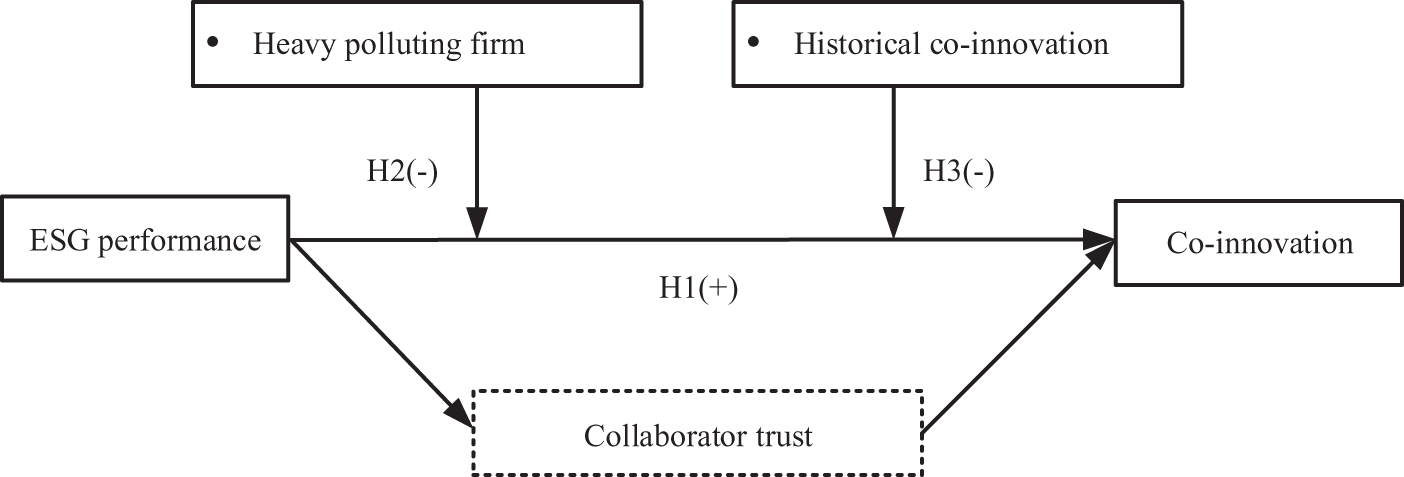
In developing the theoretical derivation of the baseline hypothesis (H1), we make two implicit assumptions: first, that collaborators do not consider other factors when interpreting ESG signals. Thus, collaborators automatically interpret firms with ESG signals as firms having values and ethical stances of respecting and safeguarding the interests of others and being long-term oriented. Second, collaborators do not have access to more direct and adequate optimal information from other sources to replace the suboptimal information they receive from ESG signals, which is often indirect and even unreliable. In what follows, we relax these assumptions by introducing the moderating roles of heavy polluting firm attributes and historical co-innovation, which provide more refined insights into the relationship between ESG performance and firms’ co-innovation. The theoretical model is shown in Figure 1.
Theoretical framework

Heavy polluting firm attributes as a moderator
We argue that, compared with non-heavy polluting firms, the promotion effect of ESG performance on co-innovation in heavy polluting firms will be weakened. In some cases, firms sending ESG signals are driven by instrumentalist motives rather than their good moral code and long-term orientation (Ko, Nie, Ran, & Gu, Reference Ko, Nie, Ran and Gu2020). For example, previous research has noted that firms may strategically send ESG signals to eliminate the adverse consequences of their negative behaviors (Bachrach, Vlachos, Irwin, & Morgeson, Reference Bachrach, Vlachos, Irwin and Morgeson2022; Zeng, Ren, & Ning, Reference Zeng, Ren and Ning2022) or divert public attention from corporate misbehavior (Du, Reference Du2015; Lungeanu, Paruchuri, & Tsai, Reference Lungeanu, Paruchuri and Tsai2018; Zhong et al., Reference Zhong, Chen and Ren2022). Heavy polluting firms are major contributors to national economies, especially in emerging economies. However, they are also the mainstays of environmental pollution and ecological damage (Kong, Yang, Liu, & Yang, Reference Kong, Yang, Liu and Yang2020; Shi, Yu, Li, & Wang, Reference Shi, Yu, Li and Wang2022; Zeng, Ren, & Ning, Reference Zeng, Ren and Ning2022). Compared with non-heavy polluting firms, heavy polluting firms face greater pressure and expectations from the government, regulators, and the public due to the strong negative externalities generated by their operations (Guo et al., Reference Guo, Li, Song and Tang2024). These pressures and expectations require heavy polluting firms not only to work harder to improve their environmental performance but also to make more social and ecological contributions to compensate for the damage to social well-being caused by their past actions (i.e., to pay for past misdeeds). In other words, compared with ESG signals sent by non-heavy polluting firms, ESG signals sent by heavy polluting firms are more likely to be driven by instrumentalist motivation rather than their values and ethical stances of respecting and safeguarding the interests of others and being long-term oriented (Gu, Liu, & Xu, Reference Gu, Liu and Xu2023; Hong, Jiang, Xu, & Yu, Reference Hong, Jiang, Xu and Yu2024; Kong et al., Reference Kong, Yang, Liu and Yang2020). Considering this, heavy polluting firms are less likely to gain trust from collaborators in their ESG signals, weakening the positive impact of ESG performance on co-innovation.
Therefore, we propose the following hypothesis:
Hypothesis 2 (H2): Compared with non-heavy polluting firms, the positive impact of ESG performance on co-innovation is weaker in heavy polluting firms.
Historical co-innovation as a moderator
We propose that the signaling effect of ESG performance on firms’ co-innovation weakens as the level of historical co-innovation rises. The attention that collaborators pay to the information embedded in the ESG signals of the focal firm depends on the ability of the collaborators to obtain more accurate, direct, and adequate alternative information from other sources. As noted in previous studies, ESG signals contain ‘soft information’ (Elmghaamez et al., Reference Elmghaamez, Nwachukwu and Ntim2024; Lee et al., Reference Lee, Raschke and Krishen2022) that usually does not include, or does not fully include, direct and sufficient information related to a firm’s specific strategic activities (e.g., co-innovation activities). Specifically, ESG signals can provide collaborators with only indirect or even inaccurate and inadequate information to reflect focal firms’ ethical stances and long-term orientation in co-innovation activities. Therefore, when collaborators can obtain ‘hard information’ that is highly direct to the ethical stand and value orientation of the focus firm in co-innovation activities, they are less likely to rely on ESG signals to build trust in the focus firm and make corresponding co-innovation decisions. Historical co-innovation is a good indicator of how well the focal firm and its collaborators have behaved in co-innovation. In a sense, the higher the level of historical co-innovation is, the greater the degree to which the focal firm does not show opportunistic behavior in co-innovation, but fully respects the contributions and intellectual property rights of the collaborators. In this context, we argue that historical co-innovation reduces the likelihood that collaborators rely on ESG signals to develop their own trust in the focal firm. In turn, this weakens the positive impact of ESG performance on firms’ co-innovation at higher levels of historical co-innovation.
Therefore, we propose the following hypothesis:
Hypothesis 3 (H3): Historical co-innovation weakens the positive impact of focal firms’ ESG performance on their co-innovation.
Methods
Measurements
Dependent variables
The dependent variable is co-innovation. Jointly owned patents are potential outputs of co-innovation and are often used as a proxy for co-innovation outcomes in the management and organizational literature (Arora et al., Reference Arora, Athreye and Huang2016; Brockman et al., Reference Brockman, Khurana and Zhong2018; Shi et al., Reference Shi, Jiang and Liu2023). Therefore, following the practices of previous studies (Brockman et al., Reference Brockman, Khurana and Zhong2018; Lv et al., Reference Lv, Zhu, Chen and Lan2021), we used the natural logarithm of the number of patents jointly held by a firm and other entities (e.g., another firm, university, or research institution) to measure co-innovation. We used the number of patents applications rather than the number of patents granted to measure co-innovation because it takes time for firms to grant patents, is subject to a high degree of uncertainty, and may be affected by a range of uncontrollable external factors.
Independent variables
The independent variable is ESG performance. The ESG scoring system consists of three first-level dimensions – environmental (E), social (S), and governance (G) – 16 second-level indicators – and 44 third-level indicators. Specifically, environmental responsibility includes five second-level indicators: climate change, resource utilization, environmental pollution, environmental friendliness, and environmental management. Social responsibility includes five second-level indicators: human capital, product responsibility, supply chain, social contribution, and data security and privacy. Corporate governance includes six second-level indicators: shareholders’ equity, governance structure, disclosure quality, governance risk, external sanctions and business ethics.Footnote 1 The ESG ratings were divided into nine categories in descending order: AAA, AA, A, BBB, BB, B, CCC, CC, and C. On the basis of a previous study, we used a conversion process to define ESG, in which C corresponds to 1 and AAA corresponds to 9.
Moderating variables
The first moderator variable is heavy polluting firms. According to the Guidelines for Environmental Information Disclosure of Listed Companies published by the Ministry of Environmental Protection, heavy polluting firms cover 16 industry categories: thermal power, iron and steel, cement, aluminum, coal, metallurgy, chemicals, petrochemicals, building materials, papermaking, brewing, pharmaceuticals, fermentation, textiles, tanning, and mining. Heavily polluting industries cause severe environmental pollution. Referring to the practice of a previous study (Kong et al., Reference Kong, Liu, Wang and Zhu2023), if a firm is a heavy polluter, it is 1; otherwise, it is 0. In the sample of manufacturing firms in this study, there are 5095 firm-year observations belonging to heavy polluting firms.
The second moderator variable is historical co-innovation. We used the mean of a firm’s co-innovation performance level over the past three years to measure historical co-innovation.
Control variables
To capture the factors affecting co-innovation, we controlled for relevant variables at the firm level, manager level, and internal and external governance levels. First, we controlled for variables related to firm characteristics that may have an important effect on firms’ co-innovation (Huang, Li, Shen, & Wang, Reference Huang, Li, Shen and Wang2024; Lv et al., Reference Lv, Zhu, Chen and Lan2021; Shi et al., Reference Shi, Jiang and Liu2023). We controlled for firm age (the actual number of years since the establishment of the firm). Then, variables that can affect a firm’s resources and innovation capabilities were controlled for, including growth (the difference between the current period revenue minus the previous period revenue, divided by the previous period revenue), the asset‒liability ratio (total liabilities/total assets), the R&D investment ratio (the share of R&D investment in operating revenue), and the R&D staff ratio (the share of R&D staff in the number of employees).
Second, we controlled for a range of executive-level variables (Biscotti, Mafrolla, Giudice, & D’Amico, Reference Biscotti, Mafrolla, Giudice and D’Amico2018; Bogers, Foss, & Lyngsie, Reference Bogers, Foss and Lyngsie2018; Lv et al., Reference Lv, Zhu, Chen and Lan2021). Prior research has shown that vertical pay disparity on executive teams can significantly impact firm innovation; we also controlled for vertical pay dispersion (the natural logarithm of CEO pay minus the mean of non-CEO pay) (Messersmith, Kim, & Patel, Reference Messersmith, Kim and Patel2018). We controlled for executive R&D background (a dummy variable equals one if the CEO or chairperson has an academic background and zero otherwise). This is because executives with an R&D background are more likely to be focused on innovation strategy and can provide efficient guidance and advice on co-innovation strategy decisions (Haneda & Ito, Reference Haneda and Ito2018). We determine whether an executive has a background in R&D in two ways, i.e., if the professional background is ‘R&D’ or if the resume contains fields related to ‘R&D’.Footnote 2
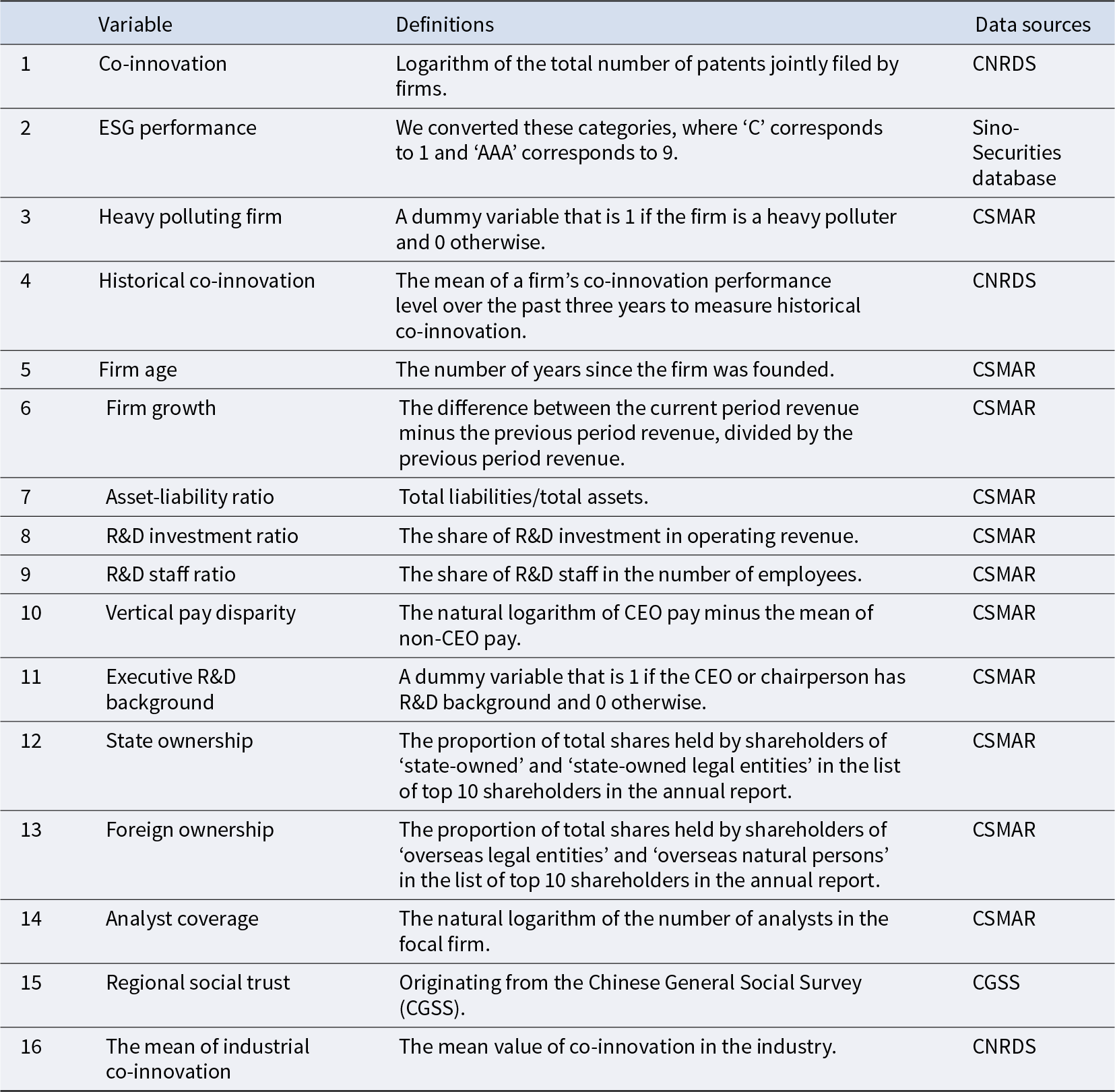
Finally, we controlled for variables at the internal and external governance level (Brockman et al., Reference Brockman, Khurana and Zhong2018). The shareholding structure affects decision-making, financing, monitoring, and incentives, which are highly relevant to co-innovation. We separately controlled for state ownership (shareholdings of ‘state-owned’ and ‘state-owned legal entities’ as a percentage of total share capital among the top 10 shareholders in the annual report) and foreign ownership (shareholdings of ‘overseas legal entities’ and ‘overseas natural persons’ as a percentage of total share capital among the top 10 shareholders in the annual report). Analysts are a form of external monitoring and information brokering that may also have an important impact on co-innovation, so we also controlled for analyst coverage (the natural logarithm of the number of analysts in the focal firm). As an informal system, social trust in the external environment may also affect business co-innovation (Brockman et al., Reference Brockman, Khurana and Zhong2018). Hence, we controlled for social trust, which was derived from the Chinese General Social Survey (CGSS). Finally, we also controlled for the mean of industrial co-innovation (the mean value of co-innovation in the industry). The measurements and data sources for all the variables are detailed in Appendix Table A1.
Sample and Data
We selected A-share manufacturing companies listed and trading on the Shanghai and Shenzhen Stock Exchanges from 2010 to 2021 as our initial sample. There are three reasons why we choose Chinese listed manufacturing companies as our research sample. First, manufacturing is the lifeblood of China’s economic development, but the Chinese manufacturing sector is currently facing multiple difficulties (e.g., the return of high-end manufacturing to developed economies and the rapid rise in labor costs), and they urgently need to enhance their innovation capabilities to improve their global competitive advantage. Second, the manufacturing industry involves complex and multiple activities, and it is difficult for a single enterprise to master all the advanced knowledge and technologies related to it. Therefore, the integration of knowledge and technology from different entities to develop co-innovation is the core means for manufacturing enterprises to rapidly increase their innovation capability. Finally, China’s manufacturing sector plays a pivotal role in global economic development. Focusing on the potential impacts of China’s ESG activities in the manufacturing sector provides practical insights that are important for the realization of global sustainable development goals. In addition, we selected 2010 as the starting year of the sample to mitigate the potential adverse effects of the financial crisis (2008 and 2009).
The data sources are as follows: Referring to previous studies, the patent data used in this study come from the China Research Data Service Platform (CNRDS), which is a high-quality, open-ended, platform-based comprehensive data platform for China’s economic, financial, and business studies that has been widely used by scholars in previous studies. ESG performance data were obtained from Sino-Securities Index Information Service (Shanghai) Co., Ltd, which was derived from the Wind database terminal (Fang, Nie, & Shen, Reference Fang, Nie and Shen2023; Yu & Luu, Reference Yu and Luu2021). Compared with the ESG ratings of other agencies, the ESG data obtained from the Sino-Securities Index Information Service (Shanghai) Co., Ltd, were localized on the basis of the international ESG evaluation system, and the indicators were more refined and adjusted on an ad hoc basis in the face of major events. Additionally, these ESG data are timely and accurate because they are evaluated on a quarterly basis and cover all A-share listed companies in China. In addition, other variables involved in this study were obtained from the China Stock Market and Accounting Research (CSMAR) database and some of the data, such as social trust from the CGSS. Continuous variables were winsorized at the 1% level to avoid interference from outliers. We excluded samples with missing data and obtained data for 2076 listed companies covering 13,011 firm-year observations. The sample screening process is shown in Appendix Table A2.
Empirical Model
The dependent variable is the number of joint patent applications, and many enterprises have zero joint patent applications, indicating that the patent data have a mixed distribution of ‘zero-value accumulation plus positive values’, which requires us to use the panel Tobit model to overcome the biased estimation problem brought by the panel fixed-effects model. In addition, we used a high-dimensional fixed effects panel Poisson model as a robustness test. In the panel Tobit model, we controlled for the dummy variables of year and industry. By doing so, the unfavorable effects of time (e.g., changes in the macroeconomic situation, changes in policies) and industry differences (innovation level of the industry) can be excluded to a certain extent. To test the impact of ESG performance on co-innovation, we first constructed Equation (1):
 \begin{align}Co - innovatio{n_{i,t + 1\,}} = {\beta _0} + {\beta _1}ES{G_{i,t}} + {\beta _2}Contro{l_{i,t}} + Industry + Year + {\varepsilon _{i,t}}\end{align}
In Equation (1), the subscript i represents the firm, t represents the year, and the explanatory variable, co-innovation, indicates the firm’s level of co-innovation. In this study, the explanatory variable is set to the t + 1 period to alleviate the possible reverse causality problem of ESG performance on co-innovation, and the signals conveyed by ESG may also have some lagged effects on enterprises’ co-innovation; therefore, the explanatory variable is set to period t + 1, which can also effectively control for such effects. Control represents all the control variables in this study. Industry and Year denote dummy variables controlling for industry and year, respectively. Finally, ε represents a random error term.
To test the moderating role of heavy polluting firms and historical co-innovation, we introduced interaction terms between ESG performance and heavy polluting firms and between ESG performance and historical co-innovation on the basis of Equation (1). We constructed Equations (2) and (3):
 \begin{align}Co - innovatio{n_{i,t + 1\,}} & = {\beta _0} + {\beta _1}ES{G_{i,t}} + {\beta _2}ES{G_{i,t}} \times Heavily\,polluting\,fir{m_{i,t}} + {\beta _3}Contro{l_{i,t}}\nonumber\\ &\quad+ Industry + Year + {\varepsilon _{i,t}}\end{align}
 \begin{align}Co - innovatio{n_{i,t + 1\,}} & = {\beta _0} + {\beta _1}ES{G_{i,t}} + {\beta _2}ES{G_{i,t}} \times Historical\,co - innovatio{n_{i,t}} + {\beta _3}Contro{l_{i,t}}\nonumber\\ & \quad + Industry + Year + {\varepsilon _{i,t}}\end{align}
Finally, to mitigate possible endogeneity issues in this study, in addition to the practices described above, an instrumental variable approach and a Heckman two-stage approach were used to mitigate the endogeneity issues present in the model as much as possible. In addition, we applied extensive robustness tests to ensure the reliability of the findings.
Results
The descriptive statistics for all the variables involved in this study are shown in Table 1. First, the mean value of the co-innovation of the sample firms is 0.648, and the standard deviation reaches 1.226, indicating large differences in co-innovation among the sample enterprises. A number of firms in the sample interval did not file joint patents with other organizations. Second, the mean value of ESG performance is 4.02, with a minimum value of only 1, which corresponds to ‘C’, and a maximum value of 8, which corresponds to ‘AA’. In addition, the mean value of heavy-pollution enterprises is 0.392, indicating that 39.2% of the firms in the sample are heavily polluting. In addition, the mean value of historical co-innovation is 0.515, and the standard deviation is as high as 0.986, which indicates that there are large differences in the level of historical co-innovation among firms.
Descriptive statistics

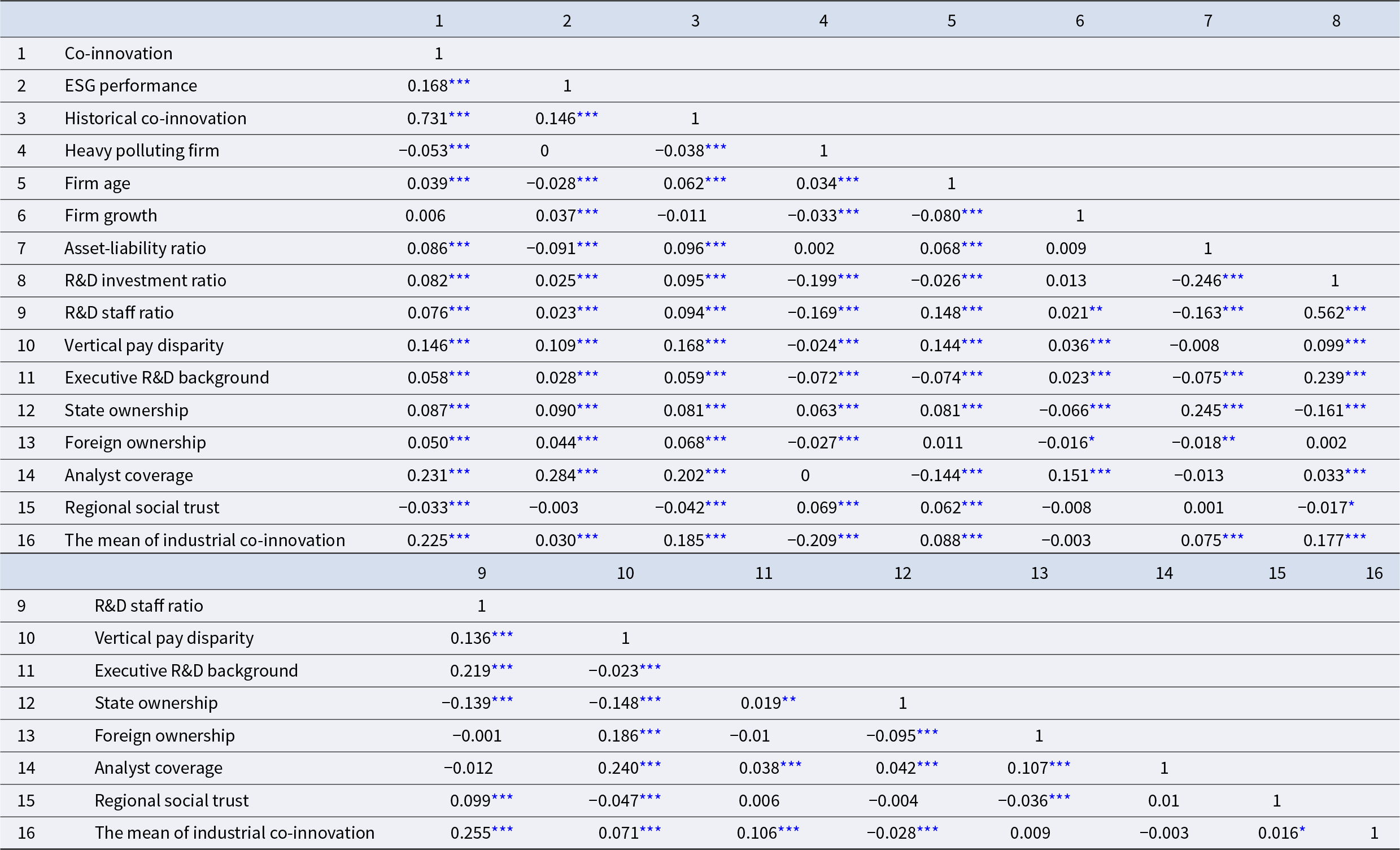
The descriptive statistics for all the variables included in this study are shown in Table 2. According to the rule of thumb suggesting severe multicollinearity with correlations exceeding 0.8 (Lu et al., Reference Lu, Zhu, Zhu and Gao2022), our analysis reveals the absence of severe multicollinearity among our variables. To further examine the problem of multicollinearity, we conducted a variance inflation factor test (VIF test) on all variables; the results showed that the VIFs among all explanatory variables were well below the threshold value of 10, with a mean value of 2.47, which further indicates that the model setting of this study is reasonable, that there is no serious problem of multicollinearity, and that we can embark on the next step of empirical testing.
Pearson correlation analysis

*** Notes: p<0.01, **p<0.05, *p<0.1
Models (1) and (2) in Table 3 demonstrate the effects of ESG performance on co-innovation via the panel Tobit model and high-dimensional fixed effects panel Poisson model, respectively. As Model (1) in Table 3 shows, the coefficient of ESG performance is significantly positive (β = 0.1542, p < 0.01); as Model (2) in Table 3 shows, the coefficient of ESG performance is significantly positive (β = 0.1674, p < 0.01), indicating that ESG performance has a significant positive impact on co-innovation. Hence, H1 is supported.
Regression results for ESG performance and co-innovation

*** Notes: Unless otherwise specified, a panel Tobit model is used, the same as below; ***p<0.01, **p<0.05, *p<0.1
The moderating effects are presented in Table 4. Models (1) and (2) employ the panel Tobit model, whereas Models (3) and (4) utilize the high-dimensional fixed effects panel Poisson model. As shown in Model (1) in Table 4, the coefficient of heavy polluting firm × ESG performance is significantly negative (β = −0.1095, p < 0.05); as shown in Model (3) in Table 4, the coefficient of heavy polluting firm × ESG performance is significantly negative (β = −0.0656, p < 0.05), suggesting that heavy polluting firms reduce the positive impact of ESG performance on firms’ co-innovation. Hence, H2 is supported.
Regression results for moderating effects

*** Notes: p<0.01, **p<0.05, *p<0.1
Endogeneity Tests
Although we controlled for important variables affecting firms’ co-innovation at different levels, there are still some inevitable endogeneity problems owing to omitted variables or variable measurement errors. All of these factors may cause the measurements of the variables to correlate with the error term, resulting in biased coefficient values. To mitigate the endogeneity problem, we first adopted an instrumental variables approach. First, the instrumental variables must be highly correlated with ESG performance; that is, they must satisfy the principle of relevance. Second, the instrumental variables must be independent of the stochastic perturbation term of the model; that is, they must satisfy the principle of exogeneity.Footnote 3 Drawing on previous work (Breuer, Müller, Rosenbach, & Salzmann, Reference Breuer, Müller, Rosenbach and Salzmann2018), we used the mean ESG performance of other firms in the region where the focal firm is located as the instrumental variable for ESG performance, labeled IV1. From the perspective of relevance, the market development situation, financial development environment, and intensity of government regulation in which they are located are roughly the same, and they are supported by the same or similar policies so that the instrumental variables are correlated. Logically, the mean ESG performance of other firms in a region does not directly affect a focal firm’s co-innovation.
The results for the instrumental variables are presented in Table 5. Model (1) in Table 5 demonstrates the effect of IV1 on ESG performance. The coefficient of IV1 is significantly positive (β = 0.3398, p < 0.01), indicating that IV1 has a significantly positive effect on ESG performance. Moreover, the results show that the corresponding p value of the ‘Kleibergen‒Paap rk LM statistic’ is 0, whereas that of the ‘Kleibergen‒Paap rk Wald F statistic’ is greater than the 10% threshold of the corresponding Stock–Yogo weak instrumental variables test. The above can significantly reject the original hypothesis of a weak instrumental variable. In addition, since the IV1 varies according to region, it is unlikely to be associated with firms’ co-innovation patenting behavior. Although IV1 may indirectly affect firms’ co-innovation by influencing the ESG performance of focal firms, it is reasonable to assume that they do not have a direct effect on co-innovation. Model (2) in Table 5 shows the results of the second stage of the regression with instrumental variables. The coefficient of ESG performance is positive (β = 2.1520, p < 0.01), suggesting that the effect of ESG performance on firms’ co-innovation remains robust after the adoption of instrumental variables.
Regression results for ESG performance and co-innovation (the instrumental variable model)

*** Notes: p<0.01, **p<0.05, *p<0.1
As the dependent variable in this study is co-innovation, a significant number of firms do not engage in co-innovation behavior. The direct exclusion of this part of the sample may have led to a biased conclusion. Although we added 1 to take the logarithm of the co-innovation data, it still does not solve the distributional problem of having part of the sample concentrated at zero. To mitigate this problem, we reanalyzed all the hypotheses via a Heckman two-stage model.
In the first stage of the Heckman model, the dependent variable is a dummy indicator, which takes a value of 1 if the focal firm has co-innovation in year t + 1, and 0 otherwise. We included all control variables in the baseline model. In addition, we introduce an exogenous instrumental variable that may influence whether the focal firm engages in co-innovation. We used the mean of the number of strategic partnership announcements made by firms in the focal firm’s industry as the IV2. The inverse Mills ratio (IMR) is calculated via the first stage of the Heckman procedure. We then introduced the IMR into the second stage for fitting. The results of Heckman’s second-stage regressions are presented in Table 6, which shows that all regressions are consistent with the results of the baseline regression. The IMR was significant, suggesting that there may have been some sample selection bias. The results of this study remain robust after addressing the issue of sample bias.
Regression results for ESG performance and co-innovation (the Heckman two-stage model)

*** Notes: p<0.01, **p<0.05, *p<0.1
Robustness Tests
First, referring to previous studies (Tan, Tian, Zhang, & Zhao, Reference Tan, Tian, Zhang and Zhao2020), we also excluded the utility model and design patent data, considering that they may have a certain gap with the invention patent data and used only the natural logarithm of the number of invention patents filed to measure firms’ co-innovation, which is labeled co-innovation1. The regression results for replacing the dependent variable are detailed in Table 7. All the results remain the same after the measurement of the dependent variable is replaced.
Regression results for ESG performance and co-innovation (replacement of the measurement of the dependent variable)

*** Notes: p<0.01, **p<0.05, *p<0.1
Second, there are differences in evaluating firm ESG performance among different agencies. To verify the credibility of the results, we replaced the measurement of ESG performance. We used ESG data from the BloombergFootnote 4, SynTao Green FinanceFootnote 5, and Sino-Securities IndexFootnote 6 (Ren et al., Reference Ren, Zeng and Zhong2024). Bloomberg’s ESG focuses on scoring the level of firms’ ESG disclosure. Bloomberg’s ESG data metrics are based mainly on annual reports, social responsibility reports, and relevant information on corporate websites published by companies, and the level of corporate ESG disclosure is scored on the basis of 120 specific ESG indicators. SynTao Green Finance launched its self-developed ESG rating system in 2015 and established an ESG database of Chinese listed companies. Specifically, the ESG ranges from one to nine and corresponds to C− to A+, respectively. Finally, we also replaced the ESG rating data with ESG scoring data from the Sino-Securities Index. Table 8 presents the empirical results after the replacement of ESG measurements. The results remain robust to the benchmark regression.
Regression results for ESG performance and co-innovation (replacement of the measurement of the independent variable)

*** Notes: p<0.01, **p<0.05, *p<0.1
Third, since our analysis is based solely on a sample from Chinese manufacturing industries, the generalizability of the results may be limited. To address this, we further tested the main hypothesis using the full sample of Chinese A-share listed companies. The results, presented in Table 9, show that all the hypotheses remain supported after replacing the sample with the full dataset.
Regression results for ESG performance and co-innovation (replacement of the sample with the full sample of Chinese A-share listed companies)

*** Notes: p<0.01, **p<0.05, *p<0.1
Fourth, prior research has noted that too many control variables may be detrimental to the results (Ren et al., Reference Ren, Zeng and Zhong2024). Moreover, some of the variables at the managerial and governance levels may have some correlation with ESG performance. To exclude potential adverse effects, we retained only six relatively independent control variables, including firm age, growth, the R&D investment ratio, state ownership, social trust, and the mean of industrial co-innovation to re-test all hypotheses. As shown in Table 10, all the results remain robust.
Regression results for ESG performance and co-innovation (reducing the control variables)

*** Notes: p<0.01, **p<0.05, *p<0.1
Further Examination
First, the quality of co-innovation profoundly affects both partners’ long-term development and core competitiveness. However, whether ESG performance enhances co-innovation quality remains unclear. Therefore, we tested the impact of ESG performance on the quality of co-innovation. We used the natural logarithm of the number of citations of patents jointly filed by firms in the current year and the number of citations of jointly filed patents after excluding self-citations to measure the quality of co-innovation, labelled co-innovation quality1 and co-innovation quality2, respectively. A greater number of citations of a firm’s jointly filed patents indicate that the firm’s co-innovation quality is more valuable. The results in Appendix Table A3 illustrate that ESG performance enhances a firm’s co-innovation quality.
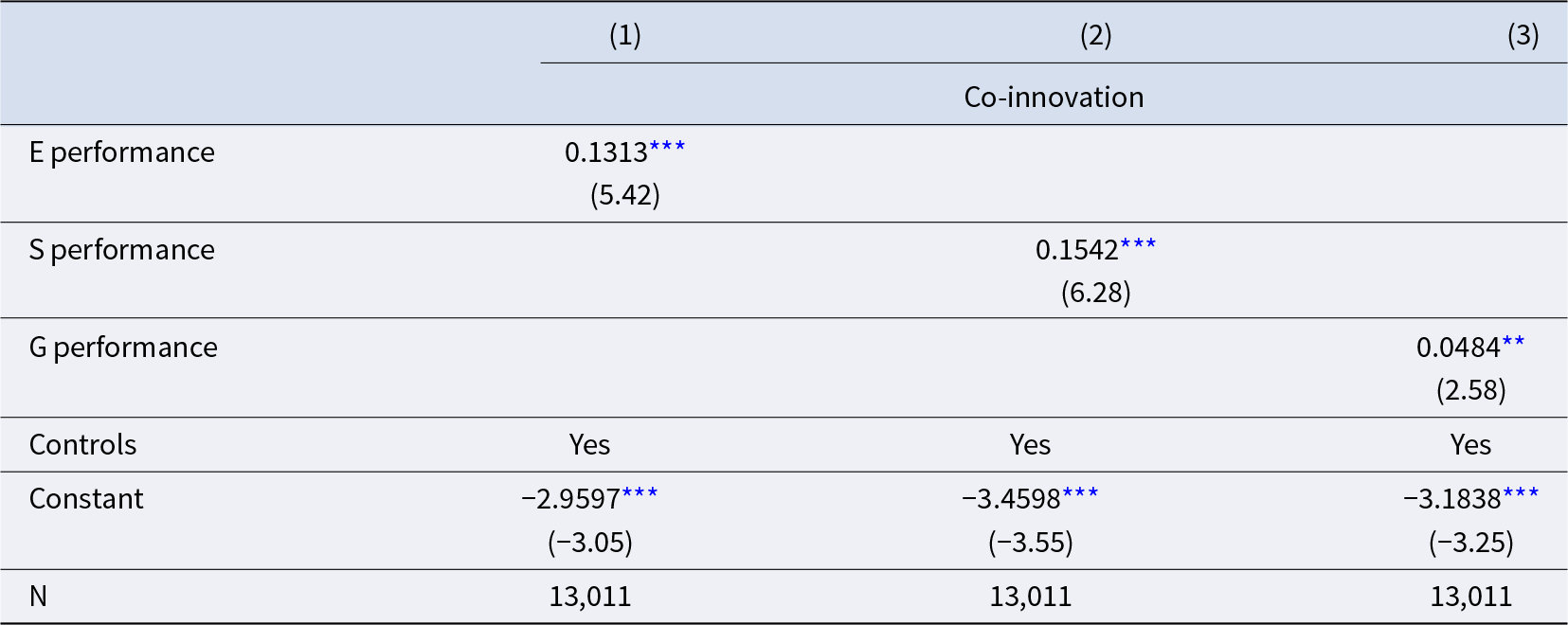
Second, the components of an ESG may send signals with variability to different stakeholders, which can lead to differential outcomes. Therefore, we further distinguished between the effects of E, S, and G performance on co-innovation. As shown in Appendix Table A4, E, S, and G performance all have a positive effect on co-innovation.
Third, the preceding empirical evidence indicates that ESG performance enhances corporate co-innovation. In this context, what is the impact of ESG performance on independent innovation? To examine this, we use the natural logarithm of the total number of a firm’s independent patent applications as a proxy for independent innovation and conduct empirical analyses. The results in Appendix Table A5 show that ESG performance also significantly influences independent innovation (β = 0.0963, p < 0.01; β = 0.1332, p < 0.01). This suggests that while ESG performance fosters co-innovation, it does not inhibit, but rather further promotes, independent innovation.
Fourth, since firms often need to engage in joint R&D activities before engaging in co-innovation, this can be time-consuming. Therefore, for robustness, we retested the main hypothesis by setting the dependent variable to period t + 2 to t + 3. As seen from the results in Appendix Table A6, the positive signals emitted by ESG performance remain significant.
Mechanism Tests
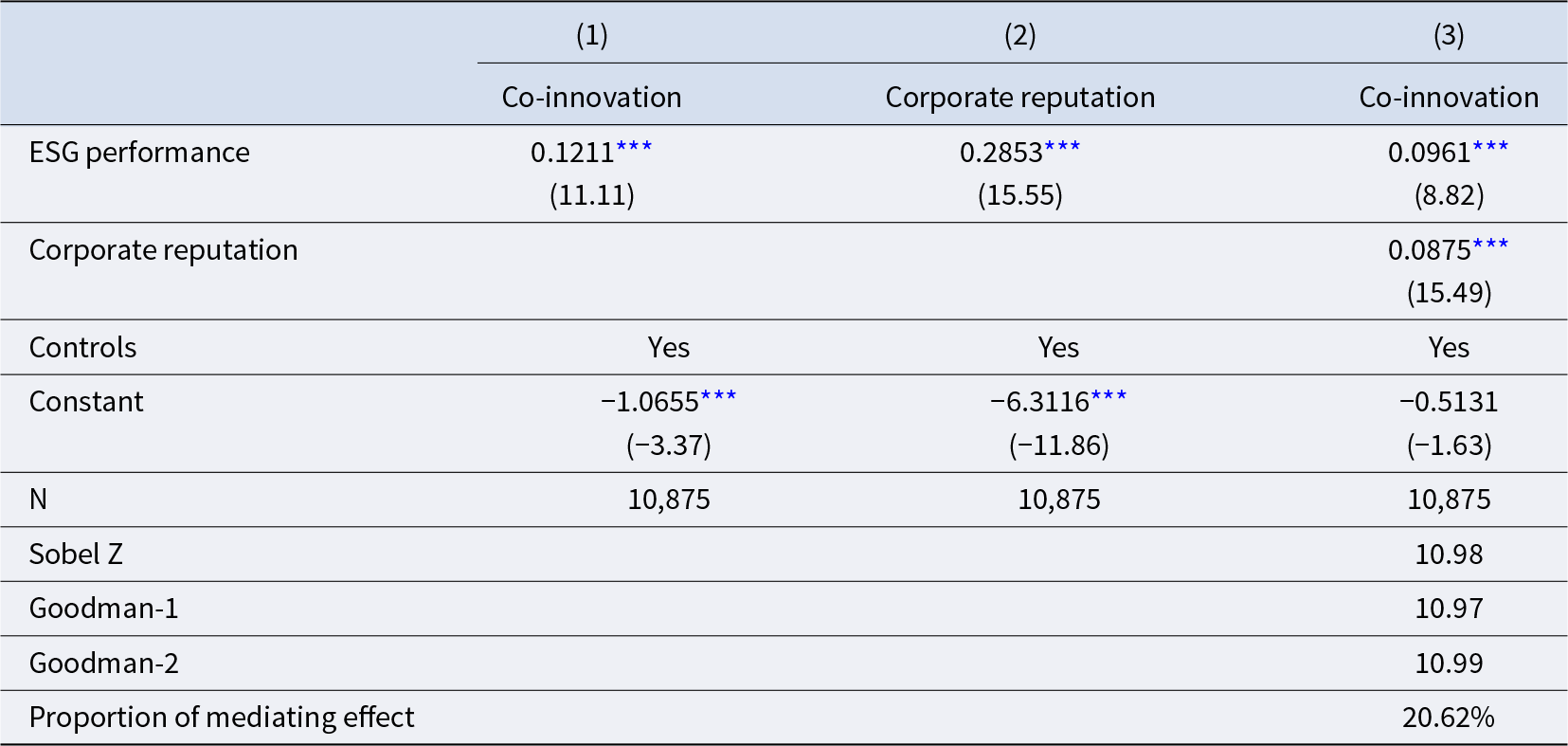
In the previous section, we argued that ESG performance helps firms win the trust of potential external innovation partners, thus improving the focal firms’ level of co-innovation. However, a large sample based on secondary data cannot directly or accurately measure the mechanism variable of ‘trust’. Reputation is closely related to trust and is often used in the extant literature to assess the trustworthiness of trustees (Chaudhary et al., Reference Chaudhary, Dhir, Ferraris and Bertoldi2021; Norheim-Hansen, Reference Norheim-Hansen2015). In view of this, to further validate the potential mechanism by which ESG performance affects co-innovation, we used corporate reputation as a proxy for trust.Footnote 7
Models (1)–(3) in Appendix Table A7 test the mediating mechanism of corporate reputation. As shown in Model (2), ESG performance has a positive effect on corporate reputation. As shown in Model (3), when both ESG performance and corporate reputation are included in the model, the coefficient of corporate reputation is significantly positive, whereas the coefficient of the impact of ESG performance on co-innovation has decreased. The proportion of the mediating accounts for 20.62%. These findings suggest that corporate reputation serves as a potential mechanism linking ESG performance and co-innovation.
Discussion
From the perspective of our collaborators, we theoretically analyze and provide empirical evidence on the basis of signaling and trust theories to show that focal firms’ ESG performance plays a key role in promoting co-innovation. Using data from 13,011 firm-year observations of 2076 Chinese listed firms, we find that ESG performance significantly and meaningfully impacts firms’ co-innovation. Specifically, the better a firm’s ESG performance is, the greater its level of co-innovation. We attribute this to the fact that ESG performance induces collaborators to trust that the focal firm will not act opportunistically during collaboration, thus fostering co-innovation. Using firm reputation as a proxy for collaborator trust, we also indirectly confirm the intrinsic mechanistic role of collaborator trust in the relationship between ESG performance and firms’ co-innovation. Second, we find that the relationship between ESG performance and firms’ co-innovation and innovation varies according to heavy polluting firm attributes and historical co-innovation. On one hand, the signaling effect of ESG performance on co-innovation is more prominent among non-heavy polluting firms than among heavy polluting firms. On the other hand, historical co-innovation causes the signaling effect of ESG performance on firms’ co-innovation to become less pronounced. Overall, we provide the first large sample evidence explaining how and when ESG signals can have a signaling effect on firms’ co-innovation.
Theoretical Contributions
First, this study extends the literature on co-innovation by explaining why focal firms have higher levels of co-innovation in terms of collaborators rather than the focal firm focus. The co-innovation literature has extensively explored the antecedents of co-innovation and provided constructive insights. However, most of these studies take the focal firms’ perspective and explore why they choose or do not choose to engage in co-innovation (Fatima & Masood, Reference Fatima and Masood2024; Lv et al., Reference Lv, Zhu, Chen and Lan2021; Wu, Zhang, & Tsai, Reference Wu, Zhang and Tsai2023). In fact, co-innovation involves at least two subjects – the focal firm and the collaborator (Langlois et al., Reference Langlois, BenMahmoud-Jouini and Servajean-Hilst2023; Wyrwich et al., Reference Wyrwich, Steinberg, Noseleit and de Faria2022) – and cannot occur unless the collaborator is willing to engage in co-innovation with the focal firm (Arora et al., Reference Arora, Athreye and Huang2016; Lichtenthaler, Reference Lichtenthaler2011). Nevertheless, there is a dearth of insight into why collaborators are willing or unwilling to engage in co-innovation with focal firms (Hasche et al., Reference Hasche, Linton and Öberg2017). For the first time, we provide theoretical and empirical evidence that collaborators infer unobservable ethical stances and value orientations on the basis of the focal firm’s observable ESG performance and thus make decisions to engage in co-innovation. In doing so, this study extends beyond the vast majority of existing explanations of what enables co-innovation to take shape, expanding the research perspective and explanatory logic of the co-innovation literature.
Second, this study contributes to the ESG literature by introducing trust to illustrate how ESG performance affects firms’ co-operative activities. There is a growing body of research on the economic consequences of ESG performance (Elmghaamez et al., Reference Elmghaamez, Nwachukwu and Ntim2024; Guo et al., Reference Guo, Li, Song and Tang2024; Lee et al., Reference Lee, Raschke and Krishen2022). These studies have also explored the impact of ESG performance on firm innovation (Wan, Fu, & Zhong, Reference Wan, Fu and Zhong2024; Wang et al., Reference Wang, Ma, Dong and Zhang2023). However, most previous studies have focused on independent activities within the firm. This study extends and adds to the stream of literature exploring the economic consequences of ESG performance by highlighting the impact of firms’ ESG performance on their own co-innovation. Simultaneously, by emphasizing the importance of balancing the interests of shareholders, society and the environment in fostering firms’ co-innovation, this study also adds to the small number of existing studies that have explored how firms’ initiatives to increase social benefits (e.g., philanthropic donations) can contribute to co-innovation (Bereskin et al., Reference Bereskin, Campbell and Hsu2016; Holmes & Smart, Reference Holmes and Smart2009). In addition, emerging research has shown that ESG performance can influence firms’ strategic choices through mechanisms such as obtaining government policy support (Wan et al., Reference Wan, Fu and Zhong2024), alleviating financing constraints (Guo et al., Reference Guo, Li, Song and Tang2024) and reducing monitoring costs (Wang et al., Reference Wang, Ma, Dong and Zhang2023). By adding how ESG performance can help firms gain access to important intangible resources (e.g., trust) and subsequently improve their own innovation capabilities, we contribute to an emerging stream of literature that aims to explore how ESG performance affects firms’ strategic choices.
Finally, by integrating insights from trust theory into signaling theory to develop new insights into how and when ESG signals are more likely to affect firms’ strategic performance, this study also contributes to signaling theory. Signaling theory has been widely used to explain firm value (Friske et al., Reference Friske, Hoelscher and Nikolov2023; Zhong, Chen, & Ren, Reference Zhong, Chen and Ren2022), IPO performance (Kirschbaum et al., Reference Kirschbaum, Minardi, Rossoni and Da Silva2023), overseas subsidiary performance (Jiang et al., Reference Jiang, Jung and Makino2020), acquisitions (Vasudeva et al., Reference Vasudeva, Nachum and Say2018), and technological knowledge adoption (Huang & Li, Reference Huang and Li2019). On the basis of these studies, we further apply signaling theory to corporate co-innovation, expanding the explanatory and predictive power of signaling theory on corporate strategic choices and performance. In addition, while signaling theory has been applied to understand how stakeholders respond to ESG or CSR (Flammer, Reference Flammer2021; Su, Peng, Tan, & Cheung, Reference Su, Peng, Tan and Cheung2016), how signals affect firm behavior and the conditions under which they apply are two important aspects of signal theory that have been relatively understudied (Friske et al., Reference Friske, Hoelscher and Nikolov2023; Jiang et al., Reference Jiang, Jung and Makino2020; Ren et al., Reference Ren, Zeng and Song2022). To address these issues, on the one hand, we extend the theoretical logic of signaling theory in explaining firms’ strategic choices by integrating insights from trust theory (Mayer et al., Reference Mayer, Davis and Schoorman1995) and describing how signaling affects firms’ strategic behavior from a trust perspective. On the other hand, we challenge the implicit assumption that specific signals provoke the same or similar behavioral responses in signal recipients. We provide strong evidence that unless the information embedded in ESG signals is valued by signal receivers or unless ESG signals authentically convey the information that signal receivers desire (Connelly et al., Reference Connelly, Certo, Ireland and Reutzel2011), signal receivers are unlikely to respond accordingly to ESG signals. Thus, this study provides a more complete picture that extends our understanding of the boundary conditions for the effectiveness of ESG signals.
Practical Implications
Our findings provide important practical insights and implications for policy development. First, firms can adopt ESG practices to signal their own ethical orientations and behavioral tendencies to collaborators, thereby evoking a positive response from them. Doing so can effectively increase firms’ levels of co-innovation, thereby enhancing their market competitiveness. This approach may be more valuable in emerging economies such as China, where information opacity is still high in capital markets (Ren et al., Reference Ren, Zeng and Song2022) and where it is difficult for stakeholders to access relevant information about specific firms. Importantly, the facilitating effect of ESG signals on firms’ co-innovation is more pronounced in non-heavy polluting firms and firms with lower levels of historical co-innovation. In addition, given the strategic importance of high ESG performance in fostering co-innovation, shareholders should take steps to change decision makers’ perceptions of ESG and incentivize them to be more active in ESG activities. For example, shareholders can prevent decision-makers from developing a one-sided view that investments in ESG increase costs only by providing them with regular training.
Second, engaging in co-innovation is a major challenge for any firm presenting both opportunities and challenges. Our study implies that firms can select potential partners on the basis of ESG performance, which can help them select high-quality partners who are unlikely to engage in opportunistic behaviors (e.g., knowledge misappropriation and free-riding) in the co-innovation process. Finally, the results have important implications for policymakers. Policymakers, especially those in emerging economies, should further develop and improve ESG evaluation systems and expand the influence of ESG ratings on firms. This is because ESGs can be an important bridge to motivate different subjects to actively engage in coordination and cooperation, which, in turn, reduces transaction costs in the national economy.
Limitations and Future Research Directions
First, this study primarily focuses on Chinese companies. We believe the findings of this study are likely applicable to companies in emerging economies such as Vietnam and Brazil, which face a similar innovation environment to that of Chinese companies. For example, fierce competition for innovation and rapidly iterating technological advances have made it increasingly uneconomic and unviable for these firms to carry out innovation activities on their own. Since most firms in advanced economies have a strong capacity for independent innovation, our conclusions may not apply to them. In addition, we used ESG data obtained from Sino-Securities Index Information Service (Shanghai) Co., Ltd, to measure firm ESG performance. Although the methodology has been recognized by academics (Fang et al., Reference Fang, Nie and Shen2023; Yu, & Luu, Reference Yu and Luu2021), it is difficult to deny that there is also noise in this evaluation system. Therefore, we call for future research to develop better methods for assessing firms’ ESG performance and subsequently validate or revise the findings of this study.
Second, we only indirectly verified the intrinsic role of collaborator trust in the relationship between ESG performance and co-innovation. We call for future research based on questionnaires and experimental methods to directly obtain data that can accurately measure trust in collaborators and to directly test whether trust in collaborators acts as a transmission channel between ESG performance and co-innovation.
Third, building on this study, the boundary conditions of the relationship between ESG performance and co-innovation must be clarified. Future research should introduce other moderators beyond heavy polluting firm attributes and historical co-innovation.
Finally, owing to data availability, we empirically tested only the impact of ESG performance on the final outcome of co-innovation but did not examine the impact of ESG performance on collaboration target selection and the collaborative process in detail. We encourage future research to address this gap to develop a more refined understanding of how ESG influences co-innovation.
Data availability statement
The data that support the findings of this study are available from the corresponding author upon reasonable request.
Acknowledgements
We appreciate the help and hard work of Editor-in-Chief Professor Xiao-Ping Chen, and Deputy Editor Professor Kenneth G. Huang. Meanwhile, we are also grateful to the two anonymous reviewers for their insightful comments and suggestions. This work was supported by the National Social Science Foundation Project of China (Grant No.22BGL099).
Appendix
Sample screening process

Definitions of variables

Regression results for ESG performance and co-innovation quality

*** Notes: p<0.01, **p<0.05, *p<0.1
Regression results for E/S/G performance and co-innovation

*** Notes: p<0.01, **p<0.05, *p<0.1
Regression results for ESG performance and independent innovation

*** Notes: p<0.01, **p<0.05, *p<0.1
Regression results for ESG performance and co-innovation (setting the dependent variable to periods t + 2 to t + 3)

*** Notes: p<0.01, **p<0.05, *p<0.1
Regression results for testing potential mechanisms between ESG and co-innovation

*** Notes: The mechanism was tested via the ordinary least squares method; ***p < 0.01, **p < 0.05, *p < 0.1
Ge Ren (Hrenge@yeah.net) is a doctoral student at the School of Business Administration, South China University of Technology. Her research lies at the intersection of ESG and corporate innovation strategy. She has published in several journals, including Management and Organization Review, Corporate Social Responsibility and Environmental Management, Business Ethics, the Environment and Responsibility, Journal of Engineering and Technology Management, among others.
Ping Zeng (Pzeng@scut.edu.cn) is a professor and PhD supervisor in the School of Business Administration South China University of Technology. His research lies at the intersection of green innovation and digital transformation. He has published in several journals, including Business Ethics, the Environment and Responsibility, Corporate Social Responsibility and Environmental Management, Journal of Engineering and Technology Management, Nankai Business Review International, among others.
Xi Zhong (HGzhongxi@163.com) is an associate professor at the College of Management, Shenzhen University. His research lies at the intersection of business ethics, performance feedback, and digital transformation. He has published over 100 academic articles in various scholarly journals, including Management and Organization Review, Journal of Business Ethics, Journal of Business Research, Technovation, Industrial Marketing Management, R&D Management, Asia Pacific Journal of Management, European Management Review, among others.