Refine search
Actions for selected content:
8 results
A new lattice construction: The amalgamation of lattices
- Part of
-
- Journal:
- Canadian Mathematical Bulletin , First View
- Published online by Cambridge University Press:
- 14 July 2026, pp. 1-10
-
- Article
-
- You have access
- HTML
- Export citation
-
Let L and K be two distributive lattices, J be an ideal of $K,$
 and $f:L\to K$
 be a lattice homomorphism. In this article, we introduce the sublattice $L \bowtie ^f J:= \{(a,f(a)\vee i) \mid a\in L,\ i\in J \}$
 of $L \times K$
 , called the “amalgamated lattice of L with K along J with respect to f,” and study some of its basic properties.


Hyperbinary partitions and q-deformed rationals
- Part of
-
- Journal:
- Forum of Mathematics, Sigma / Volume 14 / 2026
- Published online by Cambridge University Press:
- 26 February 2026, e30
-
- Article
-
- You have access
- Open access
- HTML
- Export citation
-
A hyperbinary partition of the nonnegative integer n is a partition where every part is a power of
 $2$ and every power of
 $2$ appears at most twice. We give three applications of the length generating function for such partitions, denoted by
 $h_q(n)$. Morier-Genoud and Ovsienko defined the q-analogue of a rational number
 $[r/s]_q$ in various ways, most of which depend directly or indirectly on the continued fraction expansion of
 $r/s$. As our first application we show that
 $[r/s]_q=q\,h_q(n-1)/h_q(n)$ where
 $r/s$ occurs as the nth entry in the Calkin-Wilf enumeration of the non-negative rationals. Next we consider fence posets which are those which can be obtained from a sequence of chains by alternately pasting together maxima and minima. For every n we show there is a fence poset
 ${\cal F}(n)$ whose lattice of order ideals is isomorphic to the poset of hyperbinary partitions of n ordered by refinement. For our last application, Morier-Genoud and Ovsienko also showed that
 $[r/s]_q$ can be computed by taking products of certain matrices which are q-analogues of the standard generators for the special linear group
 $\operatorname {\mathrm {SL}}(2,{\mathbb Z})$. We express the entries of these products in terms of the polynomials
 $h_q(n)$.


On Annelidan, Distributive, and Bézout Rings
- Part of
- Distributive lattices
- Local rings and generalizations
- Radicals and radical properties of rings
- Rings and algebras arising under various constructions
- Modules, bimodules and ideals
- Boolean algebras (Boolean rings)
- Chain conditions, growth conditions, and other forms of finiteness
- Conditions on elements
-
- Journal:
- Canadian Journal of Mathematics / Volume 72 / Issue 4 / August 2020
- Published online by Cambridge University Press:
- 03 May 2019, pp. 1082-1110
- Print publication:
- August 2020
-
- Article
-
- You have access
- Export citation
VARIETIES OF DE MORGAN MONOIDS: COVERS OF ATOMS
-
- Journal:
- The Review of Symbolic Logic / Volume 13 / Issue 2 / June 2020
- Published online by Cambridge University Press:
- 26 January 2019, pp. 338-374
- Print publication:
- June 2020
-
- Article
-
- You have access
- Export citation
-
The variety DMM of De Morgan monoids has just four minimal subvarieties. The join-irreducible covers of these atoms in the subvariety lattice of DMM are investigated. One of the two atoms consisting of idempotent algebras has no such cover; the other has just one. The remaining two atoms lack nontrivial idempotent members. They are generated, respectively, by 4-element De Morgan monoids C4 and D4, where C4 is the only nontrivial 0-generated algebra onto which finitely subdirectly irreducible De Morgan monoids may be mapped by noninjective homomorphisms. The homomorphic preimages of C4 within DMM (together with the trivial De Morgan monoids) constitute a proper quasivariety, which is shown to have a largest subvariety U. The covers of the variety
 (C4) within U are revealed here. There are just ten of them (all finitely generated). In exactly six of these ten varieties, all nontrivial members have C4 as a retract. In the varietal join of those six classes, every subquasivariety is a variety—in fact, every finite subdirectly irreducible algebra is projective. Beyond U, all covers of
 (C4) [or of
 (D4)] within DMM are discriminator varieties. Of these, we identify infinitely many that are finitely generated, and some that are not. We also prove that there are just 68 minimal quasivarieties of De Morgan monoids.


Coaxer Lattices
-
- Journal:
- Canadian Mathematical Bulletin / Volume 60 / Issue 2 / 01 June 2017
- Published online by Cambridge University Press:
- 20 November 2018, pp. 372-380
- Print publication:
- 01 June 2017
-
- Article
-
- You have access
- Export citation
Level Rings Arising from Meet-Distributive Meet-Semilattices
-
- Journal:
- Nagoya Mathematical Journal / Volume 181 / March 2006
- Published online by Cambridge University Press:
- 11 January 2016, pp. 29-39
-
- Article
-
- You have access
- Export citation
Minimum sized fibres in distributive lattices
- Part of
-
- Journal:
- Journal of the Australian Mathematical Society / Volume 70 / Issue 3 / June 2001
- Published online by Cambridge University Press:
- 09 April 2009, pp. 337-350
-
- Article
-
- You have access
- Export citation
-
A subset F of an ordered set X is a fibre of X if F intersects every maximal antichain of X. We find a lower bound on the function ƒ (D), the minimum fibre size in the distributive lattice D, in terms of the size of D. In particular, we prove that there is a constant c such that
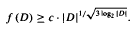 In the process we show that minimum fibre size is a monotone property for a certain class of distributive lattices. This fact depends upon being able to split every maximal antichain of this class of distributive lattices into two parts so that the lattice is the union of the upset of one part and the downset of the other.
 In the process we show that minimum fibre size is a monotone property for a certain class of distributive lattices. This fact depends upon being able to split every maximal antichain of this class of distributive lattices into two parts so that the lattice is the union of the upset of one part and the downset of the other.
Homomorphisms of Distributive Lattices as Restrictions of Congruences. II. Planarity and Automorphisms
-
- Journal:
- Canadian Journal of Mathematics / Volume 46 / Issue 1 / 01 February 1994
- Published online by Cambridge University Press:
- 20 November 2018, pp. 3-54
- Print publication:
- 01 February 1994
-
- Article
-
- You have access
- Export citation
