Refine search
Actions for selected content:
90 results
THE VINOGRADOV INTEGRAL AND ITS APPLICATIONS
- Part of
-
- Journal:
- Bulletin of the Australian Mathematical Society , First View
- Published online by Cambridge University Press:
- 26 October 2026, pp. 1-3
-
- Article
-
- You have access
- HTML
- Export citation
EXTREME VALUES OF DERIVATIVES OF DIRICHLET L-FUNCTIONS
- Part of
-
- Journal:
- Bulletin of the Australian Mathematical Society , First View
- Published online by Cambridge University Press:
- 02 October 2026, pp. 1-8
-
- Article
-
- You have access
- HTML
- Export citation
-
In this paper, we establish lower bounds for extreme values of derivatives of Dirichlet L-functions in the range $1/2<\sigma <1$
 . Compared with the work of Aistleitner et al. [‘On large values of $L(\sigma , \chi )$
 ’, Q. J. Math. 70 (2019), 831–848], our result shows that derivatives of Dirichlet L-functions can attain extreme values of the same order of magnitude as the original L-functions in the interval ${1/2<\sigma <1}$
 .

Mean square estimates for the error terms of sums of the greatest common divisor
- Part of
-
- Journal:
- Canadian Mathematical Bulletin , First View
- Published online by Cambridge University Press:
- 18 September 2026, pp. 1-12
-
- Article
-
- You have access
- HTML
- Export citation
-
We investigate the mean square behavior of error terms that arise in the summation of $\gcd (n_1,\ldots ,n_k)$
 with $n_1\ldots n_k \le x$
 . We first analyze error terms related to certain Dirichlet series $\zeta ^2(s)\zeta (2s-1)\zeta ^M(2s)$
 and obtain upper bounds for their mean squares, depending on the parameter M. We then extend our analysis to the general case with $k \ge 3$
 , providing estimates for the mean square of the corresponding error terms.

The first moment of primitive cubic $L$
 -functions with fixed genus
- Part of
-
- Journal:
- Canadian Mathematical Bulletin , First View
- Published online by Cambridge University Press:
- 29 July 2026, pp. 1-14
-
- Article
-
- You have access
- HTML
- Export citation
-
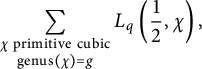
We study the first moment of primitive cubic $L$
 -functions over $\mathbb {F}_q(T)$
 in the non-Kummer setting $q\equiv 2\ {\mathrm{mod}}\ 3$
 . More precisely, we study the sum $$ \begin{align*} \sum_{\substack{\chi\ \mathrm{primitive}\ \mathrm{cubic}\\ \mathrm{genus}(\chi)=g}}L_q\left(\frac{1}{2}, \chi\right), \end{align*} $$where $L_q(s,\chi )$
 denotes the $L$
 -function associated with primitive cubic character $\chi $
 . Using a double Dirichlet series, we obtain an asymptotic formula with an error term of size $q^{(\frac {7}{8}+\varepsilon )g}$
 . The argument avoids an explicit residue computation and clarifies why the poles at $u^3=1$
 do not contribute, thereby resolving the question left in Remark 4.6 of David et al. (2019, algebra number theory).


Liouville function, von Mangoldt function, and norm forms at random binary forms
- Part of
-
- Journal:
- Glasgow Mathematical Journal , First View
- Published online by Cambridge University Press:
- 21 July 2026, pp. 1-34
-
- Article
-
- You have access
- Open access
- HTML
- Export citation
-
We analyze the average behavior of various arithmetic functions at the values of degree
 $d$ binary forms ordered by height, with probability
 $1$. This approach yields averaged versions of the Chowla conjecture and the Bateman–Horn conjecture for random binary forms. Furthermore, we show that the rational Hasse principle holds for almost all Châtelet varieties defined by a fixed norm form of degree
 $e$ and by varying binary forms of fixed degree
 $d$, provided
 $e$ divides
 $d$. This proves an average version of a conjecture of Colliot-Thélène.


On the quantitative simultaneous sign changes of Fourier coefficients attached to Hecke–Maass forms over certain quadratic forms
- Part of
-
- Journal:
- Canadian Mathematical Bulletin , First View
- Published online by Cambridge University Press:
- 26 June 2026, pp. 1-20
-
- Article
-
- You have access
- HTML
- Export citation
-
Let f and g be two distinct Hecke–Maass cusp forms of weight zero for the full modular group $SL(2,\mathbb {Z})$
 with Laplacian eigenvalues $\frac {1}{4}+t_{1}^{2}$
 and $\frac {1}{4}+t_{2}^{2}$
 , and denote by $\lambda _{f}(n)$
 and $\lambda _{g}(n)$
 the n-th normalized Fourier coefficients attached to f and g, respectively. In the present article, we establish a quantitative result regarding the sign changes of the sequence $\{\lambda _{f}(n)\lambda _{g}(n)\}_{n\geqslant 1}$
 in the interval $(x,2x]$
 , supported at a certain primitive integral binary quadratic form with fixed negative discriminant $D<0$
 , for sufficiently large x.


EXTREME VALUES OF DERIVATIVES OF THE DEDEKIND ZETA FUNCTION OF A CYCLOTOMIC FIELD
- Part of
-
- Journal:
- Journal of the Australian Mathematical Society , First View
- Published online by Cambridge University Press:
- 16 June 2026, pp. 1-27
-
- Article
-
- You have access
- HTML
- Export citation
SOME DISJOINTNESS RESULTS ON THE DISTRIBUTION OF ORBITS ALONG $\Omega (n)$

- Part of
-
- Journal:
- Bulletin of the Australian Mathematical Society / Volume 114 / Issue 3 / December 2026
- Published online by Cambridge University Press:
- 15 June 2026, pp. 464-474
- Print publication:
- December 2026
-
- Article
-
- You have access
- HTML
- Export citation
-
In this note, we study bounded functions of invariant average under multiplication. We show that if an arithmetic function is of moderate growth, then it is asymptotically uncorrelated to such functions. This provides several new disjointness results on the distribution of orbits along $\Omega (n)$
 .


Some asymptotic formulas related to the Möbius function of higher order
- Part of
-
- Journal:
- Canadian Mathematical Bulletin , First View
- Published online by Cambridge University Press:
- 12 February 2026, pp. 1-16
-
- Article
-
- You have access
- HTML
- Export citation
-
In 1970, Apostol introduced the Möbius function of order k for an integer
 $k\ge 1$. In 2001, it was generalized by Bege to the Möbius function
 $\mu _{k,m}$ of two parameters for any integers
 $m\ge k\ge 1$. In this article, we will establish three kinds of asymptotic formulas related to
 $\mu _{k,m}$ for
 $m\ge k\ge 2$ in a unified elementary method. These formulas are related to the shifted convolution sums of Fourier coefficients of holomorphic cusp forms, Bergelson and Richter’s dynamical generalization of the prime number theorem, and the Titchmarsh divisor problem.


Average sizes of mixed character sums
- Part of
-
- Journal:
- Proceedings of the Royal Society of Edinburgh. Section A: Mathematics , First View
- Published online by Cambridge University Press:
- 26 January 2026, pp. 1-15
-
- Article
-
- You have access
- Open access
- HTML
- Export citation
-
We prove that the average size of a mixed character sum
(for a suitable smooth function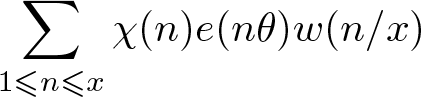 \begin{equation*}\sum_{1\leqslant n \leqslant x} \chi(n) e(n\theta) w(n/x)\end{equation*}
 $w$) is on the order of
 $\sqrt{x}$ for all irrational real
 $\theta$ satisfying a weak Diophantine condition, where
 $\chi$ is drawn from the family of Dirichlet characters modulo a large prime
 $r$ and where
 $x\leqslant r$. In contrast, it was proved by Harper that the average size is
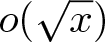 $o(\sqrt{x})$ for rational
 $\theta$. Certain quadratic Diophantine equations play a key role in the present paper.


Oscillation results for the summatory functions of fake
 $\mu $’s
- Part of
-
- Journal:
- Canadian Journal of Mathematics , First View
- Published online by Cambridge University Press:
- 15 August 2025, pp. 1-44
-
- Article
-
- You have access
- Open access
- HTML
- Export citation
-
Martin, Mossinghoff, and Trudgian [19] recently introduced a family of arithmetic functions called “fake
 $\mu $’s,” which are multiplicative functions for which there is a
 $\{-1,0,1\}$-valued sequence
 $(\varepsilon _j)_{j=1}^{\infty }$ such that
 $f(p^j) = \varepsilon _j$ for all primes p. They investigated comparative number-theoretic results for fake
 $\mu $’s and, in particular, proved oscillation results at scale
 $\sqrt {x}$ for the summatory functions of fake
 $\mu $’s with
 $\varepsilon _1=-1$ and
 $\varepsilon _2=1$. In this article, we establish new oscillation results for the summatory functions of all nontrivial fake
 $\mu $’s at scales
 $x^{1/2\ell }$ where
 $\ell $ is a positive integer (the “critical index”) depending on f; for
 $\ell =1$ this recovers the oscillation results in [19]. Our work also recovers results on the indicator functions of powerfree and powerfull numbers; we generalize techniques applied to each of these examples to extend to all fake
 $\mu $’s.


Mean values of arithmetic functions and application to sums of powers
- Part of
-
- Journal:
- Mathematical Proceedings of the Cambridge Philosophical Society / Volume 180 / Issue 1 / January 2026
- Published online by Cambridge University Press:
- 08 August 2025, pp. 1-13
- Print publication:
- January 2026
-
- Article
-
- You have access
- HTML
- Export citation
-
We provide new upper bounds for sums of certain arithmetic functions in many variables at polynomial arguments and, exploiting recent progress on the mean-value of the Erdős—Hooley
 $\Delta$-function, we derive lower bounds for the cardinality of those integers not exceeding a given limit that are expressible as certain sums of powers.

The Chowla conjecture and Landau–Siegel zeroes
- Part of
-
- Journal:
- Mathematical Proceedings of the Cambridge Philosophical Society / Volume 179 / Issue 1 / July 2025
- Published online by Cambridge University Press:
- 19 May 2025, pp. 167-187
- Print publication:
- July 2025
-
- Article
-
- You have access
- Open access
- HTML
- Export citation
-
Let
 $k{\geqslant} 2$ be an integer and let
 $\lambda$ be the Liouville function. Given k non-negative distinct integers
 $h_1,\ldots,h_k$, the Chowla conjecture claims that
 $\sum_{n{\leqslant} x}\lambda(n+h_1)\cdots \lambda(n+h_k)=o(x)$. An unconditional answer to this conjecture is yet to be found, and in this paper, we take a conditional approach. More precisely, we establish a non-trivial bound for the sums
 $\sum_{n{\leqslant} x}\lambda(n+h_1)\cdots \lambda(n+h_k)$ under the existence of a Landau–Siegel zero for x in an interval that depends on the modulus of the character whose Dirichlet series corresponds to the Landau–Siegel zero. Our work constitutes an improvement over the previous related results of Germán and Kátai, Chinis and Tao and Teräväinen.


Almost sure upper bound for a model problem for multiplicative chaos in number theory
- Part of
-
- Journal:
- Mathematical Proceedings of the Cambridge Philosophical Society / Volume 179 / Issue 1 / July 2025
- Published online by Cambridge University Press:
- 13 May 2025, pp. 29-44
- Print publication:
- July 2025
-
- Article
-
- You have access
- HTML
- Export citation
NOTE ON A DYNAMICAL GENERALISATION OF THE PRIME NUMBER THEOREM FOR ARITHMETIC PROGRESSIONS
- Part of
-
- Journal:
- Bulletin of the Australian Mathematical Society / Volume 113 / Issue 1 / February 2026
- Published online by Cambridge University Press:
- 27 February 2025, pp. 55-62
- Print publication:
- February 2026
-
- Article
-
- You have access
- HTML
- Export citation
-
Bergelson and Richter [‘Dynamical generalizations of the prime number theorem and disjointness of additive and multiplicative semigroup actions’, Duke Math. J. 171(15) (2022), 3133–3200] established a new dynamical generalisation of the prime number theorem (PNT) and the PNT for arithmetic progressions. Let
 $h\ge 1, k\ge 2$. Mirsky [‘Note on an asymptotic formula connected with r-free integers’, Quart. J. Math. Oxford Ser. 18 (1947), 178–182] showed that the numbers n such that
 $n+l_1,\ldots , n+l_h$ are k-free have a natural density for any given nonnegative integers
 $l_1,\ldots , l_h$. In this note, we show that the Bergelson–Richter theorem holds for the numbers studied by Mirsky.


Partition regularity of Pythagorean pairs
- Part of
-
- Journal:
- Forum of Mathematics, Pi / Volume 13 / 2025
- Published online by Cambridge University Press:
- 12 February 2025, e5
-
- Article
-
- You have access
- Open access
- HTML
- Export citation
-
We address a core partition regularity problem in Ramsey theory by proving that every finite coloring of the positive integers contains monochromatic Pythagorean pairs (i.e.,
 $x,y\in {\mathbb N}$ such that
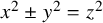 $x^2\pm y^2=z^2$ for some
 $z\in {\mathbb N}$). We also show that partitions generated by level sets of multiplicative functions taking finitely many values always contain Pythagorean triples. Our proofs combine known Gowers uniformity properties of aperiodic multiplicative functions with a novel and rather flexible approach based on concentration estimates of multiplicative functions.


Furstenberg systems of pretentious and MRT multiplicative functions
- Part of
-
- Journal:
- Ergodic Theory and Dynamical Systems / Volume 45 / Issue 9 / September 2025
- Published online by Cambridge University Press:
- 03 February 2025, pp. 2765-2844
- Print publication:
- September 2025
-
- Article
-
- You have access
- HTML
- Export citation
A function field analog of Jacobi’s theorem on sums of squares and its moments
- Part of
-
- Journal:
- Canadian Mathematical Bulletin / Volume 68 / Issue 3 / September 2025
- Published online by Cambridge University Press:
- 10 January 2025, pp. 667-683
- Print publication:
- September 2025
-
- Article
-
- You have access
- HTML
- Export citation
-
In this article, we establish a function field analog of Jacobi’s theorem on sums of squares and analyze its moments. Our approach involves employing two distinct techniques to derive the main results concerning asymptotic formulas for the moments. The first technique utilizes Dirichlet series framework to derive asymptotic formulas in the limit of large finite fields, specifically when the characteristic of
 $\mathbb {F}_q[T]$ becomes large. The second technique involves effectively partitioning the set of polynomials of a fixed degree, providing asymptotic formulas in the limit of large polynomial degree.

Convolution of periodic multiplicative functions and the divisor problem
- Part of
-
- Journal:
- Canadian Journal of Mathematics / Volume 77 / Issue 6 / December 2025
- Published online by Cambridge University Press:
- 14 November 2024, pp. 1966-1984
- Print publication:
- December 2025
-
- Article
-
- You have access
- HTML
- Export citation
-
We study a certain class of arithmetic functions that appeared in Klurman’s classification of
 $\pm 1$ multiplicative functions with bounded partial sums; c.f., Comp. Math. 153(2017), 2017, no. 8, 1622–1657. These functions are periodic and
 $1$-pretentious. We prove that if
 $f_1$ and
 $f_2$ belong to this class, then
 $\sum _{n\leq x}(f_1\ast f_2)(n)=\Omega (x^{1/4})$. This confirms a conjecture by the first author. As a byproduct of our proof, we studied the correlation between
 $\Delta (x)$ and
 $\Delta (\theta x)$, where
 $\theta $ is a fixed real number. We prove that there is a nontrivial correlation when
 $\theta $ is rational, and a decorrelation when
 $\theta $ is irrational. Moreover, if
 $\theta $ has a finite irrationality measure, then we can make it quantitative this decorrelation in terms of this measure.


Distribution of the number of prime factors with a given multiplicity
- Part of
-
- Journal:
- Canadian Mathematical Bulletin / Volume 67 / Issue 4 / December 2024
- Published online by Cambridge University Press:
- 07 November 2024, pp. 1107-1122
- Print publication:
- December 2024
-
- Article
-
- You have access
- Open access
- HTML
- Export citation
-
Given an integer
 $k\ge 2$, let
 $\omega _k(n)$ denote the number of primes that divide n with multiplicity exactly k. We compute the density
 $e_{k,m}$ of those integers n for which
 $\omega _k(n)=m$ for every integer
 $m\ge 0$. We also show that the generating function
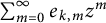 $\sum _{m=0}^\infty e_{k,m}z^m$ is an entire function that can be written in the form
 $\prod _{p} \bigl (1+{(p-1)(z-1)}/{p^{k+1}} \bigr )$; from this representation we show how to both numerically calculate the
 $e_{k,m}$ to high precision and provide an asymptotic upper bound for the
 $e_{k,m}$. We further show how to generalize these results to all additive functions of the form
 $\sum _{j=2}^\infty a_j \omega _j(n)$; when
 $a_j=j-1$ this recovers a classical result of Rényi on the distribution of
 $\Omega (n)-\omega (n)$.


