





1 Introduction
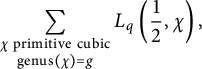
In this article, we study the first moment of primitive cubic Dirichlet
$L$
 -functions
$L_q(s,\chi )$
 over
$\mathbb {F}_q(T)$
 in the non-Kummer setting
$q \equiv 2\ {\mathrm{mod}}\ 3$
 . More precisely, we average
$L_q(s,\chi )$
 over primitive cubic characters
$\chi $
 of fixed genus
$g$
 . Our main result confirms the asymptotic formula established by David et al. [Reference David, Florea and Lalín6] with a streamlined argument based on a double Dirichlet series.
The first moment of cubic
$L$
 -functions has a substantial literature over number fields. Luo [Reference Luo9] analyzed the cubic twists over
$\mathbb {Q}(\xi _3)$
 . Güloğlu and Yesilyurt [Reference Güloğlu and Yesilyurt8] proved a mollified first-moment asymptotic over the Eisenstein field and David et al. [Reference David, Faveri, Dunn and Stucky5] obtained a power-saving error term for the mollified second moment. Over
$\mathbb {Q}$
 , Baier and Young [Reference Baier and Young1] established the asymptotic formula

with an explicit constant
$c$
 . This result was later refined by Gao and Zhao [Reference Gao and Zhao7], who employed double Dirichlet series to improve the error term to

The key input in (1.2) is that one can continue the underlying double Dirichlet series to a larger region while preserving its functional equations. This continuation yields finer control of the generating series and ultimately produces the exponent
$\frac {7}{8}$
 in the error term. They established the functional equation for cubic
$L$
 -function in terms of double Dirichlet series, whose coefficients are generalized Gauss sums. This method allows them to meromorphically continue the underlying double Dirichlet series to a larger region without altering it. This approach was first used by Soundararajan and Young [Reference Soundararajan and Young12], and later by Čech [Reference Čech4] to study the ratios conjecture for real Dirichlet characters.
In the function field setting, the mean value of cubic
$L$
 -functions was first explored by Rosen [Reference Rosen11], who averaged over all monic polynomials of a given degree. A significant advancement was made by David et al. [Reference David, Florea and Lalín6], who investigated the first moment of cubic
$L$
 -functions
$L_q(s,\chi )$
 over primitive cubic characters of fixed genus when
$q \equiv 2\ {\mathrm{mod}}\ 3$
 , establishing the asymptotic formula

Here,
$\zeta _q(s)=\frac {1}{1-q^{1-s}}$
 and
$\mathcal {A}_{nK}$
 is an explicit function. Motivated by the work of Gao and Zhao [Reference Gao and Zhao7], we adapt their approach using double Dirichlet series to compute the first moment of cubic
$L$
 -functions in the function field setting. Our main result is stated as follows.
Theorem 1.1 Let
$q$
 be an odd prime power such that
$q\equiv 2\ {\mathrm{mod}}\ 3$
 . Then

with
$P(u)$
 and
$Z(u,v)$
 given in Section 3.3.
This result confirms, and in fact refines, the asymptotic formula of David et al. [Reference David, Florea and Lalín6], while substantially reducing the computational complexity. In particular, our method resolves the question left open in [Reference David, Florea and Lalín6] concerning the putative contribution from the poles at
$u^3=1$
 . We show that these poles lie outside the region of absolute convergence, and therefore the associated residue does not contribute to the asymptotic.
In [Reference David, Florea and Lalín6], a secondary term of size
$q^{5g/6}$
 was conjectured to arise from the residue of the generating function at
$u^3=1$
 , and considerable effort was devoted to its estimation. However, the dominant error originates from integration along the contour
${|u|=q^{-(7/8+\varepsilon )}}$
 , which already contributes an error term of order
$q^{(\frac {7}{8}+\varepsilon )g}$
 ; consequently, any such secondary term is necessarily absorbed by the error. Our approach predicts this in advance by exhibiting explicitly the convex hull of the convergence domain. Of course, if one could develop new techniques to enlarge the domain of convergence, this residue would reappear in the main term; in this sense, the work of [Reference David, Florea and Lalín6] remains highly significant.
Methodologically, we rely solely on the functional equation, without invoking auxiliary approximation functions. While it is often assumed that the functional equation alone is insufficient, we prove that thanks to the equivalence of Fourier transform, functional equation, and approximational function equation in the function field setting, the functional equation by itself suffices. We reformulate the relevant sums in a way that reveals the region of convergence, apply Perron’s formula directly to this expression, and bound the error by contour integration. This streamlined argument not only clarifies the absence of the
$u^3=1$
 contribution but also yields the main term with significantly less computational effort.
2 Preliminary
In this section, we recall the basic properties of cubic characters, Gauss sums, and the functional equation for the corresponding
$L$
 -functions. These facts are standard and their proofs are readily available in the literature; we therefore record only the statements that will be used later.
Throughout, we work in the non-Kummer setting:
$q$
 is an odd prime power satisfying
$q\equiv 2\ {\mathrm{mod}}\ 3$
 . For simplicity, we do not discuss the Kummer case
${q\equiv 1\ {\mathrm{mod}}\ 3}$
 , where analogous methods yield a similar first-moment asymptotic for cubic
$L$
 -functions.
2.1 Primitive cubic characters and
$L$
 -functions

In the non-Kummer setting, primitive cubic characters over
$\mathbb {F}_q[T]$
 are most conveniently constructed by restricting cubic characters over
$\mathbb {F}_{q^2}[T]$
 (see [Reference Bary-Soroker and Meisner2]).
Assume
$q\equiv 2\ {\mathrm{mod}}\ 3$
 and fix an isomorphism
$\Omega $
 between the cubic roots of unity in
$\mathbb {C}^\ast $
 and those in
$\mathbb {F}_{q^2}^\ast $
 . Let
$\pi \in \mathbb {F}_{q^2}[T]$
 be monic irreducible such that
$\pi \pi ^\sigma =P$
 is irreducible in
$\mathbb {F}_q[T]$
 , where
$\sigma $
 denotes the nontrivial element of
$\mathrm {Gal}(\mathbb {F}_{q^2}/\mathbb {F}_q)$
 . For
$a\in \mathbb {F}_{q^2}[T]$
 , define the cubic residue symbol
$\chi _\pi (a)$
 by

where
$\alpha $
 is the unique cubic root of unity in
$\mathbb {C}$
 such that

Then
$\chi _\pi |_{\mathbb {F}_q[T]}$
 is a cubic character modulo
$P$
 .
We extend this definition by multiplicativity. For a monic polynomial
$F=\pi _1^{e_1}\dots \pi _s^{e_s}\in \mathbb {F}_{q^2}[T]$
 with distinct
$\pi _i$
 , set
$\chi _F=\chi _{\pi _1}^{e_1}\dots \chi _{\pi _s}^{e_s}$
 . Restricting
$\chi _F$
 to
$\mathbb {F}_q[T]$
 yields a cubic character on
$\mathbb {F}_q[T]$
 . Moreover,
$\chi _F$
 is primitive if and only if
$e_i=1$
 for all
$i$
 and
$F$
 has no prime divisor in
$\mathbb {F}_q[T]$
 ; in this case, the conductor is
$FF^\sigma $
 .
Let
${\mathcal {A}_{q}}$
 (resp.
${\mathcal {A}_{q^2}}$
 ) denote the set of monic polynomials over
$\mathbb {F}_q$
 (resp.
$\mathbb {F}_{q^2}$
 ), and let
$\mathcal {H}_q$
 (resp.
${\mathcal {H}_{q^2}}$
 ) denote the set of monic square-free polynomials in
${\mathcal {A}_{q}}$
 (resp.
${\mathcal {A}_{q^2}}$
 ). Recall that
${\mathcal {H}_{q^2, g/2+1}}$
 denotes the set of monic square-free polynomials in
${\mathcal {A}_{q^2}}$
 of degree
$g/2+1$
 . We write
$|a|=q^{\deg a}$
 for
$a\in {\mathcal {A}_{q}}$
 and
$|a|_2=q^{2\deg a}$
 for
$a\in {\mathcal {A}_{q^2}}$
 . With this notation, David et al. [Reference David, Florea and Lalín6] show the following lemma.
Lemma 2.1 (Lemma 2.11 in [Reference David, Florea and Lalín6])
Suppose
$q\equiv 2\ {\mathrm{mod}}\ 3$
 . Then

Since

for
$\alpha \in \mathbb {F}_q\subset \mathbb {F}_{q^2}$
 , and
$q$
 is odd with
$q\equiv 2\ {\mathrm{mod}}\ 3$
 , every cubic character over
$\mathbb {F}_q[T]$
 is even, that is,
$\chi |_{\mathbb {F}_q^\ast }=1$
 . Consequently, we have the following functional equation.
Lemma 2.2 (Functional equation for even
$L$
-functions)

Let
$F\in {\mathcal {H}_{q^2}}$
 and suppose that
$F$
 has no prime divisor in
${\mathcal {A}_{q}}$
 . Then

where
$\epsilon (\chi _F)=q^{-\deg F}G(\chi _F)$
 and
$G(\chi _F)$
 is the Gauss sum defined in Definition 2.1.
This is Lemma 2.3 in [Reference David, Florea and Lalín6].
Next, we record bounds for cubic
$L$
 -functions; this restates Lemmas 2.6 and 2.7 of [Reference David, Florea and Lalín6].
Lemma 2.3 (Lindelöf Hypothesis)
Let
$\chi $
 be a primitive cubic character of conductor
$h\not =1$
 defined over
$\mathbb {F}_q[T]$
 . Then, for
$\Re (s)\ge \frac {1}{2}$
 and all
$\varepsilon>0$
 ,

and for
$\Re (s)\ge 1$
 and all
$\varepsilon>0$
 ,

2.2 Gauss sums
We recall standard properties of polynomial Gauss sums (see, for instance, [Reference Zheng13]).
Definition 2.1 For
$\chi $
 a primitive character of modulus
$h$
 on
$\mathbb {F}_q[T]$
 , define

Here,

where
$a_1$
 is the coefficient of
$1/T$
 in the Laurent expansion of
$\frac {a}{h}$
 in
$\mathbb {F}_q((1/T))$
 .
We also define generalized Gauss sums as follows.
Definition 2.2 Let
$\chi _f$
 be a cubic character of
$\mathbb {F}_q[T]$
 defined as above for some
${f\in \mathbb {F}_q[T]}$
 . We define

Lemma 2.4 Suppose that
$q\equiv 1\ {\mathrm{mod}}\ 3$
 and let
$f_1,f_2\in {\mathcal {A}_{q}}$
 .
-
(1) If $(f_1,f_2)=1$
, then $$ \begin{align*} G_q(V,f_1f_2) &=\chi_{f_1}(f_2)^2G_q(V,f_1)G_q(V,f_2)\\ &=G_q(Vf_2,f_1)G_q(V,f_2). \end{align*} $$
-
(2) If $V=V_1P^{\alpha }$
with
$P\nmid V_1$
, then (2.5) $$ \begin{align} G_q(V,P^i)=\left\{ \begin{array}{@{}ll} 0, & \text{if } i\le\alpha \text{ and } i\not\equiv 0\quad {\mathrm{mod}}\ 3;\\ \phi(P^i), & \text{if } i\le\alpha \text{ and } i\equiv 0 \quad{\mathrm{mod}}\ 3;\\ -|P|^{i-1}, & \text{if } i=\alpha+1 \text{ and } i\equiv 0\quad {\mathrm{mod}}\ 3;\\ \epsilon(\chi_{P^i})\chi_{P^i}(V_1^{-1})|P|^{i-\frac{1}{2}}, & \text{if } i=\alpha+1 \text{ and } i\not\equiv 0\quad {\mathrm{mod}}\ 3;\\ 0, & \text{if } i\ge\alpha+2, \end{array}\right. \end{align} $$where $\phi $
is the Euler function for polynomials. We recall that
$\epsilon (\chi )=1$
when
$\chi $
is even. For
$\chi _{P^i}$
, this holds when
$3\mid \deg P^i$
.


This is Lemma 2.12 of [Reference David, Florea and Lalín6]. For the primitive character
$\chi _F$
 defined above, we have the following lemma.
Lemma 2.5 For
$F\in \mathbb {F}_{q^2}[T]$
 , we have

Moreover, if
$F$
 is square-free, then

2.3 Distribution of Gauss sums
The generating series for Gauss sums is defined by

and

We now discuss the distribution of Gauss sums. Patterson established the distribution of cubic Gauss sums for
$S$
 -integers (see [Reference Patterson10]); with minor adjustments, we obtain the following estimate.
Lemma 2.6 (Lemma 3.11 in [Reference David, Florea and Lalín6])
If
$q^{-\frac {1}{2}}\ge |u|\ge q^{-\frac {3}{2}}$
 and both
$|u^3-q^{-4}|>\delta $
 and
${|u^3-q^{-2}|>\delta }$
 , then

2.4 Multivariable complex analysis lemmas
Our approach uses two standard results from multivariable complex analysis. We begin with the notion of a tube domain.
Definition 2.3 An open set
$T\subset \mathbb {C}^n$
 is a tube if there exists an open set
$U\subset \mathbb {R}^n$
 such that

For any set
$U\subset \mathbb {C}^n$
 , we define
$T(U)=U+i\mathbb {R}^n\subset \mathbb {C}^n$
 . We quote Bochner’s Tube Theorem [Reference Bochner3].
Theorem 2.1 Let
$U\subset \mathbb {R}^n$
 be a connected open set and let
$f(z)$
 be holomorphic on
$T(U)$
 . Then
$f(z)$
 admits a holomorphic continuation to the convex hull of
$T(U)$
 .
We denote the convex hull of an open set
$T\subset \mathbb {C}^n$
 by
$\widehat T$
 . Our next result is [Reference Čech4, Proposition C.5] on the preservation of modulus inequalities under holomorphic continuation.
Theorem 2.2 Assume that
$T\subset \mathbb {C}^n$
 is a tube domain and that
$g,h:T\rightarrow \mathbb {C}$
 are holomorphic. Let
$\tilde g,\tilde h$
 be their holomorphic continuations to
$\widehat T$
 . If
$|g(z)|\leq |h(z)|$
 for all
$z\in T$
 and
$h(z)$
 is nonzero on
$T$
 , then
$|\tilde g(z)|\leq |\tilde h(z)|$
 for all
$z\in \widehat T$
 .
3 Analytical behavior of
$A_3(u,v)$

3.1 The generating function
Now, we construct a double Dirichlet series to rewrite the sum in equation (2.1). From now on, we will always use
$P$
 ,
$P_1$
 , or
$P_2$
 to denote irreducible polynomial in corresponding polynomial ring. For
$\Re (s)$
 and
$\Re (w)$
 sufficiently large, we define

Upon taking
$u=q^{-2s}$
 , we rewrite the sum as

by applying Perron’s formula for function fields

Here,
$A_3(u, w)=A_3(s, w)$
 . Hereafter, we will use
$A_3(s,w)$
 and
$A_3(u,w)$
 interchangeably when there is no ambiguity.
Next, we consider the different expressions of
$A_3(s,w)$
 on different convergence regions and find out the convex hull of convergence regions.
3.2 The first convergence region
To analyze the behavior of
$A_3(u,v)$
 , we begin by using Möbius inversion

This allows us to remove the divisor condition. Applying this,
$A_3(s,w)$
 can be rewritten as

The last equality uses a trick

Here,
$\chi ^{(N)}(F)=\chi _F(N)$
 is the Hecke character induced by
$\chi _F$
 .
$L_{q^2}(s,\chi ^{(N)})$
 denotes the
$L$
 -function over
$\mathbb {F}_{q^2}(T)$
 . Meanwhile, we recall that
$|F|=q^{\deg F}$
 and
$|F|_2=q^{2\deg F}$
 .
Using the lemma below, we simplify
$A_3(s,w)$
 further.
Lemma 3.1 If
$D, F\in {\mathcal {A}_{q}}$
 and
$(D, F)=1$
 , then we have
$\chi _D(F)=1$
 .
Proof Let
$\sigma : \mathbb {F}_{q^2}\to \mathbb {F}_{q^2}$
 be the nontrivial Frobenius automorphism. It’s sufficient to treat the case
$D=P\in {\mathcal {A}_{q}}$
 is irreducible. Assume first that
$P$
 does not split in extension
$\mathbb {F}_{q^2}(T)/\mathbb {F}_{q}(T)$
 . By definition, we have

which is equivalent to say
$F^{\frac {q^{2\deg P}-1}{3}}=f(T)P+\Omega (\alpha ).$
 Applying
$\sigma $
 and using
${\sigma (F)=F}$
 , we have
$F^{\frac {q^{2\deg P}-1}{3}}=f^{\sigma }(T)P+\sigma (\Omega (\alpha ))\equiv \sigma (\Omega (\alpha ))\ {\mathrm{mod}}\ P$
 . Since two constants congruent modulo
$P$
 must coincide,
$\sigma (\Omega (\alpha ))= \Omega (\alpha )$
 , hence
$\Omega (\alpha )=1$
 . If instead
${P=\pi \pi ^{\sigma }}$
 splits, then
$\chi _{P}(F)=\chi _{\pi }\overline {\chi _{\pi }}(F)=1$
 . For the general case,
$D=P_1^{e_1}\dots P_k^{e_k}$
 follows by multiplicativity, since
$\chi _D=\chi _{P_1}^{e_1}\dots \chi _{P_k}^{e_k}$
 .
Using the lemma, we obtain

where

For
$\Re (s)>\frac {1}{2}$
 , it follows that

As
$(1-\frac {1}{|P_1|_2^s})^{-1}=1+\frac {1}{|P_1|_2^s-1}\ll |P_1|_2^{\max \{0,-\Re (s)\}}$
 , we will obtain

Taking
$u=q^{-2s}$
 and
$v=q^{-w}$
 , we have

where

and

It is easy to see that
$P(u, \chi ^{(N)})$
 is analytic for
$|u|<q^{-1}$
 .
The function
$L_{q^2}(u,\chi ^{(N)})$
 is a polynomial in
$u$
 and convergent for
$|u|<q^{-1}$
 in general. If
$N$
 is a cube, then
$L_{q^2}(u,\chi ^{(N)})$
 has a simple pole at
$u=q^{-2}$
 and
$L_{q^2}(u^2,\chi ^{(N)})^{-1}$
 is a polynomial in
$u$
 . If
$N$
 is not a cube, then
$L_{q^2}(u,\chi ^{(N)})$
 is analytic and
$L_{q^2}(u^2,\chi ^{(N)})$
 has zeros on the circle
$|u|=q^{-1/2}$
 . Hence,
$(u-q^{-2})\frac {L_{q^2}(u,\chi ^{(N)})}{L_{q^2}(u^2,\chi ^{(N)})}$
 is analytic for
$|u|<q^{-\frac {1}{2}}$
 .
When
$N$
 is not a cube,
$\frac {L_{q^2}(u, \chi ^{(N)})}{L_{q^2}(u^2, \bar {\chi }^{(N)})}$
 is a rational function in
$u$
 with possible simple poles on the line
$|u|=q^{-\frac {1}{2}}$
 . The Lindelöf Hypothesis gives, for
$|u|<q^{-1}$
 and arbitrary
$\varepsilon>0$
 ,

There is a possible simple pole at
$u=q^{-2}$
 when
$N$
 is a cube in
$A_3(u,v)$
 . In fact, combining (3.7)–(3.10), for
$|u|<q^{-1}$
 and any
$\varepsilon>0$
 , we have the bound

Meanwhile,
$(u-q^{-2})A_3(u,v)$
 is holomorphic in the convergence region of the right-hand side of the above inequality:

Remark 3.1 In
$(s,w)$
 -coordinates, the region
$S_1$
 becomes

We will always describe all convergence regions in the
$(s,w)$
 -coordinate, since Bochner’s Tube Theorem is stated for tube domains.
3.3 Residue at
$u=q^{-2}$

We now analyze the possible poles at
$u=q^{-2}$
 . Let
$\zeta _{q^2}(u)=\frac {1}{1-q^2u}$
 be the zeta function for the field
$\mathbb {F}_{q^2}(T)$
 . The possible pole comes from the term
$N$
 being a cube. We have

where

and

Taking
$v=q^{-\frac {1}{2}}$
 , we have

3.4 The second region
The Lindelöf Hypothesis gives, for
$|v|\le q^{-\frac {1}{2}}$
 and any
$\varepsilon>0$
 ,

and hence

For the term
$F=1$
 , we note that

for all
$v$
 , where
$\zeta _q(v)=\frac {1}{1-qv}$
 is the zeta function of
$\mathbb {F}_q(T)$
 . Therefore,
$(v-q^{-1}) A_3(u,v)$
 is holomorphic in the convergence region

Similarly, when
$|v|\ge q^{-\frac {1}{2}}$
 , the Lindelöf Hypothesis with the functional equation yields, for any
$\varepsilon>0$
 ,

Consequently,

in the convergence region

Combining the two cases, we obtain

Remark 3.2 In
$(s,w)$
 -coordinates, this region becomes

4 The dual term
4.1 The third convergence region
We now derive the third convergence region. The functional equation (Lemma 2.2) gives

Replacing
$q$
 by
$q^2$
 , Lemma 2.4 shows
$G_{q^2}(ND,F)=0$
 whenever
$F$
 is not square-free. Hence, we may rewrite
$A_3(s,w)$
 as

where

and

Taking
$u=q^{-2s}$
 and
$v=q^{-w}$
 ,
$A_3(u,v)$
 becomes

where

and

As before, we do not distinguish
$C_3(s,w)$
 from
$C_3(u,v)$
 nor
$H(Q,s)$
 from
$H(Q,u)$
 when no confusion can arise.
Replacing
$q$
 by
$q^2$
 in Lemma 2.6, we obtain
$H(ND,uv^2)\ll |u^{\frac {1}{2}}vq^{\frac {3}{2}+\varepsilon }|^{\deg ND}$
 for
$q^{-\frac {3}{2}}\le |u^{\frac {1}{2}}v|\le q^{-\frac {1}{2}}$
 . Moreover,

It follows that
$A_3(u,v)$
 is holomorphic in region

Remark 4.1 In
$(s,w)$
 -coordinates,
$S_3$
 becomes

We now combine the three domains obtained above. Recall that
$S_1$
 and
$S_2$
 were first obtained in
$(u,v)$
 -coordinates and then translated into
$(s,w)$
 -coordinates (see Remarks 3.1 and 3.2), while
$S_3$
 is already stated in
$(s,w)$
 -coordinates. Since Bochner’s Tube Theorem applies to tube domains in
$\mathbb {C}^2$
 , we work in the
$(s,w)$
 -system and compute the convex hull of
$S_1\cup S_2\cup S_3$
 . The convex hull in
$(s,w)$
 -coordinates can be determined by elementary geometric computation, and we obtain

By Bochner’s Tube Theorem,
$(u-q^{-2})(v-q^{-1})A_3(u,v)$
 admits a holomorphic continuation to the corresponding region in
$(u,v)$
 -coordinates, namely,

Remark 4.2 The potential poles at
$(uv^2)=q^{-8}$
 do not lie in
$S_4$
 .
4.2 Complete the proof
We now complete the proof by evaluating the integral (3.2). Fix
$v=q^{-\frac {1}{2}}$
 . We shift the contour from
$|u|=r$
 to
$|u|=q^{-(\frac {7}{4}+\varepsilon )}$
 . The only pole crossed is the simple pole at
$u=q^{-2}$
 . Therefore,

The residue at
$u=q^{-2}$
 produces the main term in (1.4). For the shifted contour integral, since
$A_3(u,v)$
 is holomorphic on the contour
$|u|=q^{-(\frac {7}{4}+\varepsilon )}$
 , we bound it by

which yields the claimed error term in (1.4).
Acknowledgements
The authors would like to express their sincere gratitude to Prof. Peng Gao for proposing the subject of this study and for providing invaluable guidance and insightful recommendations throughout the research process.



