Refine search
Actions for selected content:
42 results
WIEFERICH PRIMES AND MONOGENIC TRINOMIALS
- Part of
-
- Journal:
- Bulletin of the Australian Mathematical Society , First View
- Published online by Cambridge University Press:
- 21 September 2026, pp. 1-7
-
- Article
-
- You have access
- HTML
- Export citation
-
A prime $p$
 is called a Wieferich prime if $2^{p-1}\equiv 1 \pmod {p^2}$
 . A monic polynomial $f(x)\in {\mathbb Z}\, [x]$
 of degree $N\ge 2$
 is called monogenic if $f(x)$
 is irreducible over ${\mathbb Q}$
 and $\{1,\theta ,\theta ^2,\ldots ,\theta ^{N-1}\}$
 is a basis for the ring of integers of ${\mathbb Q}(\theta )$
 , where $f(\theta )=0$
 . We show that ${\mathcal F}_p(x):=x^{2p}+2x^{p}+2$
 is monogenic if and only if $p$
 is not a Wieferich prime.


A NOTE ON ABELIAN MONOGENIC TRINOMIALS
- Part of
-
- Journal:
- Bulletin of the Australian Mathematical Society , First View
- Published online by Cambridge University Press:
- 23 July 2026, pp. 1-5
-
- Article
-
- You have access
- HTML
- Export citation
-
An abelian monogenic polynomial $f(x)\in {\mathbb Z}[x]$
 is a monic polynomial of degree $N\ge 2$
 that is irreducible over ${\mathbb Q}$
 , such that the Galois group of $f(x)$
 over ${\mathbb Q}$
 is abelian, and $\{1,\theta ,\theta ^2,\ldots ,\theta ^{N-1}\}$
 is a basis for the ring of integers of ${\mathbb Q}(\theta )$
 , where $f(\theta )=0$
 . We determine all abelian monogenic trinomials of the form $x^{2n}+ax^{n}+b$
 , where $n,a,b\in {\mathbb Z}$
 with $n\ge 1$
 and $ab\ne 0$
 .


ON THE MONOGENICITY AND GALOIS GROUPS OF $\boldsymbol {x^{2p}+ax^p+b^p}$

- Part of
-
- Journal:
- Bulletin of the Australian Mathematical Society , First View
- Published online by Cambridge University Press:
- 07 July 2026, pp. 1-7
-
- Article
-
- You have access
- HTML
- Export citation
-
Let $f(x)=x^{2p}+ax^p+b^p$
 , where p is a prime and $a,b\in {\mathbb Z}$
 with $ab\ne 0$
 . If $f(x)$
 is irreducible over ${\mathbb Q}$
 , we say that $f(x)$
 is monogenic if $\{1,\theta ,\theta ^2,\ldots ,\theta ^{2p-1}\}$
 is a basis for the ring of integers of ${\mathbb Q}(\theta )$
 , where $f(\theta )=0$
 . We give a characterisation of the monogenic trinomials $f(x)$
 according to their Galois groups. These results extend prior investigations of the authors.


Small differences between cubic and rational numbers
- Part of
-
- Journal:
- Glasgow Mathematical Journal , First View
- Published online by Cambridge University Press:
- 17 June 2026, pp. 1-8
-
- Article
-
- You have access
- Open access
- HTML
- Export citation
-
In this paper, we show that for each sufficiently large integer
 $H$, there is a real cubic number
 $\alpha$ and a rational number
 $r$, both of height smaller than
 $H$, such that
 $0\lt \alpha -r\lt 272/H^4$. The exponent
 $4$ of
 $H$ in this inequality is best possible. The numbers
 $\alpha$ and
 $r$ are both constructed explicitly. We also show that a necessary and sufficient condition on
 $(u,v)$ under which there is a positive constant
 $c_1=c_1(d,u,v)$ such that the inequality
 $|\alpha -\beta | \geq c_1 H(\alpha )^{-u} H(\beta )^{-v}$ holds for all real algebraic numbers
 $\alpha$ of degree
 $d \geq 2$ and all real algebraic numbers
 $\beta$ of degree
 $d-1$ is
 $u \geq d-1$ and
 $v \geq d$.


ON THE DISCRIMINANT AND INDEX OF A CERTAIN CLASS OF POLYNOMIALS
- Part of
-
- Journal:
- Bulletin of the Australian Mathematical Society / Volume 114 / Issue 3 / December 2026
- Published online by Cambridge University Press:
- 07 May 2026, pp. 475-482
- Print publication:
- December 2026
-
- Article
-
- You have access
- HTML
- Export citation
-
Let $f(x) = (x^{2}+1)^{n} - ax^{n} \in \mathbb {Z}[x]$
 and assume $f(x)$
 is irreducible. Let $\theta $
 be a root of $f(x)$
 , set $K= \mathbb {Q}(\theta )$
 and denote by $\mathbb {Z}_{K}$
 the ring of integers of K. The index of f, denoted $\operatorname {ind}(f)$
 , is the index of $\mathbb {Z}[\theta ]$
 in $\mathbb {Z}_{K}$
 . A polynomial $f(x)$
 is said to be monogenic if $\operatorname {ind}(f) = 1$
 . We compute the discriminant of the polynomial $f(x)$
 , and then derive necessary and sufficient conditions on the parameters a and n for $f(x)$
 to be monogenic. Furthermore, we provide a complete description of the primes that divide $\operatorname {ind}(f)$
 .


NOTES ON GENERALISED INTEGRAL POLYNOMIAL PELL EQUATIONS
- Part of
-
- Journal:
- Bulletin of the Australian Mathematical Society / Volume 114 / Issue 1 / August 2026
- Published online by Cambridge University Press:
- 09 December 2025, pp. 46-58
- Print publication:
- August 2026
-
- Article
-
- You have access
- HTML
- Export citation
-
Given a nonzero integer n, Gupta and Saha [‘Integer solutions of the generalised polynomial Pell equations and their finiteness: the quadratic case’, Canad. Math. Bull., to appear] classified all polynomials $x^2+ax+b\in {\mathbb {Z}}[x]$
 for which the polynomial Pell equation $P^2-(x^2+ax+b)Q^2=n$
 has solutions ${P,Q\in {\mathbb {Z}}[x]}$
 with $Q\neq 0$
 . We generalise their work to the equation $P^2-(f^2+af+b)Q^2=nR$
 , where f is a fixed polynomial in ${\mathbb {Z}}[x]$
 . As an application of our results, we study the equation $P^2-D(f)Q^2=n$
 , where D is a monic, quartic and non square-free polynomial in ${\mathbb {Z}}[x]$
 . This extends Theorem 1.4 of Scherr and Thompson [‘Quartic integral polynomial Pell equations’, J. Number Theory 259 (2024), 38–56].


Improvements on dimension growth results and effective Hilbert’s irreducibility theorem
- Part of
-
- Journal:
- Forum of Mathematics, Sigma / Volume 13 / 2025
- Published online by Cambridge University Press:
- 19 September 2025, e153
-
- Article
-
- You have access
- Open access
- HTML
- Export citation
-
We sharpen and generalize the dimension growth bounds for the number of points of bounded height lying on an irreducible algebraic variety of degree d, over any global field. In particular, we focus on the affine hypersurface situation by relaxing the condition on the top degree homogeneous part of the polynomial describing the affine hypersurface, while sharpening the dependence on the degree in the bounds compared to previous results. We formulate a conjecture about plane curves which provides a conjectural approach to the uniform degree
 $3$ case (the only remaining open case). For induction on dimension, we develop a higher-dimensional effective version of Hilbert’s irreducibility theorem, which is of independent interest.

Integer solutions of the generalized polynomial Pell equations and their finiteness: The quadratic case
- Part of
-
- Journal:
- Canadian Mathematical Bulletin / Volume 69 / Issue 1 / March 2026
- Published online by Cambridge University Press:
- 27 August 2025, pp. 261-272
- Print publication:
- March 2026
-
- Article
-
- You have access
- HTML
- Export citation
-
Determining the polynomials
 $D \in {\mathbb Z}[x]$ such that the polynomial Pell equation
 ${P^2-DQ^2=1}$ has nontrivial solutions
 $P,Q$ in
 ${\mathbb Q}[x]$ (and in
 ${\mathbb Z}[x]$) is an open question. In this article, we consider the generalized polynomial Pell equation
 $P^2-DQ^2=n$, where
 $D \in {\mathbb Z}[x]$ is a monic quadratic polynomial and n is a nonzero integer. For
 $n=1$, such an equation always has nontrivial solutions in
 ${\mathbb Q}[x]$, but for a non-square integer n, the generalized polynomial Pell equation
 $P^2-DQ^2=n$ may not always have a solution in
 ${\mathbb Q}[x]$. Depending on n, we determine the polynomials
 $D=x^2+cx+d$, for which the equation
 $P^2-DQ^2=n$ has nontrivial solutions in
 ${\mathbb Q}[x]$ and in
 ${\mathbb Z}[x]$. Taking
 $n=-1$, this allows us to solve the negative polynomial Pell equation completely for any such D. An interesting feature is that there are certain polynomials D for which the generalized polynomial Pell equation has nontrivial solutions in
 ${\mathbb Z}[x]$, but only finitely many, whereas the solutions in
 ${\mathbb Q}[x]$ are infinitely many. Finally, we determine the monic quadratic polynomials D for which the solutions of
 $P^2-DQ^2=n$ in
 ${\mathbb Z}[x]$ exhibit this finiteness phenomenon.


Squarefree values of polynomial discriminants II
- Part of
-
- Journal:
- Forum of Mathematics, Pi / Volume 13 / 2025
- Published online by Cambridge University Press:
- 13 May 2025, e17
-
- Article
-
- You have access
- Open access
- HTML
- Export citation
-
We determine the density of integral binary forms of given degree that have squarefree discriminant, proving for the first time that the lower density is positive. Furthermore, we determine the density of integral binary forms that cut out maximal orders in number fields. The latter proves, in particular, an ‘arithmetic Bertini theorem’ conjectured by Poonen for
 ${\mathbb {P}}^1_{\mathbb {Z}}$.
Our methods also allow us to prove that there are
 $\gg X^{1/2+1/(n-1)}$ number fields of degree n having associated Galois group
 $S_n$ and absolute discriminant less than X, improving the best previously known lower bound of
 $\gg X^{1/2+1/n}$.
Finally, our methods correct an error in and thus resurrect earlier (retracted) results of Nakagawa on lower bounds for the number of totally unramified
 $A_n$-extensions of quadratic number fields of bounded discriminant.


Irreducible factors of a polynomial
- Part of
-
- Journal:
- Proceedings of the Edinburgh Mathematical Society / Volume 68 / Issue 2 / May 2025
- Published online by Cambridge University Press:
- 24 January 2025, pp. 573-582
-
- Article
-
- You have access
- HTML
- Export citation
-
Let (K, v) be a valued field and
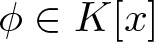 $\phi\in K[x]$ be any key polynomial for a residue-transcendental extension w of v to K(x). In this article, using the ϕ-Newton polygon of a polynomial
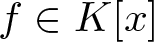 $f\in K[x]$ (with respect to w), we give a lower bound for the degree of an irreducible factor of f. This generalizes the result given in Jakhar and Srinivas (On the irreducible factors of a polynomial II, J. Algebra 556 (2020), 649–655).
ON A CONJECTURE OF LENNY JONES ABOUT CERTAIN MONOGENIC POLYNOMIALS
- Part of
-
- Journal:
- Bulletin of the Australian Mathematical Society / Volume 110 / Issue 1 / August 2024
- Published online by Cambridge University Press:
- 21 November 2023, pp. 72-76
- Print publication:
- August 2024
-
- Article
-
- You have access
- HTML
- Export citation
-
Let
 $K={\mathbb {Q}}(\theta )$ be an algebraic number field with
 $\theta $ satisfying a monic irreducible polynomial
 $f(x)$ of degree n over
 ${\mathbb {Q}}.$ The polynomial
 $f(x)$ is said to be monogenic if
 $\{1,\theta ,\ldots ,\theta ^{n-1}\}$ is an integral basis of K. Deciding whether or not a monic irreducible polynomial is monogenic is an important problem in algebraic number theory. In an attempt to answer this problem for a certain family of polynomials, Jones [‘A brief note on some infinite families of monogenic polynomials’, Bull. Aust. Math. Soc. 100 (2019), 239–244] conjectured that if
 $n\ge 3$,
 $1\le m\le n-1$,
 $\gcd (n,mB)=1$ and A is a prime number, then the polynomial
 $x^n+A (Bx+1)^m\in {\mathbb {Z}}[x]$ is monogenic if and only if
 $n^n+(-1)^{n+m}B^n(n-m)^{n-m}m^mA$ is square-free. We prove that this conjecture is true.


ON DISCRIMINANTS OF MINIMAL POLYNOMIALS OF THE RAMANUJAN
 $t_n$ CLASS INVARIANTS
- Part of
-
- Journal:
- Bulletin of the Australian Mathematical Society / Volume 108 / Issue 2 / October 2023
- Published online by Cambridge University Press:
- 11 April 2023, pp. 264-275
- Print publication:
- October 2023
-
- Article
-
- You have access
- HTML
- Export citation
-
We study the discriminants of the minimal polynomials
 $\mathcal {P}_n$ of the Ramanujan
 $t_n$ class invariants, which are defined for positive
 $n\equiv 11\pmod {24}$. We show that
 $\Delta (\mathcal {P}_n)$ divides
 $\Delta (H_n)$, where
 $H_n$ is the ring class polynomial, with quotient a perfect square and determine the sign of
 $\Delta (\mathcal {P}_n)$ based on the ideal class group structure of the order of discriminant
 $-n$. We also show that the discriminant of the number field generated by
 $j({(-1+\sqrt {-n})}/{2})$, where j is the j-invariant, divides
 $\Delta (\mathcal {P}_n)$. Moreover, using Ye’s computation of
 $\log|\Delta(H_n)|$ [‘Revisiting the Gross–Zagier discriminant formula’, Math. Nachr. 293 (2020), 1801–1826], we show that 3 never divides
 $\Delta(H_n)$, and thus
 $\Delta(\mathcal{P}_n)$, for all squarefree
 $n\equiv11\pmod{24}$.


An improvement on Schmidt’s bound on the number of number fields of bounded discriminant and small degree
- Part of
-
- Journal:
- Forum of Mathematics, Sigma / Volume 10 / 2022
- Published online by Cambridge University Press:
- 10 October 2022, e86
-
- Article
-
- You have access
- Open access
- HTML
- Export citation
-
We prove an improvement on Schmidt’s upper bound on the number of number fields of degree n and absolute discriminant less than X for
 $6\leq n\leq 94$. We carry this out by improving and applying a uniform bound on the number of monic integer polynomials, having bounded height and discriminant divisible by a large square, that we proved in a previous work [7].

SOLVABILITY OF A SYSTEM OF POLYNOMIAL EQUATIONS MODULO PRIMES
- Part of
-
- Journal:
- Bulletin of the Australian Mathematical Society / Volume 106 / Issue 3 / December 2022
- Published online by Cambridge University Press:
- 23 March 2022, pp. 404-407
- Print publication:
- December 2022
-
- Article
-
- You have access
- Open access
- HTML
- Export citation
-
Let F be a system of polynomial equations in one or more variables with integer coefficients. We show that there exists a univariate polynomial
 $D \in \mathbb {Z}[x]$ such that F is solvable modulo p if and only if the equation
 $D(x) \equiv 0 \pmod {p}$ has a solution.

RECIPROCAL MONOGENIC QUINTINOMIALS OF DEGREE
 $\boldsymbol {2^n}$
- Part of
-
- Journal:
- Bulletin of the Australian Mathematical Society / Volume 106 / Issue 3 / December 2022
- Published online by Cambridge University Press:
- 04 March 2022, pp. 437-447
- Print publication:
- December 2022
-
- Article
-
- You have access
- HTML
- Export citation
-
We prove a new irreducibility result for polynomials over
 ${\mathbb Q}$ and we use it to construct new infinite families of reciprocal monogenic quintinomials in
 ${\mathbb Z}[x]$ of degree
 $2^n$.


DIOPHANTINE EQUATIONS FOR POLYNOMIALS WITH RESTRICTED COEFFICIENTS, I (POWER VALUES)
- Part of
-
- Journal:
- Bulletin of the Australian Mathematical Society / Volume 106 / Issue 2 / October 2022
- Published online by Cambridge University Press:
- 22 February 2022, pp. 254-263
- Print publication:
- October 2022
-
- Article
-
- You have access
- HTML
- Export citation
A Note on Lawton's Theorem
-
- Journal:
- Canadian Mathematical Bulletin / Volume 60 / Issue 3 / 01 September 2017
- Published online by Cambridge University Press:
- 20 November 2018, pp. 484-489
- Print publication:
- 01 September 2017
-
- Article
-
- You have access
- Export citation
A Generalization of the Eisenstein–Dumas–Schönemann Irreducibility Criterion
- Part of
-
- Journal:
- Proceedings of the Edinburgh Mathematical Society / Volume 60 / Issue 4 / November 2017
- Published online by Cambridge University Press:
- 31 January 2017, pp. 937-945
-
- Article
-
- You have access
- Export citation
TOPICS IN DIVISIBILITY: PAIRWISE COPRIMALITY, THE GCD OF SHIFTED SETS AND POLYNOMIAL IRREDUCIBILITY
- Part of
-
- Journal:
- Bulletin of the Australian Mathematical Society / Volume 94 / Issue 1 / August 2016
- Published online by Cambridge University Press:
- 02 January 2016, pp. 167-168
- Print publication:
- August 2016
-
- Article
-
- You have access
- Export citation
Explicit Form of Cassels’ p-adic Embedding Theorem for Number Fields
-
- Journal:
- Canadian Journal of Mathematics / Volume 67 / Issue 5 / 01 October 2015
- Published online by Cambridge University Press:
- 20 November 2018, pp. 1046-1064
- Print publication:
- 01 October 2015
-
- Article
-
- You have access
- Export citation
-
In this paper, we give a general explicit form of Cassels’
 $p$ -adic embedding theorem for number fields. We also give its refined form in the case of cyclotomic fields. As a byproduct, given an irreducible polynomial
 $f$ over
 $\mathbb{Z}$ , we give a general unconditional upper bound for the smallest prime number $p$ such that $f$ has a simple root modulo $p$ .


