Refine search
Actions for selected content:
5 results
Isoperimetric inequality for nearly spherical domains in the Bergman ball
 $\mathbb{B}_2$
- Part of
-
- Journal:
- Proceedings of the Royal Society of Edinburgh. Section A: Mathematics , First View
- Published online by Cambridge University Press:
- 04 June 2026, pp. 1-25
-
- Article
-
- You have access
- HTML
- Export citation
-
We prove a quantitative isoperimetric inequality for nearly spherical domains in the Bergman ball in
 $\mathbb{C}^2$. We prove a Fuglede-type theorem for such sets. This result is a counterpart of a similar result obtained for the hyperbolic unit ball, and it provides the first result on the isoperimetric phenomenon in the Bergman ball.


A classification of
 $\mathbb {Q}$-linear maps from
 $\overline {\mathbb {Q}}^\times /\overline {\mathbb {Q}}^\times _{\mathrm {tors}}$ to
 $\mathbb {R}$
- Part of
-
- Journal:
- Canadian Mathematical Bulletin / Volume 69 / Issue 2 / June 2026
- Published online by Cambridge University Press:
- 21 October 2025, pp. 609-627
- Print publication:
- June 2026
-
- Article
-
- You have access
- Open access
- HTML
- Export citation
-
A 2009 article of Allcock and Vaaler explored the
 $\mathbb {Q}$-vector space
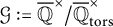 $\mathcal {G} := \overline {\mathbb {Q}}^\times /{\overline {\mathbb {Q}}^\times _{\mathrm {tors}}}$, showing how to represent it as part of a function space on the places of
 $\overline {\mathbb {Q}}$. We establish a representation theorem for the
 $\mathbb {R}$-vector space of
 $\mathbb {Q}$-linear maps from
 $\mathcal {G}$ to
 $\mathbb {R}$, enabling us to classify extensions to
 $\mathcal {G}$ of completely additive arithmetic functions. We further outline a strategy to construct
 $\mathbb {Q}$-linear maps from
 $\mathcal {G}$ to
 $\mathbb {Q}$, i.e., elements of the algebraic dual of
 $\mathcal {G}$. Our results make heavy use of Dirichlet’s S-unit Theorem as well as a measure-like object called a consistent map, first introduced by the author in previous work.


Isometric rigidity of the Wasserstein space over the plane with the maximum metric
- Part of
-
- Journal:
- Canadian Journal of Mathematics , First View
- Published online by Cambridge University Press:
- 09 June 2025, pp. 1-30
-
- Article
-
- You have access
- Open access
- HTML
- Export citation
-
We study p-Wasserstein spaces over the branching spaces
 $\mathbb {R}^2$ and
 $[-1,1]^2$ equipped with the maximum norm metric. We show that these spaces are isometrically rigid for all
 $p\geq 1,$ meaning that all isometries of these spaces are induced by isometries of the underlying space via the push-forward operation. This is in contrast to the case of the Euclidean metric since with that distance the
 $2$-Wasserstein space over
 $\mathbb {R}^2$ is not rigid. Also, we highlight that the
 $1$-Wasserstein space is not rigid over the closed interval
 $[-1,1]$, while according to our result, its two-dimensional analog, the closed unit ball
 $[-1,1]^2$ with the more complicated geodesic structure is rigid.


On traces of Bochner representable operators on the space of bounded measurable functions
- Part of
-
- Journal:
- Proceedings of the Edinburgh Mathematical Society / Volume 67 / Issue 1 / February 2024
- Published online by Cambridge University Press:
- 11 January 2024, pp. 224-235
-
- Article
-
- You have access
- HTML
- Export citation
-
Let Σ be a σ-algebra of subsets of a set Ω and
 $B(\Sigma)$ be the Banach space of all bounded Σ-measurable scalar functions on Ω. Let
 $\tau(B(\Sigma),ca(\Sigma))$ denote the natural Mackey topology on
 $B(\Sigma)$. It is shown that a linear operator T from
 $B(\Sigma)$ to a Banach space E is Bochner representable if and only if T is a nuclear operator between the locally convex space
 $(B(\Sigma),\tau(B(\Sigma),ca(\Sigma)))$ and the Banach space E. We derive a formula for the trace of a Bochner representable operator
 $T:B({\cal B} o)\rightarrow B({\cal B} o)$ generated by a function
 $f\in L^1({\cal B} o, C(\Omega))$, where Ω is a compact Hausdorff space.


An Extension Theorem Concerning Frechet Measures
-
- Journal:
- Canadian Mathematical Bulletin / Volume 38 / Issue 3 / 01 September 1995
- Published online by Cambridge University Press:
- 20 November 2018, pp. 278-285
- Print publication:
- 01 September 1995
-
- Article
-
- You have access
- Export citation