Refine search
Actions for selected content:
30 results
Recovering Hardy spaces from optimal domains of integration operators
- Part of
-
- Journal:
- Canadian Mathematical Bulletin , First View
- Published online by Cambridge University Press:
- 22 July 2026, pp. 1-16
-
- Article
-
- You have access
- Open access
- HTML
- Export citation
-
We study the optimal domains for bounded Volterra integration operators $T_g$
 between Hardy spaces $H^p$
 and $H^q$
 of the unit ball. It is shown that the optimal domain of a bounded $T_g:H^p\to H^q$
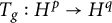 always strictly contains $H^p$
 . Moreover, the intersection of the optimal domains is equal to $H^p$
 if $p\geq q$
 , whereas if $p<q$
 , we show that this intersection is a genuinely larger tent space of holomorphic functions. In the unit disk, this problem was recently solved for $p=q$
 by Bellavita, Daskalogiannis, Nikolaidis, and Stylogiannis.


Meromorphic optimal domain of Volterra operators between Bergman–Morrey spaces
- Part of
-
- Journal:
- Canadian Mathematical Bulletin , First View
- Published online by Cambridge University Press:
- 16 February 2026, pp. 1-22
-
- Article
-
- You have access
- HTML
- Export citation
-
We study Volterra-type operators on Bergman–Morrey spaces. First, we obtain sharp boundedness criteria between scales, identifying the exact Bloch-type regularity required of the symbol and showing that the companion operator is bounded precisely for bounded symbols. Next, we develop the holomorphic optimal domain, prove that it is a Banach space with bounded point evaluations and multiplier algebra
 $H^\infty $, and establish strict inclusions as the parameters vary. Then, we introduce the meromorphic optimal domain, characterize the constant-symbol case, and show that it is a Banach space with point evaluations bounded off the zero set of the derivative. Finally, we analyze the symbol classes
 $W_g$ and
 $V_g^{p}$, prove the structural identity
 $W_g=T_g(H^\infty )+\mathbb C$, and give equivalence and comparison criteria for optimal domains across symbols.


Sobolev regularity of the Bergman projection on a class of singular Reinhardt domains
- Part of
-
- Journal:
- Canadian Mathematical Bulletin / Volume 69 / Issue 2 / June 2026
- Published online by Cambridge University Press:
- 22 September 2025, pp. 414-430
- Print publication:
- June 2026
-
- Article
-
- You have access
- HTML
- Export citation
-
In this article, we study the
 $L^p$ Sobolev regularity of the Bergman projection on monomial polyhedra, which are a wide class of bounded singular Reinhardt domains defined as sublevel sets of holomorphic monomials. This work generalizes the previous results of Sobolev regularity of the Bergman projection on various special singular Reinhardt domains.

Volterra operators between Hardy spaces of vector-valued Dirichlet series
- Part of
-
- Journal:
- Canadian Mathematical Bulletin / Volume 68 / Issue 1 / March 2025
- Published online by Cambridge University Press:
- 09 January 2025, pp. 286-300
- Print publication:
- March 2025
-
- Article
-
- You have access
- HTML
- Export citation
-
Let
 $2\leq p<\infty $ and X be a complex infinite-dimensional Banach space. It is proved that if X is p-uniformly PL-convex, then there is no nontrivial bounded Volterra operator from the weak Hardy space
 $\mathscr {H}^{\text {weak}}_p(X)$ to the Hardy space
 $\mathscr {H}^+_p(X)$ of vector-valued Dirichlet series. To obtain this, a Littlewood–Paley inequality for Dirichlet series is established.


A class of Hausdorff–Berezin operators on the unit ball
- Part of
-
- Journal:
- Canadian Mathematical Bulletin / Volume 67 / Issue 4 / December 2024
- Published online by Cambridge University Press:
- 23 October 2024, pp. 1069-1080
- Print publication:
- December 2024
-
- Article
-
- You have access
- HTML
- Export citation
Hausdorff operators on some classical spaces of analytic functions
- Part of
-
- Journal:
- Canadian Mathematical Bulletin / Volume 67 / Issue 3 / September 2024
- Published online by Cambridge University Press:
- 29 February 2024, pp. 768-780
- Print publication:
- September 2024
-
- Article
-
- You have access
- HTML
- Export citation
-
In this note, we start on the study of the sufficient conditions for the boundedness of Hausdorff operators
on three important function spaces (i.e., derivative Hardy spaces, weighted Dirichlet spaces, and Bloch type spaces), which is a continuation of the previous works of Mirotin et al. Here, $$ \begin{align*}(\mathcal{H}_{K,\mu}f)(z):=\int_{\mathbb{D}}K(w)f(\sigma_w(z))d\mu(w)\end{align*} $$
 $\mu $ is a positive Radon measure, K is a
 $\mu $-measurable function on the open unit disk
 $\mathbb {D}$, and
 $\sigma _w(z)$ is the classical Möbius transform of
 $\mathbb {D}$.


On Hardy kernels as reproducing kernels
- Part of
-
- Journal:
- Canadian Mathematical Bulletin / Volume 66 / Issue 2 / June 2023
- Published online by Cambridge University Press:
- 17 June 2022, pp. 428-442
- Print publication:
- June 2023
-
- Article
-
- You have access
- Open access
- HTML
- Export citation
-
Hardy kernels are a useful tool to define integral operators on Hilbertian spaces like
 $L^2(\mathbb R^+)$ or
 $H^2(\mathbb C^+)$. These kernels entail an algebraic
 $L^1$-structure which is used in this work to study the range spaces of those operators as reproducing kernel Hilbert spaces. We obtain their reproducing kernels, which in the
 $L^2(\mathbb R^+)$ case turn out to be Hardy kernels as well. In the
 $H^2(\mathbb C^+)$ scenario, the reproducing kernels are given by holomorphic extensions of Hardy kernels. Other results presented here are theorems of Paley–Wiener type, and a connection with one-sided Hilbert transforms.


Sharp Bounds for Oscillatory Integral Operators with Homogeneous Polynomial Phases
- Part of
-
- Journal:
- Canadian Mathematical Bulletin / Volume 63 / Issue 4 / December 2020
- Published online by Cambridge University Press:
- 20 December 2019, pp. 771-786
- Print publication:
- December 2020
-
- Article
-
- You have access
- Export citation
-
We obtain sharp
 $L^{p}$ bounds for oscillatory integral operators with generic homogeneous polynomial phases in several variables. The phases considered in this paper satisfy the rank one condition that is an important notion introduced by Greenleaf, Pramanik, and Tang. Under certain additional assumptions, we can establish sharp damping estimates with critical exponents to prove endpoint
 $L^{p}$ estimates.


ON THE BILINEAR SQUARE FOURIER MULTIPLIER OPERATORS ASSOCIATED WITH
 $g_{\unicode[STIX]{x1D706}}^{\ast }$ FUNCTION
- Part of
-
- Journal:
- Nagoya Mathematical Journal / Volume 239 / September 2020
- Published online by Cambridge University Press:
- 28 August 2018, pp. 123-152
-
- Article
-
- You have access
- HTML
- Export citation
-
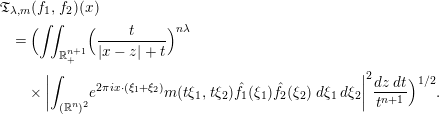
This paper will be devoted to study a class of bilinear square-function Fourier multiplier operator associated with a symbol
 $m$ defined by A basic fact about
 $$\begin{eqnarray}\displaystyle & & \displaystyle \mathfrak{T}_{\unicode[STIX]{x1D706},m}(f_{1},f_{2})(x)\nonumber\\ \displaystyle & & \displaystyle \quad =\Big(\iint _{\mathbb{R}_{+}^{n+1}}\Big(\frac{t}{|x-z|+t}\Big)^{n\unicode[STIX]{x1D706}}\nonumber\\ \displaystyle & & \displaystyle \qquad \times \,\bigg|\int _{(\mathbb{R}^{n})^{2}}e^{2\unicode[STIX]{x1D70B}ix\cdot (\unicode[STIX]{x1D709}_{1}+\unicode[STIX]{x1D709}_{2})}m(t\unicode[STIX]{x1D709}_{1},t\unicode[STIX]{x1D709}_{2})\hat{f}_{1}(\unicode[STIX]{x1D709}_{1})\hat{f}_{2}(\unicode[STIX]{x1D709}_{2})\,d\unicode[STIX]{x1D709}_{1}\,d\unicode[STIX]{x1D709}_{2}\bigg|^{2}\frac{dz\,dt}{t^{n+1}}\Big)^{1/2}.\nonumber\end{eqnarray}$$
 $\mathfrak{T}_{\unicode[STIX]{x1D706},m}$ is that it is closely associated with the multilinear Littlewood–Paley
 $g_{\unicode[STIX]{x1D706}}^{\ast }$ function. In this paper we first investigate the boundedness of
 $\mathfrak{T}_{\unicode[STIX]{x1D706},m}$ on products of weighted Lebesgue spaces. Then, the weighted endpoint
 $L\log L$ type estimate and strong estimate for the commutators of
 $\mathfrak{T}_{\unicode[STIX]{x1D706},m}$ will be demonstrated.


GENERALIZED HARDY–CESÀRO OPERATORS BETWEEN WEIGHTED SPACES
- Part of
-
- Journal:
- Glasgow Mathematical Journal / Volume 61 / Issue 1 / January 2019
- Published online by Cambridge University Press:
- 28 January 2018, pp. 13-24
-
- Article
-
- You have access
- Export citation
-
We characterize those non-negative, measurable functions ψ on [0, 1] and positive, continuous functions ω1 and ω2 on ℝ+ for which the generalized Hardy–Cesàro operator
defines a bounded operator Uψ: L1(ω1) → L1(ω2) This generalizes a result of Xiao [7] to weighted spaces. Furthermore, we extend Uψ to a bounded operator on M(ω1) with range in L1(ω2) ⊕ ℂδ0, where M(ω1) is the weighted space of locally finite, complex Borel measures on ℝ+. Finally, we show that the zero operator is the only weakly compact generalized Hardy–Cesàro operator from L1(ω1) to L1(ω2).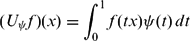 $$\begin{equation*}(U_{\psi}f)(x)=\int_0^1 f(tx)\psi(t)\,dt\end{equation*}$$
The Gradient of a Solution of the Poisson Equation in the Unit Ball and Related Operators
-
- Journal:
- Canadian Mathematical Bulletin / Volume 60 / Issue 3 / 01 September 2017
- Published online by Cambridge University Press:
- 20 November 2018, pp. 536-545
- Print publication:
- 01 September 2017
-
- Article
-
- You have access
- Export citation
-
In this paper we determine the
${{L}^{1}}\to {{L}^{1}}$ and
A NOTE ON MARCINKIEWICZ INTEGRALS ASSOCIATED TO SURFACES OF REVOLUTION
- Part of
-
- Journal:
- Journal of the Australian Mathematical Society / Volume 104 / Issue 3 / June 2018
- Published online by Cambridge University Press:
- 14 August 2017, pp. 380-402
-
- Article
-
- You have access
- Export citation
-
We establish the bounds of Marcinkiewicz integrals associated to surfaces of revolution generated by two polynomial mappings on Triebel–Lizorkin spaces and Besov spaces when their integral kernels are given by functions
 $\unicode[STIX]{x1D6FA}\in H^{1}(\text{S}^{n-1})\cup L(\log ^{+}L)^{1/2}(\text{S}^{n-1})$ . Our main results represent improvements as well as natural extensions of many previously known results.
Iterating Bilinear Hardy Inequalities
- Part of
-
- Journal:
- Proceedings of the Edinburgh Mathematical Society / Volume 60 / Issue 4 / November 2017
- Published online by Cambridge University Press:
- 30 January 2017, pp. 955-971
-
- Article
-
- You have access
- Export citation
-
An iteration technique for characterizing boundedness of certain types of multilinear operators is presented, reducing the problem to a corresponding linear-operator case. The method gives a simple proof of a characterization of validity of the weighted bilinear Hardy inequality

for all non-negative f, g on (a, b), for 1 < p 1, p 2, q < ∞. More equivalent characterizing conditions are presented.
The same technique is applied to various further problems, in particular those involving multilinear integral operators of Hardy type.
Linear non-local diffusion problems in metric measure spaces
- Part of
-
- Journal:
- Proceedings of the Royal Society of Edinburgh. Section A: Mathematics / Volume 146 / Issue 4 / August 2016
- Published online by Cambridge University Press:
- 19 July 2016, pp. 833-863
- Print publication:
- August 2016
-
- Article
-
- You have access
- Export citation
Boundedness of homogeneous fractional integrals on Lp for N/α ≤ P ≤ ∞
-
- Journal:
- Nagoya Mathematical Journal / Volume 167 / 2002
- Published online by Cambridge University Press:
- 22 January 2016, pp. 17-33
-
- Article
-
- You have access
- Export citation
-
In this paper we study the map properties of the homogeneous fractional integral operator T Ω, α on Lp (ℝn ) for n/α ≤ p ≤ ∞.
We prove that if Ω satisfies some smoothness conditions on Sn −1 then T Ω, α is bounded from Ln/α (ℝn ) to BMO(ℝn ), and from Lp (ℝn ) (n/α < p ≤ ∞) to a class of the Campanato spaces
 l, λ (ℝn ), respectively. As the corollary of the results above, we show that when Ω satisfies some smoothness conditions on S n−1 the homogeneous fractional integral operator T Ω, α is also bounded from Hp (ℝn ) (n/(n + α) ≤ p ≤ 1) to Lq (ℝn ) for 1/q = 1/p-α/n. The results are the extensions of Stein-Weiss (for p = 1) and Taibleson-Weiss’s (for n/(n + α) ≤ p < 1) results on the boundedness of the Riesz potential operator Iα on the Hardy spaces Hp (ℝn ).

Hardy spaces estimates for multilinear operators with homogeneous kernels
-
- Journal:
- Nagoya Mathematical Journal / Volume 170 / 2003
- Published online by Cambridge University Press:
- 22 January 2016, pp. 117-133
-
- Article
-
- You have access
- Export citation
Measures of Noncompactness in Regular Spaces
-
- Journal:
- Canadian Mathematical Bulletin / Volume 57 / Issue 4 / 01 December 2014
- Published online by Cambridge University Press:
- 20 November 2018, pp. 780-793
- Print publication:
- 01 December 2014
-
- Article
-
- You have access
- Export citation
-
Previous results by the author on the connection between three measures of noncompactness obtained for
 ${{\mathcal{L}}_{p}}$ are extended to regular spaces of measurable functions. An example is given of the advantages of some cases in comparison with others. Geometric characteristics of regular spaces are determined. New theorems for
 $\left( k,\,\beta\right)$ -boundedness of partially additive operators are proved.


New Characterizations of the Weighted Composition Operators Between Bloch Type Spaces in the Polydisk
-
- Journal:
- Canadian Mathematical Bulletin / Volume 57 / Issue 4 / 01 December 2014
- Published online by Cambridge University Press:
- 20 November 2018, pp. 794-802
- Print publication:
- 01 December 2014
-
- Article
-
- You have access
- Export citation
-
We give some new characterizations for compactness of weighted composition operators
 $u{{C}_{\varphi }}$ acting on Bloch-type spaces in terms of the power of the components of
 $\varphi$ , where $\varphi$ is a holomorphic self-map of the polydisk
 ${{\mathbb{D}}^{n}}$ , thus generalizing the results obtained by Hyvärinen and Lindström in 2012.


On Nonlinear Boundary Conditions Involving Decomposable Linear Functionals
- Part of
-
- Journal:
- Proceedings of the Edinburgh Mathematical Society / Volume 58 / Issue 2 / June 2015
- Published online by Cambridge University Press:
- 27 October 2014, pp. 421-439
-
- Article
-
- You have access
- Export citation
On the p-norm of an Integral Operator in the Half Plane
-
- Journal:
- Canadian Mathematical Bulletin / Volume 56 / Issue 3 / 01 September 2013
- Published online by Cambridge University Press:
- 20 November 2018, pp. 593-601
- Print publication:
- 01 September 2013
-
- Article
-
- You have access
- Export citation
