To save content items to your account,
please confirm that you agree to abide by our usage policies.
If this is the first time you use this feature, you will be asked to authorise Cambridge Core to connect with your account.
Find out more about saving content to .
To save content items to your Kindle, first ensure no-reply@cambridge.org
is added to your Approved Personal Document E-mail List under your Personal Document Settings
on the Manage Your Content and Devices page of your Amazon account. Then enter the ‘name’ part
of your Kindle email address below.
Find out more about saving to your Kindle.
Note you can select to save to either the @free.kindle.com or @kindle.com variations.
‘@free.kindle.com’ emails are free but can only be saved to your device when it is connected to wi-fi.
‘@kindle.com’ emails can be delivered even when you are not connected to wi-fi, but note that service fees apply.
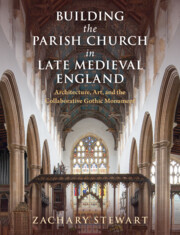
Chapter 6 investigates the ways in which new approaches to parish church design augmented the spatial, visual, and aural experience of their resident communities—with special attention to the roles of boundary-marking installations such as screens, seats, and stained-glass windows. Items of special interest include screens at Woodbridge (Suffolk) and Totnes (Devon); seats at King’s Lynn (Norfolk) and Altarnun (Cornwall); stained glass in various locations across Norfolk, Suffolk, and Cornwall; and the spectacular suite of timber furnishings preserved at Southwold (Suffolk).
Chapter 1 surveys scholarly approaches to the development of the parish church as a spatial/social phenomenon in medieval England. It introduces the example of the “open-plan parish church,” a distinctive architectural type defined by the absence of any structural division between nave and chancel, as a powerful mechanism for analyzing the dynamics of architectural form, architectural function, and architectural facture in late medieval society.
This paper sets out to consider anew the sculptural landscape of imperial Gabii by integrating newly examined evidence with the city’s archaeological record. Long portrayed in ancient sources as a city in decline after the Middle Republic, Gabii yielded an extraordinary assemblage of more than thirty life-sized statues during the excavations of the eighteenth-century antiquary, Gavin Hamilton. A previously understudied inventory from the Borghese Archives attests additional, largely fragmentary sculptures, ranging from imperial portraits to mythological figures, that expand our understanding of the city’s civic and cultic environment. By situating the archival material within the city’s archaeological context, the civic, imperial and religious display of the city comes more sharply into view, and contributes towards a more nuanced understanding of this liminal city in the imperial period.
Building the Parish Church in Late Medieval England investigates the architectural, artistic, and cultural significance of local places of worship between the Black Death and the Reformation. Zachary Stewart provides the first systematic account of an exceptional type of parish church distinguished by the absence of any structural division between nave and chancel. Tracking its development across time, place, and setting, he explores how the type's integrated format not only expressed but also reinforced and reproduced collective processes related to the conception, construction, and customization of parochial space. The result, he argues, was nothing less than a new kind of public monument to collaborative action. Informed by a wealth of archival, archaeological, and architectural research, with special attention to East Anglia, Stewart's study demonstrates the importance of the parish church as a center for innovative material production in late medieval England. It also reveals how non-elite social arrangements shaped local life on the eve of the modern era.
Scott’s struggles to maintain authorial control against the incursions of Merrilies’s witchlike powers compels him to consciously assume the more distanced role of an antiquarian collecting stories of female enthusiasm in subsequent novels, offering up prognoses of mental instability for the witches in The Antiquary, The Pirate and Ivanhoe. This chapter also introduces an entirely new and different witch figure: Rebecca, a lovely young Jewish healer whose potential marriage to Ivanhoe is challenged by racial prejudice and misogynistic suspicions that brand her as a witch. Although Rebecca is rescued from her trial as a witch, she does not receive the happy ending she deserves. Scott writes her out of the narrative in the end when she and her father decide to leave England. Yet Ivanhoe’s choice of a bride – the mild and dutiful Rowena – pales by comparison to Rebecca, inviting readers to envision an alternative ending: the union of Rebecca and Ivanhoe, and the socially transformative potential of this marriage between a Christian and a Jew, the story’s hero, and a purported witch.
This review article discusses three recent volumes: Edmund Harris, The Rogue Goths: R L Roumieu, Joseph Peacock and Bassett Keeling (2024); Peter N Lindfield, The Intimacies of George Shaw (1810–76): diaries and letters of a Gothic architect, antiquary and forger (2024); Nicholas Olsberg (photographs by James Morris) The Master Builder William Butterfield and His Times (2024). Taken together, these books show that the architect-monograph can still make an important contribution to our understanding and appreciation of the Gothic Revival. Nicholas Olsberg’s book is a tour de force, contextualising this great master and, at the same time, writing with great sensitivity about his aesthetic genius. The accompanying photographs commissioned specially for the book capture the strange presence that distinguishes so much of Butterfield’s architecture. Peter Lindfield brings to life an important regional figure who entered the field without any real training. Shaw was self-taught and his career combined dealing, decorative arts and interiors and architectural design, spanning the gap between amateur and professional. Finally, there is Edmund Harris’ insightful analysis of three architects known for their stylistic invention but whose careers to this point have been little understood. The present review contextualises these studies in the modern historiography of the Gothic Revival.
Chapter 4 continues this examination of narrative truth, focusing on the new post-Tridentine pressure to accurately portray relics in depictions of sacred history. This chapter explores how two of Borromeo’s most cherished Passion relics, the Column of Flagellation in the Church of Santa Prassede in Rome and the relic of Christ’s burial shroud in Turin, began to appear in narrative art during the 1570s for the first time in the history of Christian art. Both relics were of doubtful authenticity: Borromeo’s Column of the Flagellation was short, rather than the expected long pillar, while the long dimensions of the Shroud of Turin failed to match with descriptions of Christ’s burial cloths in the Bible. Nevertheless, Borromeo and his fellow Catholic scholars attempted to fit these prized relics into sacred history – and artists joined in this endeavor. Artists’ visual skills in the making of the istoria, the dramatic narrative still so central to ambitious art-making, were instrumental in scholarly revisions of biblical events. Artists marshalled practices of figure drawing and composition to explain the possibilities of sacred history, producing istorie of historical value for reformers and antiquarians.
Chapter 2 demonstrates that the Principality played a key role in the invention of novel understandings of the history of the British Empire. While historians like David Hume linked modern Wales with pre-Roman Britain in order to confer upon modern Britain a dubious anti-colonial pedigree, and to equate Britishness with a love of liberty, they also figured the English conquest of Wales as a necessary precondition for the establishment of British imperial power. Seizing upon this hypocrisy, antiquaries like Henry Rowlands insisted that the English were foreign interlopers who had nearly destroyed native British culture. Midcentury writers like Thomas Gray and Edmund Burke sought to suture this rift by contending that ancient Britain, and its modern descendant Wales, were crucial political and aesthetic resources for Britain’s imperial future, but some Jacobins, like Iolo Morganwg, instead portrayed Wales as an insurgent anti-imperial power waiting to unmake the British Empire from within.
This Element explores the yearning for things of the past, from early modern antiquarianism to the contemporary art market. It tells a global story about scholars who, driven by this yearning, roamed the world and amassed many of its historical artefacts. Their motivation was not just pleasure or profit. They longed for a past that had been lost and strived to reconstruct world history anew. This rewriting of history unleashed heated debates, all over the world and raging for centuries. The debates concerned not only the past but also the present and the future. Many believed that, by revealing a strange and foreign past, the material remains opened a path to modernity. So, the Element investigates not only the history of historical scholarship, and its obsession with things, but also our relationship to the past as modern human beings.
In her chapter, Elizabeth Crooke examines the work of nineteenth-century antiquarian scholar George Petrie and the poet and archivist Samuel Ferguson, who were vital to the formation of a modern revivalist movement. The accumulation of knowledge about the Irish past is a condition of freedom, for it stands as a bulwark against false and degrading historical representations and frees Irish institutions to use the recovery of cultural artifacts to support the process of national Bildung. Museums connect the past, through present cultural activity, to the realization of Ireland’s national future. This connection motivates the early designers of museums and other cultural institutions charged with preserving cultural artifacts to regard authenticity as a quality of cultural objects, an aura that transcends historical conditions. During the Decade of Centenaries (2012–2022), Petrie and Ferguson became themselves a part of Ireland’s future in the form of commemorations, the visible signs of institutional memory.
John Carter’s fervour as a recorder and polemicist for Gothic architecture has been debated since his lifetime, but his classical designs have attracted less interest. However, these give some insight into the influences upon aspiring young Georgian architects, as Carter was in the 1770s. His two sets of designs for Bywell Hall, Northumberland, the first published in the Builder’s Magazine in 1776, and a more detailed portfolio now in a private collection, are presented together for the first time. This is an opportunity to examine Carter’s early ideas and his thoughts on the appropriate styles to be employed for public, domestic and ecclesiastical buildings. Analysis of Carter’s designs demonstrates his desire to create impressive interior spaces, but poor consideration of the practicalities for family and servant life in country houses. Carter’s preference for Gothic over classical architecture, combined with humble origins and personality traits, prevented his aspiration to be an architect, but his drawing skills secured fame as one of the foremost architectural draughtsmen.
White cultural elites in the US capital of Philadelphia in the 1780s and 1790s depicted Native Americans (or “Indians”) as vanishing peoples, soon to be replaced by Anglo culture. The fledgling nation’s premier naturalist Bejamin Smith Barton and the consecrated poet of the American Revolution Philip Freneau turned to Spanish American antiquarianism to invent a glorious antiquity for North America. They learned from Antonio de Ulloa’s Noticas Americanas (1772) and Francisco Javier Clavijero’s Storia Antica del Messico (1781) how to practice antiquarian materialism, then chose early Republican literary and scientific periodicals to disseminate their conquest of the Native American past. Those two americanistas in particular showed how to collect Indigenous artifacts, assemble them, and invest them with European meanings, which inspired the first generation of US Americanists to relegate Native American life to the dustbin of prehistory and at once fabricate their own Whiteness.
The seventeenth century saw the development of increasingly centralised polities in northern and eastern Europe that sought to normalise the religious status of their unchristianised minorities. A new kind of antiquarian curiosity about unchristianised peoples was shown by figures such as Johannes Schefferus, although ethnographic study often went hand in hand with campaigns of conversion and confiscation of sacred objects (like Sami rune drums). At the same time, anxieties about witchcraft were sometimes brought to bear on unchristianised peoples as idolaters potentially in league with the devil - although attitudes varied greatly from region to region. This chapter explores the impact of colonial expansion on Europe’s unchristianised minority and the role of missionaries, antiquarians, witch-hunters, and ethnographers in redefining the ‘pagan’ threat.
The Egyptian antiquities collected by the Chinese diplomat Duanfang at the beginning of the twentieth century were largely overlooked by Chinese scholarship until the early twenty-first century, when interest in translating the inscriptions grew. Yet the collection provides a window not just into the cultural history of Egypt but of China as well. By revisiting the history of Duanfang’s collection, the author examines how its perception was shaped by Chinese antiquarianism and the evolving archaeological and political landscapes of twentieth-century China. In doing so, they reveal new insights into the agency of the replica in archaeological theory and practice.
True ruin-mindedness begins with the poet Petrarch, the subject along with his successors of the fourth chapter. He was the first person we know of who visited Rome with the intention of seeing the ruins. Thanks to his unrivalled knowledge of Latin literature, he viewed the ruins as ‘sites of memory’, complementary to and made comprehensible by the texts of Roman poets and historians. For Petrarch and his successors, the ruins became an essential part of the historical and cultural heritage of the ancient Romans, a material complement to the history of Livy and the poetry of Virgil. Such complementarity was crucial to endowing the ruins with some context and meaning; they were not just piles of broken rubble but a valuable part of the Roman cultural achievement as a whole. Petrarch’s enthusiasm was infectious and it can be claimed that he initiated two new disciplines, urban topography and antiquarianism, the subjects of the next two chapters, 5 and 6. From this point on, progression will be largely chronological, as the sentiment of ruin-mindedness is developed and enlarged.
Russell opens the book with a plea for a new approach to the comparative study of ancient cities. Past scholars – with Rykwert as the foremost example – have pointed to claims in ancient Chinese and Roman literary materials that link cities with the cosmos. They have, furthermore, used these claims to argue that, in both ancient Rome and China, the idea of the city as a microcosmos is what led to what we might call ‘placemaking’, the process by which abstract space is made meaningful to humans. Rather than disproving these claims, Russell shows the limited reach of the literary materials. First, whatever the texts claim, real cities are never scaled-down models of the cosmos: whereas the texts may seek to imbue features of the human landscape with symbolic meaning, these are most often later ascriptions, explaining features of the city that have arisen for much more concrete, mundane reasons. Second, starting from the observation that both ancient China and ancient Rome are civilisations that take great pride in their past traditions, Russell shows how the theories that associate cities with cosmological ideas are, in fact, classicising constructions of a fairly late date (last two centuries BCE), part of a growing body of technical literature, that itself was spurred into being by the cultural and intellectual changes that attended Chinese unification and Roman imperial expansion. Thus, the similarities between Roman and Chinese cities turn out to hinge on highly abstract and relatively marginal concepts of space. By showing this, Russell frees up the field for a historical investigation of cities, not as spaces but as concrete, complex places with multiple and constantly evolving social meanings. This mode of investigation gets fully underway in subsequent chapters of the book.
The antiquarian interests of Propertius 4 introduce a series of vignettes of early Rome (elegies 4.1, 4.4, 4.9, 4.10), and several further poems include rustic or quasi-rustic loca amoena in less likely contexts (a marine locale in 4.6, an urban park in 4.8). This chapter investigates how these passages engage elegy in an encounter with the genre of pastoral as codified in Virgil’s Eclogues, expanded in the Georgics and inserted in the antiquarian Aeneid. The politics of this encounter are urgent, pastoral being a vehicle of the Augustan ‘Golden Age’, but also inherently evanescent and ‘elegiac’. No less urgent are its poetics, pastoral being a lowly erotic genre like elegy, but also capable of cosmic and epic flights (as in Eclogue 6, notwithstanding its recusatio of epic themes – a tension closely tracked in elegy 4.6 on Actium). This ‘upward mobility’ is another respect in which pastoral is, arguably, analogous to elegy in its late-Propertian phase (if not earlier in the lost work of Gallus, an ‘absent presence’ here). Propertius’ recurrent loca amoena (which are not as idyllic as their name suggests) are thus spaces of generic negotiation in which ideology is never far away.
Contrary to some accounts, particularly older ones, which portray Clare as a lonely, isolated, and somewhat misanthropic figure, he was a man with a rich social life who had many friends, including literary figures, antiquarians, ornithologists, entomologists, botanists, and artists. Through these friendships, he was abreast of contemporary thought and techniques, and, if only at second hand, he was in touch with the activities of some of the leading naturalists in this country and abroad. This obviously led to an increased knowledge and sophistication in Clare’s understanding of nature, as well as leading to subtle changes in his attitude to the natural world. In particular, it meant that he no longer regarded a love of nature as something to be rather ashamed of, but instead as something which he was able to celebrate.
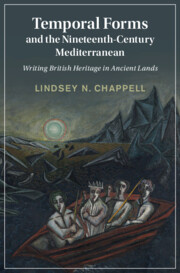
Chapter 1 begins with the problem of conflicting timescales in antiquarianism. At Pompeii, the question of human significance at the scale of geological deep time inspired writers to reconsider the material past and explore alternatives to traditional timelines. This chapter shows how Charles Dickens in particular experiments with nonlinear temporal forms in his travel narrative Pictures from Italy, which I argue uses a fractal temporal form to nest infinite pasts in present sites. A fractal is a nonlinear shape that repeats its structure even when viewed at fine scales. When Dickens deploys it as a temporal form, he necessarily changes the shape of history, offering alternative possibilities for Italian politics. Chapter 1 ends by considering the ethical ramifications of linear and nonlinear temporal forms in Arthur Hugh Clough’s Amours de Voyage. This poem, depicting the Roman Republic of 1849, dramatizes English tourists’ attempts to reassert the historicism that casts Italy as past despite the Risorgimento. Ultimately, Chapter 1 shows how both Dickens and Clough respond to political potential in Italy by reconfiguring time.
The Mediterranean is ubiquitous in nineteenth-century British literature, but this study is the first to fully recover and explore the region's centrality to Romantic and Victorian constructions of the past, the present, and the shape of time itself. Placing regions central to the making of Western cultural heritage, such as Italy and Greece, into context with one another and with European imperialism, Lindsey N. Chappell traces the contours of what she terms 'heritage discourse' – narrative that constructs or challenges imperial identities by reshaping antiquity – across nineteenth-century British texts. Heritage discourse functions via time, and often in counterintuitive and paradoxical ways. If assertions of political, cultural, and eventually racial supremacy were the end of this discourse, then time was the means through which it could be deployed and resisted. Chappell shows how historical narratives intervened in geopolitics, how antiquarianism sparked scientific innovation, and how classical and biblical heritage shaped British imperialism.