To save content items to your account,
please confirm that you agree to abide by our usage policies.
If this is the first time you use this feature, you will be asked to authorise Cambridge Core to connect with your account.
Find out more about saving content to .
To save content items to your Kindle, first ensure no-reply@cambridge.org
is added to your Approved Personal Document E-mail List under your Personal Document Settings
on the Manage Your Content and Devices page of your Amazon account. Then enter the ‘name’ part
of your Kindle email address below.
Find out more about saving to your Kindle.
Note you can select to save to either the @free.kindle.com or @kindle.com variations.
‘@free.kindle.com’ emails are free but can only be saved to your device when it is connected to wi-fi.
‘@kindle.com’ emails can be delivered even when you are not connected to wi-fi, but note that service fees apply.
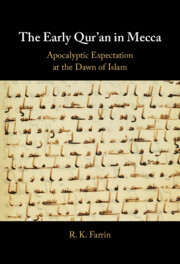
In this study, R. K. Farrin offers a fresh perspective on the emergence of Islam by tracing the structural and thematic development of the Qur'an in Mecca. He analyzes the form and content of the Qur'an at its earliest stage (ca. 609–14 CE), when it grew from a few verses to a scriptural corpus. From quantitative and literary evidence, Farrin argues that a Qur'anic nucleus – carrying a particularly urgent message – most likely formed during this period, to which units were then added as revelation continued in Mecca and Medina (ca. 615–32 CE). His study also situates the emerging Qur'an in the context of late antique Arabia, where monotheism's spread was still resisted by resident pagans. It also draws connections to contemporary Jewish and Christian ideas, especially regarding the anticipated Last Day. Significantly, Farrin's study peels back layers of Islamic history to consider the Qur'an and the environment in which it was first being recited.
The kingdom of Alania was the most powerful polity in the medieval North Caucasus. It contained strategic mountain passes across the Caucasus mountains, as well as urban centres larger than any in contemporary Rus'. Its kings retained power from the mid-ninth to the late eleventh centuries, intermarried with the ruling families of Georgia and Byzantium, and led armies that terrorised the South Caucasus. In this, the first book to explore the subject in the English language, Latham-Sprinkle sheds light on how the kings of Alania came to embody 'the power of the foreign' – the status which accrued to individuals who could access the material and spiritual products of distant lands – thus rendering the development of a state structure unnecessary. Challenging existing narratives that centre elites and the state, Latham-Sprinkle provides an important contribution to the historiography of medieval state formation, Christianisation, and transregional connection. This title is part of the Flip it Open programme and may also be available open access. Check our website Cambridge Core for details.
The cities of Byzantine and Ottoman Europe developed under distinct political and cultural influences, but both empires shared certain commonalities in their urban development. The city of Constantinople/Istanbul, as the capital of both the Byzantine and Ottoman empires, served as a hub for the political, economic, cultural, and scientific power of the two empires. At the same time, a number of fundamental differences can be identified when comparing the cities of Byzantine and Ottoman Europe. The late Byzantine provincial cities were small and often confined to the fortified areas, serving primarily a defensive purpose. In contrast, the Ottoman cities developed during a time of political stability and significant population growth. Neither Byzantine nor Ottoman cities enjoyed the same level of independence and development as their Western counterparts. Nevertheless, the role of centralisation should not be overstated when considering the development of Byzantine and Ottoman cities.
Chapter 6 explores the downfall of the Kingdom of Alania. It argues that Alania split into multiple competing princedoms during the twelfth century, and that this development cannot be blamed on Mongol or Qipchaq invasions. Rather, increasing aristocratic competition led to intercommunal conflicts, made more acute by the ability of Alan aristocrats to ally with Qipchaq nobles and bring in allied Qipchaq troops. It concludes with a brief overview of Alania during and after the Mongol invasions of the North Caucasus in 1238–40.
Chapter 2 outlines the initial stages of the Christianisation of Alania. Instead of being the result of a top-down conversion by Byzantine missionaries in the 910s and 920s, it argues that Christianising styles of adornment, burial and worship were gradually adopted by Northwest Caucasian communities in the eighth and ninth centuries because they fit in with pre-existing perceptions of foreignising styles as socially prestigious. These styles were ultimately appropriated by the Alan kings in the 880s through a royal conversion with Abasgian assistance.
Chapter 4 returns to the theme of Christianisation. It argues that Christianising styles were widely adopted in tenth- and eleventh-century Alania, having an impact which lasted until the early modern period. Moreover, this widespread acceptance of Christianising styles allowed the kings of Alania to claim that they possessed a particularly potent ‘power of the foreign’ as a result of their recognition by the Byzantine and Georgian courts and ecclesiastical hierarchies. As a consequence, they were able to effectively claim a paramount status among Central North Caucasian aristocrats and establish a hereditary dynasty.
Chapter 5 examines in greater depth the relationships between the kings of Alania and the Byzantine and Georgian courts, concentrating on the eleventh and early twelfth centuries. It argues that during this period, increased connectivity between North Caucasian, Georgian and Byzantine elites led to the formation of a single, if uneven, network of elite power in the Black Sea region. While this allowed for the maintenance and intensification of the Alan kings’ access to the ‘power of the foreign’, it also allowed for other North Caucasian elites to access the Georgian and Byzantine courts. This threatened to undermine the exclusivity of access to ‘the foreign’ that underpinned the Alan kings’ rule, leading to intense status competition between elites.
The establishment of the Bolshevik communist totalitarian regime in Russia in 1917 was facilitated by the existing institutional genes necessary for totalitarian rule, including the autocratic Tsarist system, the Russian Orthodox Church, and the secretive political organizations. Chapter 7 studies the origins and evolution of these institutional genes and it also examines their role in the failure of the Russian constitutional reforms and the genesis of communist totalitarian ideology and organization in Russia.
The advent of Islam in Arabia created a new regional actor: the Rashidun Caliphate. Later caliphates inherited the vast territories of expansion accrued under the Rashidun. The ordeal of civil war was the crucible from which the Umayyad Caliphate arose. Civil crisis had a lasting influence on both the strategic setting and then environment within which successive Umayyad and Abbasid caliphs had to contend. Unity and unification of the caliphate was a necessary political objective for the duration of all caliphates. The Umayyads fused their right to political legitimacy with their military prowess and notions of divine providence. The ideological dependency of the Umayyad Caliphate to an aggressive policy of security-maximising expansionism was predicated upon a politically legitimating doctrine of perpetual war which constantly directed strategic decision making. The dependency upon war serving as the only strategic instrument subordinated to the political ends of security, the Umayyad leadership was distracted from managing growing internal dissent and covert factions brewing rebellion and eventual revolution. The Abbasid Revolution of AD 750 not only ended the Umayyad House, but effectively sheathed the doctrine of perpetual war that the Umayyad Caliphate had wielded for nearly a century. The Abbasids squandered the vast territorial and strategic inheritance within decades of wrestling power. The early course of the Rashidun, Umayyad and Abbasid caliphates, was consistently one of political and territorial expansion followed by structural fragmentation, civil strife and subsequent collapse.
One can divide sources regarding Byzantine strategy into three main categories: sources dedicated to the exposition of strategy, tactics and logistics, i.e. military manuals and administrative documents;' Byzantine historical narratives; and non-Byzantine historical accounts written in various dialects such as Slavic, Arabic and Armenian. Still, there is an ongoing debate whether military manuals reflected current tactical and strategic practise. Equally uncertain is the extent to which Byzantine historians employed military manuals or idealised biographies as models in order to present favoured figures in an ideal light. The emperor was usually the one who set priorities and objectives, assisted by advisers as well as by treatises on strategy and logistics. Sometimes, however, high-ranking military officers, the strategoi, local commanders who executed military and political authority over their districts, also took the initiative to undertake operations. The Byzantines faced various peoples: Slavic and Turkish peoples and polities threatened and occupied its Balkan frontier; Arabs, Turks and Armenians dominated the eastern frontier (Asia Minor, Syria, Mesopotamia and Armenia), and the Normans, Crusaders and various pirates threatened Greece, Thrace and the islands of the Aegean and the Ionian Gulf. The objectives of the Byzantines varied according to the period. Defence and survival were among the dominant ones; others included retaliation, devastation of the enemy’s potential through raiding and acquisition of booty, marching deep and showing the flag in order to achieve more favourable treaties, the reconquest of lost key cities and fortresses, and, rarely, the total elimination of enemy polities. The Byzantines relied greatly on money and diplomacy to achieve their goals. When these were not enough, they would mobilise their army and navy comprising indigenous professional and semi-professional troops, as well as foreign and allied troops. The main priority in terms of strategy was to conduct military operations, as far as possible, on only one front at a time. The latter was chosen with various goals in mind: the control of major cities, fortresses, routes and mountain passes; the establishment of a client ruler; acquiring of a quick victory in order to enhance the emperor’s image; and acquiring an acknowledgement of the emperor’s overlordship in order to adhere to Byzantine political ideology which saw the emperor as the supreme ruler of the world and the legitimate claimant to the Roman Empire. It is interesting to note that religion seems to have played a lesser role than realpolitik and political ideology. When fighting their wars, the Byzantines mostly adhered to the advice found in military treatises, but there were also occasions when the neglect of such matters brought devastating defeats.
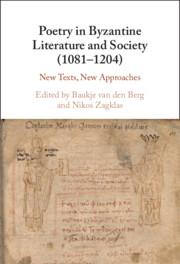
The twelfth century was one of the most fertile periods in Byzantine literary history and this volume is the first to focus exclusively on its abundant poetic production. It explores the broader sociocultural tendencies that shaped twelfth-century literature in both prose and verse by examining the school as an important venue for the composition and use of texts written in verse, by shedding new light on the relationship between poetry, patronage and power, and by offering the first editions and interpretive studies of hitherto neglected works. In this way, it enhances our knowledge of the history of Byzantine literature and enables us to situate Medieval Greek poetry in the broader literary world of the medieval Mediterranean.
In the early fourteenth century, decades before the Ottomans became the sole rulers of Anatolia, the Germiyanid beylik stood as a dominant force among the principalities that had emerged in western Anatolia following the demise of the Seljuks (1307). Nonetheless, to date, the exact origins and ethno-cultural background of the Germiyanids remain unclear. This article re-evaluates previous theories and posits that the embryo of what eventually became the Germiyanids formed between the eleventh and thirteenth centuries in the lowlands between Malatya and Lake Van, and that the name “Germiyan” was of Kurdish origin. It also suggests that an intense proto-Yedizi proselytism took place in eastern Anatolia before the Germiyanids migrated to western Anatolia. Beyond its significance to the history of the Seljuks, the Ottomans, the Mongols, and Byzantium, this paper challenges the prevailing narrative that views the emergence of the beyliks as an exclusively Turkic phenomenon and sheds light on the role played by non-Turkic people, including Kurds and Arabs, in their formation.
This chapter addresses the subject of sex in Constantinople in the sixth century CE, the heart of the Eastern Roman Empire. It draws on a range of rich evidence. A fundamental starting point is provided by the writings of the contemporary historian Procopius, in particular his comments in Secret History on the life and deeds of the empress Theodora, wife of the emperor Justinian I (527–565), who was an actress before marrying her husband. In addition it draws on the legislation of the emperor Justinian, the chronicle of John Malalas, erotic epigrams of the period, and Christian ascetic literature. From these writings strong ideals of right and wrong sexual behaviour emerge, revealing both traditional Roman values and the increasing Christianisation of society. This can create the impression that sexual activity was very tightly controlled, especially prostitution, extra-marital sex, and same-sex sex. However, it is apparent that life was less clear-cut. Justinian himself recognized that desire was a powerful impulse and that people did ‘sin’. It is also evident that people could enjoy thinking about illicit sex, and engage in it enthusiastically. Ironically, overtly Chistian texts could even incite the desire they sought to neutralize.
Caroline Humfress explores the distinctive relationship between sacred (Christian) temporality and (Western) ‘hermeneutics of the state’, through a focus upon the founding texts of the Civilian legal tradition: the sixth-century CE Digest, Code and Institutes. Part 1 analyses the Emperor Justinian’s claim that these law-books were to be ‘valid for all eternity’ through a series of close textual readings of the same law-books’ prefatory constitutions. Part 2 contextualises Justinian’s lawyerly invocation of ‘eternity’ within contemporary Eastern Christological disputes, including a set of theological debates, orchestrated by Justinian himself, that took place at the same time (and location) as his law-books were being compiled. Part 3 concludes by arguing that the ‘timeless’, rational, universal, authority of the Civilian Legal tradition – as explored in the chapter by Ryan – was in fact underpinned by a specific Eastern (‘Byzantine’) sacred temporality.
The Romans adaptation of Greek philosophy was illustrated by the Stoics and Epicureans. The Stoics held that humanity is determined by the fates of nature, while the Epicureans believed that happiness came from seeking pleasure and avoiding pain. Plato was revived by Plotinus and dominated Roman philosophy during the early years of Christianity. Both the missionary zeal of early Christians and the tranquility of Roman administration rapidly spread Christianity. The teachings of Jesus were bolstered by defenders, who gave Christianity form and content. St. Augustine successfully reinterpreted Platonic thought within Christian theology, and the consequent influence on psychology continued well beyond. With the fall of the Western empire, intellectual life came to a virtual halt, and only the monastic movement preserved remnants of Greek and Roman civilization. The papacy assumed a leading role in spiritual direction and civil administration. The power shift to the East saw the Byzantine Empire assume a distinctive Greek character. The rise of Islam threatened the survival of Christianity in the Middle East and in North Africa. But, at the same time, much of the Greek heritage of scholarship was preserved and extended in the great academic centers of medieval Islam.
This article examines how the introduction of western European crusaders and settlers to northern Syria from 490/1097 onwards impacted upon two important mechanisms of regional diplomacy; the ransom of prominent political prisoners and tributary relationships. Discussion begins with a comparison of the capture and ransom of high-ranking captives in northern Syria between 442-522/1050-1128, where it is argued that the establishment of the crusader states led to an increase in both the rate at which prisoners of elite status were ransomed and the financial sums involved in these interactions. This is followed by a reassessment of the various peace treaties, tributary arrangements and condominia or munāṣafa agreements concluded between the rulers of Antioch and Aleppo during the late fifth/eleventh and early sixth/twelfth centuries. Ultimately, this article seeks to place key features of northern Syrian diplomacy from the early crusading period within the context of regional norms in the decades preceding the crusaders’ arrival.
This article looks at the rise of Venice and the expansion of its economic, political and military power in the Adriatic from the early ninth until the fourteenth centuries. It assesses how local, interconnecting commercial networks transformed into more elaborate, intensive and long-distance connections that came about as a result of wider patterns of change not only in the Adriatic, but in the Mediterranean, Europe and beyond during this period. The article examines the relationship between Venice and the coastal towns of Dalmatia and Italy and charts how patterns of co-operation and mutual interest gave way to domination through a deliberate and coherent series of policies adopted by Venice’s leaders. The participation of an increasing number of elements of Venetian society in the commercial and political success of the city played an important role in providing domestic stability on the one hand and in shaping a civic identity on the other, that was also to prove important during the time of the crusades where new markets and opportunities opened up for the city. Financial structures that allowed for – and even prompted – inclusivity played a key role too in eliding the interests of the elites with those of Venice’s citizens.
This chapter discusses some general principles of spatial organisation and perception in the Medieval Roman (“Byzantine”) Empire as can be reconstructed from written sources, furthermore the definition and dynamics of frontiers and the significance of the centre (Constantinople) and its demands for the spatial framework of imperial politics. The chronological focus is on the centuries from the inauguration of Constantinople as new capital (330 CE) up to the Fourth Crusade in 1204 CE. Furthermore, the papers deal more with the frontiers and relations of Byzantium to the East, where also Byzantine authors identified (competing) polities of a similar imperial quality, than with the connections to and conflicts with medieval Western Europe. It aims to demonstrate how specific aspects of Byzantium´s spatial dynamics can be integrated in a more general comparative discussion of empires as spatial phenomena.