To save content items to your account,
please confirm that you agree to abide by our usage policies.
If this is the first time you use this feature, you will be asked to authorise Cambridge Core to connect with your account.
Find out more about saving content to .
To save content items to your Kindle, first ensure no-reply@cambridge.org
is added to your Approved Personal Document E-mail List under your Personal Document Settings
on the Manage Your Content and Devices page of your Amazon account. Then enter the ‘name’ part
of your Kindle email address below.
Find out more about saving to your Kindle.
Note you can select to save to either the @free.kindle.com or @kindle.com variations.
‘@free.kindle.com’ emails are free but can only be saved to your device when it is connected to wi-fi.
‘@kindle.com’ emails can be delivered even when you are not connected to wi-fi, but note that service fees apply.
Chapter 9 assesses the role of trade in and after the Cold War, emphasizing how it mattered less to the two principals than to their allies and clients. Beyond reviewing trade relations between the Soviet Union and the United States, this chapter offers a case study in the political economy of alliances. It highlights the differing ways that these contenders approached trade with their own allies and satellites, and those of their rival, as well as with third parties. Intra-bloc trade relations could be especially tricky, a problem that carries over to our own time.
How do real-life national security elites form and update their beliefs about a rival’s strategic intentions? I recruit national security elites from the CIA, State, Defense, and other agencies to participate in a wargame simulation. Subjects are presented with realistic intelligence about a fictional emerging threat to U.S. security, allowing me to test competing rationalist and psychological theories of threat perception. Critical to my theory, subjects read a transcript of a secret diplomatic meeting in which a foreign leader explains to the U.S. president that its initial militarization serves a limited principle. Subjects then learn that the threat invades a specific territory. I randomize both the principle to which the emerging threat appeals and the historical context of the territory it invades. Consistent with my theory, costless diplomacy influences threat estimates by coordinating expectations only when diplomacy appeals to a principle, and military interventions drive mistrust only when they cannot be supported by the declared principle. Experimental and survey evidence rule out alternative mechanisms and offer a broader understanding of how real-life intelligence analysts balance different sources of information.
I evaluate U.S. intelligence and grand strategy toward China, drawing on declassified documents and hundreds of elite interviews with national security officials. I explain why Presidents George H.W. Bush, Clinton, and George W. Bush all adopted similar hedging strategies before 2008. Drawing on interviews with National Security Council staff, I clarify why Obama’s “Pivot to Asia” was less robust than intended and how Trump overcame institutional and strategic challenges to dramatically shift U.S. strategy toward competition. I also explain why President Biden continued Trump’s policies despite their differing political affiliations and personal experiences, as well as Biden’s previous affiliation with the Pivot to Asia. Using a survey of 200 “Chinawatchers” from the U.S. national security community, alongside in-depth interviews with senior NSC officials, I identify a sudden shift from uncertainty to alarm in U.S. estimates of China’s intentions in 2011 and explain the reasoning behind this shift. Contrary to growing criticism, I argue that the U.S. intelligence community was correct not to conclude that China held aggressive intentions, even as it consolidated autocratic power, escalated tensions over Taiwan and Tibet, and invested heavily in offensive military capabilities.
This chapter explores the role football played in Cold War South America in the 1970s, including World Cup winners Brazil and Argentina. It focuses on one of the most bizarre one-sided football matches of all time: between Chile and the Soviet Union in Santiago’s Estadio Nacional on 21 November 1973. The Soviets refused to turn up for the match, arguing that Chile’s new leader, General Augusto Pinochet, had recently used the Estadio Nacional to execute left-wing opponents. The game went ahead anyway, lasting all of seventeen seconds. Chile ‘won’ 2–0 and thereby, unlike the Soviet Union, qualified for the 1974 World Cup finals. The chapter shows how the ‘game of shame’ took place at a time when Chile, due to the recent death of Marxist president Salvador Allende, was briefly at the centre of the Cold War. It explores FIFA’s investigation into goings-on at the Estadio Nacional and the international row the match generated. The peculiar Chile–Soviet Union match shows how football could be used as a powerful tool of political protest during the Cold War. It also reveals how political grandstanding could sometimes hide something more mundane – the fear of losing on the pitch.
An essay of mine, with the title “Private War Enterprise in Asia: Air America, the Brook Club and the Kuomintang,” was sent by me in 1970 to Ramparts magazine. But it was impounded by the CIA, and retained in their archives until released in 2009, under three CIA cover slips (one almost fully redacted). It is now published here, under a 2022 Introduction I have written for it.
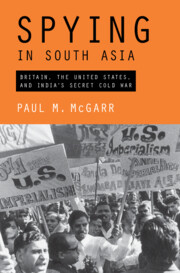
In this first comprehensive history of India's secret Cold War, Paul McGarr tells the story of Indian politicians, human rights activists, and journalists as they fought against or collaborated with members of the British and US intelligence services. The interventions of these agents have had a significant and enduring impact on the political and social fabric of South Asia. The spectre of a 'foreign hand', or external intelligence activity, real and imagined, has occupied a prominent place in India's political discourse, journalism, and cultural production. Spying in South Asia probes the nexus between intelligence and statecraft in South Asia and the relationships between agencies and governments forged to promote democracy. McGarr asks why, in contrast to Western assumptions about surveillance, South Asians associate intelligence with covert action, grand conspiracy, and justifications for repression? In doing so, he uncovers a fifty-year battle for hearts and minds in the Indian subcontinent.
Vengalil Krishanan Krishna Menon established a reputation as one of the most controversial and divisive figures in Indian and broader Cold War politics. Under Nehru’s patronage, Menon experienced a meteoric rise to political power. In 1947, he was appointed to the prestigious post of Indian High Commissioner to the United Kingdom. However, his abrasive personality and readiness to listen to and, on occasions, publicly endorse, Soviet and Communist Chinese positions on a range of international questions ruffled feathers in London and Washington. In the United States, officials characterised the Indian diplomat as ‘venomous,’ ‘violently anti-American,’ and ‘an unpleasant mischief-maker’. Many British diplomats echoed such sentiments. This chapter examines the British government’s response to Krishna Menon’s appointment. It explores the nature of Menon’s relationship with the CPGB, the risk that communists working for him posed to British security, and the strategy that MI5 developed to meet it. It illustrates the Attlee government’s conviction that India, and more particularly, Krishna Menon, represented a weak link in the Commonwealth security and intelligence chain.
In 1979, the publication of Daniel Patrick Moynihan’s memoir, A Dangerous Place, reignited debates in the subcontinent over CIA interference in India’s internal affairs. Four years later, in 1983, a vituperative assault on Henry Kissinger published by the American investigative journalist, Seymour Hersh, in his book, The Price of Power, further fanned flames surrounding the CIA’s activities in India. Hersh’s book claimed that the former Indian prime minister, Morarji Desai, had been a CIA asset and passed intelligence to the Agency at the time of the Indo-Pakistan hostilities in 1971. The accusation levelled by Hersh, which prompted Desai to sue in an American court, served as a cause celébère, and saw Kissinger forced to take to publicly testify on CIA operations in India. This chapter examines how perceptions of the CIA in India towards the end of the Cold War were influenced by memoirs, books, and articles ‘exposing’ Agency misdeeds. It analyses the motivations behind such works, their impact on the Agency’s reputation at home and abroad, and the effectiveness of strategies employed by actors in India and the United States to enhance and suppress their reach.
During the first two decades following India’s independence, the CIA had a complex, and often conflicted relationship with the ruling Congress party and the Indian media. Despite public and private criticisms levelled at the Agency by Jawaharlal Nehru, a number of CIA covert operations in the subcontinent were undertaken with the full knowledge and support of India’s intelligence service and senior figures within the Congress Party: In Kerala, in the late 1950s, the CIA worked with the Congress Party to destabilise a democratically elected communist administration; following an abortive Tibetan uprising in 1959, India’s Intelligence Bureau chose to ‘look the other way’ as CIA aircraft transited through Indian airspace in support of Agency sponsored resistance operations in Chinese-controlled Tibet; and CIA operatives spirited the Dalai Lama out of Lhasa and into northern India. This chapter probes the genesis and evolution of the CIA’s relationship with India during the Agency’s so-called ‘golden age’ in the long 1950s, when a series of major US covert operations were conducted across the globe, in places such as the Congo, Guatemala, Iran, Indonesia, and Tibet.
Spying in South Asia examines the misguided and self-defeating Cold War interventions undertaken by British and American intelligence and security agencies in post-colonial India. British and American policymakers mounted intelligence operations in the Indian subcontinent on the basis of questionable, and often conflicting assumptions: that covert action could steer Indian opinion in a pro-Western direction; that British and American intelligence agencies could be insulated from Indian antipathy for colonialism and neo-colonialism; that Western intelligence support would corrode India’s relations with the Soviet Union; that controversies surrounding American intelligence practice would not cut through with the Indian public; that the subcontinent’s politicians would not employ the CIA as a lightning rod for India’s domestic travails; and that secret intelligence activity could help to arrest a decline in British and American influence in India. Today, India’s emergence as an economic titan, renewed Sino-Indian tensions, and backwash from the ‘War on Terror’, keep the subcontinent in the global headlines.
In the late 1960s, a spotlight cast upon some of the CIA’s more questionable activities in the subcontinent had a profound and enduring impact on Indian perceptions of the United States’ government and its external intelligence service. In the wake of the Ramparts scandal, the CIA came to occupy a prominent place in mainstream Indo–U.S. cultural and political discourse. For the remainder of the twentieth-century, and beyond, anti-American elements in India drew repeatedly upon the spectre of CIA subversion as a means of undermining New Delhi’s relationship with Washington. The blanket exposure given by the world’s press to CIA indiscretions, exemplified by the international media circus surrounding Congressional probes into the U.S. intelligence community, made a deep psychological impression in South Asia. This chapter traces the socio-political impact of Indira Gandhi’s assertions that the malevolent hand of the CIA lay behind India’s problems, foreign and domestic. It recovers South Asian agency in intelligence terms by interrogating the utility of Gandhi’s policy of exploiting the CIA’s reputation as a socio-political malefactor to court popular legitimacy.
On 20 October 1962, a border dispute between India and the People’s Republic of China erupted into open warfare, leaving the Indian Army reeling and the country’s political leadership in a state of panic. A State of Emergency was declared, a National Defence Fund established, and recruiting stations for India’s armed forces were flooded with eager volunteers. This chapter dissects the impact of joint covert action operations undertaken by India and the United States in the wake of Sino-Indian hostilities. It examines how and why the CIA assisted the IB in equipping and training a clandestine warfare unit tasked with monitoring Chinese military supply routes into Tibet and oversaw the insertion of nuclear-powered surveillance equipment on two of India’s Himalayan peaks to collect data on Chinese atomic tests. Coming at a point when new mechanisms for the implementation of covert action where being introduced by Whitehall, including the Counter Subversion Committee and the Joint Action Committee, the chapter also analyses how the border war was approached by Whitehall as an opportunity to test new British covert capabilities and to roll-back communism in South Asia.
Spying in South Asia’s conclusion addresses the impact of the end of the Cold War, and the onset of a ‘war on terror’, on British and American intelligence relationships with India. It explores the rationale behind Indian governments’ softening of anti-CIA rhetoric from the mid-1980s, and the implications for New Delhi’s intelligence agencies of the precipitous collapse of the USSR, and the abrupt conclusion of the Cold War. It assesses factors underlying the post-Cold War recovery of Western secret services from the position of public pariahs in India to that of New Delhi’s principal partners in intelligence and security matters. In 1947, as the Cold War dawned and the newly independent subcontinent confronted formidable threats to its stability and security, New Delhi turned to London and Washington for covert support. Some half-a-century later, after decades of what might best be described as circumscribed cooperation compromised by conflict and conspiracism, the intelligence services of India, the United Kingdom, and the United States, once more found compelling reasons to put their differences aside, and work together as close partners in a new secret war.
Under the Convention against Torture, if states know of torture having taken place, they have obligations to provide redress and rehabilitation for victims and pursue prosecution of those responsible. Despite this, the United States continues to detain prisoners who were subjected to years of CIA torture in Guantánamo Bay. The United States is pursuing the death penalty through the Military Commissions (MC) system which falls far short of any international standards for fair trial. Ongoing systematic physical and psychological abuse prolongs torture’s effects. We argue that the ongoing arbitrary detention, abuse, denial of healthcare, and the MCs constitute a regime of torture that persists today, with the acquiescence of successive US administrations, and with the collusion of multiple agencies of the US state. This regime is deliberately intended to keep CIA torture victims incommunicado as long as possible to prevent evidence of the worst excesses of CIA torture from ever coming to light. This regime has profound implications for human rights accountability and the rule of law. Our argument offers an opportunity to revisit the prevailing narrative in International Relations literature, which tends to view the CIA torture programme as an aberration, and its closure an indicator of the restoration of the anti-torture norm.
The conclusion argues that U.S. analysis on France reveals the complex relationship between intelligence and the formulation of American foreign policy in the early Cold War. It contends that a transnational and at times transimperial web of French factions and informants was largely responsible for shaping these views through their frequent informal and formal exchanges with American diplomats and intelligence officials, and they did so with their own political agendas and interests in mind. Through their U.S. contacts, they directly contested images of France, demonstrated legitimacy and outmaneuvered rivals, and played a fundamental role in shaping American perceptions and policy. This chapter also shows that the narrative of French weakness and communist intrigue began to unravel under the scrutiny of analysts who understood its provenance and questioned its basis. In fact, there were a myriad of other explanations for seemingly nefarious communist activity in France, ones for which emotionally driven and depleted observers failed to account.
During the 1960s, the effects of the Cuban Revolution – especially in terms of support for guerrilla warfare against U.S. allies – became all too evident, and the United States pursued interventionism with new vigor. This renewed use of power included economic and diplomatic pressures, veiled threats, covert operations, and even invasion. U.S. officials framed the Cold War as a valiant struggle to protect freedom in the hemisphere, and the cases of Cuba, Nicaragua, and Guatemala epitomized the lengths to which the United States would go to fight what it considered to be security threats. In Latin America, many elites supported U.S. policy, but a growing undercurrent of discontent also emerged, which pushed for negotiated conclusions to war and protested against the treatment of so many citizens caught in the middle. They did not share the notion that leftist or even Marxist governments necessarily constituted a threat to national security and global order. This chapter ends with a discussion of the U.S. invasion of Panama in 1989.
This chapter examines the consolidation of Pahlavi rule after the removal of Reza Shah from power, especially after 1953, when the reign of Mohammad Reza Pahlavi was reestablished following a CIA-sponsored coup. The chapter explores the tenuous beginnings of the reign of the new Shah, the increasing legislative and policy-making significance of the Majles in the 1940s, and the era of oil nationalization, from 1951 to 1953. Prime Minister Mohammad Mosaddeq was successful in getting the powers of the monarchy to be significantly reduced, but his overthrow was followed by the restoration of absolute monarchy built on a massive army and a feared secret service called SAVAK. Ultimately, however, the Pahlavi state failed to incorporate within its orbit and its social base remained weak. As the oil revenues began to lag, and the state was forced into making “housecleaning” concessions, it began to crumble under the weight of the gathering storm.
The Kennedy assassination traumatized a nation, and the official investigation conducted by the Warren Commission (1963–64) contained discrepancies that invited conspiratorial speculation. Subsequent investigations by the Church Committee (1975–76) and the House Select Committee on Assassinations (1976–79) raised questions regarding the covert activities of the CIA, particularly the enlistment of the Mafia to assassinate Castro, which reframed the entire Kennedy assassination. Skepticism regarding the findings of the Warren Commission and revelations from the Church Committee fueled a cultural paranoia that pervades the work of Don DeLillo, particularly in a run of novels from Players (1977) and Running Dog (1978) through The Names (1982) and Libra (1988). Deeply indebted to the findings of these three flawed investigations, DeLillo’s fictionalization of the life of Lee Harvey Oswald, Libra, mines this paranoia, but also contextualizes the JFK assassination within an American social totality marked by contradictions and antagonisms. By exploring historical trauma in a way that calls into question official history, Libra represents an exemplary work of what Linda Hutcheon calls historiographic metafiction.
The Introduction sets the stage for the book by explaining the impact of Soviet Union’s collapse in 1991 had on America’s role in the world. Without the perils posed by the USSR, the United States behaved as a liberal hegemon with little constraint. Inspired by Wilsonian idealism and its own post–World War II success, America tried to make the world a better place by militarily invading in a host of nations beset with civil wars, ethnic cleansing, brutal dictators, or devastating humanitarian conditions. It installed democracy and promoted human rights by force of arms for peace and US security interests. So, interventions, regimes, and insurgencies characterized the post–Cold War era. The 9/11 terrorism led America into large-scale incursions and occupations to secure its safety from further assaults by al Qaeda in Afghanistan and from phantom nuclear arms in Iraq. One difference between Cold War era and its immediate aftermath stemmed from the means used by Washington to rid itself of pesky dictators. Before the Berlin Wall disappeared the United States did not want to face a direct confrontation with a nuclear armed Soviet Union. So it turned to the CIA to remove anti-American strongmen in Iran, Guatemala, and Chile with covert operations. When CIA efforts failed to oust dictators after Soviet disappearance, Washington turned to military invasions.
In Chapter 4, I investigate the emergence and evolution of the USA’s targeted killing programme, focusing mainly on its origins within the CIA and its transformation from a limited, ad hoc method to a systematic and institutionalised form of militarised counterterrorism. I question whether it represents the erosion of international and domestic prohibitions on assassination and find that it does not; those prohibitions continue to exist and play a normative role in shaping how force is used, but they have changed in content – they refer to something different than before. Central to this process were legal arguments and bureaucratic politics designed to adjust the delegation of authorities across the agencies of the US security apparatus, facilitated by the development of armed unmanned aerial vehicles, which supplied an essential means, and by pressure from the Bush and Obama administrations.