To save content items to your account,
please confirm that you agree to abide by our usage policies.
If this is the first time you use this feature, you will be asked to authorise Cambridge Core to connect with your account.
Find out more about saving content to .
To save content items to your Kindle, first ensure no-reply@cambridge.org
is added to your Approved Personal Document E-mail List under your Personal Document Settings
on the Manage Your Content and Devices page of your Amazon account. Then enter the ‘name’ part
of your Kindle email address below.
Find out more about saving to your Kindle.
Note you can select to save to either the @free.kindle.com or @kindle.com variations.
‘@free.kindle.com’ emails are free but can only be saved to your device when it is connected to wi-fi.
‘@kindle.com’ emails can be delivered even when you are not connected to wi-fi, but note that service fees apply.
This chapter follows the activities of the Paul and Gertrud Ruegg Defense Committee in Shanghai, which was led by Soong Ching-ling and Agnes Smedley. The two women recruited the young American Harold Isaacs, fresh out of Columbia University, to establish a Comintern-funded newspaper (the China Forum) to publish partisan articles designed to embarrass the Guomindang government. Meanwhile, Willi Münzenberg sent the young Swiss lawyer Jean Vincent to Shanghai to be his eyes and ears during Rudnik and Moiseenko’s upcoming trial – all at the expense of the Comintern. While Rudnik and Moiseenko were awaiting their trial, the Japanese bombardment of Shanghai in early 1932 threw the Guomindang into chaos, and resulted in bringing Chiang Kai-shek – who was desperate to see them punished – back into power.
This chapter allows readers to see why the Comintern set up the Far Eastern Bureau in Shanghai, how it was operated, who composed its staff, and what its objectives were. It pays particular attention to the role of Rudnik, who at this point was in Shanghai without Moiseenko and was responsible for nearly all of the FEB’s logistical needs. It also discusses the finances of the FEB, as well as its mandate for aiding communist revolutions in Malaya, the Philippines, Indochina, Korea, and Japan.
This chapter follows the activities of the FEB after 1930, when Moiseenko arrived in Shanghai with her son. It chronicles the many conflicts between FEB staff and the Politburo of the Chinese Communist Party (CCP), and then shows how the FEB steadily gained influence over the CCP by recalling its leader to Moscow and by rigging elections to the Politburo. During this time, the Comintern’s commitment to Zhou Enlai as a Politburo member remained strong, and FEB members seem to have persuaded him not to resign when his protégé Gu Shunzhang turned traitor in April 1931. The far-reaching goals of the Comintern in China, via the FEB, help to explain why the Comintern was so anxious to ensure Rudnik and Moiseenko did not reveal their secrets to the Guomindang.
In 1937, Japanese aggression once more influenced Rudnik and Moiseenko’s story, because the Japanese attack on Nanjing in August led the Guomindang to release all political prisoners in accordance with the Soviet-brokered Second United Front with the CCP. Rudnik and Moiseenko tried to get back to the Soviet Union, but were delayed for nearly two years. They finally made it back to Moscow in 1939, just after the worst of Stalin’s Great Terror was ending. Even after they were home, they still had to wait until 1944 to finally be reunited with their son.
This chapter follows the fate of Rudnik and Moiseenko, as well as the fate of the FEB, after the couple’s conviction in 1932. For the prisoners, the next few years were extremely difficult. They had little hope of being released, they both experienced serious illness, and their young son nearly died of typhoid fever at his foster home. Meanwhile the Comintern tried to rebuild the FEB, but was hampered at every step by surveillance and repression at the hands of the Guomindang. In Germany, Adolf Hitler’s rise to power in 1933 led Willi Münzenberg to go underground, which made communication between the prisoners and Moscow extremely difficult. And to top it off, the foster family caring for Rudnik and Moiseenko’s son became staunch Nazi supporters. In 1936, much to the sorrow of Moiseenko, their son was sent to an orphanage in the Soviet Union.
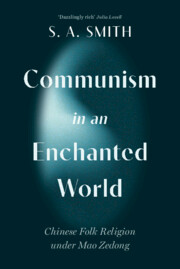
Drawing together decades of research, Steve Smith explores the survival and adaptation of folk beliefs in Mao's China in the face of seismic social change and growing political repression. Bringing an oftenneglected aspect of modern Chinese history to the fore, he shows how folk religion maintained a vital presence in everyday life. In myriad ways, through Buddhism, Daoism, and Confucianism, spirit mediums and spirit healing, divination, geomancy, and the reform of traditional marriage and funeral rites, rituals, and beliefs provided resources for adaptation and resistance to the regime. Nevertheless the survival of folk religion must be set against the secularizing forces that the regime unleashed. This unique history gives readers a vivid sense of life under Mao Zedong as vibrant, contentious, and resilient – a far cry from stereotypes of a secular, regimented, and monochrome society.
How does the party-state exercise leadership over universities and manage the individuals embedded in the university system without restraining their capacity for excellence and innovation? I argue that the presidential responsibility system has resolved a fundamental agency problem in Chinese universities. The system is supported by a set of mechanisms designed to enforce loyalty to the leadership of the Chinese Communist Party. It can easily adapt to political changes and thus maintain authoritarian rule without compromising the overarching agenda of research excellence.
This chapter begins with a concise overview of China’s economic modernization since the 1980s, highlighting its domestic and international ramifications. It introduces the theoretical framework of political guardianship psychology, emphasizing the importance of studying political psychology within the context of China’s political evolution. This framework offers a valuable lens for understanding public trust in government, attitudes toward democracy, and perceptions of China’s rise in relation to foreign nations. In addition, the chapter elaborates on the book’s central themes and outlines the datasets employed to address the theoretical questions explored throughout the work.
The past few decades have witnessed a significant religious revival in China, coinciding with a sharp increase in economic inequality. This chapter investigates the impact of religion on the Chinese public’s perceptions of income disparity and political trust. The findings reveal a notable difference in the perceived fairness of personal income distribution between religious and nonreligious individuals. Religious beliefs are positively correlated with a heightened sense of fairness regarding both personal and national income distribution. These perceptions of fairness, in turn, contribute to fostering people’s trust in political institutions and government officials. However, religious beliefs mitigate the positive effect of perceived fairness in income distribution on institutional trust. Consequently, when income distribution is perceived as unfair, institutional trust declines more sharply among religious believers compared to their nonreligious counterparts.
Democracy is a contested concept; utilizing four rounds of national survey data, this chapter elucidates the characteristics of the Chinese public’s perception of democracy and its longitudinal changes over the past few decades. The findings indicate a growing percentage of individuals who understand democracy in procedural terms. This popular perception of democracy holds significance, as those who adopt a substantive view tend to perceive democracy as less compatible with China and to overestimate the democratic nature of the current regime, compared to those who approach democracy procedurally.
China’s engagement with the global arena and its economic modernization are anticipated to foster democratization and alignment with the liberal international order. However, despite several decades of economic development, the authoritarian system remains resilient, and China’s foreign policy has become increasingly assertive. This chapter aims to unveil the micro-foundations underlying the unexpected trajectory of China’s rise by examining the public’s nationalist and international orientations. The findings indicate that international orientations exert a limited influence on popular attitudes toward domestic politics and foreign relations, whereas nationalist orientations significantly bolster public support for the authoritarian regime and China’s assertive foreign policy. Additionally, intergenerational variations in public opinion are evident, with the Xi generation displaying a distinct pattern of political values compared to preceding generations.
Citizens in authoritarian regimes comprehend the concept of democracy through a lens shaped by state manipulation and individual agency. This chapter investigates Chinese citizens’ perceptions of three principles of governance – government (1) of the people, (2) by the people, and (3) for the people – without explicitly invoking the term “democracy.” Notably, the principle of government by the people is the most favored among the Chinese people. Those who frame their understanding of democracy through the lens of government of the people express dissatisfaction with the current state of democracy and are critical of authoritarian politics. Conversely, public interpretations of democracy based on government for the people exhibit an anti-democratic orientation and align more closely with support for authoritarian rule.
This article analyses the fanghuiju 访惠聚 campaign as a core component of grassroots governance in Xinjiang. It traces its evolution from Mao-era mobilization practices to a systematized mechanism of authoritarian control in the Xi Jinping era. Moving beyond institutional and security-centric frameworks, the study situates fanghuiju as a regionally initiated, localized adaptation by the Xinjiang government and grassroots cadres that blends revolutionary traditions in China with contemporary innovations in surveillance, personalized datafication and ideological governance. Drawing on state media, policy documents and extensive analysis of work team literature, this paper argues that fanghuiju work teams represent a localized fusion of Maoist mobilization and Xi-era high-tech governance. They function as tools for grassroots surveillance, political indoctrination and socio-economic restructuring, marking a shift from episodic campaigns to permanent, embedded governance that blends top-down control with bottom-up engagement.
Chapter 11 focuses on the creation, expansion, and operating mechanism of the communist totalitarian regimes in China. Its coverage starts from the first of these regimes, the Chinese Soviet Republic, founded in 1931, up to the founding of the nationwide regime, the People’s Republic of China, and the establishment of a full-fledged classical totalitarian system. The key communist totalitarian strategies were state mobilization and domination, including land reform and the suppression of those deemed to be counterrevolutionaries. The chapter explores the regime’s progression from decentralized to centralized totalitarianism, detailing how power became more concentrated over time. The final section explores the “Sovietization” of the state, describing the construction of a classical totalitarian system, following the Soviet model, which was characterized by strict centralized control and ideological uniformity. This transformation laid the groundwork for the pervasive and enduring nature of the Chinese communist state.
Chapter 10 investigates the establishment and growth of China’s Bolshevik Party, the core element in the communist totalitarian revolution and regime, that was orchestrated by the Comintern. The chapter commences with an examination of the inception and operational dynamics of the Chinese Communist Party (CCP) as a Comintern offshoot. It also addresses the reorganization of the Kuomintang (KMT) and the formation of the CCP-KMT alliance as key strategies implemented by the Comintern to bolster the fledgling CCP.
The narrative underscores the essential role the Chinese secret societies played in the development of the CCP’s organizational and military forces, following the directives of the Comintern and their implementation in practice. Additionally, the chapter examines the introduction of totalitarian rules within the CCP and its military branches, which fostered a reign of terror and enabled the rise of a totalitarian leader. It traces the initial establishment of a totalitarian institutional structure within the CCP and assesses the Comintern’s decisive role in fortifying the CCP’s ultimate leadership, suggesting its profound and lasting impacts on the Chinese political landscape.
Under Xi Jinping, the Communist Party of China has systematically centralized decision-making power over a wide range of policy areas while strengthening the organizational capacity of Party institutions to implement the Party’s agenda. The Party has expanded its presence and influence across government agencies, private enterprise and non-profit organizations. The final frontier for Party control lies in the countryside, where villages have enjoyed relative autonomy and civic organizational status since decollectivization in the early 1980s. This article explains how the Party has systematically deepened its penetration into China’s villages by empowering village-level Party branches and Party agents to take control of village affairs. The policies have sought to turn village committees into party-state implementation agencies, but messy realities on the ground raise questions about the efficacy of the measures for policy implementation and formal Party control. Drawing on interviews with villagers, village leaders and township officials in several rural Chinese counties in western and eastern parts of China, alongside Party documents and Chinese-language academic journal articles, this article examines the Party’s strategy for taking greater control of China’s 600,000 plus villages and presents observations about the impacts and consequences of the recent centralization initiatives for rural governance in China.
In this essay, I point out that the age-limit norm is misrepresented and misperceived in current analyses of leadership changes in the Chinese Communist Party for two reasons. First, the method employed in these analyses fails to capture the complexity of the rules that constitute the norm. Second, the method is ill-equipped to reflect the stratification of power at the top of the Party. To rectify these issues, I provide a structured framework to examine the age distribution patterns of membership changes at national Party congresses. I conclude that the age-limit norm functions as a nondemocratic mechanism for the Party and its top leaders to facilitate the exit of current powerholders and redistribute power en masse in a peaceful manner with reduced cost, enhanced transparency, and reasonable credibility. The framework I offer can help reveal the hidden significance and resilience of the age-limit norm, which has thus far been overlooked, obscured, or underestimated in current analyses.
This article addresses the return of popular protests in Hong Kong in 2020, after the government's adoption of emergency measures to address the COVID-19 pandemic in Hong Kong and following calls by the Chinese Communist Party for the government to take a much more repressive stance against protests. The pandemic has also accelerated the downturn in U.S.-China relations. The article reviews the parallel, and at times intersecting, evolution of popular protests and pandemic control measures in Hong Kong. It also outlines the ways in which the 2019 protests were departures from previous protest cycles.
As relations between the United States and China have grown tenser, how has the Chinese Communist Party's (CCP) portrayal of the United States changed? And what might portrayals of the United States tell us about domestic messaging in China? This study systematically investigates CCP messaging about the United States in the contemporary era. To do this, we hand code, categorize and analyse 1,761 editorials about the United States published between 2003 and 2022 in People's Daily, the Party's flagship newspaper. In addition to showing a sustained rise in critical portrayals since 2018, we identify and elaborate three distinct critical narratives about the United States: it is a dangerous hegemon abroad, it has poor values at home, and it is increasingly weak and in decline. These narratives appear both independently and in combination and are often framed to contrast with portrayals of China. We argue that these narratives are not just negative propaganda to discredit the United States but can also be a strategy to promote a positive vision of the CCP's virtues and governance at home. This study contributes empirically and theoretically to research on propaganda and legitimation in China.
This chapter explores Angang and Northeast China during the economic reforms following Mao’s death in 1976. As the People’s Republic of China’s (PRC) developmental strategy shifted its focus to export-oriented light industry, regions with a greater presence of heavy industry such as Northeast China fared worse than light industry regions such as East China. Despite a series of state-owned enterprise (SOE) reforms including privatization, the PRC further integrated larger SOEs such as Angang into the party-state bureaucracy. The final echo of the Maoist era emerged in the form of SOE workers protesting for job security and social welfare benefits by appropriating the socialist discourse of the state. As China moved away from socialist industrialization, the legacies of this period in Northeast China transformed the region into a rust belt filled with ageing, unprofitable SOEs in heavy industry.