To save content items to your account,
please confirm that you agree to abide by our usage policies.
If this is the first time you use this feature, you will be asked to authorise Cambridge Core to connect with your account.
Find out more about saving content to .
To save content items to your Kindle, first ensure no-reply@cambridge.org
is added to your Approved Personal Document E-mail List under your Personal Document Settings
on the Manage Your Content and Devices page of your Amazon account. Then enter the ‘name’ part
of your Kindle email address below.
Find out more about saving to your Kindle.
Note you can select to save to either the @free.kindle.com or @kindle.com variations.
‘@free.kindle.com’ emails are free but can only be saved to your device when it is connected to wi-fi.
‘@kindle.com’ emails can be delivered even when you are not connected to wi-fi, but note that service fees apply.
Prior to the Pieve’s radical renovation in the nineteenth century, Vasari’s Albergotti altarpiece decorated an altar at the end of the church’s left aisle. Its main panel depicts the Coronation of the Virgin and was originally commissioned by the Florentine Filippo Salviati for the church of San Vincenzo in Prato. This chapter investigates that early commission and the painting’s subsequent purchase by the Aretine lawyer Nerozzo Albergotti, thus providing a deeper understanding of the Albergotti altarpiece’s conception and complicated patronage history, as well as of its iconography and the ways in which Vasari adapted it to the altar in the Pieve on which it was installed.
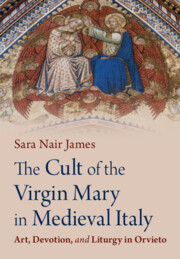
Late medieval Italy witnessed the widespread rise of the cult of the Virgin, as reflected in the profusion of paintings, sculptures, and fresco cycles created in her honor during this period. The cathedral of papal Orvieto especially reflects the strong Marian tradition through its fresco and stained-glass window narrative cycles. In this study, Sara James explores its complex narrative programs. She demonstrates how a papal plan for the cathedral to emulate the basilica of S. Maria Maggiore in Rome, together with Dominican and Franciscan texts, determined the choices and arrangement of scenes. The result is a tour de force of Marian devotion, superior artistry, and compelling story-telling. James also shows how the narratives promoted agendas tied to the city's history and principal religious feasts. Not only are these works more interesting, sophisticated, and theologically rich than previously realized, but, as James argues, each represents the acme in their respective media of their generation in central Italy.
Recommend this
Email your librarian or administrator to recommend adding this to your organisation's collection.