Refine search
Actions for selected content:
2 results
Validity condition of normal form transformation for the
 $\beta$-FPUT system
-
- Journal:
- Journal of Nonlinear Waves / Volume 2 / 2026
- Published online by Cambridge University Press:
- 19 October 2026, e24
-
- Article
-
- You have access
- Open access
- HTML
- Export citation
-
In this work, we provide a validity condition for the normal form transformation to remove the non-resonant cubic terms in the
 $\beta$-FPUT (Fermi–Pasta–Ulam–Tsingou) system. We show that for a wave field with random phases, the normal form transformation is valid by dominant probability if
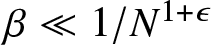 $\beta \ll 1/N^{1+\epsilon}$, with
 $N$ the number of masses and
 $\epsilon$ an arbitrarily small constant. To obtain this condition, a bound is needed for a summation in the transformation equation, which we prove rigorously in the paper. The condition also suggests that the importance of the non-resonant terms in the evolution equation is governed by the parameter
 $\beta N$. We design numerical experiments to demonstrate that this is indeed the case for spectra at both thermal-equilibrium and out-of-equilibrium conditions. The methodology developed in this paper is applicable to other Hamiltonian systems with cubic non-linearities where a normal form transformation needs to be applied.


Small-amplitude periodic travelling waves in dimer Fermi–Pasta–Ulam–Tsingou lattices without symmetry
- Part of
-
- Journal:
- Journal of Nonlinear Waves / Volume 1 / 2025
- Published online by Cambridge University Press:
- 15 August 2025, e6
-
- Article
-
- You have access
- Open access
- HTML
- Export citation
