Refine search
Actions for selected content:
1 results
The finite forms of MacMahon’s q-series
- Part of
-
- Journal:
- Proceedings of the Edinburgh Mathematical Society / Volume 69 / Issue 3 / August 2026
- Published online by Cambridge University Press:
- 02 January 2026, pp. 867-894
-
- Article
-
- You have access
- HTML
- Export citation
-
In his seminal work on partitions and divisor functions, MacMahon introduced the following two q-series:
 \begin{align*}A_k(q):= \sum_{0 \lt s_1 \lt s_2 \lt \cdots \lt s_k} \frac{q^{s_1+s_2+\cdots+s_k}}{(1-q^{s_1})^2(1-q^{s_2})^2\cdots(1-q^{s_k})^2},\qquad\quad\quad\quad\\[6pt]C_k(q):= \sum_{0 \lt s_1 \lt s_2 \lt \cdots \lt s_k}\frac{q^{2(s_1+s_2+\cdots+s_k)-k}}{(1-q^{2s_1-1})^2(1-q^{2s_2-1})^2\cdots(1-q^{2s_k-1})^2}.\end{align*}
In 2013, Andrews and Rose proved that
 $A_k(q)$ and
 $C_k(q)$ are quasimodular forms of weight
 $\leq 2k$. Recently, Ono and Singh proved two interesting identities involving
 $A_k(q)$ and
 $C_k(q)$ and showed that the generating functions for the three-coloured partition function
 $p_3(n)$ and the overpartition function
 $\overline{p}(n)$ have infinitely many closed formulas in terms of MacMahon’s quasimodular forms
 $A_k(q)$ and
 $C_k(q)$. In this paper, we introduce the finite forms
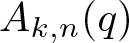 $A_{k,n}(q)$ and
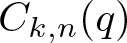 $C_{k,n}(q)$ of MacMahon’s q-series
 $A_k(q)$ and
 $C_k(q)$ and prove two identities which generalize Ono–Singh’s identities. We also prove some new identities involving
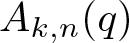 $A_{k,n}(q)$,
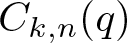 $C_{k,n}(q)$ and certain infinite products based on two Bailey pairs. Those identities are analogous to Ono–Singh’s identities.


