To save content items to your account,
please confirm that you agree to abide by our usage policies.
If this is the first time you use this feature, you will be asked to authorise Cambridge Core to connect with your account.
Find out more about saving content to .
To save content items to your Kindle, first ensure no-reply@cambridge.org
is added to your Approved Personal Document E-mail List under your Personal Document Settings
on the Manage Your Content and Devices page of your Amazon account. Then enter the ‘name’ part
of your Kindle email address below.
Find out more about saving to your Kindle.
Note you can select to save to either the @free.kindle.com or @kindle.com variations.
‘@free.kindle.com’ emails are free but can only be saved to your device when it is connected to wi-fi.
‘@kindle.com’ emails can be delivered even when you are not connected to wi-fi, but note that service fees apply.
This chapter discusses a Buddhist perspective on the idea of life as a planetary phenomenon. It concludes that while the doctrine of interdependence can accommodate this idea, the pragmatic orientation of Buddhist thought, in which the truth of an idea is tied to the extent to which it promotes liberation and happiness, carries more weight than a theory of life.
This chapter examines the notion that life exists at a planetary scale, on Earth and potentially elsewhere, from the perspective of Christian theology and some of its ancient philosophical sources. It considers life as an integrated whole, drawing on the Hebrew prophets and the notion of a “world soul” in Christian and pre-Christian philosophy, before turning to what the scholastic tradition offers for thinking about how a word such as “life” might be applied in different contexts in a different but related – which is to say “analogical” – way.
A planetary science perspective reveals that life on Earth may be fruitfully viewed as a planetary-scale phenomenon. Implications of this viewpoint for the search for extraterrestrial life, for views of the “Anthropocene epoch” in Earth’s evolution, and for the relationship between scientific and spiritual viewpoints are considered.
As our planet undergoes both chemical transformations and climate shifts, grasping the fundamental structures of the atmosphere and its interconnectedness with the Earth system is paramount. Here, a system-level approach is indispensable. This approach requires us to understand natural and man-made drivers of chemical change in the atmosphere, not as separate influences or part of an isolated system, but as closely interwoven and interactive processes in the Earth system. As we progress, it is important to cultivate an integrated understanding of atmospheric chemistry that connects across scales, from the microscopic to the global; one that incorporates human actions and potential future scenarios.
This chapter provides a brief historical overview of the origin and evolution of our atmosphere, also examining how its physical structure influences its composition. It also frames seeing the atmosphere as part of a larger Earth system. This will help us to understand in later chapters, for example, Chapters 10 and 11, how processes within Earth’s subsystems interact with and influence one another.
Scientific research on life in the universe has caught the public's imagination. This new field of astrobiology has also deepened our understanding of life on Earth. One such insight has come from planetary science. It studies life on a planetary scale in the interaction of the Earth's geology and biology. But what are the implications of seeing life on this planetary scale for the views of life in the universe held by world religions? Astrobiology, Religion, and Society takes up this question. Drawing on a dialogue between astrobiologists and scholars of religion at the Center of Theological Inquiry, this volume of essays offers a detailed account of the varied ways in which Christian theology, Judaism, Islam, Hinduism, Buddhism, Daoism, and environmental ethics consider life on this planetary scale. This book shows the value of seeing life as a planetary phenomenon for global religious understanding and ethical responsibility in the Anthropocene.
Urbanization has evolved from a symbol of human progress to a global force reshaping the Earth system. Cities, once founded in resource-rich environments, now expand into marginal areas, relying heavily on distant resources and energy-intensive infrastructure. This growth intensifies climate change, disrupts biogeochemical cycles, and creates profound challenges for water resources. Cities also hold potential as centers of adaptation and mitigation of global environmental change. As urban populations rise, understanding and managing the interactions between urban ecosystems and the Earth system are crucial for ensuring a resilient and healthy future for the majority of Earth's population.
In this chapter, the exploration of urbanization interactions with global environmental change commences. The chapter begins by defining what a city is. It then explains the physical and biogeochemical feedbacks within the Earth's system, highlighting how changes in these interactions contribute to and shape global environmental change. In this context, the Gaia hypothesis is introduced that views Earth as a self-regulating system in which living organisms, the atmosphere, oceans, and land interact to maintain conditions suitable for life. Considering urbanization within this framework emphasizes how urban processes can influence and be influenced by planetary regulatory mechanisms.
How do cities shape the planet, and how can we shape cities for a sustainable future? This book explores how urbanization drives global environmental change and how cities function as dynamic ecosystems within the Earth system. Connecting urban ecology, Earth system science and socio-environmental thinking, it provides the knowledge and perspective to understand cities not just as challenges but as critical spaces for innovation and change. From air and water systems to energy flows, biodiversity, and climate impacts, it offers clear frameworks, real-world case studies, and tools for analyzing urban ecosystems and their impacts across scales. Written in accessible language, the book is for both physical and social scientists working in urban ecology, urban planning and sustainability. It will equip advanced students, researchers and professionals with the knowledge and tools to reimagine cities as critical hubs of resilience and sustainable innovation.
We know that the Earth’s climate has changed in the past, including times when humans had yet to put in an appearance. These changes must, therefore, have been the result of ’natural processes’. So how do we know that current changes are not similarly natural? The challenge this poses for science is to understand the processes that were at work in the past, and compare them with the climate drivers, both natural and anthropogenic, at work today. There are two reasons to try to unravel the climatic history of our planet. The first might be described as its intrinsic interest. The more important reason is to see what lessons we can learn that might help us think about potential future climate change, and especially the much slower response of sea level to changes in temperature. This is the reason that it is now an important component of the IPCC process.
Chapter 3 moves on to our first constellation, the utopian vision of Planet Earth as an actor in its own right. Rather than conceiving of humans as endowed with a special status that sets them apart from both non-human animals and the planetary ecosphere, proponents of this idea sketch a hypothetical scenario that destabilizes entrenched ways of reflecting on our species’ place in the world. I approach this proposal, framed by a What-If plot line, via two stages: first, by unpacking the Gaia hypothesis as recently revisited by Bruno Latour. I posit that Gaia should be deciphered as a framework that seeks to estrange us for, rather than from, the world. In a second step, the chapter directs attention to N. K. Jemisin’s Broken Earth trilogy, proposing that this fantasy text can further tease out the elusive Gaia figure. Even if the champions of the Gaia hypothesis as well as the author of the Broken Earth trilogy assess several options, their utopianism primarily consists in the speculative opening up of novel possibilities for being and living otherwise. A fault line running through the What-If plot line is therefore its characteristic reluctance to forge concrete ways forward.
During the 1980s, Gaia was perhaps the hottest topic in the Earth sciences. Lovelock and his colleagues published ground-breaking scientific papers. A 1985 TV documentary was dedicated to the story of Gaia, including interviews with Margulis, Lovelock, Richard Dawkins, and others. In March 1988, the American Geophysical Union sponsored a Chapman conference on the Gaia hypothesis. This major scientific decade for Gaia also saw the start of a wide-ranging reconfiguration of the Earth sciences, leading in coming decades to the constitution of the IGBP and NASA’s promotion of Earth system science. However, the correspondence for this decade records the first appreciable rifts in their working relationship. Lovelock’s Daisyworld project for a computer model of Gaian self-regulation, intensively developed in collaboration with Andrew Watson, marked the first significant divergence in effort between Gaia’s primary collaborators. Lovelock and Margulis effectively repaired their collaboration not with a renewed research effort but rather with a new book project developing Lovelock’s second book, The Ages of Gaia.
In 1972 and 1973 Lovelock and Margulis composed and circulated their first Gaia articles. After initial rejections at the end of 1972, they published three co-authored Gaia papers in 1974 and a fourth in 1975, lead-authored by Margulis. After this set of original Gaia articles was published, the immediate response was muted at best. Margulis continued to work on her reconstructions of Gaia’s early evolution. However, at mid-decade, Lovelock was embroiled in the ozone controversy, putting their joint efforts on hiatus. Around 1977, Margulis revived their collaboration with a Gaian consideration of planetary atmospheres in light of data from the 1976 Viking mission to Mars. After a decade of Gaia writing in the professional article format appropriate to the introduction of a new concept, they now proceeded to book projects. As the 1970s closed, Margulis was working on her next major book, Symbiosis in Cell Evolution, while Lovelock was putting finishing touches on his first book, Gaia: A New Look at Life on Earth.
The correspondence commences in the summer of 1970, when a still untenured Margulis sends Lovelock a request for information along with offprints of her own work. The scientific collaboration of Lovelock and Margulis launched in earnest in January 1972, a year and a half after their first exchange of letters. The opening chapters of their correspondence document Margulis’s importance for both the construction and the communication of Gaian ideas. Their collaboration develops precisely as a writing partnership, with Margulis in the de facto role of in-house editor as well as co-author of their early papers. The letters exchanged in 1972 show them meticulously working through the host of technical matters intrinsic to their bold project until an initial manuscript is ready for submission. These early letters are also the most minutely specialized, as they are both still teaching the other what they need to learn in order to bring their respective specializations together.
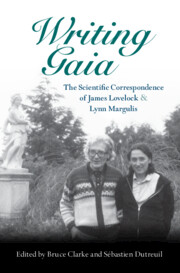
In 1972, James Lovelock and Lynn Margulis began collaborating on the Gaia hypothesis. They suggested that over geological time, life on Earth has had a major role in both producing and regulating its own environment. Gaia is now an ecological and environmental worldview underpinning vital scientific and cultural debates over environmental issues. Their ideas have transformed the Earth and life sciences, as well as contemporary conceptions of nature. Their correspondence describes these crucial developments from the inside, showing how their partnership proved decisive for the development of the Gaia hypothesis. Clarke and Dutreuil provide historical background and explain the concepts and references introduced throughout the Lovelock-Margulis correspondence, while highlighting the major landmarks of their collaboration within the sequence of almost 300 letters written between 1970 and 2007. This book will be of interest to researchers in ecology, history of science, environmental history and climate change, and cultural science studies.
This initial chapter in the carbon removal section focuses on several of the more tangential possible solutions, each of which may form a wedge in a portfolio of carbon removal solutions but will by no means constitute the primary intervention. After touching upon the Gaia hypothesis, we move to everyone’s favorite climate solution – trees. Though afforestation/reforestation appear superficially attractive and cheap, they are merely a fragile and temporary bank of carbon with a storage capacity that is woefully subscale for our problem. Bio energy with carbon capture and sequestration would ameliorate the land saturation problem that limits the capacity of forests, but is also far less green than it appears and confronts similar scaling constraints. Regenerative agriculture, blue carbon, biochar, and other soil carbon enhancement techniques are further wedges in the portfolio, but each with substantial scaling limitations. Enhanced chemical weathering faces cost problems, and ocean iron fertilization is more nearly pollution than a climate solution. While some of these techniques will prove relevant, none promises climate salvation.
Recommend this
Email your librarian or administrator to recommend adding this to your organisation's collection.