To save content items to your account,
please confirm that you agree to abide by our usage policies.
If this is the first time you use this feature, you will be asked to authorise Cambridge Core to connect with your account.
Find out more about saving content to .
To save content items to your Kindle, first ensure no-reply@cambridge.org
is added to your Approved Personal Document E-mail List under your Personal Document Settings
on the Manage Your Content and Devices page of your Amazon account. Then enter the ‘name’ part
of your Kindle email address below.
Find out more about saving to your Kindle.
Note you can select to save to either the @free.kindle.com or @kindle.com variations.
‘@free.kindle.com’ emails are free but can only be saved to your device when it is connected to wi-fi.
‘@kindle.com’ emails can be delivered even when you are not connected to wi-fi, but note that service fees apply.
Scholars have sometimes questioned whether the gothic is a genre that has any purchase on MacDonald’s writings, since his theology is so optimistic. Yet MacDonald’s fiction is replete with tropes associated with the gothic literary mode: secret chambers and labyrinthine passages, magic mirrors, battling skeletons, ghosts and supernatural voices. These figures and effects recur throughout his work, not only in the romances but also in his realist ‘kailyard’ Scottish novels. MacDonald’s work participates in a wider late Victorian turn toward a ‘realist’ gothic in which the supernatural basis of reality was a given, whether in Oliphan’s man at the library window, whose real presence is attested by several characters, or Stoker’s Dracula, who can be controlled by Catholic sacramentals. MacDonald goes further, crafting a fully gothic mystical theology, a journey into the life of God himself. His Gothic engenders an initiation into an occluded but real supernatural realm, in which, paradoxically, the fear of distance enables a closer mystical union with the divine.
‘Irish Gothic’ identifies a consensus in the critical literature in relation to the term, which has largely been applied to a set of male authors – Charles Robert Maturin, Joseph Sheridan Le Fanu, and Bram Stoker – whose novels have been read in psychoanalytic terms as allegories for the anxieties of a failing Anglo-Irish elite in the nineteenth century. However, this term largely overlooks the pervasive incidence of a Gothic mode in earlier novels from the late eighteenth century, such as those of Sydney Owenson and Regina Maria Roche. The advent of the digital archive makes readily available previously overlooked texts, such as the anonymous Adventures of Miss Sophia Berkley (1760), which allow us to significantly extend if also complicate the history of the Irish Gothic, while James McHenry’s The Wilderness (1823) is an Irish Gothic novel largely set in Pennsylvania, reminding us of the extended transnational dimension of the Irish Gothic.
‘The National Tale’ argues that we ought to consider the national tale to be a mode, rather than a genre, in that the former can operate across genres and forms (literary and non-literary). From this perspective, the national tale is a literary mode in which problems of national identity and political sovereignty are narrativised in a form that produces a solution. The intermarriage of coloniser and colonised that is found in national tales in the romance mode, notably those of Sydney Owenson (Lady Morgan), and especially her Wild Irish Girl (1806), provides a familiar instance. Equally, there are national tales that function within the genres of the historical novel and of the Gothic novel. Across these generic forms, the national tale often encodes a resistance to the modern nation-state but, in so doing, exposes the impossibility of solving the problems of sovereignty and autonomy that they identify.
‘Politics and Violence in the Irish Novel after 1922’ opens by observing that in a state that came into being with acts of violence in 1922 (followed by the Civil War), it is not surprising that novelists of the period consistently interrogate the authority to use or to justify violence. This manifests in various ways, whether in the form of the burning of the country house in Elizabeth Bowen’s The Last September (1929), a jealous murder in Elizabeth Connor’s Mount Prospect (1936), the Gothic elements in Dorothy Macardle’s Dark Enchantment (1953), or the channelling of crime fiction and the political thriller in the novels of Liam O’Flaherty. In each case, there is a concern with how authority attempts to legitimise itself through violence, articulated in a manner that would become increasingly difficult with the resurgence of political violence in the 1960s.
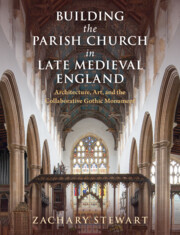
Building the Parish Church in Late Medieval England investigates the architectural, artistic, and cultural significance of local places of worship between the Black Death and the Reformation. Zachary Stewart provides the first systematic account of an exceptional type of parish church distinguished by the absence of any structural division between nave and chancel. Tracking its development across time, place, and setting, he explores how the type's integrated format not only expressed but also reinforced and reproduced collective processes related to the conception, construction, and customization of parochial space. The result, he argues, was nothing less than a new kind of public monument to collaborative action. Informed by a wealth of archival, archaeological, and architectural research, with special attention to East Anglia, Stewart's study demonstrates the importance of the parish church as a center for innovative material production in late medieval England. It also reveals how non-elite social arrangements shaped local life on the eve of the modern era.
Though considered a minor novel, A Laodicean is crucial in Thomas Hardy's career, literary art, and exploration of nineteenth-century religious issues. This is the first authoritative variorum edition of the novel, featuring a full account of its history, references, sources, and literary-religious importance. It explores Hardy's interpretation of English religious culture and his engagement with the debate between Anglicanism, Catholicism, and secularism, woven not only through its treatment of Anglican-Catholic histories of place, but also through the love lives of the main characters, connected as these are with their gradual accommodation of innate secularism alongside their growing religious interest. Alongside extensive explanatory notes, an introductory essay provides new and enlightening insights into the novel's fascinating contexts and into the process of its composition, its reception, its various editions, and the novel's rich dialects and geographies.
Gothic Masculinities in the Victorian Age explores masculinity and the Gothic in the literature of the long nineteenth century. In recent criticism masculinity in the Gothic is most usually discussed as being fractured, unstable, and threatened. Gothic Masculinities examines this fragmentation of gendered identity, but it also considers other types of arguments and representations of men in Gothic literature. The Gothic (genre and mode) is multiple, shifting, changing, multifaceted, and intertextual, and there are significant differences in the types of masculinity depicted. This Element examines the myth and deconstruction of an idealised conception of one whole, unified, hegemonically powerful masculinity, but it also examines some of the many other identities available within the practices of masculinity. The Gothic has always allowed space for subversion and the unconventional and Gothic Masculinities explores and celebrates some unexpected representations of men and their many different and sometimes surprising forms of masculine identity.
Whereas male poets such as Coleridge and Keats used the figure of the witch to explore the connections between the shapeshifting powers of the female demonic and (male) creativity, the third chapter reveals how women novelists like Charlotte Smith and Maria Edgeworth remapped contemporary cultural anxieties in Britain surrounding witches and transgressive female energies onto the colonial landscape of Jamaica. These two authors position the female practitioners of Obeah as an intriguing alternative to the degradation of women in England and the enslaved populations in the colonies.
This chapter provides an analysis of Ann Radcliffe’s representation of contemporary female artists and authors like herself and Sarah Siddons as witches or enchantresses in “On the Supernatural in Poetry,” and offers examples of the wide variety of witches in Romantic-period Gothic literature, with sections on mother witches, political witches, marvelous witches, Faustian witches and serpent witches. Romantic-era Gothic writers discussed include well-known authors such as Ann Radcliffe, Matthew Lewis, Samuel Coleridge and Charlotte Dacre as well as lesser-known writers (at least to us now) such as Catherine Smith, Mary Julia Young and George Brewer.
Written against the backdrop of ten years of visits and studies in 220 Gothic cathedrals, Gothic iconic local churches, and neo-Gothic cathedrals, this Element examines the idea of historical religious structures as 'hybrid media spaces' using grounded theory and communication and media approaches to capture the processes of communicating and erasing Christian processes of excommunicating in contemporary secular society. They show that at the current pace of societal conditions, cathedrals and iconic churches labeled as Gothic style are becoming the new platform for religious hybrid media practices and connections between religious and non-religious approaches.
This chapter explores the category of the “EcoGothic” that has emerged out of the attempt by Gothic Studies to confront the reality of the climate crisis and ideas of the Anthropocene. The Gothic is often presented as a privileged mode, given its interest in affective states of fear and horror and its ability to operate at different scales from domestic realism. It can evoke apocalypse and planetary transformations, from Mary Shelley’s Frankenstein to John Ruskin’s late lectures on storm clouds. The chapter proposes the EcoGothic be considered less as a set of objects or texts than a method of apprehension of many kinds of Victorian cultural objects. Authors discussed include Edmund Burke, Anne Radcliffe, Matthew Lewis, Charles Lyell, Charles Darwin, H. G. Wells, Robert Louis Stevenson, M. P. Shiel, H. P. Lovecraft, Algernon Blackwood, and others.
Gothic Dementia: Troubled Minds in Gothic Timelines introduces Gothic studies as a valuable lens through which to critically consider how we think about dementia. It argues that the Gothic's foundational narrative techniques can model approaches to similar dementia symptoms, such as chronological confusion, fragmentation, cyclical storytelling, repetition, unreliable narrators, unstable identities, uncanny behaviours, and Otherness. If we can navigate these challenging narrative elements in literature, can we navigate similar challenging dementia signs using interpretive strategies? Gothic Dementia considers this question in two ways: (1) through Gothic literary elements that correlate to characteristics of dementia and (2) through contentious horror film depictions of characters with dementia and their caregivers. Reading Gothic works and horror films within the context of dementia studies—and vice versa—can contribute valuable insights into a feared disease that threatens the core of who we imagine ourselves and others to be.
Anglican Gothic fiction proceeds beyond broad anti-Catholicism to consider theological problems. To some Anglican writers, the novel appealed as a more attractive vehicle for these ideas than religious tracts. In Melmoth the Wanderer, Charles Maturin articulates in novel form the ideas of an earlier sermon, which argues that specific, false doctrines of Catholicism lead to damnation. Oscar Wilde’s The Picture of Dorian Gray approaches idolatry as obstructive because it places objects between the believer and paths to salvation. Both in Carmilla and in short fiction, Sheridan Le Fanu asserts what he believes are central topics for Victorian religious debate: the implications of science for theories of the natrural order, and damnation and persecution as realities of a spiritual life.
This chapter discusses the sympathetic relationship between the gothic and sublimity regarding their serving similar social and political functions, emphasising their adaptability to the rhetorical interests of those in power in a given place and time. It then goes on to clarify their differences and consider whether they have a more ‘universal’ application than typically understood by taking a broadly historical approach, to examine the xenophobic and gendered origins of the sublime, and the ideological changes that come with the post-Kantian tradition. Rethinking the sublime as the differend identified by Jean-François Lyotard alerts us to imbalanced power relations and the demand for new idioms that give voice to the silenced, thus avoiding the sublime’s traditional claim to transcendence and therefore Western humanism. Similarly, a world-gothic sublime serves to witness the differend, the power imbalance between the ‘normal,’ who sets the terms of any tribunal, and the Other, who is silenced.
Disability is central to the Gothic imagination. This Element draws together disability and Gothic literature in ways that show the interplay between them. The first chapter offers a brief history of Critical Disability Studies, and the manner in which Gothic has been integral to the evolution of disability theory. It shows the increasing centrality of the Gothic to the development of Critical Disability Studies, and describes the emergence of the subfield of Gothic Disability Studies. The second chapter and third chapters offer close readings of particular texts, showing how Gothic bodies and minds articulate and shift their relationship to the aesthetic and affective frameworks of the nineteenth century. While disability sometimes represents the 'other' in Gothic literature, this positioning far from exhausts the ways in which disability is presented in this genre.
Chapter 4 shows how, as the Wales novel congealed into a stable genre, it began to confront the knotty problem of race. The notorious economic underdevelopment of Wales posed a problem to Scottish Enlightenment-inspired anthropologists who cast climate and religion as the determinants of standardized, stadial socioeconomic progress. Such theories failed to account for the wealth gap between Wales and England, since Wales’s climate was mostly identical to England’s and Wales had come to be understood as the heartland of British Protestantism. As authors struggled to explain Welsh impoverishment, they became increasingly willing to use race to figure the Welsh as different from Anglo-Britons in kind, rather than in degree of social development. Some authors contended that the Welsh were “negroes,” “savages,” and “men of copper,” who deviated from a phenotypically white Britishness, while others insisted they were the progenitors of a pure race destined to rule the world.
The chapter traces a period of growing self-confidence in Irish letters that might seem surprising in the context of the post-Waterloo recession but takes some of its charge from the strength and eventual success of the campaign for Catholic Emancipation. Between 1815 and 1830, Irish writers felt able to look more closely at the island on their own terms, a move that meant for many a new interest in coastal locations and the shaping force of the sea. The chapter proposes new watery co-ordinates for mapping Irish romanticism via the cases of Gerald Griffin, Charles Robert Maturin and Jeremiah Joseph Callanan.
This Element demonstrates how Poland became a gothic setting in British fiction between the 1790s and the 1830s as a result of public interest in the partitions of Poland (1772–95) and their aftermath. It first discusses the ways Minerva gothics capitalised on the appeal of the Polish cause and showcases salient patterns for the 'Gothicisation' of Poland. This is followed by two focused readings of texts – Jane Porter's Thaddeus of Warsaw (1803) and Catherine Gore's Polish Tales (1833) – that build on this tradition and further explore the potential of female gothic frameworks and the gothic's long-standing investment in war and revolution to generalise and allegorise the political turmoil in Poland. This Element argues that the idea of Gothic Poland in British fiction was negotiated between the particular and the universal, the familiar and the unknown, the need for historical and factual accuracy and the prevalent patterns of gothic obfuscation.
Donizetti's opera, based on Walter Scott's novel, is a staple of the bel canto operatic repertoire and famed above all for its vocally challenging and frequently reinterpreted 'mad scene' that precedes the lead character's death. This handbook examines the impact Lucia has had on opera and investigates why, of all of Donizetti's seventy operas, this particular work has inspired so much enthusiastic interest among scholars, directors and singers. A key feature is the sheer mutability of the character Lucia as she transforms from a lyric bel canto figure to a highly charged coloratura femme fatale, fascinating not just to opera historians but also to those working on sound studies, literary theories of horror and the gothic, the science of the mind, gender theory and feminist thought. The book places Lucia within the larger contexts of its time, while underlining the opera's central dramatic elements that resonate in the repertoire today.
Salvadore Cammarano’s libretto is based on the historical novel The Bride of Lammermoor by Walter Scott and thus invites us to examine the real-life sources for Scott’s published work. In addition, as the Scott work was published in 1819, it follows on the heels of the more famous novel by Mary Shelley, Frankenstein; or, the Modern Prometheus in 1818. Shelley’s gothic novel reveals a similar fascination with the sociopolitical environment of the early Enlightenment, as well as the spectres of madness, murder and the private lives of individuals caught up in vengeful forces beyond their control. Beyond the literary sources for the libretto, the opera also bears witness to the use of medical knowledge in defining the appearance and sound of a mentally ill young woman who has succumbed to hysteria. According to medical treatises of the time, hysteria was a disease that bore physical and emotional symptoms, the severity of which could be diagnosed with the relatively new invention of the stethoscope (1816). As Donizetti’s work premiered during a time of heightened listening, whereby audiences sought to hear within the notes of the music the inner world of the composer or the performer, the sound of pain or latent disease was now understood to reflect a lexicon of medically understood sounds that reveal themselves to the careful listener.