To save content items to your account,
please confirm that you agree to abide by our usage policies.
If this is the first time you use this feature, you will be asked to authorise Cambridge Core to connect with your account.
Find out more about saving content to .
To save content items to your Kindle, first ensure no-reply@cambridge.org
is added to your Approved Personal Document E-mail List under your Personal Document Settings
on the Manage Your Content and Devices page of your Amazon account. Then enter the ‘name’ part
of your Kindle email address below.
Find out more about saving to your Kindle.
Note you can select to save to either the @free.kindle.com or @kindle.com variations.
‘@free.kindle.com’ emails are free but can only be saved to your device when it is connected to wi-fi.
‘@kindle.com’ emails can be delivered even when you are not connected to wi-fi, but note that service fees apply.
The second decade of the twenty-first century saw emergent social movements challenge the authority of the Islamic Republic. The pattern prompted competing notions of revolution in public debates about Iranian politics. This introductory chapter posits questions regarding the subject of revolution in the debates. It identifies a shared rhetorical pattern between competing parties, who, despite their differences, construe revolutionaries as partisans. The chapter proposes an inquiry into the 1979 revolution, recovering an unexamined archetype of collective action to reframe polemics. The archetype of an insurgent witness describes the millions of people who joined mass demonstrations from December 1978 until the fall of the Pahlavi state on February 11, 1979, as both partisans and spectators. The idea departs from prevalent templates in social science studies of revolution, political theories of agency in revolutionary contexts, and extant studies of modern Iran. To see it more clearly, we may consider a perspectival comparison with Taziyeh mourning processions, in conversation with Ali Shariati’s insurrectionary speeches about the Karbala paradigm.
In 2016, the Amhara Fano movement emerged as a peaceful activist network with the stated goal of defending the Amhara against injustices attributed to the Ethiopian state. Although the Fano contributed to the 2018 political change and initially aligned itself with the transitional leaders, it eventually transformed into an armed insurgency. This article examines the political conditions and processes behind the transformation through interviews, media analysis and document review. The findings indicate that the 2018 transition generated expectations among Amhara nationalists that longstanding grievances concerning territorial claims, political marginalization and security would be addressed. However, unmet promises, the Pretoria Agreement that ended the Tigray conflict, and state-led disarmament campaigns targeting Amhara security structures strained relations between the state and the Amhara Fano. Expanding political opportunities enabled the Fano to recruit fighters, accumulate weapons, expand social networks, and strengthen organizational capacity. Yet subsequent political constraints reinforced existential threat narratives that justified increasingly militarized repertoires of contention among Fano actors. The article contributes to broader social movement scholarship by highlighting how the failure to accommodate ethno-nationalist demands can transform contentious collective action into sustained armed resistance during fragile political transitions.
How do we describe the collective identity of people who make a popular revolution? Notwithstanding marked differences, most accounts understand revolutionary collectives as partisan and relegate spectators to irrelevance – or, worse, to the ignominy of cowards and traitors. Revisiting histories of the 1979 revolution in Iran, Arash Davari explores how millions of people defied expectations and joined popular assemblies to demand the fall of the Pahlavi regime. Through the lens of recent global social movements, Insurgent Witness presents an archetype of collective identity as partisan and spectator at once. Combining novel findings with a fresh methodological approach to previously considered collections, this book presents a distinct concept of revolutionary subjectivity – one that describes the terms of mass revolt in Iran and challenges prevailing assumptions about social change and popular sovereignty in contemporary political thought.
This volume argues that the rise of the far right in Latin America represents a reactionary response to the partial success of democratic regimes in incorporating historically marginalized groups. Despite persistent inequalities, Latin American democracies have gradually weakened the dominance of traditional elites over majority–minority relations, creating fertile ground for a backlash against political, social and cultural change. Like their counterparts in Europe and the United States, far-right actors in the region resist adapting to ongoing transformations, instead invoking an idealized national past and mobilizing exclusionary ethnic, cultural, and political appeals to construct a radically homogeneous community. This volume employs a theoretical framework informed by contemporary debates on the far right in Europe and the United States and brings together leading scholars to examine key country cases across Latin America. This title is also available as open access on Cambridge Core.
Despite increases in the military capabilities of Sahelian jihadists over the last decade, similarities and differences between the fighting styles of groups with common transnational jihadist affiliations remain underexplored. This article compares the activities of the two Islamic State (IS)-affiliated groups in the wider Sahel: the Islamic State West Africa Province (ISWAP) and the Islamic State Sahel Province (ISSP). Despite a common affiliation, these groups operate in different local contexts, over a thousand kilometres apart. Similarities and differences in their military approaches can thus help us understand the respective impact of local and transnational dynamics on jihadist behaviour. Drawing on qualitative fieldwork and quantitative/geospatial analysis, this article explores this issue through analysis of strategic goals, command and control, military hybridisation, tactics/attack profiles and spatial variations. While their activities are by no means uniform, we find a growing convergence between these groups over time driven by a mix of IS influence and local dynamics.
This chapter concludes the book by revisiting its key findings and by reflecting on their meaning from a broader perspective. The first half of the chapter consists of a summary of the rise and fall of the classical doctrine of civil war as explained in the preceding chapters. The second half assesses the overall legacy of the classical doctrine in the light of modern legal theory, and observes how the classical law was hardly better able to overcome the problems of indeterminacy and recognition than current principles are. Yet this does not mean that the classical doctrine would have been meaningless, as its practical utility may have been based precisely on its limited effectiveness and inevitable ambiguity.
For the first time in its modern history, the post-2003 state faced a severe legitimation crisis, which was compounded by its inability to establish the authority to dominate. Chapter 4 argues that the fragmentation of the state’s authority resulted from the undoing of its domination capacity by the US-led invasion during the first three months of the occupation. The extent of the fragmentation was plain to see in 2003 when militia-backed political groups moved into the space where the state used to be – by the end of the 2006 civil war, those groups had firmly consolidated their demarcated domains of authority over Iraq’s economy and politics. The chapter investigates the Coalition Provisional Authority’s biggest civil project: repairing the national electrical grid. Technical and material elements of that project became sites of physical and political contestation over the state’s consolidation at a moment when its domination had disappeared. The chapter also traces the trajectory of “state-building” as an influential and ultimately dangerous framework, from its roots in 1980s US academia and 1990s UN peace-keeping practices to its arrival in Iraq with the US-led invasion.
This chapter helps readers make sense of the array of activities that can be considered as irregular warfare. As an umbrella term for a particular form of warfare, its methods consist of terrorism, insurgency, revolution, coup d’état and civil war. The chapter compares and contrasts these methods according to the level of resources they employ, their respective centres of gravity, strategic and tactical orientations, mechanism for success and duration. It provides a useful taxonomy for students seeking to better comprehend irregular warfare but narrows down subsequent study to its two most prevalent methods: terrorism and insurgency.
This chapter provides a critical analysis of the material scope of NIAC and is divided into seven sections. The first explores the material concepts of NIAC pursuant to both CA3 and APII, and explores how the drafters understood these concept and how it has been interpreted in practice. Second, it examines the concept of NIAC contained in Additional Protocol II of 1977, looking at how its distinct identity emerged, as well as its specific material elements. The second section explores some of the legal and operational challenges that arise from the existence of two categories of NIAC, and in particular how the activation of APII can fragment the applicable legal regime, resulting in fluctuating levels of protection during NIAC. The fourth section undertakes a comparative analysis of the material scope and associated threshold of NIAC pursuant to the Tadić definition of NIAC (CA3) and that contained in APII, in order to identify areas of convergence and divergence. The fifth section explores how developments in both customary and conventional IHL applicable during NIAC have influenced its material scope and, in particular, the level of organization armed groups require in order to qualify as a Party to a NIAC. Following from the conclusions of sections four and five, the sixth section assesses the continued relevance of the distinction between CA3 and APII NIACs in practice.
The book offers a critical and comprehensive examination of the concept of NIAC, including its normative foundations, threshold of activation, and corresponding personal, geographical, and temporal scope of applicability under International Humanitarian Law. It identifies and critically examines some of the most controversial aspects of modern NIACs, including notions of a 'global battlefield' and 'forever war' and provides practical guidance on identifying NIACs in real time. It is essential reading for international law academics, students and practitioners. This title is part of the Flip it Open Programme and may also be available open access. Check our website Cambridge Core for details.
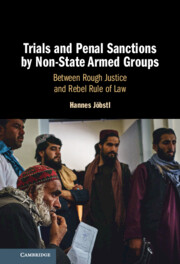
During armed conflict, non-State armed groups frequently establish their own judicial systems to resolve disputes, impose penal sanctions and implement social control. Examples such Hamas in Gaza, Rojava in Syria, or the 'People's Republics' in Eastern Ukraine demonstrate that this aspect of 'rebel governance' has become increasingly common. How can or should international law regulate the establishment of courts, conduct of trials and passing of penal sanctions by insurgent movements that challenge the judicial monopoly of states? Based on an in-depth doctrinal analysis, this study demonstrates that the administration of criminal justice by insurgents is not inherently illegal or illegitimate, and explains how to measure the conduct of armed groups against clear legal standards. Drawing on a broad range of real-world examples, this study makes a vital contribution to the law applicable in armed conflict.
Irregular war, like war, remains an enduring feature of security studies both as they relate to internal state security and sovereignty as well as to international relations. Irregular war may not always appear to hold political purposes; many today seem driven by religious ideology, but the institution of theocratic governance has a politics of its own. Thus, like regular war, irregular war is subordinate to a political purpose. Whether they occur on the periphery of regular wars or perform roles to keep state competition from escalating into conflict, irregular wars are often intricately tied to their regular counterparts. While two broad theories of counterinsurgency both claim to have prescriptions for winning an irregular fight, one – the good governance approach – is plagued by problems of implementation at the governmental level, and the other – coercion – entails unreasonable brutality against both insurgent and population, often unbefitting a liberal counterinsurgent force.
Why did the British war effort in the South fail so badly, and therefore lead to the British loss of the American mainland colonies? The British tried to solve the political problem of reunification through military means, which was always a poor fit. Further, the British continuously underrated their allies and did not use them effectively. These mistakes doomed the British war effort in the South. The region dissolved into a brutal civil war fought through guerrilla means. Neither side could win complete victory. Mistakes compounded, making British victory impossible.
The Taliban insurgency happened because they enjoyed a permissive environment: safe haven in Pakistan, state failure in Afghanistan, and an America increasingly focused on Iraq. In turn, most of those had common roots in the Bush administration’s decisions in 2001: to define the conflict as a “War on Terror” best waged with a light footprint and to conflate the Taliban and al-Qaida. Some of those decisions made sense in 2001, but none of them bore scrutiny as the situation in Afghanistan changed, and the Bush administration failed to adapt quickly enough.
The Cold War is often depicted in binary terms: communists against anti-communists, the left against the right, or the free world versus the communist world. However, during the latter part of the Cold War, particularly following the 1979 war between China and Vietnam, earlier Cold War binaries no longer applied, and new alliances were established. These alliances often brought people with the same enemies together, despite having little in common ideologically. This article examines the historical circumstances and Cold War geographies of ethnic Khmu anti-Lao PDR and anti-Vietnamese insurgents, including their alliances with right-wing governments in Thailand and the communist People’s Republic of China (PRC). As neutralists, these Khmu occupied a political space rarely discussed in relation to the Cold War. Although the PRC provided training, weapons, and supplies to the neutralist Khmu between 1979 and 1983, later their political leader, General Kong Le, had a falling out with the Chinese, and the PRC stopped supporting his largely ethnic minority soldiers. However, up until 1989, the Thai government continued to allow the Khmu to maintain bases in Thailand for launching military operations inside Laos, until the Thai government adopted the “Battlefield to Marketplace” policy. Some Khmu continued resisting inside northwestern Laos during the early 1990s, but with declining numbers of soldiers and decreased outside support, armed resistance ended in 2003. It is critical that the geographies and alliances of the later Cold War be differentiated from those of the earlier years of the Cold War. This transnational insurgency deserves attention.
The September 11, 2001, attacks on the United States further propelled the global focus on terrorism. Despite international efforts, the threat of terrorism remains throughout the world. In this chapter, the challenges in defining and analyzing terrorism are established by articulating the characteristics, structures, and motivations of groups that terrorize others. These definitions of terrorism, and the features of relevant groups, are then placed within the wider context of intrastate conflict. Key questions addressed include: Why does terrorism more frequently occur in war-torn countries? And how does its occurrence lower prospects for sustainable peace? This analysis is then used to inform modern counterterrorism methods, and how their evolution is critical for future international and national security along with peace mediation studies.
Myanmar's accidental bombings of China's Yunnan province on 8 and 13 March 2015 are symptomatic of a recent decline in Sino-Myanmar relations. This article will first examine the recent unrest in Myanmar's Kokang region that led to the bombings of Yunnan. The relationship between China and the Communist Party of Burma will be shown to connect the unrest in Kokang with the Myanmar government's long-term suspicions of China. It then shifts to a broader overview of Sino-Myanmar relations, with their close ties during the international isolation of Myanmar after 1988 shown to be one of necessity for Myanmar, which ended with Myanmar's rapprochement with the US in 2011. The final section focuses on the collapse of Chinese investment in Myanmar following the Myanmar government's 2011 suspension of the Myitsone Dam project, and discussion ends with the reminder that Chinese energy concerns, manifest in the oil and gas pipelines connecting Yunnan with the Indian Ocean, make Myanmar an essential component of China's long-term plans for its energy security, thereby making it crucial for the Chinese foreign policy establishment to seek an improvement of China's bilateral relations with Myanmar.
In this chapter we locate the question of ‘radical pedagogy’ in the current moment: a time in which insurgent social movements (such as #rhodesmustfall, #metoo, and #blacklivesmatter) are raising pertinent questions of representation, accountability and justice in society as well as at universities. We reflect on our own pedagogical-scholarly practice, and ask whether it is possible to separate language activism from other kinds of social-justice/decolonial/anti-colonial activism. In answering this question we draw on the Black racial tradition(s), and we emphasize the importance of being attuned to one’s local context. In our case this means the settler-colonial realities of post-apartheid South Africa, and the Imperial university. Being an activist-scholar means that one has to be prepared to engage in ‘difficult conversations’, with other scholars, but also with students and the wider community. These are conversations that are grounded in a willingness to ‘unlearn’ and to engage in ‘dialogics’ (Paolo Freire, 1968). One area where these ‘difficult conversations’ have gained traction is around questions of citation and curriculum: How can we teach and use citation practices that are ethically responsible? Can we develop an ethics of citation, and create a curriculum that is ethically sound?
Under what conditions do insurgents challenge gender norms in the midst of conflict? And what do they gain by doing so? Using an original data set of 137 armed groups fighting between 1950 and 2019, I argue that armed groups challenge gender customs to reshape local power relations. With 40 percent of rebel groups regulating civilian gender customs during civil war, this strategy is remarkably widespread, comparable to taxation or the provision of basic security in its prevalence. I demonstrate that armed groups exploit pre-existing gender grievances, using strategies like punishing domestic violence (9 percent of groups), banning dowries (15 percent), and enforcing dress codes (11 percent) to empower targeted subsections of the population and undermine local elites. I combine cross-national analysis with qualitative case studies of al-Qaeda in the Islamic Maghreb and Katiba Macina, two Islamist groups in Mali. This allows me to demonstrate how the approach to local elites drives gender governance in two groups with a shared ideology, goals, and societal context.
This chapter opens with a literary history of armed conflicts in the Global South, and the violent suppression of these conflicts in the name of national security in India, Nigeria, Burma and the Middle East. Situated between the world literature debate and the vernacular turn within Anglophone literary criticism, the chapter develops disruptive (ir)realism as an analytical frame, one that accounts for the multiple modalities of violence in literary texts from the Global South. The chapter traces these modalities to the violent trajectories of insurgent lifeworlds through disruptive plots, mobile narrators, botched syntax, and alternating and collapsing timelines. Such tropes of disruption, the chapter reveals, are inflected in both the aesthetic configuration of insurgent figures who lack a guiding narrative anchor, and the uneven distribution of violence among fictional communities that results in further sociopolitical cleavages. The implied move toward post-terrorism in this chapter gestures toward the social (re)distribution of violence through myriad figures: rogues, rebels, guerillas, bandits, revolutionaries, and, most importantly, insurgents.