To save content items to your account,
please confirm that you agree to abide by our usage policies.
If this is the first time you use this feature, you will be asked to authorise Cambridge Core to connect with your account.
Find out more about saving content to .
To save content items to your Kindle, first ensure no-reply@cambridge.org
is added to your Approved Personal Document E-mail List under your Personal Document Settings
on the Manage Your Content and Devices page of your Amazon account. Then enter the ‘name’ part
of your Kindle email address below.
Find out more about saving to your Kindle.
Note you can select to save to either the @free.kindle.com or @kindle.com variations.
‘@free.kindle.com’ emails are free but can only be saved to your device when it is connected to wi-fi.
‘@kindle.com’ emails can be delivered even when you are not connected to wi-fi, but note that service fees apply.
This chapter examines Turkey’s use of transnational repression, arguing that it is a function of three key drivers: threat perception in globalized conflicts, democratic backsliding under the Justice and Development Party (AKP) government, and the instrumentalization of diaspora communities for geopolitical purposes. Turkey employs diverse mechanisms ranging from direct violence and surveillance to indirect pressure through religious institutions and pro-government diaspora networks, as well as mediated approaches that leverage international organizations and diplomatic pressure. The chapter demonstrates how domestic political developments—particularly the 1980 coup, Kurdish conflict escalation, and the 2016 coup attempt—correlate with intensified transnational repression. These practices have complicated Turkey’s relationship with European states and the European Union, as well as with the US and NATO, while also contributing to brain drain via increased emigration. The case illustrates broader challenges to the liberal international order, with Turkey as an EU candidate state and NATO member able to leverage its strategic importance to limit international consequences. The chapter concludes by assessing recent political developments and the prospects for continuity or change in Turkey’s transnational repression practices.
The chapter examines the Saturday Mothers, a long-standing intergenerational movement in Turkey advocating for justice for families of the disappeared. Through a relational lens, it explores how the movement constructs a social network that fosters solidarity, collective agency, and transformative personal and political identities. The Saturday Mothers, operating as a ‘political family’, challenge conventional definitions of family by creating a space of care, empathy, and shared grief. Their horizontal and transparent structure sustains their activism across diverse political, social, and economic backgrounds. The movement’s practices address the impact of ambiguous loss, enabling families to cope with psychological isolation and social marginalisation. By reclaiming public spaces such as Galatasaray Square as symbolic sites of truth and memory, they demand holistic justice. The chapter highlights how the Saturday Mothers’ grassroots mobilisation practises a relational agency, redefining victim participation and creating a social space for truth-telling and healing beyond the limitations of formal transitional justice mechanisms.
The primary indicator of authoritarianism in Turkey has been the treatment of the Kurdish minority. This chapter supports this argument with a historical overview of the evolution of the Kurdish conflict since the late Ottoman era. In response to administrative centralisation and forced cultural assimilation policies pursued by imperial and republican governments, the Kurds resorted to armed uprisings during the single-party era and to peaceful opposition following the transition to a multiparty system. The state responded with further repression in the form of forced displacement, states of exception and special criminal tribunals. This basic dynamic has remained despite the EU- and ECtHR-induced reforms. While Kurdish cultural and linguistic rights have been gradually expanded, the Kurds' political rights are still addressed in the realm of counterterrorism laws. At the same time, Turkey's Europeanisation process opened a new era in Kurdish political mobilisation, enabling the Kurds to lobby European institutions and petition the ECtHR to expand their political and cultural rights on the one hand and expand their electoral representation powers on the other.
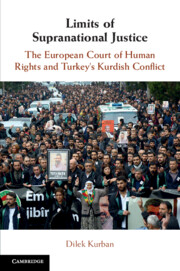
With its contextualized analysis of the European Court of Human Rights' (ECtHR) engagement in Turkey's Kurdish conflict since the early 1990s, Limits of Supranational Justice makes a much-needed contribution to scholarships on supranational courts and legal mobilization. Based on a socio-legal account of the efforts of Kurdish lawyers in mobilizing the ECtHR on behalf of abducted, executed, tortured and displaced civilians under emergency rule, and a doctrinal legal analysis of the ECtHR's jurisprudence in these cases, this book powerfully demonstrates the Strasbourg court's failure to end gross violations in the Kurdish region. It brings together legal, political, sociological and historical narratives, and highlights the factors enabling the perpetuation of state violence and political repression against the Kurds. The effectiveness of supranational courts can best be assessed in hard cases such as Turkey, and this book demonstrates the need for a reappraisal of current academic and jurisprudential approaches to authoritarian regimes.
Recommend this
Email your librarian or administrator to recommend adding this to your organisation's collection.