To save content items to your account,
please confirm that you agree to abide by our usage policies.
If this is the first time you use this feature, you will be asked to authorise Cambridge Core to connect with your account.
Find out more about saving content to .
To save content items to your Kindle, first ensure no-reply@cambridge.org
is added to your Approved Personal Document E-mail List under your Personal Document Settings
on the Manage Your Content and Devices page of your Amazon account. Then enter the ‘name’ part
of your Kindle email address below.
Find out more about saving to your Kindle.
Note you can select to save to either the @free.kindle.com or @kindle.com variations.
‘@free.kindle.com’ emails are free but can only be saved to your device when it is connected to wi-fi.
‘@kindle.com’ emails can be delivered even when you are not connected to wi-fi, but note that service fees apply.
Hoarding disorder is a mental health condition characterised by persistent difficulty discarding possessions, excessive accumulation and significant disruption to the safe use of the home. The resulting disability often impairs daily functioning and contributes to severe health and fire risks. In rented accommodation, these hazards commonly bring hoarding to the attention of landlords and local authorities, leading to concerns about property damage, access for repairs and the safety of neighbouring residents. This article outlines the essential clinical features of hoarding disorder for psychiatrists and explains the key legal implications in the UK, including possession and injunction proceedings, disability discrimination under the Equality Act 2010, safeguarding duties and the relevance of capacity assessments. Its aim is to provide a clear educational foundation for clinicians involved in assessing individuals whose hoarding behaviour has led to legal or housing intervention.
The Mental Capacity Act 2005 was not designed to, and is not fit to, provide safeguards for assisted dying. The impairment requirement puts interpersonal pressure beyond the scope of the Act. The criteria included in the Act struggle to deal with the effects of affect and motivation on decision-making even for its intended purposes and within its intended scope. The use of the Act in the Terminally Ill Adults (End of Life) Bill presents an opportunity for reform.
This Editorial introduces the Special Issue on Advance Decision-Making, Law and Mental Health. This Special Issue presents a wide range of empirical studies and perspective pieces from Irish and international authors on advance healthcare directives and other reforms in mental health and capacity law. It aims to harness an interdisciplinary approach to enrich our understanding of new legislation and how it can shape mental health practice in a person-centred way, while also tackling thorny conceptual and practical challenges in this area.
According to the Mental Capacity Act 2005, P’s family are to be afforded a consultee role in a best interests decision. That is, they are to be involved in decisions but are not empowered to act as a substitute decision maker. However, in practice, healthcare professionals can struggle to set clear boundaries where families are insistent on more active treatment. The Best Interests in Renal Dialysis Study explored the making of best interests decisions in the context of adult kidney care in England. Interviewing healthcare professionals – both doctors and nurses – we found that it is not uncommon for the ‘path of least resistance’ to be pursued in best interests decisions where the family takes a strong position. Out of a fear of legal action and a desire to maintain a working relationship, healthcare professionals will sometimes compromise in providing care that they do not consider to be in P’s best interests to appease the family. This is seemingly at odds with the requirements of the Mental Capacity Act 2005, particularly where it goes as far as to prove harmful to P. Drawing on Margalit’s conception of rotten compromise, we argue that this form of rotten medical compromise undermines the law’s recognised P-centricity.
This chapter explores working memory as the central cognitive deficit associated with dyslexia, emphasising its critical role in learning, reasoning, and performance. Working memory is described as a limited-capacity system responsible for holding and manipulating information over short periods. The authors differentiate between components of working memory – such as auditory and visual memory – and demonstrate how deficits in these areas can affect tasks such as reading, writing, problem solving, and conversation. Drawing from psychological theory and empirical research, the chapter discusses how working-memory inefficiencies underlie many of the behaviours and skill deficits seen in people with dyslexia. Examples include difficulty following multi-step instructions, forgetting verbal information, and being unable to manage competing demands. The authors also highlight how limitations in working memory can result in performance inconsistencies, which are often reported by clients. Assessment using tools such as the WAIS-IV helps identify these weaknesses and guide support strategies. Ultimately, this chapter reinforces the view that dyslexia is best understood not solely through academic outcomes but through an understanding of the cognitive systems that support performance – particularly working memory.
The introduction of the Assisted Decision Making (Capacity) Act in Ireland and developments in capacity law elsewhere prompt further consideration of our understanding of capacity and how we assess it.
Methods:
This is a perspective piece on the role of emotion in the decision-making process, and how this impacts on our understanding of capacity. Both normal and pathological emotional states are reviewed in terms of their influence on decision-making. Capacity assessments are then considered, and whether sufficient account is taken of emotions here.
Results:
The paper considers whether we need to change the legal test for capacity to take sufficient account of emotions, based on the foregoing discussion.
Conclusion:
Finally the paper makes recommendations for supporting capacity in light of our knowledge of the impact of emptions on decision-making.
In this article, I explore how the mental health and mental capacity laws in England and Wales can be used for suicide prevention. I criticise the use of compulsion for persons diagnosed with a mental disorder who nonetheless retain decision-making capacity and argue for a greater reliance upon capacity as a distinguisher between autonomous decision-making about the end of life and the risk to life posed by symptoms of mental illness. The label of ‘suicide’ is also criticised as an outdated legal notion carrying pejorative meaning. Although focused on the law in England and Wales, the arguments apply much more broadly to all jurisdictions seeking to reconcile the demands of respect for life and respect for autonomy.
The ability to manage money is essential for independent functioning but highly sensitive to cognitive decline. Managing money involves more than deploying skills rationally; it is influenced by a range of emotional and psychosocial factors. There is relatively little knowledge about how older adults, families and care professionals working with older people navigate and experience potential challenges of declining mental capacity to manage money. This article draws on a UK-based study involving 13 older people and/or family members and 28 social sector professionals, and their experiences of supporting older people with cognitive decline to manage money, triangulated with public information resources from major national organisations across the health, care, consumer and charity sectors. It focuses on the emotive and personal nature of cognitive decline and money management. Declining mental capacity to manage money can strike at the core of people’s sense of who they are, leading to strong tensions and difficulties in discussing support. Support to manage money is often framed in discussions as ‘there if we need it’; this can be reassuring for people, but may be challenged if there are subsequent disagreements and changes in perspectives about the detail and timing of support. These nuances are not well reflected in public information resources, which largely emphasise administrative procedure. Financial organisations may lack empathy that declining mental capacity to manage money is extremely challenging. The article highlights a greater need for recognition of the emotional and psychosocial complexities presented by declining mental capacity to manage money in later life.
During the first half of the nineteenth century, Mid-Atlantic States expanded guardianship to include habitual drunkards. Legislators in Pennsylvania, New York, and New Jersey empowered courts to put habitual drunkards under guardianship, a legal status that stripped them of their rights to own property, enter into contracts, make wills, and, in some states, even vote. Amid the dramatic nineteenth-century expansion of male suffrage, the habitual drunkard signified a masculine failure of self-government that disqualified propertied men from the privileges of full citizenship. The struggle to define habitual drunkenness, detect the habitual drunkard, and put him under guardianship transformed the courtroom into an arena for contesting the thresholds of compulsion, policing respectable manhood, and drawing the borders of full citizenship in the nineteenth-century United States.
Continues the discussion of mental capacity with expansion of the debates brought by the romantic perspective. Presents the political demand for radical equality coming from left romanticism with its wild ‘abolitionist’ agenda on the one hand, and a seeding of some new social approaches to capacity assessment on the other. A deeper inquiry into mental capacity and mood disorder using romantic ideas of temporality is presented as additional stimulus for the evolution of mental capacity. Some characteristics of mental capacity fitting it to a ‘superconcept’ are explained, which may guide future interdisciplinary research and teaching.
Introduces the concept of mental capacity as a key meeting point between human freedom and mental disorder/disability. The emergence of a functional test of mental capacity, away from status and outcome tests, is discussed. An account is given of how the functional idea has been operationalised in mainly US–UK law and field tested in cases before a specialised court in England. This process is viewed as a classic one involving the public use of reason within a parliamentary democracy. Study of it has shown that an important romantic concern about the functional test (namely, that it overlooks the emotional or valuational aspects of human nature with an intellectual bias) are less compelling than was thought.
Psychiatry is medicine's most multi-disciplinary specialty and arguably its most intellectually and emotionally demanding. It has long attracted dual interpretations from cool, detached perspectives valuing objectivity (classic) to hotter, embodied and more political perspectives valuing subjectivity (romantic). Professor Owen argues that psychiatry should become more aware of classic and romantic threads that run through it. He approaches core topics in psychiatry and throughout the book both research and case material are used to animate the concepts. The author relates psychiatry to questions in philosophical anthropology and ethics. He presents human nature, mental disorder, and human freedom as inherently inter-related. This is a book of broad appeal to anyone interested in psychiatry and why this branch of medicine has ethical, legal and political significance.
To explore current and potential upcoming legal provisions concerning advance healthcare directives in psychiatry in Ireland, with particular focus on clinical challenges and ethical issues (e.g., self-harm, suicide).
Methods:
Review and analysis of selected relevant sections of the Assisted Decision-Making (Capacity) Act 2015, Assisted Decision-Making (Capacity) (Amendment) Act 2022, Mental Health Act 2001, Mental Health Bill 2024, and Criminal Law (Suicide) Act 1993, and relevant publications from Ireland’s Medical Council and Decision Support Service.
Results:
The Assisted Decision-Making (Capacity) Act 2015 outlined new procedures for advance healthcare directives. The Assisted Decision-Making (Capacity) (Amendment) Act 2022 specified that advance healthcare directives relating to mental health are binding for involuntary patients unless involuntary status is based on Section 3(1)(a) of the Mental Health Act 2001 (i.e., the ‘risk’ criteria). The Mental Health Bill 2024 proposes making advance healthcare directives binding for all involuntary patients. In relation to suicide and self-harm, the Criminal Law (Suicide) Act 1993 states that ‘a person who aids, abets, counsels or procures the suicide of another, or an attempt by another to commit suicide, shall be guilty of an offence’, and the Decision Support Service advises that healthcare professionals are exempted from criminal liability if complying with a valid and applicable advance healthcare directive that refuses life-sustaining treatment, even where the directive-maker has attempted suicide.
Conclusions:
Considerable public and professional education are needed if advance healthcare directives are to be widely used. The ethical dimensions of certain advance directives require additional thought and, ideally, professional ethical guidance.
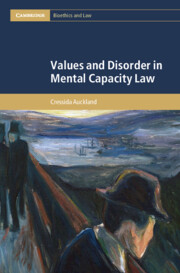
This book draws on the disciplines of law, philosophy, and psychiatry to interrogate whether the Mental Capacity Act 2005 meets the challenges posed by mental disorder to decision-making. It is often assumed that to allow space for individuality, any test for capacity must focus only on decision-making processes and not on the substance of the values that underpin decisions. Auckland challenges this assumption, arguing that the current law serves merely as a façade, behind which judgements can be made about the nature of a person's values, free from proper scrutiny. This book provides an in-depth analysis of when and how a person's disordered values should be relevant to the determination of their capacity, offering novel suggestions for reforming the capacity test to better reflect the impact of disorder on decision-making. It also explores the implications of this analysis for people found to lack capacity, concluding that reforms to the best interest provisions are urgently needed. This title is part of the Flip it Open Programme and may also be available Open Access. Check our website Cambridge Core for details.
This chapter reviews the Mental Capacity Act (2005), and Deprivation of Liberty Safeguards (Liberty Protection Safeguards). It reviews how to assess capacity, using the two-stage test, followed by when it is appropriate to undertake best interests meetings. Some of the main decisions are reviewed which are likely to be relevant to people with dementia, such as care and residence, managing finances, and deciding on medical treatment.
To make a valid will, a person should be able to understand the nature and consequences of doing so, the extent of their estate and the claims others may have on it. No disorder of mind should be present that would affect their testamentary decisions, and clinicians are therefore often asked to give an opinion on whether a person has testamentary capacity. This article discusses the legal issues involved, with reference to UK case law (in particular, the legal test of Banks v Goodfellow (1870)), and outlines the requirements of testamentary capacity assessment (including retrospective assessments), the clinician's responsibilities when requested by a solicitor to make an assessment of capacity (‘the golden rule’) and what they might expect if appearing in court to give expert witness regarding testamentary capacity. Fictitious case studies are presented illustrating certain points in testamentary capacity assessment.
This chapter discusses defences, which are a fundamental part of criminal law, and reflect important limitations on the proper scope of punishable conduct. It is the purpose of this chapter to set out and critique the law relating to defences, in both treaty-based and customary international law. This chapter is concerned with substantive defences; it does not deal with issues such as immunity, youth, ne bis in idem, or limitation periods.
This chapter will explore how the provisions governing best interests assessments ought to be reformed so as to better ensure that an agent’s authentic desires are being prioritised in decisions being taken about them. The starting point should be that the assessor ascertains ‘so far is reasonably practicable’ the individual’s wishes, feelings, beliefs, and values. This should then be supplemented by a presumption that the agent’s wishes and feelings will be determinative of what is in their best interests, except when giving effect to them will expose the person to a risk of significant harm. Even where the harms are significant, however, there will still be occasions where the agent’s wishes and feelings should nonetheless take precedence; where to do otherwise would involve frustrating their deeply and authentically held beliefs, values, or commitments. This chapter will highlight some of the potential considerations which ought to guide assessors in these circumstances. It will propose that assessors be provided with a list of factors that they must take into account when determining the degree of weight to be ascribed to the agent’s wishes, which reflect these considerations.