To save content items to your account,
please confirm that you agree to abide by our usage policies.
If this is the first time you use this feature, you will be asked to authorise Cambridge Core to connect with your account.
Find out more about saving content to .
To save content items to your Kindle, first ensure no-reply@cambridge.org
is added to your Approved Personal Document E-mail List under your Personal Document Settings
on the Manage Your Content and Devices page of your Amazon account. Then enter the ‘name’ part
of your Kindle email address below.
Find out more about saving to your Kindle.
Note you can select to save to either the @free.kindle.com or @kindle.com variations.
‘@free.kindle.com’ emails are free but can only be saved to your device when it is connected to wi-fi.
‘@kindle.com’ emails can be delivered even when you are not connected to wi-fi, but note that service fees apply.
Chapter 4 shows how the emergence of novel policy beliefs led to the adoption of globalized state-led development. It documents the policy beliefs of policy-makers from the Brazilian Workers’ Party regarding the benefits of state support for nationally controlled MNCs for the country’s long-term development. It traces the emergence of these novel policy ideas to the epistemic and policy learning of policy-makers and shows how these ideas guided industrial policy and BNDES reform. To further validate the argument, the chapter addresses competing explanations for policy adoption centered on political coalitions, macroeconomic conditions, and business pressures.
The introduction presents the book's core puzzle of why states promote the outward investments of national firms despite the political and distributional costs of doing so. It previews a theory of globalized state-led development whereby policy-makers promote the internationalization of domestic business to pursue the structural transformation of their home economies. The chapter also describes the book's research strategy of within-country and cross-national comparisons of globalized state-led development in Brazil and China.
European corporations have recently discovered vast quantities of oil and gas in Namibia, presenting significant opportunities and risks. Business and human rights (BHR) principles should be applied to the projects, but this paper is motivated by a concern that extant BHR norms are partial and inadequate, particularly in light of global economic and environmental crises. Starting from a critique of liberal human rights, this paper develops a human rights realisation-oriented vision of BHR designed to capture the root causes of harm and to enforce developmental objectives upon corporations. We study the African philosophical concept of ‘Ubuntu’, the 1970s UN Code of Conduct on Transnational Corporations, and a 2023 report on business and the right to development to develop specific principles underlying this more comprehensive version of BHR. In conclusion we argue that a more confrontational and egalitarian vision of BHR is needed to address today’s grand challenges.
Chapter 6 studies the effects of state support on firm internationalization. Based on an original dataset of the history of the foreign production and innovation investments of large Brazilian MNCs, it compares the internationalization trajectories of supported and non-supported MNCs before and after state support is introduced. Using a difference-in-differences design, it provides evidence of the effectiveness of state support for MNCs: Supported firms outpace non-supported firms both in access to markets (measured by number of host countries and access to free trade agreements) and knowledge (measured by the innovation ecosystems of the host countries and whether they establish a research and development center abroad). It further probes the mechanisms underlying this effect, relying on in-depth interviews with firm managers of supported firms and bank bureaucrats, the chapter shows that BNDES’ relational banking approach can explain why BNDES support generates positive results despite evidence of political considerations in allocation decisions.
Chapter 2 presents a theory of globalized state-led development that helps us understand the conditions under which this model is adopted and implemented. It begins with the developmentalist dilemma faced by states: how can they help national firms benefit from global markets while managing the domestic political tensions these interventions provoke? This tension has important points of comparison with the challenges faced by the East Asian developmental states, yet has become more acute. Globalization and democracy have deepened the developmentalist dilemma by increasing the relevance of international production and innovation networks, constraining policy space, and heightening political contestation. A theory of globalized state-led development explains the conditions under which governments navigate these competing pressures by supporting national firms at home and abroad.
Chapter 7 examines how relational banking operates through in-depth case studies of the ties between the BNDES and two Brazilian MNCs: JBS (an agribusiness firm) and TOTVS (an information technology firm). This case selection explores the comparative advantage-conforming and defying components of Brazil’s globalized state-led development. Through this granular empirical approach, the reader can observe the state’s interventions at the firm-level and isolate the precise levers and sequence through which the state influences firm behavior. The chapter presents both attitudinal (firm managers recognize the relevance of the state) and behavioral (support is temporally and sequentially connected to changes in the firm’s foreign investment portfolio) evidence that state financing shapes the internationalization trajectory of firms and helps states achieve their industrial policy goals.
The accountability gap in Africa’s extractive sector is not a result of the absence of binding legal frameworks or investment regulations. The African human rights system has advanced global jurisprudence by introducing and applying innovative human rights and investment norms. Despite the robust human rights regime, including legally binding regional norms for redressing human rights abuses, local communities continue to suffer the consequences of extractive MNCs’ egregious human rights abuses without access to remedies. Corporate impunity is often fueled by governments’ reluctance or inability to hold these corporations accountable and by local communities’ limited access to effective remedies. While extractive MNCs in Africa are legally obligated to respect human rights, the continent needs a robust enforcement mechanism and the political will to hold defaulting enterprises accountable. Hence, I propose strategies to implement the region’s rich human rights and investment initiatives and to narrow the accountability gap in the extractive sector.
This book explains how and why major developing countries like Brazil, China, and India globalized state-led development by creating homegrown multinational corporations. It explores how this strategy allows national firms to access new sources of profits, knowledge, and technology by producing and innovating across the globe. Drawing on an in-depth study of Brazil, alongside comparative analyses of China and India, the book demonstrates how development banks enable governments to influence business strategies and navigate political contestation. Moving beyond accounts that portray globalization and democracy as constraints on industrial policy, the book shows that late developers have changed the strategies for, but not renounced the ambition of, the structural transformation of their economies. This title is part of the Flip it Open Programme and may also be available Open Access. Check our website Cambridge Core for details.
This chapter examines the emergence of the CCMCE, a legal/structural innovation that transformed the multinational firm into a constellation of legally separate but operationally unified corporate entities. Tracing its origins to the late nineteenth century, the CCMCE emerged from evolving doctrines of corporate personhood, limited liability, and the state’s adoption of territorial sovereignty as a legal principle. The pivotal shift occurred with New Jersey’s holding company laws (1888–96), enabling corporations to own other corporations and organize control through pyramidal structures. Combined with the formal recognition of intangible property – such as goodwill and future income streams – this model allowed firms to optimize control, risk, and regulatory positioning across jurisdictions. The CCMCE’s international diffusion, initially driven by practical business needs, soon enabled new forms of jurisdictional arbitrage, as corporate groups leveraged legal fragmentation to separate tangible operations from regulatory liabilities. By embedding the firm in a network of legally autonomous subsidiaries, the CCMCE model created opportunities to exploit the ‘law of two prices’ and selectively engage national regulatory regimes.
This chapter advances the argument that jurisdictional arbitrage is not merely a tactic of tax or liability avoidance, but a distinct form of power – rooted in autonomy, control, and legal engineering – that enables CCMCEs to reshape their operating environments. Drawing on insights from corporate strategy, international political economy, and the CORPLINK project, it reframes arbitrage as a modality of power akin to the creation of a ‘hidden empire’. Through the modular structure of the CCMCEs, MNCs exploit legal and jurisdictional fragmentation to escape regulatory constraints, minimize costs, and amplify market valuation. This structural agility insulates them from state oversight, enabling them to strategically socialize costs and privatize gains. Unlike traditional theories that depict corporate power as relational or behavioural, the chapter argues for a third dimension: power as autonomy – the ability to opt out of constraints by rearranging legal structures. This form of rule-based transgression is monopolized by a global elite of corporations, investors, and advisory firms who exploit regulatory differences not by violating rules but by mastering them. Jurisdictional arbitrage, then, is a primary mechanism of modern corporate power and a central driver of global inequality.
This chapter examines the obligations and responsibilities for protecting human rights and it does so by focusing mainly on ways in which states and other entities contribute to the violation of human rights standards. One of the major questions addressed here is whether the human rights obligations of states end at their territorial borders, or whether they also have extraterritorial obligations as well.
After highlighting patterns of types and targets of human rights violations, we introduce the main perpetrators. Trying to understand what motivates them, and, more importantly, how they can be constrained, is key to improving respect for human rights. We start by introducing a theoretical framework that helps us understand why human rights are violated. Why do peaceful forms of communication and negotiation collapse in favour of violence and destruction? Are acts of atrocity born out of rational calculations or are they the product of erratic and unpredictable behaviour? We then apply this theoretical model to understand the behaviour of the most common perpetrators of life integrity violations, the military and the police, as well as less prominent perpetrators, such as militias, rebel groups, and criminal cartels. Throughout this chapter we focus primarily on perpetrators of physical violence but integrate brief examples of other types of human rights violations.
The quest for corporate accountability remains unabated in the business and human rights (BHR) field. This paper examines the role of multinational corporations (MNCs) and Business Interest Associations (BIA) as entrepreneurs, antipreneurs and saboteurs in setting human rights standards. Through this conceptualization, this paper argues that corporate accountability remains elusive because of corporate actors’ normative power and influence in the BHR norm contestation. It attributes corporate actors’ influence in the norm contestation to the UN multistakeholder design that sees nonstate actors as partners and stakeholders in setting global human rights standards. This article then argues that to force a norm change in the BHR field, there is a need to rethink the BHR governance model. Corporate actors must be reconceptualized as ‘regulated individuals’ during norm discussions and standard-setting processes.
Human rights due diligence (HRDD) is a buzzword in business and human rights (BHR) activities. However, multinational corporations (MNCs) often conduct it as a tick-box exercise without transparency. Using a relational contract theory, this article argues that when MNCs contract with local communities through community development agreements (CDAs) to perform HRDD, such contracts are internationalized relational contracts that attract a level of good faith. An established principle in international economic law, good faith serves as a standard for assessing conduct designed to discharge obligations in international contracts between states and MNCs (investor-state contracts). Similar to how investor-state arbitration tribunals use good faith jurisprudence in regulating the relationship between states and MNCs, this article proposes a BHR good faith jurisprudence to prescribe how HRDD obligations should be discharged. The article concludes that a good faith interpretational exercise in BHR would (1) reduce MNCs’ cosmetic compliance with HRDD principles; (2) increase transparency in the HRDD exercise; and (3) become a source of rights for local communities to enforce corporate accountability.
The chapter sets off by examining the theoretical bases upon which a non-state actor (NSA) may be deemed to possess human rights obligations and critiques the various approaches put forward by states and the scholarly community. It then goes on to examine a variety of NSAs along with their own distinct position as regards their human rights role. Some NSAs, such as international financial institutions (IFIs), take a legalistic approach to the matter and are generally wary of accepting even the more fundamental obligations, whereas other actors are keen to achieve a broader human rights agenda and are thus willing to accept some human rights commitments. Besides intergovernmental organisations we also focus on multinational corporations (MNCs) and the way in which their operations have a significant impact on the rights of populations worldwide. It shall be demonstrated that, while their human rights ‘obligations’, if any, have largely arisen as a result of voluntary undertakings, they are now entering a hybrid phase of limited regulation, or at least of an attempt at regulation. Finally, we shed some light on national liberation movements and rebel groups and their distinct responsibilities under international humanitarian law (IHL).
During the 1970s, governments increasingly expressed concerns about the loss of revenue through the use of tax havens by both individuals and corporations. This article explores a covert international working group (the Group of Four) set up between France, Germany, the United Kingdom, and the United States in 1969 in response to such concerns. At regular meetings, officials exchanged information gathered by their respective tax authorities in auditing multinational companies. In the 1980s, under increasing pressure from governments in a now much more hostile climate to tax authorities, the Group’s work shifted away from multinationals and toward more general, technical questions. The history of the Group of Four illustrates the importance of the 1960s and 1970s as a period for regulating economic actors and the impact of broader circumstances on the success or failure of anti-tax avoidance measures.
This chapter underlines the need for contextualism in showing that small and medium enterprises (SMEs) are more suited than multinational enterprises for wider corporate social responsibility (CSR) activities and impacts in developing and emerging markets. While highlighting institutional conditions for enabling socially responsible practices by firms, it is argued that an appropriate regulatory environment is necessary to enhance the potential of SMEs.
Globalisation has placed democratic institutions under severe pressure as economic actors seek to take advantage of the disjuncture between national political governance and transnational economic activity. This chapter provides an introduction and overview as to the key themes to be addressed in the book. In particular, we highlight the debate between different approaches to democratic representation and associational democracy which is the theoretical framing for the remainder of the book: representation as claim versus representation as structure.
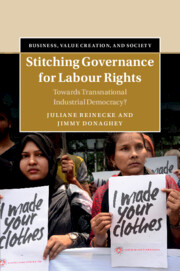
Transnational labour governance is in urgent need of a new paradigm of democratic participation, with those who are most affected - typically workers - placed at the centre. To achieve this, principles of industrial democracy and transnational governance must come together to inform institutions within global supply chains. This book traces the development of 'transnational industrial democracy', using responses to the 2013 Rana Plaza disaster as the empirical context. A particular focus is placed on the Bangladesh Accord and the JETI Workplace Social Dialogue programme. Drawing on longitudinal field research from 2013–2020, the authors argue that the reality of modern-day supply chain capitalism has neither optimal institutional frameworks nor effective structures of industrial relations. Informed by principles of industrial democracy, the book aims at enhancing emerging forms of private transnational governance as second-best institutions.