To save content items to your account,
please confirm that you agree to abide by our usage policies.
If this is the first time you use this feature, you will be asked to authorise Cambridge Core to connect with your account.
Find out more about saving content to .
To save content items to your Kindle, first ensure no-reply@cambridge.org
is added to your Approved Personal Document E-mail List under your Personal Document Settings
on the Manage Your Content and Devices page of your Amazon account. Then enter the ‘name’ part
of your Kindle email address below.
Find out more about saving to your Kindle.
Note you can select to save to either the @free.kindle.com or @kindle.com variations.
‘@free.kindle.com’ emails are free but can only be saved to your device when it is connected to wi-fi.
‘@kindle.com’ emails can be delivered even when you are not connected to wi-fi, but note that service fees apply.
This chapter proposes an approach to social science inquiry suited to the Iranian case and, more broadly, to the silences that constitute revolutionary mobilization and memorialization. With reference to a partial archive of interview data with people who experienced the mass uprisings of late 1978 and early 1979, and analytical statements they made in interviews about their experience of popular assemblies, the chapter shows how individual accounts from opposing ideological positions and social classes converged around a shared concept of collective identity in the image of Zaynab bint Ali. The chapter weaves between interviews conducted with pro-Khomeini Islamists active in Iran during the late 1970s (all of whom were men) and interviews conducted with women from leftist groups or unaffiliated members of the population as well as stories from a women’s daily magazine published at the time. It shows that narrative reception and judgment play an important role in revolutionary action, the representation of which augurs a comparative methodology for social science inquiry about revolution in the Global South.
Transcription is a key part of oral history practice. Transcribed text is often the main way in which a wider audience engages with an oral history interview, and even as the possibilities for digital and multimedia presentation become wider, text remains an important component of how interviews are received and understood. Drawing on examples from our research on memories of the Troubles in Ireland, we argue that oral historians need to think creatively and conceptually about the effects of transcription, particularly in terms of how complex narratives are received and understood. We offer some examples of how creative forms of transcription can shape engagement with these narratives and with ideas of composure, coherence and memory.
This chapter explores the archive strand of the Manchester Voices project, focusing on the analysis of historical speech recordings from Greater Manchester, particularly oral history interviews conducted in the 1980s in Oldham. Originally intended as a comparison to contemporary data, these recordings became central during the Covid-19 lockdown. The analysis focuses on rhoticity (the pronunciation of postvocalic /r/), a feature now rare in most of England but variably present in the archive data. Using both acoustic and auditory methods, the team tracked rhoticity across six speakers, revealing intra-speaker variation linked not only to linguistic context but also to social meaning. The chapter uses Lectal Focusing in Interaction to explore how shifts in rhoticity relate to speakers’ orientations toward tradition, modernity, and personal identity. The findings suggest that rhoticity can index alignment with older values or ways of life, while non-rhoticity may be linked to modernity and change. This chapter highlights how variation in archived speech can offer insight into past social meaning and ongoing processes of language change.
Chapter 2 studies common and sometimes confusing linguistic expressions in the song lyrics found in the Cantares Mexicanos. The chapter breaks down the many elements of the songs, including typical vocabulary, vocables, Spanish loanwords, micropoetics, metaphors, and then contextualizes them in the larger framework of phrases and stanzas. Finally, the chapter considers whole compositions and engages with new understandings of Aztec (or Mexica) songs that suggest the lyrics were composed in layers and woven together into large compositions. The chapter shows that we are now able to study the lyrics with a clearer grasp of the grammar than we used to have and that they are neither wholly abstract nor impossible to understand.
The 1940s were a formative and divisive decade in modern Greek history, leaving enduring scars on society. This study explores the ethnic dimension of the Greek Civil War (1946–1949) through the lens of conflicting collective memories and political identities in northern Greece’s Kastoria region. Drawing on oral history interviews conducted with local residents and secondary sources, it examines how two key ethnic groups in the area — the Dopii and the Pontians — developed divergent narratives of the 1940s. The analysis shows how wartime experiences and postwar persecution shaped each group’s memory of occupation and civil conflict, which in turn reinforced distinct ethnic identities and political affiliations. Over time, these narratives of victimhood and blame became central to group identity, although recent generational changes and new social realities began to soften the divisions. The findings underscore the dynamic interplay between memory, identity, and historical trauma in a multiethnic context, illustrating how the civil war’s legacy continues to shape local identities and intergroup relations, albeit with diminishing intensity over time.
Throughout the Syrian conflict (2011–2024), cultural heritage was both a deliberate target and an incidental casualty. Damage to the complicated relationships between communities and local and regional heritage has a much longer lineage. This article draws on oral histories conducted during the recent conflict to explore the relationship between the major archaeological site of Dura-Europos and local communities and stakeholders. It argues that some foreign-led excavations have had negative impacts upon Middle Eastern communities and their relationships with heritage, and that historic and ongoing community relationships to archaeological heritage need to be considered with increased attention and care.
A long-standing debate in oral history centres on the researcher’s positionality as either an ‘insider’ or ‘outsider’ to the research participants. This comment argues that insider status is not a stable but a relational category, one that must be critically interrogated to avoid privileging insider perspectives. Reflecting on thirteen life-history interviews with South Asian scientists who undertook postgraduate training at post-war British universities, I examine how the normative assumption of a shared ‘South Asianness’ shaped my negotiation of the insider/outsider positionality continuum. My positionality as a South Asian researcher in the UK studying previous generations of South Asian students certainly reduced intersubjective distance with interviewees. However, the presumption of insider status also exposes the instability of identity-based claims to authority. The immense heterogeneity of nationality, language, age, class, gender, occupation, educational and migration trajectories of the interviewees complicated any straightforward claim to insider status on my part. By examining how shared identity both enabled and complicated the research encounter, this comment destabilises the insider/outsider dialectic underpinning research positionality, arguing instead that positionality is a shifting intersubjective condition, constituted through an iterative process of reflexive praxis within historical research and analysis.
In this article I suggest looking at memory as a symbolic field animated by the emotional tensions that emerge from popular interpretations of state hegemonic narratives. These affective engagements challenge the binary framings of memory as a contested project between the elite’s script and the resistance from below. Using the iconography of the Brazza Mausoleum, I argue that colonial memory in Congo acts as a spectral force through which the grievances from the colonial past convey meaning to the frustrations experienced through the postcolonial state. Colonial history returns as a phantom haunting the unfulfilled promises of the independent state.
This chapter analyses a set of rarely utilised recorded interviews produced by linguist Lorenzo Dow Turner with formerly enslaved people in the 1930s. This chapter argues that through using oral history and memory studies methods, recorded testimonies provide historians with unique opportunities to consider formerly enslaved people’s memories about, and feelings towards, slavery. In their interviews, the elderly African Americans evidenced the complex long-term emotional legacy of slavery: the lingering emotional impact of violence, the communal fear of slavery’s return, the anger about exploitative labour regimes and the pride they felt in their labour achievements. Despite this complex emotional legacy, the interviewees composed their memories with statements of survival and hope, utilising these emotions as scaffolds to create a coherent narrative of their life from slavery into freedom. In doing so, formerly enslaved people created their own emotional framework to understand and document slavery’s impact, counteracting white people’s continued attempts to present slavery as a benevolent institution and restrict African Americans’ emotional expressions.
La historia contemporánea de la solidaridad internacionalista está compuesta por miles de trayectorias anónimas que estuvieron inmersas en las grandes trasformaciones globales del pasado siglo. La multiplicidad de sujetos, silencios y barreras socioculturales sostenidas a lo largo del tiempo ha dificultado el acercamiento interdisciplinar desde la historia oral al estudio de una realidad particularmente influyente en territorios como Cuba. El análisis histórico de cuarenta testimonios inéditos relacionados con la proyección externa del proceso revolucionario introduce nociones desconocidas en torno al impacto de un fenómeno que ha marcado a sucesivas generaciones de cubanos desde la década de los sesenta hasta la más inmediata actualidad. Las diversas perspectivas recogidas sobre las raíces, dimensiones y legados de la solidaridad internacionalista revelan un heterogéneo mosaico de experiencias subjetivas que trascienden las narrativas institucionales producidas alrededor de un horizonte todavía presente en los desafíos actuales de la sociedad cubana contemporánea.
Drawing on methods from the history of emotions to study enslaved people's lives, Beth R. Wilson exposes the social, cultural and political role that emotion played in the US South. Exploring both individual and collective emotions, Wilson shows how enslaved people resisted white people's attempts to restrict their feelings and expressions by developing their own emotional ideals and expectations. Moving through case studies that examine a range of underexplored forms of testimony, the book introduces readers to slave narratives, letters, written interviews and recorded testimony to show that emotion was central to how enslaved people resisted, survived and remembered the system of slavery. Enslaved people's descriptions of their individual experiences of love, pain, grief and joy are woven throughout this study, which provides a framework that historians can use to paint a nuanced, detailed and empathetic picture of the complex emotional impact of slavery.
Community-based archaeology does not always arrange itself cleanly into standard frameworks of practice. As archaeologists, our relationships with communities are situated and emergent. It stands to reason that our methods should be as well. Several years ago, as a graduate student at the start of a community-based project, I remember my anxious desire for a roadmap—a prescribed set of methods that would guide my work with and in community. Actual practice, however, demonstrated that roadmaps have little utility on this type of terrain. Community-based archaeology is rooted in relationship building as much as research design, and relationships push us to reorient how we do (and write about) archaeology. This article examines my on-the-ground and emergent experiences using three methods during a community-based project: (1) working with oral histories as narrative sources, (2) navigating community archives in the field, and (3) learning and applying close-range photogrammetry. I argue that examining how methods emerge and change during community-based projects is a valuable aspect of archaeological practice and that a narrative approach to discussing methodology allows us to interrogate how specific challenges push us to develop creative and interdisciplinary ways to do archaeology with others.
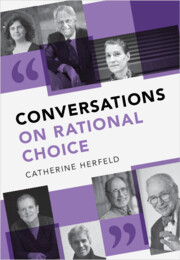
Rational choice theories belong to the most important building blocks of 20th century economics. Their usefulness to model human behaviour has been extensively debated in modern social science and beyond. While some have argued that rational choice theories should be applied to a broad range of political and social phenomena, the rise of behavioural economics questions whether they are appropriate at all for understanding economic behaviour. Conversations on Rational Choice sheds light on what is actually at stake in these debates. In 23 conversations, some of the most prominent protagonists from economics, psychology, and philosophy discuss their individual perspectives on the nature, possible justifications, and epistemic limitations of rational choice theories. Offering a comprehensive assessment of the value of rational choice theories in producing knowledge in economics, these conversations lay the ground for a more nuanced appraisal of rational choice theories from a practical viewpoint.
This shorter chapter focuses on one groundbreaking bio-psycho-social network meta-study related to historical trauma in the virtual absence of social science studies. It centers on studies on health and associated health disparities in diaspora populations with migrants from India and Pakistan of the second and third generations. Topics are suicide rates of South Asian women, somatoform symptoms and disorders, and physical health conditions like cardiovascular disease and type 2 diabetes. In addition, an anthology is included on psychiatric, historical, and literary science case studies in which one chapter analyzes the metaphorical use of ‘madness’ as a description of the historical events. It presents small-scale studies from microeconomics on the impact of education, the autoethnography of cultural mourning, and a psychological experiment that examines social identity theory in relation to mutual rejection between Hindus and Muslims. As potential remedies, various forms of commemoration are examined, as they have evolved in India and in the diaspora over the last decade.
Daniel James, a preeminent historian of the Argentine working class and Peronism, has fundamentally transformed how we understand Latin American labor history. This oral history interview, conducted by four of his former doctoral students, explores the personal, intellectual, and methodological foundations of his pioneering work. James discusses his working-class upbringing in post-war England as the son of Communist Party militants, his formative experiences at Oxford during the late 1960s, and his introduction to Argentina during the politically charged early 1970s. The conversation traces his evolution from the social history approach of Resistance and Integration: Peronism and the Argentine Working Class (1988) through his methodological innovations in oral history with Doña María’s Story (2000) to his recent collaborative work on photography and memory in Paisajes del pasado (2025). James reflects candidly on the influence of E. P. Thompson, Walter Benjamin, and the Latin American Labor History Workshop on his scholarship, while emphasizing the centrality of relationships, empathy, and historical imagination in his approach to working-class history. The interview also addresses his teaching philosophy, his commitment to graduate mentorship, and his view of history as a moral enterprise aimed at rescuing ordinary people “from the enormous condescension of posterity.” James concludes by outlining two prospective research projects on Argentine photography and political exile.
This article examines the experiential and perceptual environment in which social encounters between soldiers and civilians occurred in Allied-occupied Italy (1943–45) and its enduring impact on the lives of those who experienced it. It does so by applying Mary Louise Pratt’s theoretical framework of the ‘contact zone’ to the case of occupied Italy and by exploring it through the lens of oral history sources. The critical analysis of interviews with Antonio Taurelli, an Italian teenager in 1944 who fought with American soldiers, and Harry Shindler, a British veteran who married an Italian woman during the war, sheds light on how ordinary individuals shaped their own experience of occupation within the contact zone as well as on the life-changing impact of their encounters with ‘otherness’. This article aims to contribute to our understanding of the social experience of the Allied occupation of Italy and the impact of military-civilian encounters in occupation environments more broadly.
As a nation, the United States has historically avoided meaningful introspection in favor of glorious narratives with clear heroes and villains. Perhaps the most instructive example of this selective remembering is the nearly forgotten history of the Gnadenhutten Massacre where members of an American militia slaughtered ninety-six Lenape men, women, and children in present-day Ohio. Americans’ dim memory of this event today is intentional, stemming from two hundred years of purposefully uncritical mythmaking. To fully understand the meaning of the Revolution, we must examine how we have remembered it and for what ends. We must learn about Gnadenhutten and how people have used the memory of this event for political purposes. This chapter examines the contested memory Gnadenhutten from the initial cover-up in 1782 through the modern historical drama that re-enacts the massacre.
This chapter explores the roles of different generations of lawyers in Estonia’s post-1991 democratic transformation. Focused on young, progressive lawyers familiar with Western legal culture and established leaders educated under the Soviet regime, the study draws on extensive interviews and document analysis to trace how these actors shaped the nation’s transition from Soviet legal structures to a contemporary democratic framework. The findings highlight the critical importance of individual efforts in redefining legal practices, emphasising the dual impact of innovative youth and experienced mentors in driving significant legal and institutional reforms. The study enhances understanding of the dynamics of legal transitions in post-Soviet states, highlighting the essential blend of innovation and experience necessary for successful legal reform.
‘Us and Them’ is a community history project and artistic collaboration exploring physical and intellectual disability and mental illness, in the past and present. It is part of a broader initiative to open out wider conversations about the history of psychiatric care in Epsom (Surrey, UK) and to explore ways in which medical histories, creative engagement strategies and oral history praxis can illuminate the instability of contemporary understandings of ‘healthy minds’ and ‘normative bodies’. This article charts our recent reuse of asylum photography and the restaging of wet-plate collodion portrait making, opening out key ethical questions about our complicity as consumers of historical sources, the role of re-enactment and empathy, and the place of the haptic and the ludic in exposing the porous and precarious boundaries between ableism and disability. Exploring our own vulnerabilities and solidarities in co-producing a public history project with our disabled artist collaborators, it offers insight into our evolving ‘micro ethics’, foregrounds lived experience perspectives, and offers some initial thoughts on ways to rethink critically some core tenets of oral history methodology.
The Shona people of Zimbabwe hold rich social histories that should be approached as public humanities. This article explores the oral traditions, pre-colonial sociopolitical systems, and the profound impacts of colonial and post-colonial developments on cultural identity to understand the cohesion of the Shona people. The Shona people’s rich culture of myths, folktales, and storytelling serves as a repository of collective memory that preserves the values, beliefs, and cosmologies underpinning their society. In examining pre-colonial Shona governance, this article highlights the decentralised political systems rooted in chieftaincy, kinship networks, and communal land tenure still in practice today. Using a hybrid methodological approach that integrates ethnographic insights, historical analysis, and theoretical frameworks, such as Santos’ (2018) epistemologies of the South, this study positions Shona public humanities within broader debates on African Indigenous knowledge systems and post-colonial identity reconstruction. The analysis extends to the economic practices of agrarian subsistence and long-distance trade, underscoring the sophisticated socio-economic frameworks of Shona society. Despite the challenges posed by industrial encroachment and cultural commodification, a resilient Shona heritage upholds adaptive strategies. A Shona situated approach contributes to broader debates on decolonisation for the preservation of Indigenous knowledge in a rapidly globalising world.