To save content items to your account,
please confirm that you agree to abide by our usage policies.
If this is the first time you use this feature, you will be asked to authorise Cambridge Core to connect with your account.
Find out more about saving content to .
To save content items to your Kindle, first ensure no-reply@cambridge.org
is added to your Approved Personal Document E-mail List under your Personal Document Settings
on the Manage Your Content and Devices page of your Amazon account. Then enter the ‘name’ part
of your Kindle email address below.
Find out more about saving to your Kindle.
Note you can select to save to either the @free.kindle.com or @kindle.com variations.
‘@free.kindle.com’ emails are free but can only be saved to your device when it is connected to wi-fi.
‘@kindle.com’ emails can be delivered even when you are not connected to wi-fi, but note that service fees apply.
Trust in paper money principally was based on faith in its issuing authority, but the tangible features of paper money, including the designs imprinted on it, were essential to the calculus that determined its value. No specimens of Song paper money survive. However, contemporary descriptions offer important clues about the design of paper bills, which changed regularly. In addition, several extant metal printing plates also provide visual evidence for the design of paper money, but the authenticity of these plates has been questioned. This chapter analyzes the documentary and artifactual evidence to affirm the authenticity of these plates and to reconstruct the visual appearance of Song paper currency. It also compares the Song designs with those for Jin and Yuan paper currency (for Yuan, we have many extant specimens). But the Jin–Yuan governments adopted radically different design features than the Song bills.
Spanish confessional diplomatic efforts in London greatly influenced English Catholicism during the first half of the seventeenth century, including through the circulation of illicit Catholic imprints across the Channel. A survey of Spanish and English sources showcases the different actors and mechanisms that allowed for the flow of English Catholic books through the embassy courier, from the Spanish ambassadors themselves to English transnational family networks tied to their entourage. This article identifies the activities and attitudes of key protagonists, thus revealing patterns of transnational exchange, collaboration and conflict involving Spanish diplomats and local Catholics. It argues that the Spanish embassy in London functioned as a vibrant site of cross-border mobility that fostered the integration of the English Catholic community within Global Reformed Catholicism. The dynamics of book circulation simultaneously expose some of the fundamental tensions that underlaid its patronage relationship with the Spanish Monarchy.
This chapter attends to Los Angeles’s long and varied history of journalistic writing. For Chihara, the LA Times, which grew in prominence along with the city itself in the early decades of the twentieth century, incubated writing about the developing city not only in its own pages but also in the resistive responses to its advocacy on behalf of capital. Chihara then turns her attention to the New Journalism-era writings of Joan Didion and Eve Babtiz, in which personal positionality is as unapologetically present within text as within the city – even as the two differed markedly in their subjectivities and styles. In Jonathan Gold’s restaurant reviews of the 1990s and 2000s, food is only ever part of the story: Gold uses the global tastes and smells of LA’s culinary culture to hymn, critique, and grieve the city itself. In conversation with writer Matthew Specktor, Chihara considers the material challenges faced by contemporary writers in Los Angeles – the decline of traditional journalism; the rising cost of living; corporate consolidation of creative industries – and wonders if careers in LA reportage like those of Didion, Babitz, and Gold are still possible.
This chapter explores the flourishing of Buddhist print culture during the Song dynasty, focusing on its visual, material, and transregional dimensions. It shifts attention from elite literary publishing to religious book production, highlighting how Buddhist printing developed in both court-sponsored and commercial contexts. Beginning with rare early blocks, it sheds light on some of the earliest extant printed materials. The discussion on the Imperial Secret Treasures demonstrates visual strategies in imperially sponsored scripture printing. Finely produced Buddhist texts discovered in the tomb of Lady Sun reveal how printed books functioned in funerary practice and lay devotional life. The final section examines Hangzhou as a vibrant printing hub, where family-run publishers produced richly illustrated scriptures. Modular visual strategies in these frontispieces facilitated the circulation of Buddhist imagery, spreading Hangzhou’s Buddhist print culture to Xi Xia, Korea, Japan, and other parts of Asia. The chapter argues that image-bearing prints operated as visual and ritual media, enabling dynamic visual transmissions that often exceeded the textual reach alone.
Race has been a dominant theme in studies of US black art and politics in the 1910s and 1920s. This chapter shifts focus to imperial concerns during a period marked by US occupations in Haiti, Nicaragua, and the Dominican Republic, as well as the acquisition of the Danish Virgin Islands. It explores how the era’s print culture both revealed and obscured the expansion of a US Empire or Greater United States in the Caribbean. US governance in places like Haiti did not go unchallenged in leftist and race-conscious periodicals such as The Nation, The Crisis, and The Crusader. While non-fiction provoked anti-imperial analyses, fiction did not prompt the same responses. Assessing reviews and commentary of fiction, including Eugene O’Neill’s The Emperor Jones, Carl Van Vechten’s Nigger Heaven, Claude McKay’s Home to Harlem and Eric Walrond’s Tropic Death, this chapter examines why anti-imperial reading proved so elusive in this context.
Chapter 1 starts by exploring the history of the term ‘settlement’. Having traced its emergence in the seventeenth century, the chapter investigates the making of the ‘settlement’ act of 1662. A study of parliamentary records uncovers the emergence of new legislation in the post-Restoration context and illuminates the final stages of the process when amendments were made that shaped the settlement legislation for centuries to come. Subsequent laws led to the introduction of new ‘settlement certificates’. The third section traces the spread of the ‘settlement’ system and its impact on both local administrations and the negotiating strategies of the poor – central issues pursued throughout the book. These explorations draw on records from two corners of England, Sussex in the south-east and Lancashire in the north-west. Additional sources are employed from metropolitan London and other localities.
By 1776, when a parliamentary survey was held to assess poor law expenditure in England and Wales, the ‘settlement’ system was a familiar feature in local communities, regulating access to poor relief and if necessary removal since the previous century. The introduction explores the broad historiography on the topic and suggests how key provisions emerged in the Restoration era, a development examined in Chapter 1. The discussion proceeds to introduce the arguments of the remaining chapters, in which some of the unintended consequences of the legislation are explored: from the emergence of a huge body of administrative forms to the regulation of kinship and family for the purposes of migration, and on to impacts on parish and county administration, community life, and even the state’s capacity to mobilise forces for large-scale international wars.
The conclusion brings together the book’s several arguments to explain the impact of the settlement legislation on family, community, and national life during our period. Discussions highlight how legal changes taking place in the Restoration era, and developed thereafter, affected English society and state formation in ways little imagined by the legislators, and how the focus on parish settlement has brought together an array of fields not often studied together and has enabled the book to engage with local experiences as well as broad processes of historical change.
This chapter argues that to truly understand Emerson, we need to see and hear him at the lectern. It sketches Emerson’s place within the performance culture and popular lecture circuit of antebellum America and contends that we should regard his works as a form of “voiced essay.” The chapter brings to life Emerson’s dramatic, modulated style as a performer of his own work, showing how his writing simulates these spoken elements at the levels of both style and theme, and inviting readers to become active listeners. The “voiced essay” ultimately dissolves strict boundaries between orality and writing, energizing a new form of social engagement. By encouraging readers to hear Emerson as a figure with a strikingly modern grasp of media forms and the synergy between orality and textuality, the chapter underscores Emerson’s ongoing relevance to debates about performance, intellectual virality, authority, and the transmission of ideas.
Chapter 2 branches out to study one of the most noticeable – if unintended – impacts of the settlement legislation: the emergence of a huge body of administrative paperwork relating to the settlement of the poor. This chapter begins with the role of printers and stationers, masters of the metropolitan Stationers’ Company, who played a key role in the production and distribution of the settlement forms. Drawing on our north-western and south-eastern samples, the chapter explores how the business of forms took root. It also investigates the continued and highly significant use of manuscript. Influential social and political theorists – from Max Weber to Michel Foucault – have emphasised state control of bureaucratic procedures. Here we see how, while dealing with the settlement laws, influences emerged from the bottom up, as stationers, scribes, local officers, and even paupers contributed to the rise of the form.
In Chapter 3, notions of kinship and family come to the fore. Once belonging had been articulated by the settlement laws, and moreover was seen to have been invested not only in individuals but in families, the question soon arose: who counted as ‘family’ for the purposes of the law? For example, when and under what circumstances would the status of ‘child’ expire? What would be the effects of marriage and remarriage? A study of legal sources helps distil the changing regulations – another unintended consequence of the settlement laws which affected millions, and echoes today. A case study concerning one woman illustrates the effects of the settlement laws on kinship and community relations. Local and regional samples suggest how the law was implemented in near and distant localities.
This article examines the transregional life and typographic legacy of a 24-point Ottoman naskh printing type (MI-24), developed in 1867 by the Ottoman–Armenian punch-cutter Oḥannes Mühendisyan in collaboration with the court calligrapher Ḳāżīʿasker Muṣṭafá ʿİzzet Efendi. Celebrated for its exceptional calligraphic fidelity and mechanical refinement, MI-24 emerged as the pinnacle of Arabic-script typography in the Ottoman empire. Drawing on previously unexamined archival materials, this study reconstructs MI-24’s production, dissemination, and adaptation across a wide geography—from Istanbul to Beirut, Cairo, Tehran, Kabul, and even Chicago, London and Oxford. It explores how regional actors including Jesuit missionaries, Armenian type-founders, Arab Nahḍa intellectuals, and European Orientalists engaged with and modified this typographic model to suit diverse cultural, religious, and technological needs. In tracing these typographic networks, the article situates MI-24 at the intersection of Islamic visual culture, print modernity, and global knowledge circulation. Far from being a product confined to Istanbul’s imperial presses, MI-24 became a mobile and malleable artefact—reshaped by local aesthetics and political agendas. Ultimately, this article reframes Arabic-script typography as a dynamic site of visual negotiation and transimperial collaboration, contributing to broader discourses on print culture, design history, and the materialities of Islamicate text production.
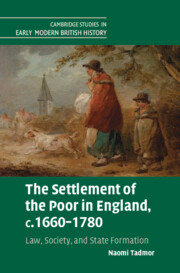
In 1662, in the aftermath of the Restoration, parliament passed new legislation for the settlement and removal of the poor. Important provisions were finalised in no more than a few days. But once the settlement of the poor was set in law it became an agent of historical change that affected society, state formation, and the lives of millions in Britain and beyond for centuries to come. Within a few decades, practices of local government were transformed. In towns and villages hierarchies of social status and gender were affected. The rising empire employed the settlement administration to mobilise forces for large-scale international wars and to deal with soldiers' wives and children left behind. The huge number of bureaucratic forms generated following the new policies made a lasting impact on administrative culture. The Settlement of the Poor in England is about social change and about history's unintended consequences. It is also about the struggles and experiences of individuals and communities. It reminds us how the settlement legislation still resonates today. This title is part of the Flip it Open Programme and may also be available Open Access. Check our website Cambridge Core for details.
This Element centers the 'Black Pacific' as a generative site for comparative and intersectional methodologies and transnational frameworks for thinking about racial formations, post-national literary forms, and cultural histories. At the end of the nineteenth century, US overseas expansion into the Pacific brought white supremacy and colonial rule into alignment. It also threw into greater relief the contradictions of US citizenship and national identity as legalized segregation and rising anti-Black violence foreclosed Reconstruction's possibilities. Race accrued dynamic new meanings in the age of new imperialism. Focusing on the earliest of African American literary magazines, the Boston-based Colored American Magazine (1900–09) and its southern rival, the Atlanta-based Voice of the Negro (1904–7), this Element examines the formative role of magazine and periodical writings in the development of early Black transpacific internationalism.
Moving beyond binary nationalist and unionist narratives of nineteenth-century Irish history, this study instead explores political thought through ideological battles over government. Drawing on neglected pamphlets, political tracts and polemic newspapers, Colin Reid reveals how Irish protagonists - unionists and anti-unionists, Catholic Emancipationists, Repealers, Tories, Fenians, and federalists - clashed over the meaning of representation, sovereignty and the British connection. Reid traces how competing constitutional visions, rather than national allegiances, drove Ireland's political evolution. From the bitter Union debates to the birth of Home Rule, it recovers forgotten arguments about parliamentary reform, the 'Irish question' in imperial context and the fraught experience of a small nation within a multinational polity. With fresh insights into figures such as Daniel O'Connell, Isaac Butt and lesser-known polemicists, this study redefines Irish political thought as a dynamic struggle for representative government. This title is also available as open access on Cambridge Core.
This chapter studies the creation of Algeria as a topos of transregional literature during the War of Independence (1954–1962) on the pages of the Beirut-based literary and political journal al-Ādāb. This process relied on gendered imagery of suffering Algerian bodies, notably the FLN fighter Djamila Bouhired, who became an Arab nationalist icon following her imprisonment by the French. Arabic transregionalism imagined Algeria as a palpable expression of Arab nationalist rhetoric on Arab revolution. This led al-Ādāb authors to critique Jean-Paul Sartre, insisting on the Arab, rather than global, scale of Algeria’s decolonization. In al-Ādāb poetry, I show that contributors took for granted that fuṣḥā, as anti-colonial transregional print medium, would be the vehicle of postcolonial Algerian literature. Al-Ādāb thus elided complex realities of multilingualism in Algeria, taking for granted, and even viewing as inevitable, the “restoration” of fuṣḥā as a sign of Algeria’s proto-Arab identity. The chapter reads al-Ādāb’s editorial production of itself as transregional journal, including the insertion of advertisements, debates, and exchanges to map circulation networks. I detail the journal’s efforts to recruit Algerian contributors to educate transregional publics on the country’s history and culture and demonstrate its support for the new FLN state after independence.
This chapter reads writings on and in Arabic in the Moroccan avant-garde journals Souffle and Anfās (1966–1971) between national and transregional scales for literature. After 1969, this movement produced itself as a periphery within transregional literature by plugging into literary networks with the Mashreq, particularly Beirut. Contributors experimented with various forms of fuṣḥā – from iconoclastic, futurist poetics to dogmatic Marxist-Leninist prose – to found the written Arabic to express Moroccan literature’s belonging in an unfolding Arab revolution and to shatter the Moroccan monarchy’s monopoly over the language as the sign of permanent, sacred, Arab-Islamic national culture. For Souffles–Anfās, Morocco’s connection to transregionalism lay in the people’s emotional connection to the Arabic language and their Arab nationalist sentiments. This avant-garde movement sought – but never found – a Moroccan poetry to launch into the transregional system. The chapter reads issues of Anfās as transregional literature, Arabic poetics in bilingual Souffles, and translational engagements in French with a future Moroccan Arabic.
This chapter discusses market literature from its emergence in the late 1940s in southern Nigeria to its contemporary versions, with a focus on Onitsha market literature, Tanzanian pamphlets, and Ghanaian market fiction. The essay shows that the concept of the “market” is essential to the genre: it is a commercial print literature made for quick trade among the common person on the street seeking self-growth and a lively literature pushing at the boundaries of acceptability, prompting change and promising sensation and transformation. The cases of Tanzania and Ghana urge a reconsideration of the genre’s defining features, particularly in terms of the tensions between commercialization and artistry, and didacticism and poetics. We see how an uncensored industry trained on novelty may by turns elicit tabloidesque stories and expose social abuses. In its wide variability, the genre registers the turbulent process of putting norms of many kinds under social pressure. Ghana market literature’s spectacular rise and fall mirrors that of Onitsha market literature to make plain how sociopolitical optimism encourages aesthetic adventuring while economic downturns reduce publishers’ and readers’ options to survivalist works.
‘Bluebeard’ arrived in England not long after The Thousand and One Arabian Nights in theearly 1700s; and both ‘Bluebeard’ and the Arabian Nights came to England from the samesource: France. By the 1800s, ‘chapbook illustrations for ‘Bluebeard’ and for Arabian Nightswere literally interchangeable’ between the two (Hermansson 2009, 58) . These storiesexemplify the transnational origins of the gothic trope of woman as ‘dead’ in marriage(Wallace 2016) and that Arab women are ‘survival writers’. This chapter traces motifs fromthese conflated tales onto contemporary Arab women’s instances of ‘bloody chambers’ whichregister the world-system and revive other (supressed) women’s stories.
This chapter focuses on the philosophical novels of Sarah Fielding and Sarah Scott, younger sisters to fame and zealous proponents of literary and social reform, though perhaps not in that order. Tracking their novels’ trajectory away from the organizing singular narrator toward collective perspectives allows me to diagram a genealogical chain of formal experimentation that runs through Sarah Fielding’s The Adventures of David Simple (1744) and The Governess (1749) through Sarah Scott’s Description of Millenium Hall (1762). This chapter offers a new approach that discerns the patterned formal framework that undergirds how these novels imagine reparative communal responses to gender-based harms and women-centered alternatives to possessive individualism.