To save content items to your account,
please confirm that you agree to abide by our usage policies.
If this is the first time you use this feature, you will be asked to authorise Cambridge Core to connect with your account.
Find out more about saving content to .
To save content items to your Kindle, first ensure no-reply@cambridge.org
is added to your Approved Personal Document E-mail List under your Personal Document Settings
on the Manage Your Content and Devices page of your Amazon account. Then enter the ‘name’ part
of your Kindle email address below.
Find out more about saving to your Kindle.
Note you can select to save to either the @free.kindle.com or @kindle.com variations.
‘@free.kindle.com’ emails are free but can only be saved to your device when it is connected to wi-fi.
‘@kindle.com’ emails can be delivered even when you are not connected to wi-fi, but note that service fees apply.
Chapter 2 explores 300 years of St. Augustine history, from its founding in 1565 until the end of the Civil War in 1865. The chapter demonstrates the city’s many connections to American slavery—well beyond the Slave Market in the center of the Plaza. These include:
An argument that the first slaves in land that became the United States arrived in St. Augustine in 1565, rather than in Jamestown, Virginia in 1619.
The fact that St. Augustine had a free community of former slaves more than a century before the end of the Civil War, in Fort Mose.
The fact that a public slave sale in the center of the city was witnessed—and written about—in the 1820s by Ralph Waldo Emerson.
The fact that St. Augustine fought on both sides of the Civil War. First, St. Augustine was part of the Confederacy, but Union troops took control of the city in 1862.
One consequence of that was that Lincoln’s Emancipation Proclamation actually freed slaves in St. Augustine before the war ended—something that was written about in colorful fashion in The New York Times.
The introduction takes the author’s hometown, Pittsburgh, Pennsylvania, as a perspective. At the head of the Ohio River, Pittsburgh drew international observers who wished to study industrialization in the nineteenth century. Its rivers, coal, natural gas reservoirs, and oil fields catalyzed a fossil-fuel boom. The introduction illustrates the formation of a new idiom in the lyceums and lecture circuit of the industrial heartland and energy frontier of the Ohio River Valley, from Ralph Waldo Emerson’s 1851 lectures to Henry Adams’s account of a journey on the Pennsylvania Railroad in The Education of Henry Adams (1907), and of what Adams called “energies quite new.” This chapter provides an overview of energy and economy as contingent ideas. It shows how they raise basic questions about personhood and agency. “Burning Ideas” details a historiography shaped by Pittsburgh’s productive forces, explains the book’s dialectical approach, and concludes with chapter summaries.
This chapter follows America’s foremost public intellectual to the smoky city in 1851, starting with a journey across the Alleghenies before the Pennsylvania Railroad was completed. There, to the Young Men’s Mercantile Library Association, Emerson lectured on “Economy” and “Power.” Inspired by Pittsburgh, Emerson fashioned practical ideas for how to live in a carbon-fueled culture. Young people, he argued, should embrace life’s dialectical nature: “We can only obey our own polarity.” Coal sparked his imagination. Emerson mythologized engineers as Promethean demigods. The lectures, later collected in The Conduct of Life, set the terms for the fossil-fuel culture materializing on the banks of the Monongahela and Ohio Rivers. This chapter illustrates the emergence of that culture under the conditions of a new energy regime in the vision of a capitalistic philosopher and self-described poet.
This ambitious history of industrial and cultural revolution illuminates the formation of a new idiom of energy and economy in nineteenth-century America. In 1851, Ralph Waldo Emerson made an arduous journey to Pittsburgh, Pennsylvania. There, in a series of lectures, he articulated modern ideas of industrial power, the soul's economy, and a value system premised on a new set of prime movers, fossil fuels. Emerson asked a practical question: 'How shall I live?' His response was to create a mythic language centered on the energy-and-economy dialectic. This book vividly shows how other authors, from Catharine Beecher, who laid the groundwork for the environmental canon, and W. E. B. Du Bois, who poeticized labor, to Henry Adams and Edith Wharton, as well as conservationists, homemakers, and coal miners, built on Emerson's 'practical question' to give fresh purpose to human existence in a radically altered world.
Emerson’s poetry has been somewhat of an enigma for readers and critics alike, who have often found it thematically opaque and stylistically unwieldy. Many have concluded that he was incapable of writing “better” verse, a conclusion predicated upon the assumption that he intended to do otherwise but couldn’t. This essay takes as a starting point the idea that the roughness of Emerson’s poetic style was intentional and that his metric irregularities are not accidents. After analyzing the style, rhetoric, and prosody of the poems, this essay contextualizes these elements within Emerson’s metaphysics. It argues that Emerson’s poetry reveals the crumbling of meter that led to the modernist revolution and free verse; poetic style did not suddenly jump from Longfellow to Whitman, but rather meter was stretched and strained before it was broken.
Before his rehabilitation got under way in the late 1970s, had Emerson really been the object of “repression” by the American philosophical establishment? The validity of the historical claim put forward by Stanley Cavell has always seemed doubtful. In point of fact, Emerson turns out to have, from his day to ours, a largely unbroken chain of legitimate heirs among American philosophers. This chapter, which builds on previous scholarly efforts to correct and complete the record, notably by historians of pragmatism, continues the work of recovering the Emersonian legacy in American philosophy. The multiform nature of that legacy, which extends to pedagogical theory and classroom practice in American schools, raises important questions for historiographers as they deal with changes in cultural and institutional reception over time. Of particular importance is the question raised by Cavell’s own contribution to Emerson studies: what is philosophy’s relation to the broader literary culture?
This chapter considers the place of democracy in the writings of Ralph Waldo Emerson. By conceptualizing democracy, in pragmatist fashion, as a “way of life,” Emerson can be shown to have engaged democracy throughout his career in several different dimensions, both within and beyond official, state, or legal power relations. While Emerson participated in a discourse that was skeptical of the social dynamics of democracy in mass society, he simultaneously upheld his commitment to a philosophy of history that recognized in what he called “the democratic element” a driving force toward greater justice and equality. Democracy furthermore provided the key through which Emerson interpreted his own practice and poetics as a freelance lecturer. Emerson’s commitment to a transcendentally conceived notion of justice at times came into conflict with democracy’s requirements of negotiation and compromise, particularly in the context of radical abolitionism and the Civil War. As this chapter argues, Emerson tirelessly strove to resolve this conflict.
Ethics, for Emerson, begins in perceiving the “wonderful congruity which subsists between man and the world” such that ethics, in thinking and in living, is a matter of being “allied to all.” In this view, the “infinitude of the private man” – often yoked to the concept of “self-reliance” – names a metaphysical and ontological fact at the heart of Emerson’s ethics: human existence within a web of interconnections. This chapter draws widely from Emerson’s oeuvre to show how he unites “severe science with a poetic vision,” seeing and seeking to express how “Our life is consentaneous and far-related.” His work teaches us to see kinships between ethics, aesthetics, religion, science, and politics, and to consider ethics a practice of observing the intimacies in which we exist and in which the ethical question “How shall I live?” begins living in us.
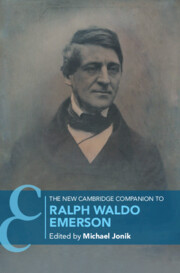
While Emerson's place in American literary history has remained secure, the New Cambridge Companion to Ralph Waldo Emerson draws on a wealth of recent Emerson scholarship which has highlighted his contemporary relevance for questions of philosophy and politics, ecology and science, poetics and aesthetics, or identity and race, and connects these to the key formal and interpretive issues at stake in understanding his work. The volume's contributors engage the full breadth of Emerson's writing, developing novel approaches to canonical works like Nature, the essays 'Self-Reliance' 'Experience,' or to his poetry and journals, and bringing critical attention to his lectures and to the long-overlooked texts of his later period. This New Cambridge Companion to Ralph Waldo Emerson thus both bears witness to the new Emersons that have emerged in the past decades, and draws a new circle in Emerson's reception.
In the first half of the nineteenth century, America’s breathtaking economic and territorial expansion furnished the context for a Second Great Awakening, Romanticism, and electoral politicking. These accelerated the ascent of individualism and encouraged self-refashioning to pursue new ambitions. Individuals’ choices inspired stories that reveal how the evolving myth of self-made success both symbolized and widened the nation’s social and cultural chasms. High-profile self-fashionings of the period included Eliza Jumel’s rags-to-riches, Henry Clay’s feigned humble origins, and reformer Dorothea Dix’s discarding of traditional roles. Leading preachers, including Charles Grandison Finney, inspired thousands to take on individual spiritual choices and worldly service, while Romanticists beckoned men to accept heroic self-agency as their duty. Chief among the latter, Ralph Waldo Emerson insisted that American men exert their "self-reliance." Amid all this churning, antebellum storytellers shifted use of the phrase “self-made” from a rhetorical tool for moral judgments to one for increasingly secular accolades, preparing the way for a gradual turn to financial measures of success.
This chapter explores the overall significance of genius in the eighteenth and nineteenth centuries as it became associated with authorship, the fine arts, and nature in ways that helped produce a new form of cultural nationalism. The Romantic idea of genius supported new versions of both autonomous individualism and national identity, as readers identified through the genius of representative “great men” with the nation. Genius in this way simultaneously individuated and connected, playing a key role in the formation of national high cultures and canons as well as the overall creation of a liberal democratic social order. Beginning in the late eighteenth century, genius also became increasingly associated with wild and sublime nature, naturalizing these newly emerging forms of social identity and laying the groundwork for the landscape of genius.
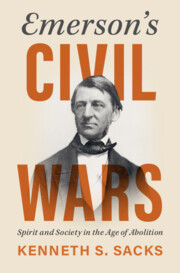
Kenneth S. Sacks explores how America's first public intellectual, determined to live self-reliantly, wrestled with his personal philosophy and eventually supported collective action to abolish slavery. Ralph Waldo Emerson was successful in creating a national audience for his philosophy and enjoyed the material and social rewards of that success. Contrary to most other Emerson scholars, however, Sacks argues that Emerson resisted active abolition and did not become a supporter until events forced his hand. Committing to the antislavery movement was risky and ran against his essential belief in social gradualism. Events in the mid-1850s, though, hastened Emerson's conversion and he eventually became a leader in the movement. A study of an intellectual under the pressure to engage in political action, Emerson's Civil Wars enriches our understanding of Emerson's antislavery activities, life, and career.
This essay revisits Emerson’s iconic transparent eyeball passage to rethink it as a moment of crossing over into queer embodiment and sensory expansion. If “trans” is “to move across” and “scandre” to climb, the point is not to rise above the physical world, but to move into it in such a way as to be in touch with its divine energies. To do so was to climb out of the enclosure and isolation of subjectivity and inhabit something much more capacious. Expanding the scope of Transcendentalism proper, the essay tracks this queer “I” into a number of other texts in which a similar experience or phenomenon of ecstasy opens onto novel social, sexual, and gender understandings. Margaret Fuller, Margaret Sweat, women trance writers, Walt Whitman, and Harriet Jacobs animate the “trans-” in Transcendentalism in their critical crossings and dynamic reassemblages of body and soul, self and other, and sex, gender, and race.
This chapter focuses on the essays of Transcendentalists such as Henry David Thoreau, Ralph Waldo Emerson, and Margaret Fuller who used writing as a spiritual and philosophical tool. This special form of prose allowed them to write themselves, and thus Transcendentalism as a movement, into being, creating a flexible, open-ended, and experimental instrument for the radical self-fashioning of an emergent sensibility: the American individual as a freestanding soul, entire in (him)self, capable of encompassing all the potential of the cosmos. The resulting works forever stamped this most antinomian of genres with the Transcendentalist’s indelible signature. The chapter traces the movement back to Harvard College in the 1820s and ’30s, where students and faculty discussed spirituality, philosophy, and the art of writing. The chapter traces the influence of this convergence and of key figures like the Unitarian preacher William Ellery Channing on the burgeoning movement. The chapter’s final pages highlight how central Transcendentalism has been to the American essay tradition, with writers today of greatly varying backgrounds absorbing its lessons and style into their own writing.
This chapter surveys the history of nature writing and the nature essay, from American Transcendentalists such as Ralph Waldo Emerson, Henry David Thoreau, and Margaret Fuller to more recent writers such as Barry Lopez, Amitav Ghosh, and Camille T. Dungy. The author examines the political and scientific aspects of nature writing and the genre’s response to changing conceptions of “nature.”
In “Toward a Transatlantic Philosophy of Nature,” Samantha C. Harvey demonstrates how British Romantic poets like Wordsworth and Coleridge articulated a philosophy of nature in poetic form that would be reinterpreted in two central prose works of American Transcendentalism: Emerson’s Nature (1836) and Thoreau’s Walden (1854). Through detailed analysis of the works of Wordsworth and Emerson, Harvey suggests that nature’s vital role in the nineteenth century becomes particularly pronounced when Romanticism is considered as a transnational movement that flowed beyond national boundaries. Harvey shows how a transcendentalist philosophy of nature crossed, recrossed, and crisscrossed the Atlantic in various directions, undergoing continual transformations along the way.
After tallying up what it cost to build his humble “abode in the woods” in Walden (1854), Henry David Thoreau reflects on the far more substantial sums required to establish an institution of higher learning. The typical “mode of founding a college,” he writes, is to get up a subscription of dollars and cents, and then, following blindly the principles of a division of labor, – a principle which should never be followed but with circumspection, – to call in a contractor who makes this an object of speculation, and he employs Irishmen or other operatives actually to lay the foundations, while the students that are to be are said to be fitting themselves for it; and for these oversights successive generations have to pay.1 Although Thoreau himself had trouble paying tuition at Harvard, his primary concern here is not with the bill that students and their families are left to foot when colleges are founded as “object[s] of speculation.” Instead, Thoreau takes issue with the assumption that colleges should be construction sites like any other, a practice he feels is symptomatic of the American college’s misguided sense of mission. By shielding students from the vagaries of life, Thoreau charges, colleges substitute the platitudes of the classical curriculum for anything remotely concrete. There is no shortage of material “professed and practiced,” to be sure, but nothing that could be called useful. Thoreau’s critique was not unique in the mid-nineteenth century. Countless reformers argued against the classical curriculum’s focus on “dead languages” and potted metaphysics, while others railed at the toilsome pedagogy of recitation and “mental discipline” that treated Greek, mechanics, and English as interchangeable tools for training moral character. But if Thoreau is in good company in disdaining the antebellum college, the solution he proposes is far from conventional: students should be required to lay the foundation for their studies in actual concrete – by building the colleges they attend. The point, Thoreau argues, is not to replace the liberal arts with vocational education, but to ground college learning in lived experience. Doing so would help ensure that students do “not play life or study it merely” but “earnestly live it from beginning to end.” No longer shut off from reality, the American college would become a place of active engagement with the world beyond the campus and with “the art of life.”2
Though in some ways Ralph Waldo Emerson (1802–1882) and Edgar Allan Poe (1809–1849) are contrasting figures in the history of American Romanticism, scholarship over the past thirty years connects them as writers whose work articulates concerns over race and enslavement. Moreover, critical recognition that each writer engages such matters emerged only in the late twentieth century, after decades of work that effaced each writer’s political resonance. This chapter approaches these issues through some of the signal trends that have informed scholarship on Emerson and Poe over the past thirty years.
“Amidst his gray philosophizing, Life breaks upon a man like a morning.” Melville, Pierre or the Ambiguities1 In the decades since Stanley Cavell’s provocation in Senses of Walden that nineteenth-century American philosophy is perhaps best found in the “metaphysical riot of its greatest literature,”2 critics have charted with renewed interest how writers such as Emerson, Thoreau, Poe, Melville, Dickinson, Douglass, and Whitman have responded to and challenged the philosophical tradition. They have explored how these writers anticipate philosophers such as Friedrich Nietzsche, William James, Martin Heidegger, and Gilles Deleuze, and how contemporary philosophers from Giorgio Agamben to Slavoj Žižek have used pallid Melville as a cipher for their own conceptual systems.3 At the same time, critics have articulated how nineteenth-century American writers offer unique philosophies; how their writings blur literature and philosophy, as well as science and psychology; and how they develop their own philosophies of democracy, race, and sexuality.4 For Elizabeth Duquette, recent philosophical investigations of American literature have highlighted the importance “of the practice and place of philosophy in nineteenth-century American literature” and inspired scholars to “reexamine assumptions about abstraction, and what we do when we read a literary text.”5 It is not only a question of recognizing that writers such as Dickinson or Poe, Melville or Douglass are themselves perspicuous readers of philosophy, or that they make philosophical interventions of their own. These writers also push us to rethink issues of representation, interpretation, expression, style, and form. Given the wealth of recent philosophical readings of American literature, then, one might even be tempted to consider the study of American literature and philosophy as an emergent subfield.
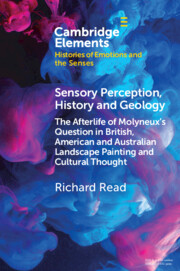
William Molyneux's question to John Locke about whether a blind man restored to sight could name the difference between a cube and a sphere without touching them shaped fundamental conflicts in philosophy, theology and science between empirical and idealist answers that are radically alien to current ways of seeing and feeling but were born of colonizing ambitions whose devastating genocidal and ecocidal consequences intensify today. This Element demonstrates how landscape paintings of unfamiliar terrains required historical and geological subject matter to supply tactile associations for empirical recognition of space, whereas idealism conferred unmediated but no less coercive sensory access. Close visual and verbal analysis using photographs of pictorial sites trace vividly different responses to the question, from those of William Hazlitt and John Ruskin in Britain to those of nineteenth-century authors and artists in the United States and Australia, including Ralph Waldo Emerson, Thomas Cole, William Haseltine, Fitz Henry Lane and Eugene von Guérard.