To save content items to your account,
please confirm that you agree to abide by our usage policies.
If this is the first time you use this feature, you will be asked to authorise Cambridge Core to connect with your account.
Find out more about saving content to .
To save content items to your Kindle, first ensure no-reply@cambridge.org
is added to your Approved Personal Document E-mail List under your Personal Document Settings
on the Manage Your Content and Devices page of your Amazon account. Then enter the ‘name’ part
of your Kindle email address below.
Find out more about saving to your Kindle.
Note you can select to save to either the @free.kindle.com or @kindle.com variations.
‘@free.kindle.com’ emails are free but can only be saved to your device when it is connected to wi-fi.
‘@kindle.com’ emails can be delivered even when you are not connected to wi-fi, but note that service fees apply.
This chapter uses a prosopographical frame to contrast the condition and professional formation of British composers around the beginning of the twentieth century and following the post-Robbins expansion of university music from the 1960s. The early Royal College of Music’s compositional training was such a radical force because of its completeness: in the range and quality of its overall performance environment, and in the breadth of repertoire that student composers thus experienced. This milieu fostered the creative independence of the RCM’s most notable composers. Cultural, technological and economic developments during the twentieth century, together with the BBC, then changed British composers’ circumstances and skills needs to an unimaginable degree. We see the effect of these developments both in the prominence of composers in the life and work of the new university music departments and in the greater esteem British composers were acquiring more generally, supported by the public funding of the arts.
Maconchy’s musical outlook was fundamentally shaped by her time at the Royal College of Music (RCM) in London. She first entered the RCM in 1923 as a painfully shy teenager from Ireland but the six years that she spent there as a student transformed her into a confident and brilliant, young professional – ready to take on the world with her music. Rhiannon Mathias considers the transformative encounters at the RCM that opened up entirely new paths for Maconchy, including the discovery of music that most inspired her, inspirational lessons with Ralph Vaughan Williams, her composition and performance experiences and the important friendships with fellow collegians, including Grace Williams, that would stimulate and sustain her throughout her life.
The interwar era was a formative period in Elizabeth Maconchy’s development as a composer, and much can be gleaned through a cross section of British musical circles between the First and Second World Wars. The endemic misogyny of the time, which affected the prospects of both earlier and contemporaneous female composers, had a profound impact on what opportunities were available to her as well as how her works were received. Many of the connections she made at this time – such as those forged with her professors and fellow students at the Royal College of Music – would endure for the rest of her career. Maconchy was interested in both continental modernism and Irish and Welsh nationalism, involved in the Macnaghten and Lemare concert series – which provided much-needed performance opportunities for young composers – as well as the pageant Music for the People, which furthered left-wing political causes such as anti-fascism, anti-racism, and class consciousness.
While Elizabeth Maconchy was not keen on the term ‘woman composer’ her career was nonetheless affected by the fact of her gender. Against a backdrop of long-standing, widespread and seemingly intractable sexism, Maconchy found support and validation from other women composers, notably Grace Williams. This chapter explores the phenomenon of such ‘Supportive Sisterhoods’ over generations and across many different milieus, both artistic and otherwise, from the Amazons to the wives and sisters of the Lake Poets, to the CIA, to the group of women who formed the Macnaghten–Lemare concert series in the 1930s. We find that women have consistently and instinctively banded together to not only form creative partnerships but to stand against the extraordinarily persistent, if ill-founded, view that creativity is something best left to men.
Throughout his life, Vaughan Williams was a notorious flirt. This love of women and flirtation permeates not only his music, but his professional and personal relationships alike. Yet, perhaps somewhat paradoxically, Vaughan Williams was also a strong advocate for many women who sought to develop professional careers in the male-dominated music world. This conflict between his behaviour and actions presents a conundrum for those looking to investigate his broader advocacy of women on the one hand and his private behaviour on the other. This chapter explores the contradictory nature of Vaughan Williams’s behaviour and beliefs, from his period of teaching at the Royal College of Music, to the emergence of the nickname ‘Uncle Ralph’ and all that name entailed, revealing a more complex portrait than has hitherto been proposed of the composer’s relationship with his female composition students, in particular.
Britten’s relationship to his predecessors and contemporaries in the ‘English Musical Renaissance’ was complicated. He found the Royal College of Music parochial and amateurish, and was frustrated by composition lessons there with John Ireland, not least in comparison to his private study with Frank Bridge. He largely rejected the influence of English folk traditions and Tudor music important to the ‘pastoral school’, favoring the more cosmopolitan example of Bridge, and his own exploration of continental European modernism. Britten’s view of composers such as Vaughan Williams as insular and regressive has shaped the historiography of British music in ways that still reverberate today. Scholars have typically taken such attitudes at face value; but this obscures a more complex reality, in which the composer attempted to annex and reimagine, rather than simply reject, core achievements of his predecessors, incurring conceptual if not direct stylistic debts to them. In the case of Holst in particular, whom Britten came to embrace in later life, insufficient attention has been paid to this legacy.
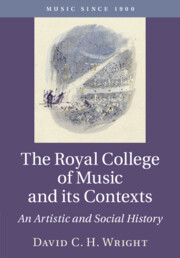
Located between the great Victorian museums of South Kensington and the Royal Albert Hall, the Royal College of Music, founded in 1883, has been a central influence on British musical life ever since. This wide-ranging account places the College within its musical and educational environments. It argues that the RCM's significance lies not only in its famous performers and composers, but also the generations of its more anonymous former students who have done so much to improve the musical life of the localities in which they have worked as teachers and animateurs. As a cultural history, this account also captures how significantly society's consumption of music - from new technologies to the altered perspectives of historical and world musics - has changed since the College was founded, and how very different our points of musical reference now are. This study traces the effects of such developments on the College's work.
Recommend this
Email your librarian or administrator to recommend adding this to your organisation's collection.