Refine search
Actions for selected content:
2 results
An infinite family of Thue equations with at most two solutions
- Part of
-
- Journal:
- Canadian Mathematical Bulletin , First View
- Published online by Cambridge University Press:
- 31 July 2026, pp. 1-5
-
- Article
-
- You have access
- Open access
- HTML
- Export citation
-
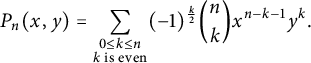
For an odd positive integer $n$
 , define $$ \begin{align*}P_n(x, y) = \sum\limits_{\substack{0 \leq k \leq n\\k \text{ is even}}}(-1)^{\frac{k}{2}}\binom{n}{k}x^{n - k - 1}y^k. \end{align*} $$We prove that, for $n \geq 5$
 , the Thue equation $P_n(x, y) = 1$
 has exactly two solutions in integers $x$
 and $y$
 , namely, $(1, 0)$
 and $(-1, 0)$
 , and that the Thue equation $P_n(x, y) = -1$
 has no solutions. Our result is a consequence of the famous theorem of Bilu, Hanrot, and Voutier on Lucas sequences.


TWIN SQUAREFUL NUMBERS
- Part of
-
- Journal:
- Journal of the Australian Mathematical Society / Volume 93 / Issue 1-2 / October 2012
- Published online by Cambridge University Press:
- 19 September 2012, pp. 43-51
-
- Article
-
- You have access
- Export citation
-
A number is squareful if the exponent of every prime in its prime factorization is at least two. In this paper, we give, for a fixed
 $l$, the number of pairs of squareful numbers
 $n$,
 $n+l$ such that
 $n$is less than a given quantity.


