Refine search
Actions for selected content:
2 results
ON SPARSE HOLES AND A FINITE-FOLD PROBLEM OF NATHANSON CONCERNING MINIMAL ADDITIVE COMPLEMENTS
- Part of
-
- Journal:
- Bulletin of the Australian Mathematical Society , First View
- Published online by Cambridge University Press:
- 25 September 2026, pp. 1-12
-
- Article
-
- You have access
- HTML
- Export citation
-
Let $W\subseteq \mathbb Z$
 be bounded below and normalised by $\inf W=1$
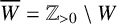
 , and put $\overline W=\mathbb Z_{>0}\setminus W$
 . Nathanson asked whether infinite sets of integers admit minimal additive complements. Chen and Yang [‘On a problem of Nathanson related to minimal additive complements’, SIAM J. Discrete Math. 26 (2012), 1532–1536] proved that the two-sided case is positive and that sufficiently large consecutive gaps in $\overline W$
 force nonexistence in the one-sided case. Chen and Ding [‘On a problem of Nathanson on nonminimal additive complements’, Bull. Aust. Math. Soc. 114, 6–13] isolated a sparse-hole condition under which no ordinary minimal complement exists. We prove a finite-fold version of this sparse-hole obstruction. For an integer $h\geq 1$
 , write $hC=C+\cdots +C$
 . We show that if $\overline W$
 contains a sequence $a_1<a_2<\cdots $
 such that $a_{t+1}-a_t\to \infty $
 and the four-neighbourhoods $(a_{t-2},a_{t+2})$
 contain at most K elements of $\overline W$
 for all sufficiently large t, then there is no set $C\subseteq \mathbb Z$
 which is minimal subject to $hC+W=\mathbb Z$
 . This result recovers and broadens the Chen–Ding nonexistence theorem as the special case $h=1$
 .


ON ADDITIVE COMPLEMENTS IN THE COMPLEMENT OF A SET OF NATURAL NUMBERS
- Part of
-
- Journal:
- Bulletin of the Australian Mathematical Society / Volume 113 / Issue 2 / April 2026
- Published online by Cambridge University Press:
- 07 November 2025, pp. 203-215
- Print publication:
- April 2026
-
- Article
-
- You have access
- HTML
- Export citation
-
Let A be a set of natural numbers. A set B of natural numbers is an additive complement of the set A if all sufficiently large natural numbers can be represented in the form
 $x+y$, where
 $x\in A$ and
 $y\in B$. We establish that if
 $A=\{a_i: i\in \mathbb {N}\}$ is a set of natural numbers such that
 $a_i<a_{i+1} $ for
 $i \in \mathbb {N}$ and
 $\liminf _{n\rightarrow \infty } (a_{n+1}/a_{n})>1$, then there exists a set
 $B\subset \mathbb {N}$ such that
 $B\cap A = \varnothing $ and B is a sparse additive complement of the set A.


