To save content items to your account,
please confirm that you agree to abide by our usage policies.
If this is the first time you use this feature, you will be asked to authorise Cambridge Core to connect with your account.
Find out more about saving content to .
To save content items to your Kindle, first ensure no-reply@cambridge.org
is added to your Approved Personal Document E-mail List under your Personal Document Settings
on the Manage Your Content and Devices page of your Amazon account. Then enter the ‘name’ part
of your Kindle email address below.
Find out more about saving to your Kindle.
Note you can select to save to either the @free.kindle.com or @kindle.com variations.
‘@free.kindle.com’ emails are free but can only be saved to your device when it is connected to wi-fi.
‘@kindle.com’ emails can be delivered even when you are not connected to wi-fi, but note that service fees apply.
The purpose of this Element is twofold. First, it offers an up-to-date introduction to Paleo-Hebrew inscriptions. Second, it argues that the wealth of information they yield about ancient Israel and Judah is underappreciated and needs to be reevaluated. To these ends, it first briefly retraces the slow rediscovery of the Paleo-Hebrew script by modern scholars from the Renaissance onward and shows that it remained poorly identified by many until the second third of the twentieth century. Even today, most historians focus on a few iconic inscriptions or sets of inscriptions in specific periods. This Element then retraces the biography of the script in its entirety and highlights the surprising variety of its uses over more than a millennium. Finally, it shows, by a selection of relevant documents, how Paleo-Hebrew inscriptions shed light on daily life, historical events, religious beliefs and practices, and literacy in ancient Israel and Judah.
The relationship between the biblical representations of the past and the history of the second and early first millennia BCE is best comprehended by the concept of cultural memory. This volume investigates the dynamics of cultural memory in the Hebrew Bible, with case studies on the ancestors, the Exodus, the conquest, and Solomon and the Queen of Sheba. The texts create a monumental past by a mixture of memory, forgetting, revision, and re-actualization, motivated in various measures by religion, politics, the landscape, ethnic relationships, and cultural self-fashioning. The archaeology of the Levant illuminates the complicated pathways between history and biblical memory.
All historiography or history writing is done with a purpose, and the purpose of Israel as expressed in the Old Testament was clearly religious and theological. The Israelites sought to record their relationship with God in the past – to relate their unique understanding of God, his universe, and his relationship to Israel. Additionally significant is the fact that Israel was among the first nations in the ancient world to write history.
This chapter will take us into the library of ancient Israel to get a better look at how the books of the Old Testament narrate history and how these books have been organized. Specifically, we will investigate the sources that appear to have been interwoven to create the so-called Primary History. These sources are characterized by their distinctive ways of referring to God and by their themes and literary techniques. We will observe that the Old Testament presents the Primary History in such a way as to provide a framework for understanding the historical contexts of all the rest of the Old Testament books.
Ancient Israel existed in real time and space. In time, we will recall that ancient Israel was preceded by thousands of years of world history, including, for example, the first writing of the Sumerians (third millennium bce), the Babylonian Empire, and the renowned history of ancient Egypt. In space, Israel was part of Syria–Palestine. Together with Egypt and Mesopotamia, Israel constituted a vast swath of arable land known as the “Fertile Crescent.” Syria–Palestine was thus a vital land bridge between three continents and, likewise, highly vulnerable to surrounding power struggles. The latter meant frequent invasions and domination by a succession of world empires.
The primary purpose of Israel’s story contained in the pages of the Old Testament is to explore its relationship with God. Yahweh initiated an intimate relationship with a man named Abraham, which was defined by a covenant and by promises of descendants and land. The ensuing history covers an era that left its own mark on world history, in no small part due to Israel’s legacy. The age between 800 and 200 bce(the Axial Age) witnessed the appearance of ethical religion and rational philosophy in human civilization. Israel gave the world the Old Testament and the concept of monotheism emerging in its pages.
This chapter will lay some historical groundwork in preparation for our consideration of Old Testament books included in the Primary History. As we attempt to reconstruct Israel’s history, we will discover several challenges. The first is how best to relate the historical accounts in the biblical texts with the evidence of modern archaeology. One example, excavation at the ancient settlement of Jericho (featured in the conquest narrative of Joshua), will demonstrate the difficulty of the endeavor and the need for a balanced interpretive approach.
A second challenge is that of Old Testament chronology, which must be relative since we lack evidence for fixed dates prior to the seventh century bce. Only as we move through the Old Testament to later events can we confirm dates of biblical accounts with parallels in ancient Near Eastern sources. Finally, we will consider what we can know of Israel’s history of religious ideas. Although biblical texts were written and preserved by members of the “official” religion, we can detect the vestiges of “local” and “family” religion from earlier sources used to compile the Old Testament.
The significance of the Old Testament for human history and culture is undeniable. Whatever our personal convictions regarding its content, the Old Testament contains the origins of nearly everything we think about God. Variously labeled as the Hebrew Bible, the Tanak, the First Testament, and the Old Testament, among others, this library of texts from ancient Israel has been preserved for more than two thousand years.
Emerging from the polytheistic context of the ancient world, the enduring significance of the Old Testament is to be found in the concept of monotheism. Indeed, Judaism, Christianity, and Islam share in this unique religious legacy. We will discover in this chapter what lies behind the terminology we use when we speak of monotheism, and how the Old Testament perceives and develops the understanding of a singular God. Known to ancient Israel as Yahweh, Israel’s God came to be understood as Creator, source of all, and sovereign over all. Only in time would Israel come to believe that Yahweh was not only its God, and the God Israelites were called to worship, but the one and only God.
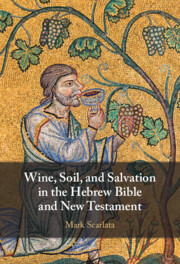
Biblical authors used wine as a potent symbol and metaphor of material blessing and salvation, as well as a sign of judgement. In this volume, Mark Scarlata provides a biblical theology of wine through exploration of texts in the Hebrew Bible, later Jewish writings, and the New Testament. He shows how, from the beginnings of creation and the story of Noah, wine is intimately connected to soil, humanity, and harmony between humans and the natural world. In the Prophets, wine functions both as a symbol of blessing and judgement through the metaphor of the cup of salvation and the cup of wrath. In other scriptures, wine is associated with wisdom, joy, love, celebration, and the expectations of the coming Messiah. In the New Testament wine becomes a critical sign for the presence of God's kingdom on earth and a symbol of Christian unity and life through the eucharistic cup. Scarlata's study also explores the connections between the biblical and modern worlds regarding ecology and technology, and why wine remains an important sign of salvation for humanity today.
This chapter copes with the challenge of portraying a divinity which is supposed to be nameless and imageless, and evoked by ‘abstract’ notions such as the ‘God’, the ‘Lord’, the ‘Name’ or even the ‘Place’. The bans on pronouncing his name and depicting his image are two faces of the same coin: to explore in a new and unpredictable way his identity. Starting from the role played by names in ancient Near Eastern traditions and in the Hebrew Bible, this chapter explores the onomastic puzzle of the biblical god, who holds many names, but whose name YHWH is the only one regarded as a proper name and revealed by himself to Moses. Such a central and enigmatic name is interpreted as a promise of presence and assistance to the people god chose on earth (Israel). The onomastic connection between YHWH and the Jews never ceased to strike external observers and produced many misunderstandings, and even mystifications, in the history of the research of the biblical divine names.
The preeminent example of monotheism, the God of the Hebrew Bible, is the end product of a long process. The world from which this literature emerged was polytheistic. The nature and arrangement of the literature diminishes polytheistic realities and enhances the effort to portray a single divine being. The development of this divine character through the course of a sustained narrative with a sequential plot aided the move toward monotheism by allowing for the placement of diverse, even conflicting, portrayals of the deity at distant points along the plot line. Through the sequence of events the divine character becomes more withdrawn from the sphere of human activity, more aged in appearance and behavior, and increasingly disembodied. All these characteristics lend themselves to the presentation of disparate narrative portrayals as a singular subject in this Element.
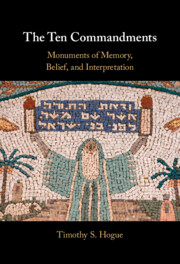
The Decalogue, commonly known as the Ten Commandments, is usually analysed as a text. Within the Hebrew Bible, however, it is depicted as a monument– an artifact embedded in rituals that a community uses to define itself. Indeed, the phraseology, visual representations, and ritual practices of contemporary monuments used to describe the Ten Commandments imbue them with authority. In this volume, Timothy Hogue, presents a new translation, commentary, and literary analysis of the Decalogue through a comparative study of the commandments with inscribed monuments in the ancient Levant. Drawing on archaeological and art historical studies of monumentality, he grounds the Decalogue's composition and redaction in the material culture and political history of ancient Israel and ancient West Asia. Presenting a new inner-biblical reception history of the text, Hogue's book also provides a new model for dating biblical texts that is based on archaeological and historical evidence, rather than purely literary critical methods.
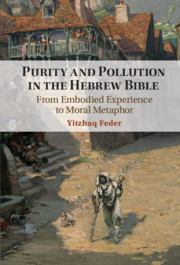
In this book, Yitzhaq Feder presents a novel and compelling account of pollution in ancient Israel, from its emergence as an embodied concept, rooted in physiological experience, to its expression as a pervasive metaphor in social-moral discourse. Feder aims to bring the biblical and ancient Near Eastern evidence into a sustained conversation with anthropological and psychological research through comparison with notions of contagion in other ancient and modern cultural contexts. Showing how numerous interpretive difficulties are the result of imposing modern concepts on the ancient texts, he guides readers through wide-ranging parallels to biblical attitudes in ancient Near Eastern, ethnographic, and modern cultures. Feder demonstrates how contemporary evolutionary and psychological research can be applied to ancient textual evidence. He also suggests a path of synthesis that can move beyond the polarized positions which currently characterize modern academic and popular debates bearing on the roles of biology and culture in shaping human behavior.