Refine search
Actions for selected content:
4 results
A NEW WEAK CHOICE PRINCIPLE
- Part of
-
- Journal:
- The Journal of Symbolic Logic / Volume 91 / Issue 2 / June 2026
- Published online by Cambridge University Press:
- 19 February 2026, pp. 538-555
- Print publication:
- June 2026
-
- Article
-
- You have access
- HTML
- Export citation
-
For every natural number n we introduce a new weak choice principle
 $\mathrm {nRC_{fin}}$:
Given any infinite set x, there is an infinite subset
 $y\subseteq x$ and a selection function f that chooses an n-element subset from every finite
 $z\subseteq y$ containing at least n elements.
By constructing new permutation models built on a set of atoms obtained as Fraïssé limits, we will study the relation of
 $\mathrm {nRC_{fin}}$ to the weak choice principles
 $\mathrm {RC_m}$ (that has already been studied in [3] and [6]):
Given any infinite set x, there is an infinite subset
 $y\subseteq x$ with a choice function f on the family of all m-element subsets of y.
Moreover, we prove a stronger analogue of the results in [6] when we study the relation between
 $\mathrm {nRC_{fin}}$ and
 $\mathrm {kC_{fin}^-}$ which is defined by
Given any infinite family
 $\mathcal {F}$ of finite sets of cardinality greater than k, there is an infinite subfamily
 $\mathcal {A}\subseteq \mathcal {F}$ with a selection function f that chooses a k-element subset from each
 $A\in \mathcal {A}$.


8 - Consistency Results
-
- Book:
- Proof Complexity Generators
- Published online:
- 29 May 2025
- Print publication:
- 26 June 2025, pp 75-92
-
- Chapter
- Export citation
THE RELATION BETWEEN TWO DIMINISHED CHOICE PRINCIPLES
- Part of
-
- Journal:
- The Journal of Symbolic Logic / Volume 86 / Issue 1 / March 2021
- Published online by Cambridge University Press:
- 15 February 2021, pp. 415-432
- Print publication:
- March 2021
-
- Article
-
- You have access
- Export citation
-
For every
 $n\in \omega \setminus \{0,1\}$ we introduce the following weak choice principle:
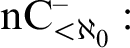 $\operatorname {nC}_{<\aleph _0}^-:$ For every infinite family
 $\mathcal {F}$ of finite sets of size at least n there is an infinite subfamily
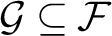 $\mathcal {G}\subseteq \mathcal {F}$ with a selection function
 $f:\mathcal {G}\to \left [\bigcup \mathcal {G}\right ]^n$ such that
 $f(F)\in [F]^n$ for all
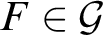 $F\in \mathcal {G}$.
Moreover, we consider the following choice principle:
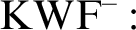 $\operatorname {KWF}^-:$ For every infinite family
 $\mathcal {F}$ of finite sets of size at least
 $2$ there is an infinite subfamily
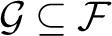 $\mathcal {G}\subseteq \mathcal {F}$ with a Kinna–Wagner selection function. That is, there is a function
 $g\colon \mathcal {G}\to \mathcal {P}\left (\bigcup \mathcal {G}\right )$ with
 $\emptyset \not =f(F)\subsetneq F$ for every
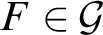 $F\in \mathcal {G}$.
We will discuss the relations between these two choice principles and their relations to other well-known weak choice principles. Moreover, we will discuss what happens when we replace
 $\mathcal {F}$ by a linearly ordered or a well-ordered family.


MRP, tree properties and square principles
-
- Journal:
- The Journal of Symbolic Logic / Volume 76 / Issue 4 / December 2011
- Published online by Cambridge University Press:
- 12 March 2014, pp. 1441-1452
- Print publication:
- December 2011
-
- Article
- Export citation
