Refine search
Actions for selected content:
4 results
ON DIFFERENCE SETS OF DENSE SUBSETS OF $\mathbb {Z}^2$

- Part of
-
- Journal:
- Bulletin of the Australian Mathematical Society , First View
- Published online by Cambridge University Press:
- 24 September 2026, pp. 1-7
-
- Article
-
- You have access
- HTML
- Export citation
-
We study the structure of the difference set $E - E$
 for subsets $E \subseteq \mathbb {Z}^2$
 of positive upper Banach density. Fish [‘On product of difference sets for sets of positive density’, Proc. Amer. Math. Soc. 146 (2018), 3449–3453] asked in Problem 2 whether, for every such set E, there exists a nonzero integer k such that $k \cdot \mathbb {Z} \subseteq \{ xy : (x,y) \in E - E \}$
 . Although this question remains open, we establish a relatively weaker form. Specifically, we prove that if $\langle a_j\rangle _{j=1}^m$
 is any finite sequence in $\mathbb {N},$
 then there exist infinitely many integers $k \in \mathbb {Z}$
 and infinitely many sequences $\langle x_n \rangle _{n \in \mathbb {N}}$
 in $\mathbb {Z}$
 such that $k \cdot MT(\langle a_j \rangle _{j=1}^m, \langle x_n\rangle _{n}) \subseteq \{ xy : (x,y) \in E - E \}$
 , where $MT(\langle a_j \rangle _{j=1}^m, \langle x_n\rangle _{n})$
 denotes the Milliken–Taylor configuration generated by the sequences $\langle a_j\rangle _{j=1}^m$
 and $\langle x_n \rangle _{n \in \mathbb {N}}$
 .


Intersective sets for sparse sets of integers
- Part of
-
- Journal:
- Ergodic Theory and Dynamical Systems / Volume 45 / Issue 5 / May 2025
- Published online by Cambridge University Press:
- 06 November 2024, pp. 1370-1402
- Print publication:
- May 2025
-
- Article
-
- You have access
- Open access
- HTML
- Export citation
-
For
 $E \subset \mathbb {N}$, a subset
 $R \subset \mathbb {N}$ is E-intersective if for every
 $A \subset E$ having positive relative density,
 $R \cap (A - A) \neq \varnothing $. We say that R is chromatically E-intersective if for every finite partition
 $E=\bigcup _{i=1}^k E_i$, there exists i such that
 $R\cap (E_i-E_i)\neq \varnothing $. When
 $E=\mathbb {N}$, we recover the usual notions of intersectivity and chromatic intersectivity. We investigate to what extent the known intersectivity results hold in the relative setting when
 $E = \mathbb {P}$, the set of primes, or other sparse subsets of
 $\mathbb {N}$. Among other things, we prove the following: (1) the set of shifted Chen primes
 $\mathbb {P}_{\mathrm {Chen}} + 1$ is both intersective and
 $\mathbb {P}$-intersective; (2) there exists an intersective set that is not
 $\mathbb {P}$-intersective; (3) every
 $\mathbb {P}$-intersective set is intersective; (4) there exists a chromatically
 $\mathbb {P}$-intersective set which is not intersective (and therefore not
 $\mathbb {P}$-intersective).


A new upper bound for sets with no square differences
- Part of
-
- Journal:
- Compositio Mathematica / Volume 158 / Issue 8 / August 2022
- Published online by Cambridge University Press:
- 30 September 2022, pp. 1777-1798
- Print publication:
- August 2022
-
- Article
-
- You have access
- HTML
- Export citation
-
We show that if
 $\mathcal {A}\subset \{1,\ldots,N\}$ has no solutions to
 $a-b=n^2$ with
 $a,b\in \mathcal {A}$ and
 $n\geq 1$, thenfor some absolute constant
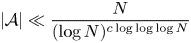 \[ \lvert \mathcal{A}\rvert \ll \frac{N}{(\log N)^{c\log\log \log N}} \]
 $c>0$. This improves upon a result of Pintz, Steiger, and Szemerédi.


ABELIAN DIFFERENCE SETS AS LATTICE COVERINGS AND LATTICE TILINGS
- Part of
-
- Journal:
- Bulletin of the Australian Mathematical Society / Volume 106 / Issue 2 / October 2022
- Published online by Cambridge University Press:
- 24 January 2022, pp. 177-184
- Print publication:
- October 2022
-
- Article
-
- You have access
- Open access
- HTML
- Export citation
-
We demonstrate that every difference set in a finite Abelian group is equivalent to a certain ‘regular’ covering of the lattice
 $ A_n = \{ \boldsymbol {x} \in \mathbb {Z} ^{n+1} : \sum _{i} x_i = 0 \} $ with balls of radius
 $ 2 $ under the
 $ \ell _1 $ metric (or, equivalently, a covering of the integer lattice
 $ \mathbb {Z} ^n $ with balls of radius
 $ 1 $ under a slightly different metric). For planar difference sets, the covering is also a packing, and therefore a tiling, of
 $ A_n $. This observation leads to a geometric reformulation of the prime power conjecture and of other statements involving Abelian difference sets.


