To save content items to your account,
please confirm that you agree to abide by our usage policies.
If this is the first time you use this feature, you will be asked to authorise Cambridge Core to connect with your account.
Find out more about saving content to .
To save content items to your Kindle, first ensure no-reply@cambridge.org
is added to your Approved Personal Document E-mail List under your Personal Document Settings
on the Manage Your Content and Devices page of your Amazon account. Then enter the ‘name’ part
of your Kindle email address below.
Find out more about saving to your Kindle.
Note you can select to save to either the @free.kindle.com or @kindle.com variations.
‘@free.kindle.com’ emails are free but can only be saved to your device when it is connected to wi-fi.
‘@kindle.com’ emails can be delivered even when you are not connected to wi-fi, but note that service fees apply.
This article interrogates the moral inflation latent in socialization programmes that court combatants’ compliance with international humanitarian law (IHL) through moral character-building identity projects but neglect the unique logic of IHL as an emergency brake on total destruction and elide the liminal subjectivity of combatants on this precipice. The article begins by uncovering two divergent views on combatants’ subjectivity that underpin different approaches to influencing their conduct: one views combatants as functionaries and advocates hardwiring IHL into commands and policies to build shortcuts to combatants’ pre-reflective self-consciousness, while the other views combatants as reflective individuals and aims for their internalization of the ethical values underpinning IHL as a more durable way of promoting restraint. The article then examines the radical potential of combatants’ self-conscious exercise of their existential freedom in war, explores the limits of the use of “identity” inculcation to rein in this freedom, and demonstrates how IHL compliance could itself be an expression of combatants’ authenticity in an existential sense through acknowledging their inherently limited subjectivity as “enemies by accident” in war.
This article explores the relationship between political myth and ontological security through an existentialist lens. It argues that political myths are primarily about not truth but rather function. They generate ontological security by offering symbolic coherence in response to existential uncertainty. Political myths are defined as a process of continuous ‘work’ on a dramatic narrative designed to provide adherents with a sense of significance (Bedeutsamkeit). Myths serve as filtering mechanisms against the absolutism of reality – a state of extreme anxiety in which we are overwhelmed by a world indifferent to our existence – and produce ontological security through dramatic narratives that provide frameworks of significance. The article demonstrates that the work on myth operates continuously and generatively to maintain identity stability and intensifies in crisis to prevent physical insecurity from cascading into identity destabilisation. It outlines three main features: the cognitive provides interpretive lenses, the integrative reinforces collective identity, and the mobilising provides existential certainty to act. It demonstrates this through an analysis of political and media responses to terrorist attacks in the UK in 2017, highlighting how narratives about an apparent conflict with a ‘perverted’ form of Islam became mythologised, functioning as a potent generator of ontological security.
Chapter 1 examines the problem of postcolonial estrangement, via a little-known episode in 1966 in which the preeminent national painter of Pakistan was commissioned to illustrate Albert Camus’ 1942 novel L’Étranger (The Stranger). These “illustrations,” artistic projects in their own right, were commissioned by an artists’ book press, and printed in a limited run, most of the copies of which were distributed to members of the guild press and the artist’s friends and family. While Sadequain had some familiarity with the major works of European modernism via print publication, his primary literary and aesthetic bibliography draws from the Urdu and Persian traditions. The lithographs, curiously cosmopolitan, are shocks of color and modernist collage, filled with grinning devils and red-lipped sinners, the images facing opposite Camus’ ascetic rendering of Meursault’s spare and affectless criminal condition and his victim. As such, they may be the first rendering of Camus’ nameless Arab – murdered on the beach – by a postcolonial subject. This chapter, based on archival research of the artist’s book and the painter’s other Paris work, examines this complicated and multifaceted text itself, as well various etiologies of estrangement.
Chapter 5 focuses on responsibility as an ethical category in a newly articulated political community. Drawing from the intellectual and political work of Bengali writer Syed Waliullah, this chapter offers an analysis of his existential call to freedom in the service of a new postcolonial subjectivity. Canonized on both sides of post-partitioned Bengal, Waliullah’s oeuvre – fiction, drama, short stories, essays and paintings – though composed almost entirely abroad, draws on the land and landscapes of rural Bengal, as it does on certain paradigms of existential philosophy; his protagonists, for example, are wracked by a singular and terrible sense of responsibility. How might we understand this complex negotiation beyond the most basic ascriptions of belatedness and mimicry? Because he was based in Paris for most of his life after government posts in England, Germany, Indonesia, and Australia, I suggest self-translation, as a larger philosophical venture and as a way to understand a metaphysical or existential line of questioning in this work. In the process, we see that both “situation” and “responsibility” become newly imbued with meaning in the context of a rural, postcolonial Bengal.
Drawn from a slight, icy novel of the towering Hindi poet Agyeya, a key figure of experimental poetry and modernist poetics in India, Chapter 2 focuses on the exit – or the form of renunciation – as a preoccupation of postcolonial literature. The novel To Each His Own Stranger (1961), written in India and revised and translated in Berkeley, California, is an exercise in the reconciliation of both Søren Kierkegaard’s Either/Or and Sartrean theories of being with the author’s heterodox reading of Hindu philosophy. This chapter argues for the late style – the exit – of Agyeya, explicitly different from the revolutionary subjectivity that characterizes his early magnum opus, the autobiographical novel Shekhar: Ek jivani, and his expressionistic, poetic oeuvre (including the haiku). Drawing on this text alongside the writer’s notebooks, originally titled Men Without Shadows, from the English translation of Sartre’s play, I suggest that modernism here is understood as a preoccupation with new forms of selfhood, alongside forms of asceticism. Moreover, this exit by avalanche (also referred to as “Zen experiment”) traces a particular genealogy of postcolonial selfhood, from rebellion to renunciation.
In this article, I invite readers to think about what it really means to taste life. I intend this to be an opening to a broader conversation about what it means to be virtuous, to flourish collectively, and even to experience transcendence. Guiding the reader through various existential views and scenarios, I explore the potential to transform both our lives and the fabric of our shared reality. Living such a life entails far more than a mundane and restrained biological, functional existence. In short, we need not ‘merely exist’; we can exist more.
This article introduces the work of Gisele Halimi, advocate and co-author with Simone de Beauvoir. Halimi’s work is examined for its philosophical content and its relation to the cultures of North Africa. This active woman exemplifies certain conceptual trends then at work in France and other areas, and her writings show the influence of the overall European and colonial milieus on a number of ethnicities.
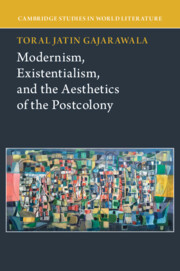
How did writers reimagine self and nation in the postcolonial moment? After the brutalities of partition and the triumph of Independence, decolonization in South Asia unfolded in a dramatic sense of disillusion and alienation. In this transnational study, Toral Gajarawala explores the cultural afterlife of decolonization in India, Pakistan and Bangladesh and its profound moment of existential reckoning. In new genres and forms, artists registered a growing sense of estrangement from nation and nationalism, and crafted a new aesthetic landscape. This book reconsiders modernism in the subcontinent, charting the unlikely affiliations and aesthetic experiments it generated. Each chapter discusses a distinct artistic experiment- Hindi novels set in snow and ice, and a Pakistani painter's Paris moment; the existential novel of Bengal, and absurdist plays on famine and extinction- in light of key philosophical concepts of the moment: askesis, responsibility, commitment. The result is an illuminating microanalysis of the 1960s that reshapes our understanding of postcolonial aesthetics.
The themes of love and loving are often, albeit not always explicitly, present in Kierkegaard's works. It is only his 1847 Works of Love, however, in which the topic serves as a central focus of inquiry. And while at first glance, this text may seem alien to Kierkegaard's poetic existentialism, revolving as it does around the commandment 'You Shall Love Your Neighbour as Yourself' rather than the drama of human existence and the mysteries of the human heart, the thesis that emerges is entirely existential: the capacity for loving is inherent to our very existence as humans. Focussing on Works of Love supported by a few short detours through other texts of Kierkegaard, this Element explores Kierkegaard's view of love as ultimately construing loving as a way of life.
Simone de Beauvoir (1908–1986) made important contributions to ethics, social philosophy, and the philosophy of the body, and was also a prize-winning novelist. Her book The Second Sex (1949) made a huge impact as part of the second wave of feminist thought. This accessible study examines Beauvoir's philosophy across all her works, including not only The Second Sex, The Ethics of Ambiguity and her essays, but also her novels, autobiography, travel diaries and memoirs. Her key ideas are analysed, including freedom and self-creation -- with special attention to their constraints and limitations – solidarity, and the role of other people in a person's existence. Her views of women's lived experience, motherhood, the body, illness, and death are related to our own time, with examples from current affairs, literature, cinema, and social media. The result is a fresh perspective on Beauvoir's philosophy and its enduring power to illuminate existential and social realities.
In this chapter, I explore historical phenomena across a century of African American poetry, mapping a series of trends through which Black vernacular music and language come together in distinct poetic modes. Within this tradition, poets have consistently innovated the genre by incorporating culturally specific forms and expressive practices from the Black vernacular. While this conflation of music and writing has led to much innovation, it also carries immense political significance, by challenging the hegemony of Western aesthetic criteria and recording Black experience and cultural knowledge against racism’s denigrations or erasures. In this multiform articulation of Black subjectivity across time, African American poets have continually affirmed the importance of music as a cultural repository and a model for alternative poetics.
This chapter explores Allen Ginsberg’s stay at the now-famous Beat Hotel. Ginsberg, along with his lover Peter Orlovsky and fellow Beat poet Gregory Corso, spent an important sojourn at this spot in Paris. Located in the Latin Quarter, this run-down hotel would come to house other Beats such as William S. Burroughs and Harold Norse as well. Ginsberg’s time there was productive. He produced “At Apollinaire’s Grave” while in Paris and began his long poem “Kaddish” as well, while simultaneously seeing the sights and meeting a variety of famous French poets and artists.
This chapter examines Sadr’s Falsafatuna and Iqtisaduna as seminal Islamic responses to the ideological and philosophical upheavals of mid-twentieth-century Iraq. Against the backdrop of the radical political transformations that culminated in the 1958 July Revolution and the subsequent contest over Iraq’s national identity – between Pan-Arab and territorial nationalists, communists, and Islamists – Sadr sought to articulate a civilizational project rooted in Islamic metaphysics, social ethics, and epistemology. Through a rigorous critique of Marxist materialism, Western empiricism, and behavioral psychology, he constructs a modern Islamic philosophy grounded in rationalist epistemology and natural theology. Engaging with Sunni revivalist thought, Arab existentialism, and emerging discourses in psychology and economics, Sadr formulated elements of an Islamic moral economy and philosophical paradigm that confronted the ideological pluralism of his time. His work repositions metaphysics within the intellectual struggle for decolonization and articulates a modern Islamic worldview aimed at promoting theism, spiritual renewal, and social justice.
In Chapter 4, I (a) explore three alternative perfectionist theories and show where they fall short. I then (b) move on to three critiques of perfectionism, arguing that they all fail. (a) Tom Hurka’s perfectionist theory jettisons teleological essentialism, yet tacitly relies on it. It advocates an ‘intuitive’ and ‘explanatory’ elucidation of the human essence, though these are not demonstratively superior to Aristotle’s rival method. George Sher’s ‘poor man’s Aristotelianism’ proves similarly unconvincing, yielding (by his own admission) an incomplete roster of perfections. Richard Boyd’s ‘homeostatic cluster’ theory, for its part, also falls short, relying on an intuitionistic and question-begging notion of ‘human need’. (b) Dale Dorsey’s critique of perfectionism fails to grasp the teleological nature of Aristotelian essentialism and relies on a defeasible set of counter-examples. Philip Kitcher’s critique centres on a ‘reductivist challenge’, which assumes (wrongly, I argue) that human nature must be characterisable in a wholly ‘value-free’ way. Last, I tackle the ‘analytic existentialist’ critique, which relies too heavily (I argue) on metaphor and normative abstraction.
This chapter explores the approach of the Italian Thomist and Kierkegaard scholar, Fr. Cornelio Fabro (1911–1995), to move contemporary scholarly discussions toward consensus regarding the dialogue between Thomism and continental philosophy, which centers on the question of the meaning of being (esse) and contingency. The central observation is that what is now taken as the canonical Thomist view of creation and freedom is indebted to Fabro’s research on the metaphysics of participation. For Fabro, the forgetfulness of being that Heidegger rightly identifies loses its way with the forgetfulness of the act of being. By distinguishing esse from existentia with Fabro’s notion of participation and act of being (actus essendi), Fabro’s Thomism avoids Cartesian dualism and phenomenological monism, which opens a constructive dialogue with continental thought. Briefly rehearsing Fabro’s metaphysical distinction between factical existence (existentia) and being (esse) illuminates Fabro’s critical evaluation of continental thought as a speculative scheme of necessary emanation or pure immanence. The chapter concludes that the best way to approach this question is not to limit it to the empirical realm of factical existence (existentia) but rather to open up the existential question to the metaphysics of creation ex nihilo.
This manifesto argues that education should incorporate philosophical exploration to help young people address existential questions and find meaning and purpose in their lives. The manifesto suggests that to understand the meaning of one’s life, one must consider personal existence and consciousness and the reality beyond the here and now. It proposes that education should provide a neutral forum for discussing these big questions, without bias towards any particular belief system, and incorporating both scientific and spiritual perspectives. By engaging in such philosophical discourse, young people can develop a clearer sense of self and purpose, fostering resilience, mental well-being and a commitment to values and moral behaviour. This can support them to survive and thrive through the opportunities and challenges of the future.
Although the concept of concept did not play a central role in twentieth-century phenomenology, what Heidegger and Merleau-Ponty thought about concepts can be inferred indirectly from what they did say about understanding, cognition and judgement. Heidegger’s approach to cognition by way of a phenomenology of assertion, for example, implies an identification of concepts with the meanings of words. Similarly, Merleau-Ponty stresses the dependence of conceptual thought on perceptual experience and bodily skill. Concepts play a more prominent role in Gadamer’s philosophical hermeneutics, particularly in his distinction between the essential ongoing formation of concepts in the interpretation of texts, and their methodical application in the natural sciences.
The concern of this chapter is with varieties of philosophical humanism and their own conceptions of the nature and significance of science. After an initial characterization of major themes in Renaissance humanism, it describes three main varieties that are evident in twentieth-century European philosophy – humanism as essentialism, humanism as rational subjectivity, and existential humanism. Different varieties of humanism are associated with different conceptions of science, some allied to the sciences, others antipathetic to them, while yet others offer subtler positions. The upshot is that there are different tales to tell about the relationship of (varieties of) philosophical humanism to (conceptions of) science, only some of which fit popular modern celebratory claims about a necessary alliance of humanism and science. If we take a wider look at the history of philosophy, we find ongoing experimentation with forms of humanism and explorations of diverse ways of understanding and evaluating scientific knowledge and ambitions. What we find is what we ought to expect of social, creative, epistemically sophisticated, self-expressive creatures: endless variety.
Part of the fascination of Being and Time is that it seeks to weave together so many different strands of thought. But unsurprisingly, its readers also worry that such a work must subject itself to such strain that ultimately it itself must unravel. Key tensions are between the outlooks of three figures: Heidegger the pragmatist, Heidegger the existentialist, and Heidegger the philosopher of being. Seeing how openness to our concerns as a whole is both necessary for authenticity and reveals a unified horizon against which entities with different ways of being show themselves, dissipates these apparent tensions. Recognition of the mediating role played by a conception of the good – that Heidegger’s reading of Aristotle and Augustine inspired – helps make clear that authenticity is both compatible with the practical embeddedness of our concerns and reveals a form of understanding necessary for ontology to be possible.
This chapter explores the connection between Heidegger’s existentialism and fundamental ontology. Specifically, and contra John Haugeland who argues that existentialism is a key feature of fundamental ontology insofar as taking responsibility for our existence entails getting the being of entities right, this chapter argues that taking responsibility for our existence explicitly exhibits the temporal horizon that is fundamental for all our purpose activities and our understanding of entities, generally.