To save content items to your account,
please confirm that you agree to abide by our usage policies.
If this is the first time you use this feature, you will be asked to authorise Cambridge Core to connect with your account.
Find out more about saving content to .
To save content items to your Kindle, first ensure no-reply@cambridge.org
is added to your Approved Personal Document E-mail List under your Personal Document Settings
on the Manage Your Content and Devices page of your Amazon account. Then enter the ‘name’ part
of your Kindle email address below.
Find out more about saving to your Kindle.
Note you can select to save to either the @free.kindle.com or @kindle.com variations.
‘@free.kindle.com’ emails are free but can only be saved to your device when it is connected to wi-fi.
‘@kindle.com’ emails can be delivered even when you are not connected to wi-fi, but note that service fees apply.
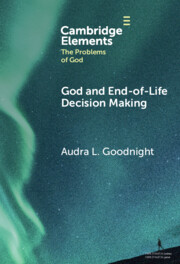
This Element explores end-of-life decision-making through a secular and spiritual lens of the human person to examine what difference God makes in these decisions. Both the spiritual and the secular perspectives reveal different goods involved in the decisions people make at the end of life: the goods of autonomy, independence, and freedom compared with the goods of relationality, dependence, and sanctity of life. With the advancements in medical technology, it is possible to keep people alive significantly longer than has ever been possible. But a longer life is not necessarily a good life, nor does it portend a good death. Thus, this Element considers the medicalization of death, the growth of hospice and palliative care, the possibility of physician-assisted suicide, and the impact that belief in God, the sanctity of life, and the nature of the human person has in these different facets of end-of-life decisions.
Recommend this
Email your librarian or administrator to recommend adding this to your organisation's collection.