To save content items to your account,
please confirm that you agree to abide by our usage policies.
If this is the first time you use this feature, you will be asked to authorise Cambridge Core to connect with your account.
Find out more about saving content to .
To save content items to your Kindle, first ensure no-reply@cambridge.org
is added to your Approved Personal Document E-mail List under your Personal Document Settings
on the Manage Your Content and Devices page of your Amazon account. Then enter the ‘name’ part
of your Kindle email address below.
Find out more about saving to your Kindle.
Note you can select to save to either the @free.kindle.com or @kindle.com variations.
‘@free.kindle.com’ emails are free but can only be saved to your device when it is connected to wi-fi.
‘@kindle.com’ emails can be delivered even when you are not connected to wi-fi, but note that service fees apply.
The feminist enterprise in law focuses on power imbalances related to gender and on unacknowledged, unrepresentative assumptions about what is reasonable and normal. On the hunch that the legally postulated “reasonable man” may not represent every reasonable person, feminist jurisprudence seeks out false (whether naïve or disingenuous) assertions of objectivity and neutrality in law and questions their premises. It rejects the retro-epistemology of evidentiary thinking, that is, the belief that there is an objective reality capable of discovery through neutral principles, logic, and clear thinking. Instead, feminist jurisprudence focuses on how language, emotion, and politics all can subtly influence law.
This article makes a case for creative methods in legal research that is both analytical and moral. Beginning with an information-theoretical account of legal evolution, I propose a shift from ‘law as language’ and ‘law as communication’ to the more foundational unit of information coded by legal language. I conceptually clarify ‘legal coding’ as the process by which legal meanings get constructed and conceptualised, and position the legal academy as an active site of legal coding. Critically examining the information that is excluded from legal codes (because of ignorance, irrelevance, or illegibility) opens pathways to reveal, challenge, and shift the selective and patterned tendencies of legal coding processes to reinforce epistemic injustice. Positioning the legal academy as a site of legal coding further helps in understanding legal research as a practice of legal coding. I argue that expanding our methodological toolkits can enable a more holistic coding of social reality. By expanding the form of legal codes, creative methods equip us to capture new (or previously excluded) information about lived realities that remain on the margins of meanings. The analytical case for coding social reality more holistically, by including new forms of information through a creative praxis, is complemented by a moral case to include alternative perspectives and hermeneutically misunderstood lives. I demonstrate these arguments through a self-produced short film ‘(IN)VISIBLE’ that captures the working lives of Indian women legal experts, towards a grounded theory of legal evolution from the south. The film combines embodied, poetic, sonic, and visual analyses to capture and analyse legal coding from the point of view of my research participants. My discussions on the process and output of the film show how a phenomenological analysis can help reveal the structural, allowing for a more complete and just coding of social reality, from within the academy.
This chapter describes the foundations for and the possibilities of implementing a Queer AZN CRT framework in social work practice. Queer AZN CRT is rooted in critical, feminist, queer, Indigenist and Pasifika theories, and explores the impacts of colonization, imperialism, and indigeneity within intersectional Asian experiences. Six proposed tenets for Queer AZN CRT are listed along with core considerations for social work practice: (1) Queer, brown Asianization; (2) challenging mainstream ideologies about Asians, Pacific Islanders, and QTPI/QTAAm; (3) global, decolonial perspectives; (4) reconstructive histories; (5) multidisciplinary story, practice, praxis, and voice; and (6) social justice perspective. Two narratives depict the application of Queer AZN CRT in social work practice, first in a clinical social work scenario, and then within a macro practice framework. Additional reflections regarding the implications for Queer AZN CRT in social work practice and education are discussed.
It is little wonder that Los Angeles, a city of compulsive self-narration, has birthed a tradition of autobiographical literature with local particularities. A uniquely LA tradition of memoir, autobiography, and autofiction come to the fore in this chapter. Allmendinger identifies three key strands of LA life writing: the Hollywood tell-all (Barbara Payton, Christina Crawford), the gang memoir, (Rafael Pérez-Torres, Freddy Negrete) and a third, more diffuse grouping – writings by women in which frank and personal explorations of gender and sexuality predominate (Eve Babitz, Maggie Nelson, Wendy C. Ortiz). While these three forms of reflection on lives lived in Los Angeles appear disparate, Allmendinger identifies in them a shared refusal of (White, male, straight) “master” narratives of Southern Californian consciousness.
This chapter studies the 2020 photo-essay “A Primordial Culture” by Sri Lankan Canadian multidisciplinary artist Rajni Perera. It centers Perera’s work as the basis of a theory of divine adornment as a creative response to climate catastrophe. Such a theory is derived from an investment in thinking alongside Anne Anlin Cheng’s concept of ornamentalism and demonstrates how forms of ornament might be complicated and utilized differently in response to Perera’s lone figure roaming unknown terrain following planetary collapse. The chapter weaves in discussions of both the photographs of Perera’s adorned traveler figure and her writing as a mode of describing a future world deeply rooted in, and indebted to, Indigenous, ancient, and anti-colonial feminist cosmologies.
Women and girls’ organisations (WGOs) are a fundamental part of the voluntary and community sector (VCS) and wider society. They have a unique history and development as a sub-set of the wider VCS and have been pivotal in meeting important needs for women and girls, yet existing analysis of the VCS using data from the Charity Commission for England and Wales (CCEW) has not previously focused on WGOs. The purpose of this paper is to present a feminist approach to identifying and classifying WGOs utilising data from the CCEW register. The paper provides a detailed exploration of the methodological approach and argues that such an approach to compiling and analysing datasets is both necessary and advantageous in exposing areas of power and contestation. The paper provides an original overview of the scope of WGOs in England and Wales between 2008 and 2018 and also demonstrates benefits that can be applied in other classification work within the field.
Within the UN, there is a divide between NGO networks with differing stances on gender equality and women’s rights. Feminist and feminist-informed NGOs push for extensive women’s rights, including reproductive rights and protection against discrimination. In contrast, conservative NGOs uphold traditional gender roles and family structures, strongly opposing reproductive rights like abortion. Studies have examined these NGOs’ stances and advocacy tactics, but a detailed comparative analysis of their views of the UN – their key battleground – is missing. The paper addresses this gap by assessing how each group evaluates the UN’s legitimacy and identifying the underlying sources of legitimacy beliefs. By combining computational and qualitative text analysis, it reveals several trends: the UN is central in the discourse of both groups of NGOs, although it appears more in feminist NGOs’ communications, and feminist groups generally evaluate the UN’s legitimacy more positively. This positivity peaks when the UN actively supports feminist objectives and collaborates with these NGOs. Conservative NGOs, on the other hand, positively evaluate the UN when they can align the UN’s foundational texts with their views and when they garner support from conservative states. Their most negative evaluations occur when they believe the UN uses deception to promote progressive policies.
Gwendolyn Alker considers particular aspects of Fornés’s work – including the way she asked her students to do yoga before writing, her various exercises developed to bypass the frontal cortex, and her prescient connections to the animal world – to argue for a “Fornésian ecology” and to evince its lessons for our collective futures on a damaged planet. Alker argues that the characters in Mud (alongside many of Fornés’s plays) must be understood through their relationship with each other and with their environment. Alker submits that Fornesian world-making prompts us to see the environment within the world of her plays, to be aware that we are outside that world and will never fully understand it, just as we cannot ever fully understand the animals that we encounter, even as Fornés’s plays challenge us to cultivate empathy for animals, understand their relevance, and believe in their truths, despite their otherness from ourselves.
German men and their collaborators perpetrated sexual violence during the Holocaust and throughout the war, during pogroms, in ghettos and labor-camps, as well as in concentration and extermination camps. They committed this violence against women, girls, and gender-nonconforming people as well as against minorities, such as Roma. Sexual coercion and abuse also occurred within the societies of those persecuted, for example in ghettos, camps, or partisan groups. In hiding or during liberation, people also experienced sexual violence at the hands of protectors, allies, or liberation soldiers. This chapter focuses on the experiences of women, but importantly also addresses those of male victims. It also addresses how sexual violence was part of Nazis’ and their collaborators’ acts of genocidal violence against Jews.
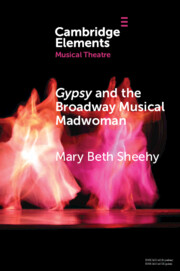
Gypsy, the groundbreaking 1959 Broadway musical by Jule Styne, Stephen Sondheim, and Arthur Laurents, introduced the world of musical theater to one of the most formidable female characters ever to strut onto the stage: Madam (Momma) Rose. She embodies the archetypal “stage mother” whose lifelong journey to achieve fame, enacted vicariously through her daughters and their vagabond life across America, drives her to a “madness” akin to that of the quintessential operatic madwoman. Her famous mad scene, “Rose's Turn,” demonstrates the many analytical possibilities intrinsic to this character definition. The creators of Gypsy's Rose thus showcased the “Broadway musical madwoman” type: a female character who, like her foremother the operatic madwoman, is rife with gendered complexity that creates a fascinating opportunity for feminist analytical study. This Element's two-pronged approach uses the frameworks of feminist theory and musicological analysis to consider the importance, legacy, and reception of Rose's journey.
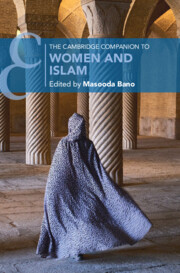
The Cambridge Companion to Women and Islam provides a comprehensive overview of a timely topic that encompasses the fields of Islamic feminist scholarship, anthropology, history, and sociology. Divided into three parts, it makes several key contributions. The volume offers a detailed analysis of textual debates on gender and Islam, highlighting the logic of classical reasoning and its enduring appeal, while emphasizing alternative readings proposed by Islamic feminists. It considers the agency that Muslim women exhibit in relation to their faith as reflected in women's piety movements. Moreover, the volume documents how Muslim women shape socio-political life, presenting real-world examples from across the Muslim world and diaspora communities. Written by an international team of scholars, the Companion also explores theoretical and methodological advances in the field, providing guidance for future research. Surveying Muslim women's experiences across time and place, it also presents debates on gender norms across various genres of Islamic scholarship.
International skilled heath worker migration is a key feature of the global economy, a major contributor to socio-economic development and reflective of the transnationalization of health and elder care that is underway in most OECD nations. The distribution of care and health workforce planning has previously been analysed solely within national contexts, but increasingly scholars have shown how care deficits are being addressed through transnational responses. This Element examines the complex processes that feed health worker migrants into global circulation, the losses and gains associated with such mobility and examples of good practices, where migrants, sending and destination communities experience the best possible outcomes. It will approach this issue through the lens of problems, and solutions, making connections across the micro, meso and macro within and across the sections.
This chapter explores the contraception campaigns of feminist groups in the 1970s including the Irish Women’s Liberation Movement, Irishwomen United and the Contraception Action Programme. It places the activities of these groups within the wider historiography of feminist health activism. Drawing primarily on oral history interviews with former members and feminist magazines, newspaper sources and the Roisin Conroy/Attic Press Archive, this chapter illuminates the personal experiences of Irish feminist activists. It illuminates the personal experiences of Irish feminist activists and illustrate the nuances of feminist demands for reproductive rights within the Irish case study. Moreover, as well as service provision, later groups such as IWU and CAP drew attention to the important class and geographic inequalities with regard to access to contraception in Ireland.
In this chapter, the author examines clinical psychological, traumatic developmental, and sociocultural perspectives of a serial murder. This includes media dynamics and feminist perspectives. The author discusses malingering, or the faking of mental illness. The case of female serial killer (FSK) Aileen Wuornos is revisited to illustrate clinical psychological issues. The cases of male serial killers (MSKs) Ronald Dominique and Dennis Rader (BTK Strangler) highlight phenomena from the chapter.
Critical accounts of the modes in which modernist poetry responds to the First World War continue to place an emphasis on men’s responses to war, either non-combatants such as T.S. Eliot and Ezra Pound, or those who served, among them Richard Aldington and Wyndham Lewis. This chapter does consider the men of the poetic avant-garde but also focuses on women of the avant-garde – H.D., Marianne Moore, Mina Loy and Juliette Roche – to unearth the generative impact of the First World War on their poetry. As this chapter explores, the war features as subject matter and stimulus for the poetries of modernism and in the pages of modernist magazines, generating new forms and perspectives alongside the vivid expressions of anger, trauma, loss, and disillusionment. However, as this chapter also argues, women poets wrote the conflict differently; in confronting both patriarchal and military violence, the First World War became a key impetus for their feminist avant-garde poetic.
This article presents a polycentric Africanist reading of Dada Masilo's Giselle, which debuted in South Africa in 2017. Although ballet was used as a tool of colonization in South Africa, establishing cultural and aesthetic norms from a European paradigm, while undermining Indigenous arts and excluding non-white artists, I argue that Dada Masilo's choreographic choices employ the narrative of Giselle to decolonize through ballet. Masilo's choreography indigenizes the ballet, transforming local and global practices through an Indigenous lens. Dada Masilo's Giselle embodies African philosophies such as ancestorism, as well as gender fluidity and complementarity. It mobilizes techniques such as signifyin(g), comedic resistance, code-switching, battling, shouting, and critically reappropriating Tswana and diasporic movements in order to convey a distinctly South African version of the European ballet. This work transcends the romantic love of Giselle in order to convey a decolonial love by centering South African ways of knowing and being in the world.
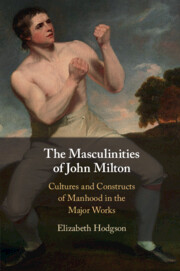
The Masculinites of John Milton is the first published monograph on Milton's men. Examining how Milton's fantasies of manly authority are framed in his major works, this study exposes the gaps between Milton's pleas for liberty and his assumptions that White men like himself should rule his culture. From schoolboys teaching each other how to traffic in young women in the Ludlow Masque, to his treatises on divorce that make the wife-less husband the best possible citizen, and to the later epics, in which Milton wrestles with male small talk and the ladders of masculine social power, his verse and prose draw from and amplify his culture's claims about manliness in education, warfare, friendship, citizenship, and conversation. This revolutionary poet's most famous writings reveal how ambivalently manhood is constructed to serve itself in early modern England.
This chapter sets out the central argument of this book – that personal bioinformation has critical roles to play in our construction of self-narratives that are capable of remaining coherent and inhabitable when confronted by our embodied and socially embedded experiences and of supporting us in making sense of and navigating these experiences. It suggests that our lives and experiences are inescapably those of embodied beings and outlines what is entailed by this claim. It proposes that any satisfactory account of narrative self-constitution must accommodate the significance of our embodiment as the context in which we construct our self-narratives and as the source of both narrative contents and limits upon unfettered self-definition. From these premises, this chapter argues that personal bioinformation – to the extent that it provides reliable and meaningful insights into our bodily and biological states, capacities, and relationships – can provide vital constitutive and interpretive tools for the interpretation and construction of our embodied self-narratives. This discussion distinguishes its position from suggestions that personal bioinformation gets us closer to narrative ‘truth’ and responds to concerns that proposing a narrative role for bioinformation commits us to the view that our identities are defined by our biology or bodies as objects.
This chapter introduces a set of six principles to guide the evaluation and design of rights-based care and support policy in liberal welfare states. The principles build on and extend the reconciliation efforts discussed in earlier chapters, using the common thread of social citizenship rights claims that runs through the feminist, carer and disability rights perspectives. The principles provide criteria for evaluating the extent to which existing policies encompass the concerns of multiple care and disability perspectives, including whether they ease policy tensions between supporting women’s unpaid care and paid work and between meeting the claims of carers and those of people with disabilities. The principles can also inform the design of policies that promote equal social citizenship rights to care, support and paid work participation for all parties to these relationships. The principles address matters including access to financial resources and good quality services; flexibility in how life is organized; time for unpaid care, paid work and self-care; incorporation of the ‘voice’ of all affected people in the policy design; and responding to difference associated with gender inequality, disability and impairment, and citizenship status.
This chapter explores the importance of women’s leadership with a focus on community-building activities. The term leadership is examined in relation to sex/gender, feminism, the qualities and styles that align with women’s gendered socialization, gender scripts and worldviews. Using a case example, we illustrate how feminist community leaders might select among six approaches to build trust and optimism in their followership. These frameworks include Transformational leadership, Servant leadership, Collaborative leadership, Innovation leadership, Diversity and Inclusion leadership, and Emotionally Intelligent leadership. Each leadership approach is synergistic with a feminist framework. The chapter discusses how women leaders can draw on these frameworks to maximize their effectiveness. We also discuss strategies to develop women as community leaders with consideration of the unique circumstances and needs of women underprivileged backgrounds.