To save content items to your account,
please confirm that you agree to abide by our usage policies.
If this is the first time you use this feature, you will be asked to authorise Cambridge Core to connect with your account.
Find out more about saving content to .
To save content items to your Kindle, first ensure no-reply@cambridge.org
is added to your Approved Personal Document E-mail List under your Personal Document Settings
on the Manage Your Content and Devices page of your Amazon account. Then enter the ‘name’ part
of your Kindle email address below.
Find out more about saving to your Kindle.
Note you can select to save to either the @free.kindle.com or @kindle.com variations.
‘@free.kindle.com’ emails are free but can only be saved to your device when it is connected to wi-fi.
‘@kindle.com’ emails can be delivered even when you are not connected to wi-fi, but note that service fees apply.
The 1810s saw a flurry of poems published in the Italianate form of ottava rima. This chapter focuses specifically on ottava rima poems that reflect on the role of expectation and anticipation in listening. This includes episodes of mishearing, which show how anticipation sometimes distorts perception. We hear what we expect or want to hear. The form of ottava rima, with its interlocking rhymes and closing couplet, presents an exaggerated example of the role of expectation at work in rhyme. The brief popularity of ottava rima in the 1810s also offers a neat marker for periodisation, which raises questions about how a given form was read at a given time and addresses the challenges of exemplarity and historical poetics.
The shairi is the genre of Swahili poetry characterized by an incredible versatility. For more than 200 years, it has traveled across media, from dance poetry to manuscripts in Arabic script, radio programs, WhatsApp groups, and school curricula; it has spilled over into hip-hop lyrics. It encompasses poems that have often been treated as belonging to mutually exclusive categories, like “traditional,” “modern,” and “popular,” and associated with different temporalities, spaces, and actors. Thus, as the chapter shows, the shairi lends itself to think about genre as a flexible frame. It zeros in on its capacity to be constituted in dynamic relations, defined by but also defining changing social worlds. By drawing on “historical poetics,” the chapter shows the multiple intersecting ancestries of the genre, sometimes forgotten sometimes rearticulated, that account for the genre’s flexibility. The genre’s critical potential lies particularly in challenging persisting notions of a teleological literary history.
This chapter adopts techniques from historical poetics to understand the queerness of American poetry before 1850. It suggests a set of techniques and methods as descriptive of queer historical poetics. It places poetry in its historical context to determine how queerness has changed across early American history. By examining poetry from Puritan New England, eighteenth-century American satires, verse of the American Revolution, and poetic collaborations from the early Republic, this chapter shows how poetry was understood to be queer in colonial American and the early republic. It suggests a relationship between queerness and formalism that looks for the ways queer sociabilities and ordinary queerness appeared in traditions of American poetry, and how these forms might challenge our idea of queer poetry as always intent on being radical, deviant, or innovative. Queer historical poetics restores sexuality to discussions of the formalist and poetic traditions of American poetry before 1850 while borrowing from queer studies the demand for relevancy.
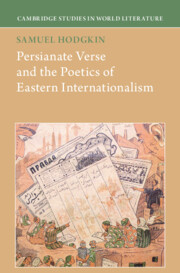
At the height of literary nationalisms in the twentieth century, leftist internationalists from Turkey, Iran, Afghanistan, India, and the Soviet East bonded over their shared love of the classical Persian verses of Hafiz and Khayyam. At writers' congresses and in communist literary journals, they affirmed their friendship and solidarity with lyric ghazals and ruba'iyat. Persianate poetry became the cultural commons for a distinctively Eastern internationalism, shaping national literatures in the Soviet Union, the Middle East, and South Asia. By the early Cold War, the literary entanglement between Persianate culture and communism had established models for cultural decolonization that would ultimately outlast the Soviet imperial project. In the archive of literature produced under communism in Persian, Tajik, Dari, Turkish, Uzbek, Azerbaijani, Armenian, and Russian, this book finds a vital alternative to Western globalized world literature.
This essay emphasizes the centrality of evangelical women poets to the culture and development of early American poetics (including hymnody), which had lasting effects well into the nineteenth century. It makes three related claims. First, early evangelical poetry was a capacious lived literature that constituted one of the major aesthetic developments of the eighteenth century. Second, one of the momentous outgrowths of this eighteenth-century experiential Christian poetics was an early form of the Poetess, a trope scholars predominantly discuss as a nineteenth-century cultural form. And third, recognizing this longer development of the evangelical poetess resituates Phillis Wheatley Peters’ poetics within an antiwhite supremacist tradition produced by free and enslaved Black people. The essay argues for the necessity of broader and deeper engagement with various eighteenth-century religious poetics in order to braid them back together with the social forms and histories within which they arose and remained entangled.
Recommend this
Email your librarian or administrator to recommend adding this to your organisation's collection.