To save content items to your account,
please confirm that you agree to abide by our usage policies.
If this is the first time you use this feature, you will be asked to authorise Cambridge Core to connect with your account.
Find out more about saving content to .
To save content items to your Kindle, first ensure no-reply@cambridge.org
is added to your Approved Personal Document E-mail List under your Personal Document Settings
on the Manage Your Content and Devices page of your Amazon account. Then enter the ‘name’ part
of your Kindle email address below.
Find out more about saving to your Kindle.
Note you can select to save to either the @free.kindle.com or @kindle.com variations.
‘@free.kindle.com’ emails are free but can only be saved to your device when it is connected to wi-fi.
‘@kindle.com’ emails can be delivered even when you are not connected to wi-fi, but note that service fees apply.
Interest in the relationship between Paul's letter openings and Koine Greek letter-writing conventions has been steady for over a century, but little new data has emerged in recent years. In this study, Gillian Asquith offers a fresh perspective on Paul's epistolary practice by adopting a multidisciplinary method that synthesises sociolinguistics and lexicography. Comparing the language of Paul's letter openings with the register of language in documentary papyri, she demonstrates that high-register language in Koine Greek epistolary formulae contributes to warm and friendly relations between correspondents. Asquith argues that Paul creatively modifies epistolary norms by using unexpected, high-register language in the remembrance motif and litotic disclosure formula. Such usage, she posits, emphatically reassures Paul's recipients of his pastoral concern for them and heightens the persuasive force of his letters. Asquith's nuanced analysis contributes valuable new data to long-running debates around Paul's practice of prayer and the structure of his letters.
Argumentation is essential to human reasoning. Chapter 4 explores the nature of argumentation and distinguishes among consensual, disputational, and deliberative forms. The chapter focuses on critical discussions as a type of deliberation and introduces the idea of wise deliberative spaces, grounded in psychological research on wisdom. These spaces promote truth-seeking and moral inquiry. They employ wise discourse practices that support cognitive diversity, face protection, and reduced status hierarchies – through using ground rules, facilitators, active listening, critical questioning, and integrative argumentation. The chapter then explores examples relating to classroom discourse, informal dialogue across divides, deliberative democracy, deliberative polling, and tribal societies. It concludes by discussing institutional wisdom – how institutions like investigative journalism and constitutional democracy can support wise deliberation – though both face mounting challenges today.Argumentation is essential to human reasoning. Chapter 4 explores the nature of argumentation and distinguishes among consensual, disputational, and deliberative forms. The chapter focuses on critical discussions as a type of deliberation and introduces the idea of wise deliberative spaces, grounded in psychological research on wisdom. These spaces promote truth-seeking and moral inquiry. They employ wise discourse practices that support cognitive diversity, face protection, and reduced status hierarchies – through using ground rules, facilitators, active listening, critical questioning, and integrative argumentation. The chapter then explores examples relating to classroom discourse, informal dialogue across divides, deliberative democracy, deliberative polling, and tribal societies. It concludes by discussing institutional wisdom – how institutions like investigative journalism and constitutional democracy can support wise deliberation – though both face mounting challenges today.
This chapter discusses the importance of conducting discourse analysis in L2 teaching and studying pragmatic norms in L2 learning. Without the knowledge about discourse and pragmatics, L2 learners might have difficulty conducting phatic communication, comprehending implicatures, performing speech acts, and appearing polite in L2 social interactions, which could lead to negative pragmatic transfer and intercultural misunderstandings. L2 learners’ motivation to interact in L2, attitude about L2 culture, or agency to accommodate or acculturate might be influenced as well. The chapter demonstrates how language teachers can analyze the L2 discourse together with L2 learners and provide pragmatics instruction to help them develop their pragmatic competence. It also displays some contextual factors that can affect L2 pragmatics learning and pedagogical activities that can promote L2 pragmatics learning.
This study proposes a new qualitative method in historical pragmatics to extract politeness formulae for master-servant directives from nineteenth-century French advice literature. Whereas traditional politeness models study strategic face-saving, this study investigates non-strategic, routinized or conventionalized politeness by mapping explicit linguistic instructions in historical prescriptive metasources. Because etiquette and conduct books targeted middle-class households – typically defined as having at least one live-in servant – they routinely discussed interactions with servants. The self-built corpus comprises 43 sources: etiquette and conduct manuals, alongside servant manuals. Through close reading I manually extract politeness formulae, which are compiled into a formulary. Historians underline servants’ harsh conditions and social erasure, typically mirrored by bare imperatives. Advice on a kind prosody is widespread, but politeness formulae (e.g. voulez-vous? – je vous prie) only emerge in the 1870s, when the crisis of domestic service begins. This shift suggests that domestic service was increasingly viewed in transactional rather than purely hierarchical terms. Despite these changes, master-servant, servant-master and peer directives remain rigidly compartmentalized. The article addresses a notable gap in French historical im/politeness studies by showing how politeness formulae in prescriptive discourse reveal the persistence of caste-like social structures in nineteenth-century French domestic service.
The term “race” was widely used in the 1500s to describe many types of blood relationships but gradually became focused on ethnicity and skin colour. The elevation of Anglo-Saxons as a superior race developed alongside “scientific racism” in the 1800s, and in turn gave an impetus to eugenics and Aryianism. By 1900, the language of race was found everywhere in England, and it declined very slowly throughout the subsequent century.
This chapter focuses on the ways in which maskilic (Jewish enlightenment) authors reshaped elements of the Hebrew language in order to make it suitable for use as a vehicle of modern European-style literature. Maskilic authors were motivated by the principle that the creation of a Hebrew literary canon based on European-language models was an essential component of the Jews’ Enlightenment. They developed a wide range of new written genres which had not previously existed in Hebrew, including original and translated novels, short stories, novellas, anecdotes, feuilletons, and plays; a flourishing press; popular science (e.g., astronomy, physics, biology, chemistry, zoology), politics, geography, and history; and fiction and nonfiction works for young readers. This large-scale endeavor resulted in the emergence of numerous linguistic innovations. In this chapter we examine several key yet understudied innovative features of maskilic Hebrew: 1) realistic colloquial dialogue, including a) new punctuation norms, b) use of interjections, and c) forms of address; 2) discussions of contemporary scientific and political topics using newly developed Hebrew vocabulary and European loanwords; and 3) prose syntax based on German and Russian stylistic models. These new components of Hebrew paved the way for the later vernacularization of the language in Ottoman Palestine.
Languages have several grammatical means of expressing the relation between speaker and addressee, including speech-style particles, politeness pronouns, allocutive marking, and honorifics. Despite the similarity in the meaning they convey, these politeness markers fall into two distributional classes: some ('content-oriented markers of politeness’) can occur in complement clauses, while others ('utterance-oriented markers of politeness’) are restricted to matrix contexts. Focusing on speech-style markers in Korean and second-person pronouns in Romance languages (especially Italian), we develop a dynamic pragmatics model of the distinct kind of meaning that they encode and provide an analysis that accounts for their distributional differences.
The present study examines how L1-English learners acquire Korean subject honorification – a system that is socio-pragmatic in interpretation but syntactically constrained. Using a multi-method design (corpus analysis, politeness ratings, and self-paced reading), we find that learners show increasing sensitivity to politeness norms yet limited awareness of morphosyntactic constraints. In corpus analysis, learners used subject honorification almost exclusively alongside addressee honorification, indicating limited functional differentiation. In politeness ratings, learners consistently associated the subject honorific suffix with greater politeness, regardless of subject type, diverging from native speakers’ judgments. In self-paced reading, learners were sensitive to semantic anomalies (e.g., inanimate subjects) but not to morphosyntactic violations. Together, these findings suggest that learners interpret the subject honorific suffix as a general politeness marker, likely due to its low cue validity and frequent co-occurrence with pragmatically salient features. Our results highlight how cue reliability and competition shape L2 acquisition pathways under conditions of noisy linguistic representations.
Historical pragmatics studies the use of language in earlier periods and the developments of usage patterns over time. Recent research in this area has increased our understanding of how usage patterns develop, and we have gained insights into a range of pragmatic phenomena at specific times in the history of English. This chapter provides exploratory accounts for each of the traditional periods in the history of English, from Old English up to Present-day English by focusing on those areas within historical pragmatics that have already received sufficient scholarly attention, in particular the use of pragmatic markers, speech acts and the use of politeness. These overview sketches of the individual periods will be linked through an analysis of specific development patterns.
Prescriptive discourse basically evaluates linguistic variants and sometimes gives reasons for preferring one variant over another. It is most readily found in metalinguistic texts, like dictionaries and grammars. Several basic assumptions in prescriptive discourse that have endured to the present were already present in early centuries and set the stage for the flourishing of prescriptive discourse in the eighteenth century. Prescriptive discourse continued to flourish and became more widespread and naturalised in subsequent centuries. It remains a robust tradition and has adapted to new modes of communication and new cultural forces. Key features of prescriptive discourse examined in this chapter include the degree of specificity with which the discourse was formulated, the venues that published prescriptive discourse, the kinds of linguistic variants that were included in prescriptive discourse, and the justifications for the prescriptive judgements.
The introduction offers an analysis of Edward Penny’s painting A City Shower (1764) and Jonathan Swift’s “A Description of a City Shower” (1710), from which it takes its inspiration, in order to establish the key concerns of the chapters that follow. These include the ways in which an ideal of urban life is so often represented as being embattled or under pressure in representations of walking; the anxieties and concerns about social intermixing in London’s public places; the physical and imaginative ordering and structuring of London’s streets; and the circulation, reworking, and persistence of particular tropes and images that is a hallmark of eighteenth- and early nineteenth-century accounts of the city. It also situates the book’s focus within other accounts of the city in this period.
This chapter recovers Schopenhauer’s previously neglected account of prudent political action. It points out the connections between the skilled governance of society and the savvy self-control of the individual in Schopenhauer’s works and argues that a full analysis of his conception of politics must include a treatment of prudence in world affairs as well as in interpersonal encounters. In fact, Schopenhauer supplemented his account of the modern state as an instrument of society-wide pacification with an account of prudent self-governance as an obligation for the modern subject. He believed that the state must impose constraints on disruptive egoism from the top, but that individuals should also prudently mask their egoism and in this way soften antagonisms. In Schopenhauer’s view, Hobbes’ theory of statehood could be constructively linked to Baltasar Gracián’s account of prudence; implemented together, they could strengthen the prospects of peace.
Chapter 3 showed that as linguistics became increasingly interested in the wider co-textual structures and meanings in which clauses and sentences were situated, stylistics drew on these developments and combined them with frameworks from narratology to produce a more sophisticated approach to style in both literary and non-literary texts. At the same time as these developments were taking place, linguists and stylisticians were also taking more and more interest in the context in which texts (written and spoken, prepared and spontaneous, ephemeral and preserved, etc.) were produced and consumed. This led stylistics to consider the extent to which the then relatively new subdiscipline of pragmatics may provide yet more insight into the style of texts. Consequently, this chapter outlines the influence of pragmatic concepts and frameworks on stylistic analysis.
Chapter 2 provides an overview of how emoticons and emojis are a human adaptation to online written conversation to compensate for the absence of non-verbal cues and physical context, but also an affordance of most written conversation to promote affiliation, creativity and play. The analysis highlights the role of emojis as ‘attendant activities’ (Jefferson, 1987) which express politeness (and impoliteness) and other pragmatic functions, including prosocial and anti-social behaviours, identities, contextualizations (physical/virtual), irony and meaning enhancement. By analysing the multiple, often overlapping interactional functions of emoticons and emojis, this chapter provides original insights into the unique role of emojis in children’s written conversation, highlighting some major differences between spoken and written interaction. Findings indicate that emojis fulfil interactional functions which go beyond simply replacing fundamental non-verbal, voice and contextual resources which are available to speakers in phone and face-to-face interaction. While further research in this area is required across different age groups and genders, the various categories of emojis identified in this chapter provide a comprehensive account of how children are likely to deploy and respond to these symbols in online interaction, and how multiple meanings are possible depending on the interactional context
The main aim of this paper is to show that the notion of the ’self-serving bias’, well established in social psychological research, may have an impact on the way in which speakers verbalise certain experiences. I hypothesise that this perceptual bias will interact with other factors; specifically, gender stereotypes (as defined by psychologists and linguists) and modesty (as defined in linguistic pragmatics). I present corpus evidence for the relevance of the self-serving bias and the complex interplay with gender stereotypes and modesty, based on variation between three different causative constructions (CAUSE, X MAKE Y happen, and X BRING about Y) as well as the use of the adverbs cleverly and stupidly. In both cases, my analysis focuses on the cooccurrence with personal pronoun subjects — specifically, differences in terms of person (first vs third) and gender (masculine vs feminine). The most general conclusion I draw is that cognitive (socio-)linguists may be able to formulate interesting new research questions based on concepts drawn from (social) psychology but that constructs developed within linguistics remain highly relevant as well.
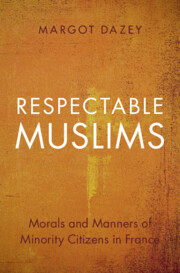
How do Muslims deal with the ever-increasing pressure to assimilate into European societies? Respectable Muslims tells the story of pious citizens who struggle for fair treatment and dignity through good manners and social upliftment. Based on an ethnographic inquiry into France's most prominent Muslim organization, the Union des organisations islamiques de France, the book shows how a non-confrontational approach underpins the fast-expanding Islamic revival movement in Europe. This method is mapped into Islamic notions of proper conduct, such as ihsān (excellence) or ṣabr (patience). These practices of exemplariness also reflect the often-overlooked class divisions separating Muslim communities, with middle-class leaders seeking to curb the so-called 'conspicuous' practices of lower-class worshippers. Chapters demonstrate that the insistence on good behavior comes with costs, both individually and collectively. Respectable Muslims expands on the concept of respectability politics to engage in a trans-Atlantic conversation on the role of class and morals in minority politics.
In early Islamic Egypt, “Arab-style” Greek (and later Coptic) letters employing religiously neutral monotheistic formularies were sent in the name of Muslim officials to Christian administrators. By analyzing old and new evidence of Egyptian Christians using this epistolary template, this paper argues that in the first decades of Arab rule, probably only a few beneficiaries of the new regime employed the “Arab-style” prescript in their letters written to other Christians to demonstrate their close connection to the new government and thus their social standing. Later, however, the “Arab-style” prescript became commonplace in communication between Christians and Muslims and among Christians only in everyday life. Thus, the religiously neutral template created by the conquerors for official top–down communication became a mechanism for facilitating not only the smooth functioning of administrative structures, but also, in the long run, the social cohesion of Christians and Muslims.
What does the periodical essay of the early eighteenth century contribute to the novel as it was developed by Samuel Richardson, Henry Fielding, Laurence Sterne, and others? This chapter focuses on how the periodical essay showed novelists new possibilities both about how to build a relationship with readers over time and on the use of an authorial persona to narrate and organise incidents. The distinctive intimacy the essay creates between author and reader, cultivated in the case of the periodical essay in instalments published over time and with attention to special features of the protracted duration of production and consumption, provides both rhetorical and material inspiration for novelists experimenting with new ways to reach readers and intensify their relationships with them.
Twentieth-century critics have opposed the supposed objectivity of the essay to the letter and diary as private, self-expressive, and autobiographical genres. But this was a modern development. From Michel de Montaigne to the early nineteenth century, the essay, the letter, and the diary were more alike and far more closely aligned than they later became, particularly with regard to representations of the self and notions of publicity. For instance, they were all considered forms of address, and means of presenting one’s intellectual physiognomy to others that were likely to be read aloud, shared, and discussed. This chapter therefore explores now-forgotten family resemblances among these genres both in form and function and concludes by showing where they were fused or embedded in one another.
This chapter traces the development of the essay in the context of a world of early eighteenth-century sociability constituted by coffee shops, periodicals, and a variety of informal clubs and societies. Never simply a reflection of a prior social reality, the periodical essay developed as part of a self-consciously created mythos of ‘polite literature’ designed to regulate manners in the inchoate and often contentious social world from which it represented itself as emerging. In the skilful hands of Joseph Addison and Richard Steele, among others, the polite essay shaped values of agreeableness, conversability, and formal equality that helped define a remarkably durable idea of polite literary culture still in play – if increasingly represented as passing away – for essayists like William Hazlitt and Leigh Hunt writing a century later.