Refine search
Actions for selected content:
1 results
On an analogue of BRK-type sets in finite fields
- Part of
-
- Journal:
- Canadian Mathematical Bulletin , First View
- Published online by Cambridge University Press:
- 13 July 2026, pp. 1-14
-
- Article
-
- You have access
- Open access
- HTML
- Export citation
-
A Besicovitch–Rado–Kinney (BRK) set in $\mathbb {R}^n$
 contains a hypersphere of every radius. In $\mathbb {F}_q^n$
 , BRK-type sets of degree $\ell $
 analogously contain a family of $(n-1)$
 -dimensional surfaces, parameterized by a dilation factor and determined by a fixed homogeneous polynomial of degree $\ell $
 . We define $(n,d)$
 -BRK-type sets of degree $\ell $
 , which contain a family of d-dimensional sets parameterized by an $(n-d)$
 -dimensional dilation factor and determined by fixed homogeneous polynomials of degree $\ell $
 . We use the polynomial method to obtain a lower bound $|S| \gtrsim _{n, \ell } q^n$
 on $(n,d)$
 -BRK-type sets S of degree $\ell $
 . We obtain an improved lower bound $|S| \geq \frac {(q-1)^n}{(\ell + 1 - 2\ell /q)^n}$
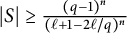 by implementing the method of multiplicities; this is the same bound obtained by Trainor on BRK-type sets of degree $\ell $
 , and we obtain this bound independently of d.


