Refine search
Actions for selected content:
3 results
Multidimensional moderators of treatment trajectories in people with schizophrenia at high risk of relapse: findings from a real-world lower middle-income country cohort
-
- Journal:
- BJPsych Open / Volume 12 / Issue 4 / July 2026
- Published online by Cambridge University Press:
- 31 July 2026, e204
-
- Article
-
- You have access
- Open access
- HTML
- Export citation
Associations between genes methylation, postnatal risk factors and psychiatric symptoms in a clinical sample of children and adolescents: Preliminar results from the remind longitudinal study
-
- Journal:
- European Psychiatry / Volume 64 / Issue S1 / April 2021
- Published online by Cambridge University Press:
- 13 August 2021, pp. S123-S124
-
- Article
-
- You have access
- Open access
- Export citation
-
Introduction
Epigenetics hypothesizes a crucial link between postnatal risk factors, individual response to stress, DNA methylation and psychiatric symptomatology changes during life.
ObjectivesWe analyzed methylation within two gene exons: NR3C1 and SLC6A4, which are involved in responses to environmental stressors. We investigated the relationship between methylation, postnatal risk factors and psychopathology assessed by Child Behavior Checklist (CBCL) in our help-seeking sample evaluated in infancy (W1), preadolescence (W2) and adult life (W3).
MethodsPostnatal risk factors data were collected at W1 in 205 clinical subjects (156 M, 49 F; age=9,13±1,95). The CBCL scores were collected at W1 and W2 (W2 age=14,52±2,12). Data regarding methylation were collected at W2. At W3 we are also collecting clinical scores. A Spearman correlation coefficient was calculated between methylation percentage and clinical data at W2. The externalizing and internalizing trajectories were evaluated through repeated measure ANOVA with postnatal risk factors (presence/absence) as between-groups factor.
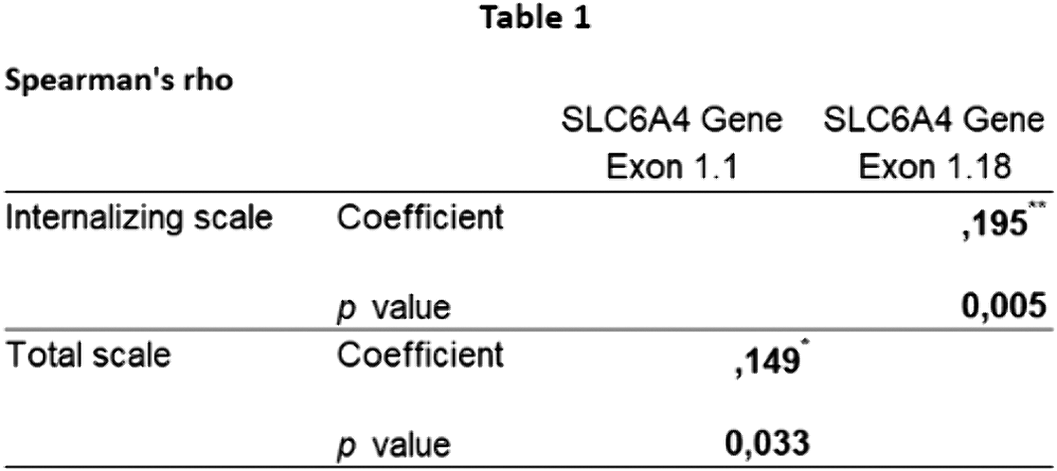
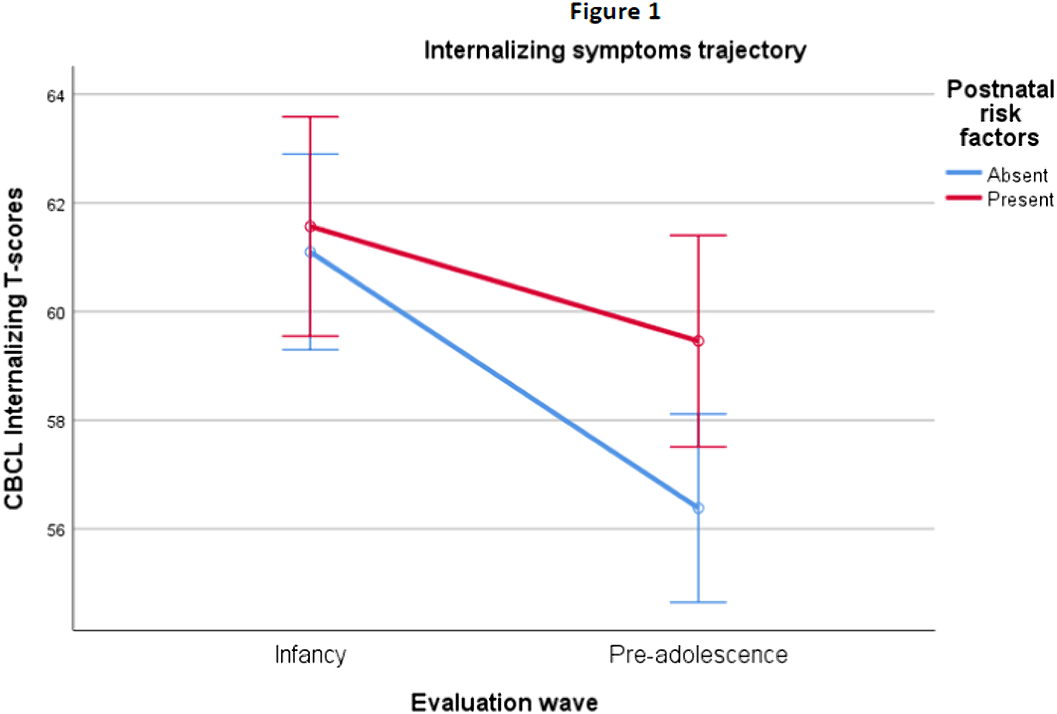
ResultsSignificant associations were found between methylation and internalizing and total clinical scores (Table 1). The rm-ANOVA results showed a significant interaction between the CBCL internalizing score and presence/absence of postnatal risk, with higher internalizing problems in subjects that were exposed to postnatal risk factors. This effect was significant at W2 but not at W1 (Figure 1).
 Conclusions
Psychopathological symptoms trajectories could depend on epigenetics and early environmental risk factors. Further analyses will address a Linear Discriminant Analysis to proceed to a machine learning oriented approach.
DisclosureNo significant relationships.
Relationship between internalizing and externalizing symptoms trajectories and perinatal risk factors in an epidemiological sample: Preliminary results from the remind project
-
- Journal:
- European Psychiatry / Volume 64 / Issue S1 / April 2021
- Published online by Cambridge University Press:
- 13 August 2021, pp. S148-S149
-
- Article
-
- You have access
- Open access
- Export citation
-
Introduction
Our 15-years follow-up ReMIND project aims to re-assess an epidemiological and a clinical sample of adults (Wave 3), who were assessed in preadolescence (Wave 1) and adolescence (Wave 2), to evaluate symptoms trajectories and their relationship with genetic/epigenetic data, environmental risk factors and neuroimaging measures.
ObjectivesHere, we depict preliminary results regarding the epidemiological sample.
MethodsWe assessed internalizing and externalizing symptoms in 40 italian subjects (25 F) from general population at three waves (W1 mean age: 12±0,82; W2 mean age: 17±0,88, W3 mean age: 28±1), through the Child Behavior Checklist (W1 and W2) or the Adult Self Report (W3), and perinatal risk factors through a socio-anamnestic questionnaire, by a new online platform (MedicalBit). We analyzed symptoms trajectories and their relation with perinatal risk factors through a repeated measures multivariate analysis of variance (rm-MANOVA).
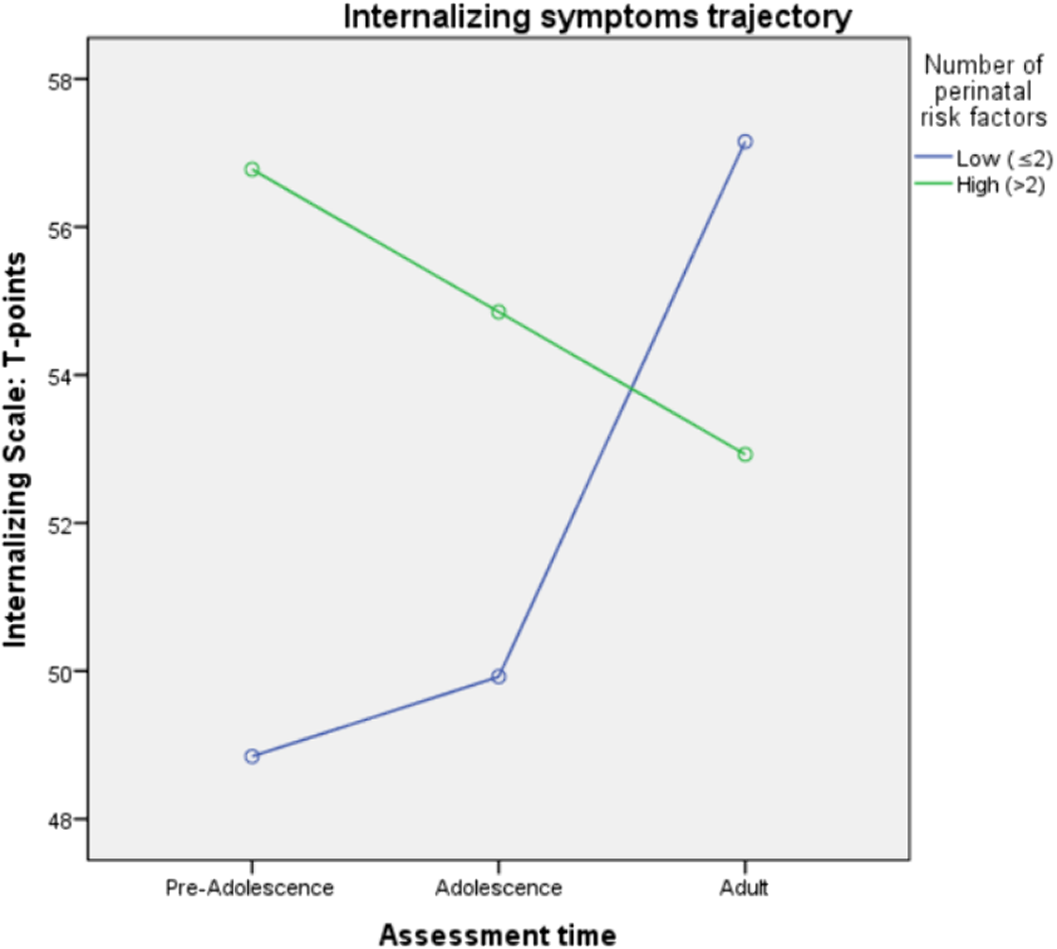
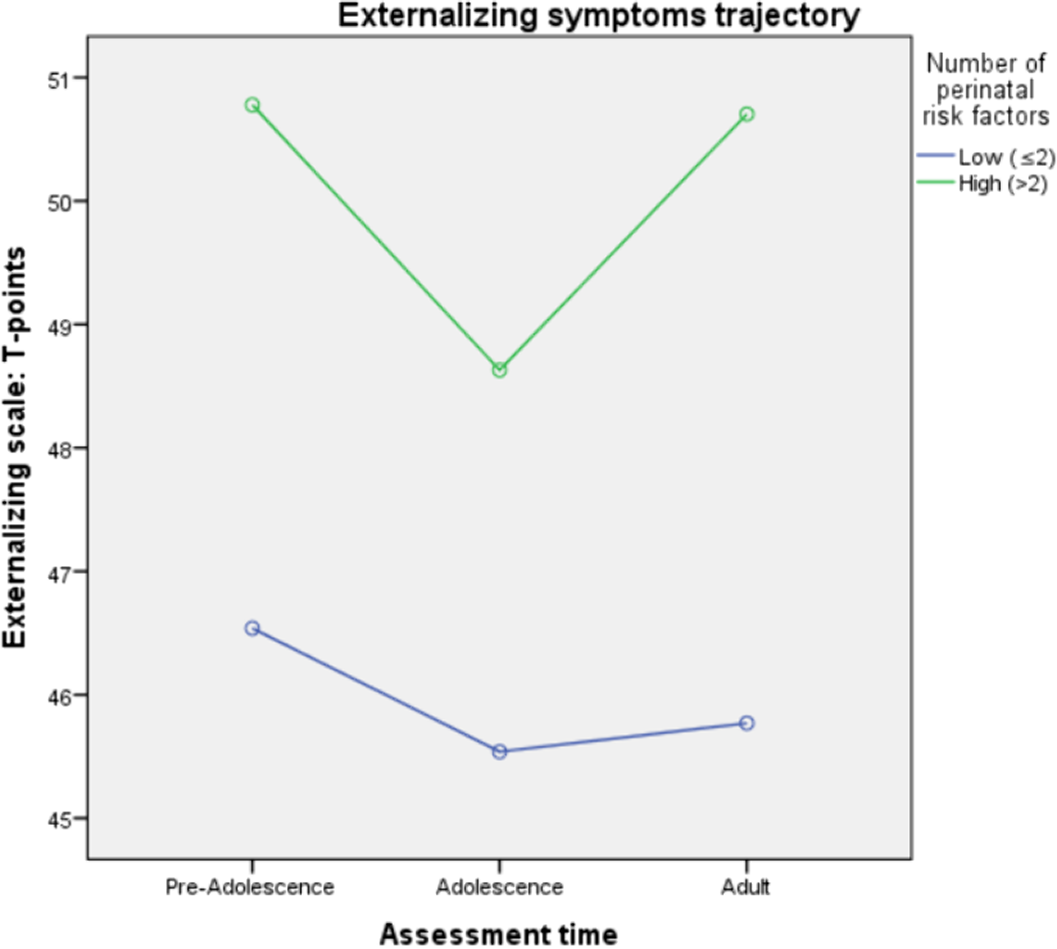
Resultsrm-MANOVA results show that high number of perinatal risks was significantly associated with higher internalizing symptomatology in preadolescence but not in adolescence and adult life. The mean difference was 8 T-points. The same trend is evident in adolescence but not in adult age (Graph 1). Perinatal risk factors did not have a significant effect on externalizing symptoms at any time point, despite a non-significant trend is evident (Graph 2).
 Conclusions
Our preliminary results suggest a trend of increased internalizing symptoms from childhood to adulthood and a significant role of perinatal risk factors in pre-adolescence. Further investigations are necessary to better understand symptoms trajectories and the role of biological and environmental factors.
DisclosureNo significant relationships.
