Refine search
Actions for selected content:
2 results
A converse of Littlewood-type theorem on random analytic functions in mixed norm spaces
- Part of
-
- Journal:
- Canadian Journal of Mathematics , First View
- Published online by Cambridge University Press:
- 21 July 2026, pp. 1-28
-
- Article
-
- You have access
- HTML
- Export citation
-
This article investigates coefficient randomizations of holomorphic functions and the resulting random analytic functions within the framework of mixed norm spaces. Adopting the perspective of the random symbol space $(\mathcal {X})_{\star }=\{f\in H(\mathbb {B}_n): \mathbb {P}(\mathcal {R} f\in \mathcal {X})=1\}$
 , we first focus on the unit disk $\mathbb {D}$
 . Specifically, for $q\geq 4$
 , we identify the conditions under which the random symbol space of the mixed-norm space $H^{p,q,u}(\mathbb {D})$
 coincides with $H^{2,q,u}(\mathbb {D})$
 . Furthermore, we extend our analysis to the higher-dimensional unit ball $\mathbb {B}_n$
 . We establish sufficient conditions and necessary constraints linking the deterministic membership of a function to the almost sure membership of its randomization in mixed norm spaces. A key finding is the identification of a sharp, dimension-dependent weight loss phenomenon that arises for $n>1$
 .


A characterization of random analytic functions satisfying Blaschke-type conditions
- Part of
-
- Journal:
- Canadian Mathematical Bulletin / Volume 67 / Issue 3 / September 2024
- Published online by Cambridge University Press:
- 17 January 2024, pp. 670-679
- Print publication:
- September 2024
-
- Article
-
- You have access
- HTML
- Export citation
-
Let
 $f(z)=\sum _{n=0}^{\infty }a_n z^n \in H(\mathbb {D})$ be an analytic function over the unit disk in the complex plane, and let
 $\mathcal {R} f$ be its randomization:
 $$ \begin{align*}(\mathcal{R} f)(z)= \sum_{n=0}^{\infty} a_n X_n z^n \in H(\mathbb{D}),\end{align*} $$
where
 $(X_n)_{n\ge 0}$ is a standard sequence of independent Bernoulli, Steinhaus, or Gaussian random variables. In this note, we characterize those
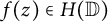 $f(z) \in H(\mathbb {D})$ such that the zero set of
 $\mathcal {R} f$ satisfies a Blaschke-type condition almost surely:
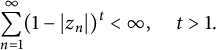 $$ \begin{align*}\sum_{n=1}^{\infty}(1-|z_n|)^t<\infty, \quad t>1.\end{align*} $$


