Refine search
Actions for selected content:
4 results
EXTREME VALUES OF DERIVATIVES OF DIRICHLET L-FUNCTIONS
- Part of
-
- Journal:
- Bulletin of the Australian Mathematical Society , First View
- Published online by Cambridge University Press:
- 02 October 2026, pp. 1-8
-
- Article
-
- You have access
- HTML
- Export citation
-
In this paper, we establish lower bounds for extreme values of derivatives of Dirichlet L-functions in the range $1/2<\sigma <1$
 . Compared with the work of Aistleitner et al. [‘On large values of $L(\sigma , \chi )$
 ’, Q. J. Math. 70 (2019), 831–848], our result shows that derivatives of Dirichlet L-functions can attain extreme values of the same order of magnitude as the original L-functions in the interval ${1/2<\sigma <1}$
 .

EXTREME VALUES OF DERIVATIVES OF THE DEDEKIND ZETA FUNCTION OF A CYCLOTOMIC FIELD
- Part of
-
- Journal:
- Journal of the Australian Mathematical Society , First View
- Published online by Cambridge University Press:
- 16 June 2026, pp. 1-27
-
- Article
-
- You have access
- HTML
- Export citation
EXTREME VALUES OF THE RANKIN–SELBERG
 $\boldsymbol {L}$-FUNCTIONS
- Part of
-
- Journal:
- Bulletin of the Australian Mathematical Society / Volume 106 / Issue 3 / December 2022
- Published online by Cambridge University Press:
- 21 March 2022, pp. 408-418
- Print publication:
- December 2022
-
- Article
-
- You have access
- HTML
- Export citation
-
In this paper, we study the extreme values of the Rankin–Selberg L-functions associated with holomorphic cusp forms in the vertical direction. Assuming the generalised Riemann hypothesis (GRH), we prove that
 $$ \begin{align*} \underset{T^{\delta}\leq t\leq T}{\max}\bigg\lvert L\bigg(\frac12+it,f\times f\bigg)\bigg\rvert \geq\exp\bigg(C\sqrt{\frac{\log T\log\log\log T}{\log\log T}}\bigg) \end{align*} $$
with
 $C\leq \mathscr {X}\sqrt {1-\delta }$, where
 $\mathscr {X}:=({2}/{\pi })\int _{0}^{\pi /3}\sin ^2\xi \,d\xi $ and
 $0\leq \delta <1$.


A NOTE ON LARGE VALUES OF
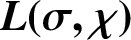 $\boldsymbol{L(\sigma ,\chi )}$
- Part of
-
- Journal:
- Bulletin of the Australian Mathematical Society / Volume 105 / Issue 3 / June 2022
- Published online by Cambridge University Press:
- 04 October 2021, pp. 412-418
- Print publication:
- June 2022
-
- Article
-
- You have access
- HTML
- Export citation
-
In this note, by introducing a new variant of the resonator function, we give an explicit version of the lower bound for
 $\log |L(\sigma ,\chi )|$ in the strip
 $1/2<\sigma <1$, which improves the result of Aistleitner et al. [‘On large values of
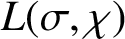 $L(\sigma ,\chi )$’, Q. J. Math. 70 (2019), 831–848].

