To save content items to your account,
please confirm that you agree to abide by our usage policies.
If this is the first time you use this feature, you will be asked to authorise Cambridge Core to connect with your account.
Find out more about saving content to .
To save content items to your Kindle, first ensure no-reply@cambridge.org
is added to your Approved Personal Document E-mail List under your Personal Document Settings
on the Manage Your Content and Devices page of your Amazon account. Then enter the ‘name’ part
of your Kindle email address below.
Find out more about saving to your Kindle.
Note you can select to save to either the @free.kindle.com or @kindle.com variations.
‘@free.kindle.com’ emails are free but can only be saved to your device when it is connected to wi-fi.
‘@kindle.com’ emails can be delivered even when you are not connected to wi-fi, but note that service fees apply.
The epilogue reviews the central conclusion—that racial reckoning must focus mainly on material accountability for cumulative racial inequality, especially at the local and state level—before summarizing many of the principles, goals and strategies discussed in the previous chapters. For instance, a key principle is to view policies about the way public goods are distributed through the lens of racial equity, even if the solution is to pursue race-neutral means. An underlying goal is to promote democracy through the deconcentration of social capital. The strategies that follow include specific, mostly localized policy choices in the areas on which the book focuses: place-based inequality, the racial wealth gap, racial health disparities, deterrence of police misconduct, DEI and equitable growth at the local level. There is also a brief example of a reparations program for urban renewal.
Transitions are essentially changes in relation to physical locations, routines and experiences. This explanation from 2012 still appropriately identifies some of the key transitions in early childhood. Transitions happen whenever children switch from parent to educator, move from place to place, or change from one activity to another. However, since 2012, we have become more aware of the significance of different transitions and the impact they can have on many other aspects of a child’s life. This chapter will start by defining what transitions are in early childhood and the different transitions that occur for most children into, within and beyond the ECEC service. Individual children respond differently to transitions so we will explore how both large and smaller transitions can impact and influence some children. This chapter will conclude with the importance of maintaining high expectations for all children, through embedding different strategies that can be used to support all children during transitions, whether they are large transitions in early childhood or smaller transitions during the day.
Education policies and frameworks are often structured by evolving political ideologies, public discourse, societal needs, and multifaceted types of media; requiring educators to remain informed about socio-political contexts aligned to education and to navigate the shifting education policy discourse landscape. It is within such a landscape that education policies and frameworks serve to provide information that supports and guides teachers in aligning their teaching and learning practices with national and/or international standards. By incorporating policy and frameworks into daily teaching, teachers make sure legal and ethical responsibilities are met, but also curriculum guidelines, assessment regulations, and inclusion requirements are adapted and applied, to meet all learners’ needs and professional obligations.
This concluding chapter invites educators to pause and reflect deeply on the interconnections between critical reflection, effective teaching, and personal wellbeing. It challenges teachers to view classroom leadership as a practice built on self-awareness, relational responsiveness, and thoughtful decision-making. Central to this interconnectedness is the ability to manage workload, set clear priorities, and self-regulate. These elements form a foundation for teaching that is effective and sustainable over time. Through this lens, wellbeing is not treated as separate from pedagogy or professionalism; rather, it directly shapes how teachers lead with empathy, uphold integrity, and make purposeful choices. By exploring how wellbeing, emotional regulation, and reflection shape the capacity to lead and connect, this chapter encourages teachers to consider how personal and professional growth are closely linked.
Entering a teaching position for the first time is a professionally significant milestone; one that requires attentive preparation, strategic planning, and active engagement. With this in mind, a diverse range of strategies in this chapter are explored with the aim of supporting early career teachers in effectively transitioning into a new educational setting. Understanding the teaching role expectations, actively engaging in orientation and/or induction, and undertaking initial classroom setup, are all necessary requirements that early career teachers must tend to in order to be best placed for a successful start.
Teaching is a purposeful profession that brings deep satisfaction through shaping lives and building communities. At the same time, it involves daily challenges, managing time, meeting diverse needs, protecting your well-being, and working with colleagues. Thriving in this complexity requires more than subject knowledge. It calls for intentional strategies that help you stay focused, balanced, and collaborative. In this chapter, you will explore practical skills in self-management, organisation, prioritisation, classroom routines, and communication. These strategies will help you build confidence and create a calm, supportive environment where both you and your student can succeed.
Routines are part of everyday life. Essentially a routine is a sequence of actions that is followed regularly, although not always with the same frequency. For example, some routines are part of every day, while others may occur weekly or even less frequently. Some people are comfortable with a framework of their day and prefer a flexible approach to routines. Others prefer a more rigid schedule, and routines are part of that fixed plan. However, there are some people who find routines challenging, and require additional support for these to be a successful part of the day. This chapter will explore some of the daily routines that are part of a child’s life, both within and outside the ECEC service. It will include what routines are, why they are important, challenges some children (and adults) might experience, and strategies that may provide additional support for routines to become less difficult, and more seamlessly embedded in the day.
Educators acknowledge the importance of utilising, implementing, and applying curriculum; a day-to-day engagement in a wide range of educational settings. So often, focus centres upon the curriculum itself; however, this chapter provides strategies for navigating curriculum and provides proven helpful cross-curriculum tools and processes for applying curriculum in effective and efficient time-friendly ways. A wide range of examples are provided to cover many aspects of the Australian Curriculum, importantly inclusive of Aboriginal and Torres Strait Islander Knowledge.
In recent years, the role of the teacher has expanded. Teaching Strategies in the 21st Century identifies and addresses the complex challenges faced by pre-service and early career teachers. This practical, research-informed book provides in-depth discussions of teaching, from junior primary to Year 10 levels. The text examines how teachers can prepare for new roles within their teaching responsibilities, embed Aboriginal and Torres Strait Islander perspectives, navigate curriculum and policy demands, manage classrooms effectively, and design inclusive, engaging and assessable learning opportunities. It explores strategies for professional collaboration and networking to sustain long-term growth and reflective practice. To encourage reflection, each chapter provides case studies, spotlight boxes, recommended readings, margin notes and definitions, and end-of-chapter questions and guided responses. Teaching Strategies in the 21st Century supports new educators to transition into their roles with confidence, while laying the foundations for a reflective, adaptive and student-centred practice.
After collective violence, states often work to rebuild and repair the social fabric by promoting legal institutions and fostering peaceful relationships. The case of legal aid in post-genocide Rwanda provides insight into how legal aid providers manage cases in the context of overburdened courts and the state’s prioritization of reconciliation. This study relies on ethnographic and interview data with legal aid providers at legal aid centers throughout Rwanda to show how legal aid providers communicate the state’s moral vision of social cohesion to manage an overburdened court system through two interconnected strategies. First, legal aid providers orient people to moral beliefs about ways of being through community awareness-raising initiatives and extra-legal obligations that promote peaceful relations. Second, legal aid providers stall cases from going to court by counseling through narratives of forgiveness and reconciliation. These strategies prevent cases from reaching the courts by managing emotional expectations about the law’s limitations and reminding people of their societal obligations. Building on the law and culture literature, these findings highlight how social actors charged with interacting with vulnerable people creatively navigate the lasting ramifications of collective violence in everyday dispute resolution and conflict mediation.
Chapter 15 explores the foundational practices of planning, assessing, and using data in mathematics education. It unpacks the essential components of effective mathematics lessons and outlines strategies for designing learning sequences that are responsive to student needs. The chapter introduces formative and summative assessment practices, the role of feedback, and how student learning data can be used to inform, adapt, and improve teaching and learning.
Chapter 12 extends students’ understanding of Statistics and introduces foundational concepts in Probability for Years 3 to 6. You will explore how to support students in collecting, organising, and interpreting data, identifying patterns, and predicting outcomes using simple probability language. The chapter also highlights strategies for integrating digital tools, adapting tasks to meet diverse learning needs, and making cross-curricular connections to enhance relevance and engagement.
Chapter 14 focuses on diversity in the primary mathematics classroom and the need to create inclusive and responsive learning environments. It examines strategies to recognise and value students’ diverse cultural, linguistic, and learning needs, and offers practical approaches for differentiation and equitable participation in mathematics. You will explore how inclusive pedagogy supports all learners in developing confidence and capability as mathematical thinkers.
Chapter 6 delves into experiments, models, and simulations in mathematics, introducing powerful strategies for inquiry and representation. You will learn how to scaffold students’ understanding of mathematical concepts through modelling frameworks and interactive tools, enhancing conceptual understanding and problem-solving.
Chapter 11 introduces students’ early engagement with Statistics in the Foundation to Year 2 level. It focuses on key concepts such as posing questions, collecting data, and interpreting simple visual representations. You will explore essential language, sample activities, and assessment strategies, along with common misunderstandings to look for when supporting young learners in developing foundational data skills.
Chapter 10 builds on earlier learning and explores how students extend their understanding of Measurement and Space in the middle and upper primary years (Years 3 to 6). It focuses on the development of key concepts such as units of measure, angles, transformations, and geometric properties. You will investigate strategies for using precise mathematical language, addressing common misconceptions, and applying spatial and measurement thinking to solve purposeful, real-world problems.
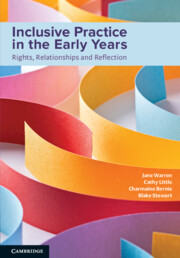
Inclusion is about recognising the rights of every person and ensuring that equitable opportunities exist for all. Inclusive Practice in the Early Years provides pre-service and in-service early childhood teachers and educators with theoretical guidance and practical strategies to allow all children to participate meaningfully in learning. Inclusive Practice in the Early Years focuses on the inclusion of children with disability, developmental delay and neurodivergence from birth to five years. The book also highlights the importance of recognising inclusive principles that apply to a wider range of diversity including Aboriginal and Torres Strait Islander children, refugee and migrant children, children who have experienced trauma and families experiencing disadvantage. Developed by authors with extensive experience across early childhood education, disability, community, and allied health, this text provides valuable information and strategies to support both pre-service and in-service teachers and practitioners to develop an inclusive practice.
This article examines how racialised memes circulating on X revive scientific racism, demonstrating that hybrid formats reconfigure biological essentialisation within contemporary digital culture. Using a corpus of 68 viral items and 4 case studies, our analysis applies Shifman’s content–form–stance model, informed by cognitive psychology. We show that these memes adopt common scientific conventions while relying on visual polarisation, whereby rapid perceptual contrasts stand in for arguments. Familiar templates, reinforced by selective algorithmic amplification, create a sense of perceptual legitimacy through fast categorisation and pre-attentive processing. We also trace how these cognitive shortcuts provide the basis for a regime of racialisation tailored to digitally immersed male audiences, producing gendered behavioural stereotypes and disappearance anxieties. A further pattern is the recoding of older racial hierarchies into neutral-sounding language of competence, allowing these ideas to travel across racialist, masculinist, techno-elitist, and anti-DEI (Diversity, Equity, Inclusion) communities. In this environment, memes work as micro-infrastructures of classification that align claims to objectivity with affect and platform incentives, making inequality appear natural and necessary. We conclude that effective critique must meet these images on their own terrain, with a pedagogy of the gaze that teaches publics how to recognise and challenge persuasion in meme-driven spaces.
Energy access, sustainability, and innovation introduce complex scenarios for all dealmakers, regardless of their level of power and leverage. This chapter examines negotiation planning, strategies, tactics, and ethics to provide a roadmap for educators who will develop strategic courses for future energy dealmakers, whether they are business leaders, politicians, environmentalists, entrepreneurs, bureaucrats, or educators.
This article examines the strategies used by some third sector organizations in Australia to advocate. The purpose of this article is to identify the kinds of activities that organizations in New South Wales and Queensland use to promote advocacy, the kinds of language that is used to describe these activities, and the reasons given for the particular strategies adopted. The extent to which the organizations adopt “softer” (that is more institutional forms of advocacy) rather than more openly challenging forms of activism is examined, particularly in light of a neo-liberal political and economic environment. In this analysis emergent strategies are identified that are not easily categorized as either “institutional” or “radical” advocacy. The article presents an exploratory analysis of some of the implications of the strategies adopted, in terms of their democratic effects and potential to strengthen the capacity of third sector organizations. The article is informed by the findings of a qualitative research project involving interviews with 24 organizations in the community services and environmental fields.