To save content items to your account,
please confirm that you agree to abide by our usage policies.
If this is the first time you use this feature, you will be asked to authorise Cambridge Core to connect with your account.
Find out more about saving content to .
To save content items to your Kindle, first ensure no-reply@cambridge.org
is added to your Approved Personal Document E-mail List under your Personal Document Settings
on the Manage Your Content and Devices page of your Amazon account. Then enter the ‘name’ part
of your Kindle email address below.
Find out more about saving to your Kindle.
Note you can select to save to either the @free.kindle.com or @kindle.com variations.
‘@free.kindle.com’ emails are free but can only be saved to your device when it is connected to wi-fi.
‘@kindle.com’ emails can be delivered even when you are not connected to wi-fi, but note that service fees apply.
In this chapter we consider how the different ethical approaches (adversarial advocacy, responsible lawyering, moral activism and ethics of care) are informing lawyers’ actions on behalf of the planet. Of course, many lawyers will draw from several ethical approaches in their work. Likewise, all four approaches can support efforts at law reform, which we discuss later in the chapter.As the law evolves to better address the dangers of climate change and environmental degradation, the advice lawyers give clients will change. Eventually, we surmise (and hope), lawyers will be advising even recalcitrant clients that to act legally they must act in ways that do not harm the environment. Until such time, a lawyer’s ethical approach will influence their advice and their daily legal practice. Lawyers can draw on the strengths of several or all of the ethical approaches discussed to empower them to step up to the task ahead. We cannot avoid this task.
This chapter introduces the concepts available to evaluate the social and environmental externalities of business. At the overarching level of the planet, there is the concept of sustainable development, with the UN Sustainable Development Goals (SDGs). At the company level, a number of concepts or frameworks translate the requirements of sustainable development to the company level, chiefly among them the concept of corporate social responsibility (CSR). We proceed to examine why companies should engage in CSR. In some cases, there are economic benefits to be gained from social and environmental initiatives – the business case for CSR; in other cases, companies respond to societal pressure, in line with their licence to operate. Last but not least, we engage with the critique that the shareholder-owned corporation is at the heart of much unsustainable behaviour. This leads to the question of what novel organizational forms for sustainability there are, such as social enterprises.
Scientific literacy is essential for informed environmental decision-making and sustainability awareness, yet both remain limited among secondary school students. This study designed, developed and evaluated an Education for Sustainable Development (ESD)-integrated interactive science e-book using a Design-Based Research (DBR) approach. The novelty of this study lies in integrating multimedia learning, contextual sustainability issues, formative assessment and project-based activities within a single digital learning environment while simultaneously examining their effects on scientific literacy and sustainability awareness. The intervention involved 28 ninth-grade students in a one-group pre-test–post-test design. Scientific literacy was assessed using a PISA 2025-based instrument, and sustainability awareness was measured using a validated questionnaire. Data were analysed using paired-samples t-tests, N-gain and effect sizes. Results showed significant improvements in both scientific literacy and sustainability awareness. Qualitative findings further indicated enhanced student engagement, motivation and conceptual understanding, supporting the effectiveness of the ESD-integrated interactive science e-book for sustainable science learning.
Today's marketplace is shaped by habits of excess that threaten both consumer well-being and the environment, placing overconsumption, materialism, and unsustainable business practices at the heart of contemporary marketing debates. Mindful Consumption and Marketing redefines how markets, organizations, and individuals navigate demand and growth by positioning mindfulness as a transformative lens for theory and practice. Situated at the intersection of consumer behavior, marketing strategy, and sustainable enterprise, it shows how conscious awareness of both internal experiences and external market forces can shape more deliberate and purposeful choices. Krittinee Nuttavuthisit advances a vision of marketing as a moral and relational practice, where value creation balances profitability with consumer well-being, social equity, and ecological responsibility. Through a combination of theory-driven chapters on consumer psychology, sociocultural context, and decision-making, alongside rich case-based illustrations, she charts a forward-looking path for scholars and practitioners seeking more balanced and sustainable market development.
How do global firms confront the defining challenge of our era? Drawing from international business, political economy, and environmental policy, Jonas Gamso offers an integrated framework for understanding how multinational corporations manage physical, transition, liability, and reputational climate risks through strategies of adaptation, avoidance, transfer, diversification, and acceptance. Blending rigorous empirical analysis with detailed case studies of Ørsted, ExxonMobil, and Saudi Aramco, among others, he reveals how companies make strategic decisions amid accelerating climate impacts and shifting policy landscapes, while also illuminating the effects of public policy and international relations. The book provides essential insights for scholars of international relations, business, and development, as well as for policymakers and practitioners seeking to align economic competitiveness with global sustainability.
The Stockholm Conference is remembered for sparking the development of modern international environmental law. It would have been fortunate if it were also remembered for sparking the reform of international economic law. This chapter illustrates that, on account of the international economic system, which is engrained in international economic law, developing states continue to face many of the challenges they brought to the table in 1972.
Sustainable development is a key concept in international politics that in a remarkably short period of time has also become firmly established in international law. Various multilateral conferences have been instrumental in this process – most notably, the 1972 Stockholm Conference on the Human Environment and the 1992 Rio Conference on Environment and Development. While the 1972 Stockholm Declaration did not yet employ the very term of sustainable development, the idea of balancing environmental conservation and human development served no doubt as a central theme at the conference and in its outcome documents. In 1987, the Brundtland Commission introduced sustainable development as the key concept for this balancing act into world politics. Subsequently, sustainable development became anchored in various sources of international law, particularly normative UN resolutions, treaties, and judicial decisions, even to such an extent that the contours of an overarching international sustainable development law can be identified. However, its cradle remains in Stockholm in 1972.
Chapter 6 proposes how the three categories of the voiceless can be better protected in the Anthropocene era. Drawing on promising recent developments integrating the categories of the voiceless, the chapter proposes a unified approach that draws on the mandate of sustainable development to limit climate change impacts on all three categories of the voiceless. It includes an extensive discussion of the recent landmark climate change advisory opinions from the International Tribunal for the Law of the Sea, the Inter-American Court of Human Rights, and International Court of Justice as additional support for the proposal. The chapter concludes with interviews with two of the leading environmental lawyers in the world – Tony Oposa from the Philippines and Hugo Echeverria from Ecuador – for their perspectives on recent developments in the protection of future generations and the protection of rights of nature and wildlife, respectively, and a discussion of the challenges and opportunities as the law evolves toward a more ecocentric focus.
In recent years, and especially, after the pandemic, policymakers in Latin America and the Caribbean have become increasingly interested in promoting the principles of the circular economy as a core component of the region’s sustainable development. Under the banner of sustainability, the national and regional markets for circular economy items have grown and consumer preference for them has been attracted. However, the debate on the impact of IPRs on the upcycling of goods, which could be protected by an IPRs system, is still very young. This chapter examines whether IP laws interfere with the production and distribution of goods by analyzing national and regional regulations in selected countries in the region, where there is growing interest in circular economy products. In addition, an analysis of the legal defences available within the IP system for the relevant stakeholders will also be undertaken. In particular, the IP systems concerning trademarks, industrial designs, and copyright will be discussed. Finally, the chapter examines whether creating distinctive signs specific to the goods produced under these practices exist and whether this seems desirable.
Urban coastal regions in the Great Lakes Basin are increasingly vulnerable to destructive flooding driven by climate impacts, outdated gray infrastructure systems, and a legacy of urban hydrological alteration and habitat fragmentation. While Nature-based Solutions (NbS) offer a path to adaptation, their implementation is often hindered by governance fragmentation, uneven regional resources, and a lack of integrated planning and design tools. This article discusses a transdisciplinary research through design framework that translates complex hydrological, ecological, and socio-spatial datasets into a suite of multimodal tools that serve as boundary objects for regional NbS planning in Southeast Michigan. The study’s core contribution is a transferable and translational methodology that bridges the gap between technical and institutional protocols, the practices of organizations stewarding existing green stormwater infrastructure projects, and the disparate experiences of flooding across urbanized watersheds. Findings show that the act of designing these tools as translational devices – such as interactive and thematic cartographies, actor-network diagrams, and sets of NbS and multispecies habitat cards – evidences a mode of inquiry that allows diverse actors to move from reactive control paradigms toward a relational framework for addressing regional interdependencies.
This study investigates how school leaders interpret and mobilize the traits and competencies required to initiate Education for Sustainable Development (ESD) in school contexts. Using a qualitative single-case study design, semi-structured interviews were conducted with eight school leaders involved in the Johor Sustainable Education Action Plan (JSEAP). Thematic analysis reveals three interrelated dimensions of leadership practice: a positive orientation towards change, substantive ESD-related knowledge and interpersonal competence. Rather than operating as static attributes, these dimensions emerge as relational and contextually shaped capacities, developed through leaders’ ongoing engagement with institutional constraints, policy expectations and school-level realities. The findings suggest that early-stage ESD leadership is less a matter of technical readiness than a process of situated sense-making, in which leaders negotiate meaning, capability and context simultaneously. This study advances ESD scholarship beyond competency frameworks towards a more complex understanding of how sustainability-oriented change is initiated in schools.
This chapter explores the relationship between international trade and sustainable development, with a particular focus on climate change. It traces the evolution of the multilateral trading system from its origins in the General Agreement on Tariffs and Trade to the present day, highlighting the shift from a focus on trade liberalisation to a broader commitment to sustainable development. The chapter examines how the World Trade Organization has grappled with integrating environmental concerns into its framework, including the development of ‘greening’ jurisprudence, institutions, and rules. It proposes a reform agenda to further align the trading system with global sustainability goals, emphasising the need for alignment with climate change commitments, harmonised sustainability standards, reformed subsidy approaches, governance and institutional reforms, and a focus on equity and justice.
This chapter examines the relationship between trade and sustainable development, including its developmental dimension. It argues that trade policy and international trade institutions must be integrated into broader international efforts to promote sustainable development. This requires an end to the siloed treatment of trade and other policy areas. It also requires a more holistic approach to international law-making, including greater cooperation among international organisations and a willingness to make trade-offs between competing goals. Finally, it requires a recognition of the different preferences of rich and poor countries and a willingness to address the power imbalances that exist in the global trading system.
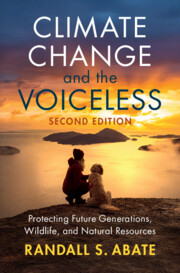
Future generations, wildlife, and natural resources – collectively referred to as 'the voiceless' in this work – are the most vulnerable and least equipped populations to protect themselves from the impacts of global climate change. In this new edition of Climate Change and the Voiceless, Randall S. Abate provides comprehensive analysis of recent landmark strategic litigation to protect vulnerable communities, significant updates on legislative and judicial developments on rights of nature, and a detailed summary of the most important climate change advisory opinions and their implications for the protection of voiceless communities. As in the original work, he identifies the common vulnerabilities of the voiceless in the Anthropocene era and demonstrates how the law can evolve to protect their interests more effectively. This work should be read by anyone interested in how the law can be employed to mitigate the effects of climate change on those who stand to lose the most.
Despite increased awareness and policy support, numerous rural individuals in India continue to struggle with the adoption of ecologically sustainable practices. This study examines the impact of village leaders’ emotional intelligence (EI) on promoting community-focused environmental education and enhancing action competence for sustainable rural development. A comparative case study including twelve villages – six high-performing and six underperforming – was conducted using leader self-assessments, community questionnaires, and field observations. The findings indicate that villages led by individuals with elevatedEI excel in water conservation, waste management, community engagement, and the development of sustainable infrastructure. These leaders exhibit heightened motivation, empathy, and social acumen, facilitating collaboration and participatory governance. The research highlights the importance of emotionally intelligent leadership in linking environmental consciousness with sustainable community practices.
Upcycling is an emerging green business model that involves transforming broken, old, useless or worn-out products into new items. Despite its importance to the circular economy, upcycling involves certain risks relating to intellectual property (IP) law. This research handbook analyses the meaning and promise of upcycling in a circular economy, as well as the fundamental conceptual elements of this phenomenon. It provides a systematic collection of chapters on the potential relevance of upcycling in all major areas of IP law. It also takes a geographical approach, including six chapters that primarily cover the policy considerations of upcycling on all inhabited continents. Furthermore, it addresses fields of science with either indirect or loose connections to IP and upcycling, such as economic, psychological, and social justice issues. The book supports upcycling at doctrinal, practical, and policy levels, and suggests measures to align the IP system with the objectives of the circular economy.
Islamic environmental law presents a comprehensive approach to ecological preservation, grounded in religious principles and ethical responsibilities. This research explores the Islamic legal framework for environmental protection, positioning humans as stewards (khalifa) of nature rather than absolute owners. The study illuminates how Islamic jurisprudence integrates environmental conservation into a holistic system of social and spiritual responsibility. The research examines key institutional mechanisms within Islamic law for environmental management, including land reclamation (Ihia’ Al-Arad Al-Mawat), natural reserves (Al-Hima), protective zones (Al-Harim), and charitable endowments (Al-Waqf). Central to this approach is the principle of prioritizing collective welfare over individual interests, with a strong emphasis on preventing environmental harm and promoting sustainable development. The paper critically analyzes the potential for implementing Islamic environmental principles in contemporary legal frameworks, particularly in Muslim-majority countries. It advocates for a renewed environmental governance model that synthesizes religious ethics, scientific understanding, and proactive institutional strategies to address ecological challenges.
In a world grappling with pressing environmental challenges, the intersection of Islamic epistemologies and sustainable development models offers a unique perspective. This chapter book delves into Islamic perspectives on environmental ethics and sustainability, exploring the theological foundations, ethical principles, and practical implications of stewardship and trust in Islam. Drawing upon Quranic teachings and scholarly insights, it examines humanity’s role as stewards of the Earth, emphasizing responsible resource management, moderation, and justice. Rooted in concepts of Khilafah (stewardship) and Amanah (trust), Islamic environmental ethics highlight the ethical obligation to ensure sustainable resource use and protect the environment for future generations. Additionally, the concepts of moderation and justice, known as "Al-Wasatiyyah," offer guidance for achieving balance, equity, and harmony in all aspects of life, including environmental conservation. Through case studies and examples, this chapter book demonstrates how Islamic principles can inform environmental decision-making processes and contribute to holistic, sustainable development efforts. By integrating spiritual dimensions into environmental conservation practices, it advocates for a more comprehensive approach to addressing contemporary environmental challenges, fostering a harmonious relationship between humans and the natural world.
Islamic legal scholarship is split on the permissibility of corporate personhood. While some scholars advocate unequivocal permissibility, others are critical because Islamic law prohibits limited liability in most contracts. The religion also regards the human being as the only subject of Divine command. Despite their differences, most jurists agree that the corporate form is an effective tool to mobilize large amounts of capital. However, only one scholar, Ahmad Ali Abdullah addresses the exploitative impact corporations have on human rights and the environment. In this context, I argue that we should address the issue of corporate personhood from a maqasid framework. The preservation and protection of wealth is a legitimate purpose of Islamic law. However, the preservation and protection of life is a higher purpose in the hierarchy. The preservation of life is directly linked to the preservation of the earth. While recognizing the corporate form’s utility, I advocate creating alternative business models that lead to more sustainable development.