To save content items to your account,
please confirm that you agree to abide by our usage policies.
If this is the first time you use this feature, you will be asked to authorise Cambridge Core to connect with your account.
Find out more about saving content to .
To save content items to your Kindle, first ensure no-reply@cambridge.org
is added to your Approved Personal Document E-mail List under your Personal Document Settings
on the Manage Your Content and Devices page of your Amazon account. Then enter the ‘name’ part
of your Kindle email address below.
Find out more about saving to your Kindle.
Note you can select to save to either the @free.kindle.com or @kindle.com variations.
‘@free.kindle.com’ emails are free but can only be saved to your device when it is connected to wi-fi.
‘@kindle.com’ emails can be delivered even when you are not connected to wi-fi, but note that service fees apply.
Beyond Magic in the Roman World reconsiders how Romans understood ritual, deviance, and alterity by moving past the modern category of 'magic.' Instead of treating magic as a single system, Andrew Durdin reveals how Roman authors used labels of ritual deviance to negotiate cultural diversity, social tension, and political authority. Drawing on texts from the late Roman Republic through the Principate, and written by Cicero, Lucan, Pliny, Tacitus, and Apuleius, he offers clear, engaging explanations as to how Romans classified the unfamiliar. The result is a vivid portrait of a society using language, accusation, and imagination to make sense of an expanding world. Durdin's book equips readers with the tools to recognize how scholarly categories – especially 'magic' – carry colonial and imperial legacies that shape interpretation. Accessible and compelling, his study will appeal to readers of Roman history, ancient religion, and anyone curious about how cultures create – and contest – categories of difference.
This chapter continues the discussion of eighteenth-century representations of Lady Macbeth as a monstrous wife and mother, examining how this was depicted in a series of paintings that portray Lady Macbeth as dominating and exerting control over her timid spouse. After the French Revolution, British caricaturists cast Jacobin sympathizers as the witches in Macbeth, and visual artists such as Johan Zoffany, Henry Fuseli and William Blake invoked the figure of the witch to fuel fears regarding dangerous female sexuality and the horrific consequences of giving women social and political power. Mary Wollstonecraft, who embodied these fears for Fuseli and Blake, along with Germaine de Staël and Sarah Siddons, responded by emphasizing the psychological elements of Macbeth and representing Lady Macbeth as a sympathetic character.
The Introduction situates Romanticism Bewitched within current historicist scholarship on gender and witchcraft, feminist political theory and recent scholarship on misogyny and women’s anger. In addition, it traces the trajectory of witchcraft belief from the seventeenth century down to the Romantic era, exploring the eighteenth-century fascination with Shakespeare’s Macbeth and the gendered politics of representations of Lady Macbeth. During the Romantic period, Siddons’s powers of enchantment in that role, and the effect it had on her audience, is an example of how the figure of the Romantic witch opened a space to imagine and explore the constructive and destructive uses of female magic. While some Romantic witches confirmed the worst fears regarding female magic and its pernicious influence, other Romantic witches invited more positive reactions, ranging from sympathy to the deep admiration bordering on awe that Siddons inspired.
This chapter provides an analysis of Ann Radcliffe’s representation of contemporary female artists and authors like herself and Sarah Siddons as witches or enchantresses in “On the Supernatural in Poetry,” and offers examples of the wide variety of witches in Romantic-period Gothic literature, with sections on mother witches, political witches, marvelous witches, Faustian witches and serpent witches. Romantic-era Gothic writers discussed include well-known authors such as Ann Radcliffe, Matthew Lewis, Samuel Coleridge and Charlotte Dacre as well as lesser-known writers (at least to us now) such as Catherine Smith, Mary Julia Young and George Brewer.
Chapter 2 reviews Plath’s metaphorical employment of the witch-martyr figure within the political and religious framework of the Cold War. The chapter outlines Plath’s subversion of the religious vocabulary and themes in her poems, like ‘Lady Lazarus’, particularly its draft, and her parallelling doctors and priests in short stories, such as ‘Johnny Panic and the Bible of Dreams’ to critique the rhetoric of the Cold War. The chapter gives evidence that Plath employs the female body as a site of modern political and medical institutional violence, seeking inspiration from the power imbalance of the early modern witch trials and Joan of Arc’s martyrdom. The close examination of Plath’s drafts of ‘Fever 103°’ and ‘Lady Lazarus’ concludes the chapter on Plath’s Cold War poetics. It argues that the anticlerical and anti-authoritarian language of her poetry reimagines witch prosecutions, martyrdom, and inquisition in periods of political torture and nuclear warfare.
Chapter 7 introduces the cultural and political context of post-war Britain in which the rise of English nationalism, immigration from the Commonwealth countries, Cold War anxieties, and the development of the Neo-Pagan Wicca religion contributed to the association of witchcraft with the dark other. The chapter reviews Plath’s short stories and poems written about a small English village community and beekeeping during the early 1960s, arguing that she engages with contemporary concerns of exclusionary politics and the racist and colonial rhetoric of witchcraft. Her bee metaphor interrogates the binary between self and otherness and ideas about magical and racialised power. The chapter concludes that in comparing the bees to diabolical flying women, Plath simultaneously challenges and reinforces the identification of the dark other with fearful magical power.
The Conclusion reviews Plath’s engagement with the supernatural within the political, cultural, and literary context of post-war America and Britain. It summarises the nuances of concepts like witch, witchcraft, black and white magic, and their relation to gender and power. The Conclusion also emphasises the importance of examining Plath’s manuscripts and additional archival materials, which her demonstrate continuous interest in magical themes around gender power dynamics. Sylvia Plath and the Supernatural concludes that the re-examination of Plath’s works with an approach of the supernatural is timely and significant not only for Plath scholarship but for literary studies. It positions the comprehensive analysis of this book in the historical reckoning with witch trials and reflects on the lasting relationship between the language of magic and poetry.
Chapter 1 situates Plath’s work within McCarthyism (anti-Communist witch-hunt) and looks at her knowledge of the Salem witch trials, from American literature to her encounters with contemporary political discourses. The chapter examines Plath’s poems inspired by the early modern witch-hunt, such as ‘Witch Burning’ and ‘The Times Are Tidy,’ and considers her employment of the witch figure as a metaphor for political and gender nonconformists during the Cold War, seeking inspiration the trials of witches and the Rosenbergs. The chapter then comparatively reads Plath’s novel The Bell Jar (1963) and Arthur Miller’s drama The Crucible (1953), arguing that Plath draws on the concept of witch-hunt as an abuse of institutional power, which was parallelled with McCarthyism and the return to Puritanical morals in post-war America. The chapter reviews Plath’s historical, literary, and political engagement with the legacies of the Salem witch trials and offers an understanding of her poetic deployment of the witch figure.
Chapter 3 describes the influence of Shakespeare’s Macbeth and The Tempest on Plath’s poetry and prose, focusing on the gendered concepts of witchcraft and magic. The chapter contextualises Plath’s depiction of maternal malice and paternal control in the framework of twentieth-century interpretations of Macbeth’s witches and Prospero from The Tempest. It addresses the mythological origins of the female trio as metaphysical beings with divinatory powers who, for Plath, embody the inescapable maternal presence. The chapter outlines the similarities between Prospero’s magical power and the beekeeping of Plath’s father figure as a magical-scholarly power. In her writings, likewise seeks inspiration from her childhood, reimagining her Atlantic seascape as the magic island from The Tempest in which Prosperoean father emerges as an idealised and dominant figure. The chapter concludes that Plath’s allusions to the early modern supernatural figures were shaped and paralleled by post-war interpretations and poetic retellings. They reflect on the gendered understanding of magical power as a sinister and benevolent controlling force.
Chapter 6 introduces the concepts associated with supernatural transformations, metamorphosis, shapeshifting, and hybridity, each expressing a different approach to the transformation of the female body. Plath’s poems frequently seek inspiration from Ovid’s Metamorphoses in which she interrogates the powerlessness of women who transform from human to vegetal form. The chapter situates Plath’s poetic narratives among her female contemporaries, such as Anne Sexton, Adrienne Rich, and even Margaret Atwood, who rely on feminist retellings of classical myths to question concerns about women’s autonomy and social position. The chapter outlines Plath’s employment of the concept of shapeshifting, associated with witches and folkloric beliefs, to reflect on the liberatory powers the animal form (often flying creatures) offers to women. It also argues that Plath experiments with the fluid boundaries between the human and the nonhuman in one of her most well-known poems, ‘Ariel,’ which portrays an imaginative flying motion as transformation.
Horror tropes are very popular for entertainment. From novels to films, to video games, we can't seem to get enough of vampires, witches and zombies. But these folkloric creatures were believed to be real by previous generations (and even some contemporary ones). It is worth engaging with our ancestors' history, their thought processes, their religious beliefs and general human psychology to see if this constant investment of energy that people give to malign supernatural agents can illuminate our thought processes and survival mechanisms.
Many eldercides in African societies are motivated by witchcraft beliefs. Yet, witchcraft-related eldercide remains an understudied criminological subject. The present study explores the scale, features and socio-cultural and economic contexts of witchcraft-related elder homicide in Kenya. A total of 94 media articles reporting the witchcraft-related killings of 136 older people in Kenya between January 2012 and December 2021 were perused. Key information about the victims and perpetrators and the circumstances surrounding each event/eldercide was collected and critically analysed. The data suggest that approximately 75% of witchcraft-related homicide victims in Kenya are 60 years old and above. Most victims were females (mainly widows) of low socio-economic backgrounds. All the cases occurred in rural communities, and the perpetrators were largely young adult males. Arson, slashing with a machete and clubbing/beating were the dominant methods used to kill alleged witches. Most killings were motivated by the belief that the victims caused misfortunes/calamities by witchcraft. However, witchcraft allegations and concomitant killings were sometimes weaponized to obtain the victims’ property/land. Because witchcraft beliefs are deeply entrenched in the culture and philosophy of the Kenyan people, the use of a multifaceted approach may be the most appropriate way of curtailing the problem.
The hairdresser who carries Ovid's invitation to his puella in Amores 1.11 is almost immediately blamed for his rejection in 1.12, before that blame is transferred to the tablets carrying that invitation. Nape (the enslaved hairdresser of the puella) has been linked to the character Dipsas, appearing in 1.7, specifically through the descriptor sobria. By focussing on the use of the verb uerto, the reference to the mythical strix, and curses related to the old age of both Dipsas and the tablets in 1.7 and 1.12, this note demonstrates that the supernatural word choice further connects Nape with Dipsas.
This chapter drills into the parish records of Little and Great Clacton to reveal new information about the Selles family, accused of witchcraft as tensions around child-rearing and illegitimacy reached a peak in a second village. It shows how parish records are vital to an understanding of the life circumstances of ordinary villagers and how much a name, a relatuonship or a life event can tell us about the processes of witch accusation.
This chapter ranges over the St Osyth lndscape, mapping its haunted spots and the location of key encounters with familiar spirits, particularly those said to belong to Elizabeth Bennet, Margerie Sammon, Ales Hunt and Joan Pechey. It introduces further key figures from the wider Darcy estate and shows how more suspects were drawn into the witch hunt. It argues that the history and features of a landscape can tell us much about the origin of local witchcraft fears.
This chapter tells the story of the witch hunts arrival in Little Oakley and Beaumont cum Moze, and reconstructs the life of the sole suspect there, Annis Herd. Using parish and manorial court records, and the records of the archdeaconry court, it shows how Annis interacted with the churchwardens of several parishes, her inter-related neighbours and the Beaumont Rector, Richard Harrison, leading to her accusation.
This chapter examines how the witch hunt that began in St Osyth spread east to the three Soken villages, Thorpe, Kirby and Walton. It draws on manorial court records of these linked villages to reveal new information about the suspects and their accusers and it discusses their economic rivalries over resources and land.
This chapter examines the origin of the St Osyth witchcraft accusations in the strained relationship between Grace Thurlowe, a servant at St Osyth Priory, and the cunning woman Ursley Kempe. It reconstructs the network of magical healers in the locality, suggesting that competition and sensitivities around child-rearing and illegitimacy were important in sparking suspicion, as well as several recent deaths of key players in the village.
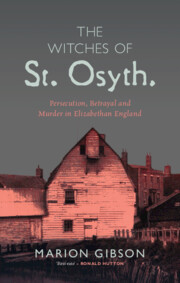
An emotive, haunting story of a community torn apart, the Essex witch accusations and trial of 1581-2 are, taken together, one of the pivotal instances of that malign and destructive wave of misogynistic persecution which periodically broke over early modern England. Yet, for all their importance in the overall study of witchcraft, the so-called witches of St Osyth have largely been overlooked by scholars. Marion Gibson now sets right that neglect. Using fresh archival sources – and investigating not just the village itself, but also its neighbouring Elizabethan hamlets and habitations – the author offers revelatory new insights into the sixteen women and one man accused of sorcery while asking wider, provocative questions about the way history is recollected and interpreted. Combining landscape detective work, a reconstruction of lost spaces and authoritative readings of newly identified key documents, Gibson skilfully unlocks the poignant personal histories of those denied the chance to speak for themselves.
An emotive, haunting story of a community torn apart, the Essex witch accusations and trial of 1581-2 are, taken together, one of the pivotal instances of that malign and destructive wave of misogynistic persecution which periodically broke over early modern England. Yet, for all their importance in the overall study of witchcraft, the so-called witches of St Osyth have largely been overlooked by scholars. Marion Gibson now sets right that neglect. Using fresh archival sources – and investigating not just the village itself, but also its neighbouring Elizabethan hamlets and habitations – the author offers revelatory new insights into the sixteen women and one man accused of sorcery while asking wider, provocative questions about the way history is recollected and interpreted. Combining landscape detective work, a reconstruction of lost spaces and authoritative readings of crucial documents, Gibson skilfully unlocks the poignant personal histories of those denied the chance to speak for themselves.