To save content items to your account,
please confirm that you agree to abide by our usage policies.
If this is the first time you use this feature, you will be asked to authorise Cambridge Core to connect with your account.
Find out more about saving content to .
To save content items to your Kindle, first ensure no-reply@cambridge.org
is added to your Approved Personal Document E-mail List under your Personal Document Settings
on the Manage Your Content and Devices page of your Amazon account. Then enter the ‘name’ part
of your Kindle email address below.
Find out more about saving to your Kindle.
Note you can select to save to either the @free.kindle.com or @kindle.com variations.
‘@free.kindle.com’ emails are free but can only be saved to your device when it is connected to wi-fi.
‘@kindle.com’ emails can be delivered even when you are not connected to wi-fi, but note that service fees apply.
Between December 1671 and the summer of 1672, the German philosopher and mathematician Gottfried Leibniz (1646–1716) addressed what amounted to a call for a new crusade against Egypt to the French king, Louis XIV. Leibniz’s Projet de conquête de l’Egypte deliberately situated its appeal in the history of French crusading, played upon the king’s piety and evoked the defeat of St Louis IX’s Egyptian crusade (1248–54) as a failure to be redressed. Devised partly as an attempt to divert the French from war in the Netherlands and partly as a call to unify Western Christian monarchs against a common foe on behalf of his employer, the Elector of Mainz, Leibniz’s plan seems never to have reached the French king.
Scholars have read Leo Strauss’s Thoughts on Machiavelli (1958) as a theological-political treatise that offers timeless truths about politics. This article argues that it also aimed to convince American conservatives to embrace a muscular foreign policy. Strauss’s correspondence and seminar transcripts reveal that he wanted the United States to support embattled outposts of Western civilization and blamed Kant’s philosophy of history for enabling the rise of Nazism and communism. Thoughts on Machiavelli teaches American elites that politics often involves a choice among evils, strong leaders are necessary to found states, democracies are better than dictatorships at maintaining states, and propaganda can mobilize a multitude to join one’s army. The article shows that Strauss wanted to influence US policy regarding the State of Israel, Cuba, and Vietnam and deserves his reputation as the founder of neoconservatism.
Interlude 1 compares the history of legal education and research in India and Palestine. In each territory, British rule fostered Western-style legal education systems, and local scholars critically engaged with English and Continental theories, applying them to their religious legal traditions. In both places, cultural nationalism shaped the study of religious law. Yet there were also major differences between the two places: Indian scholars, influenced primarily by Henry Maine’s historical approach, examined the evolution of religious law without advocating its revival. Jewish scholars, by contrast, drew on the ideas of the German Historical School and the successful revival of the Hebrew language to advance a program of modernizing Jewish law for use in a future Jewish state. Factors such as Hindu law’s association with the problematic notion of caste explain why efforts to use religious law as a foundation for modern secular national legal life were more pronounced among the Jewish community of Mandatory Palestine.
Interlude 2 compares the lives and ideas of Radhabinod Pal and Samuel Eisenstadt. Both were shaped by the political upheavals of 1905 in Europe and Asia. They both devoted parts of their academic works to defending their respective religious legal systems, Hindu and Jewish law, against Western evolutionary narratives, seeking to downplay hierarchical elements such as caste structure or gender inequality that existed in these systems, and both embraced a vision of the legal past aimed to challenge Western cultural dominance. However, Pal portrayed Hindu law as a stabilizing force, while Eisenstadt, a socialist-turned-communist, cast Jewish law as revolutionary and egalitarian. Another difference between them was that while Pal, influenced by English jurisprudence, was uninterested in the idea of legal revival, Eisenstadt, who assimilated the ideas of the German Historical School, actively promoted Jewish law as a foundation for Israel’s legal system. The interlude ends with a reflection on the way Pal and Eisenstadt used their respective religious legal traditions to construct utopian alternatives to Western law, idealizing Hindu and Jewish law, and overlooking the flaws in their traditions.
Chapter 6 explores early 20th-century scholarship on ancient Jewish public law written in the Jewish Diaspora and Mandatory Palestine. The chapter shows how rabbis and legal scholars, many of whom were associated in some way with the Tel Aviv School of Law and Economics, argued that Jewish law contained democratic, egalitarian, and international legal principles compatible with modern values. They claimed that Jewish law could be seen as an innovative legal system capable of being used to create the constitutional law of a modern state. In Jewish law, they argued, one could find notions such as the rule of law, separation of powers, equality, norms governing international relations, and principles urging the humane treatment of foreigners, women, and slaves. The chapter discusses critiques of this literature from secular liberals, right-wing nationalists, and ultra-Orthodox thinkers. It also briefly mentions analogous discussions of Islamic public law found in works published by Palestinian-Arab authors, and the impact of this literature on Jewish constitutional discourse in the period immediately before and after Israeli independence in 1948.
Chapter 4 discusses the life and thought of Samuel Eisenstadt, one of the founders of the Tel Aviv School of Law and Economics. Eisenstadt was a Russian-born Jewish legal scholar. His career spanned pre-revolutionary Russia, the Soviet Union, Mandatory Palestine, and Israel. His legal scholarship drew on the German Historical School, which viewed law as a historical and cultural phenomenon, and on Marxist legal theory, which described law as an instrument of class struggle. Eisenstadt sought to show the superiority of Jewish law, for example, by arguing that traditional institutions of Jewish legal education were better than Western ones because of their non-elitist and non-materialist nature, or by arguing for a genealogy of labor and international law which located its origins in the Bible. Eisenstadt was also engaged in apologetic efforts to defend the more problematic aspects of Jewish law, such as its treatment of slaves and women. Eisenstadt’s legal thought provides an example of the intersection of legal nationalism and socialism, and the attempt to reconcile Jewish traditions with progressive ideology.
Dublin referred to the Second World War as the Emergency, but, when applied to the minorities, even this concise and elegant understatement deserves a question mark, partly because for many Éire citizens the war was a time of opportunities and partly because their response to the war was largely a matter of individual choice. The chapter first discusses aspects of the ‘pro-fascism’ allegedly shared by the Protestant middle classes at the beginning of the war and then moves to the way the war encouraged a rethinking of British values as universal liberal principles. It contrasts such lofty rhetoric with the response of the Loyal Orange Institute in the three Ulster counties of Éire, suggesting that the turn to democracy owed more to tactical choices than conviction politics. What turned out to be permanent, however, was a tendency to articulate minority issues as either Irish concerns or universal claims. A parallel development took place within the Dublin Jewish community from the end of 1944, as the ‘old acquaintance’ with Britain was rapidly forgotten, and Zionism emerged as – simultaneously – more Irish and more self-confidently aligned with the nascent Israeli state.
This chapter continues the discussion of the centrality of the Holy Land in both the imaginary and the actual politics of the Irish religious minorities. In 1926 the Chief Rabbi of the Irish Free State, Isaac Herzog, moved to Jerusalem and to a much more prestigious Chief Rabbinate. The chapter follows the development of his philosophy, his interaction with various Zionists groups, and the parallel development of an Irish Protestant Zionism (Irish Protestants held positions of power and influence in the administration of the Mandate). If the Mandate was part of the new liberal empire, it was also a military frontier, a new Ulster. The Hebron riots of 1928 generated a strong reaction among both Irish minorities, with the development of a vocal Christian Zionism in Éire and among southern Irish Protestants serving in Palestine. From the early 1930s a renewal of anti-Semitism in Continental Europe added to the significance and urgency of Zionism. The chapter then follows the response of the authorities to the question of Jewish refugees, with three case studies: Palestine itself, the Irish Free State (which became Éire in 1937), and Northern Ireland.
The first part of this chapter’s title paraphrases the key sentence from a sermon in which a Presbyterian minister compared southern Protestants to the ancient Hebrews in their Babylonian exile, and in particular to Daniel, who kept his windows – and mind – open towards the Promised Land. Applied to minorities in interwar Ireland, it was both an exhortation and a statement: Irish Protestants and Jews looked beyond Ireland’s shores for their inspiration, like exiles groaning for a promised land. Inherently transnational groups such as Jews and Irish Protestants generated explicitly internationalist politics, accompanied by a rhetoric of social reform at home, often by means of ecumenical endeavour. While both internationalism and social reform were inspired by the then widespread revulsion against the First World War, for most people there was a persistent attachment to the British Empire and a desire to express it without provoking a republican backlash. The chapter’s last part examines minority internationalism as it engaged with the ultimate secular utopia of their day – the Soviet Union – or, rather, the way it was perceived and represented by admirers like Sean O’Casey and Rosamond Jacob.
The fourth chapter, framed by current discussions on antisemtism and the war in Gaza, explores how several younger German Jewish writers (born between 1981 and 1986, and mostly migrants from the former Soviet Union) create original and moving expressions of their newly emancipated lives in Israel. Mirna Funk, Lena Gorelik, Olga Grjasnowa, Dimitrij Kapitelman, Markus Flohr, and most recently Dana Vowinckel all wrote narratives presenting Israel as an important space for German Jewish Holocaust memory to unfold. Untangling some of their conceptions of Holocaust memory as it shapes their protagonists’ identities sheds light on how and why Israel has become such an important reference for German Jewish Holocaust discourse even before the most recent war on Gaza. Israel, for many of these younger writers’ protagonists, functions both as an exotic and exoticized locus amoenus as well as a locus terribilis in the quest to recover previous generations’ Holocaust memory. While Israel is used as a space to reflect on the protagonists’ own more personal trauma and migration stories, it also serves as a catalyst to address Jewish–Muslim relations.
Berlin offers a typically high level and broad-based discussion of nationalism and its relationship to nationality or national consciousness and the idea of the nation. The first part of this chapter will explore the structure of his essay and then its main arguments. The chapter begins with subtle distinctions between nation, national consciousness and then nationality as an ideological form and explores the claim that nationalism has been relatively overlooked compared to the other main ideologies that emerged out of the post–French Revolution world. The language of nation was important for the development of the modern European nation state, and especially in the context of the retreat of empire. He argues that the success of the nation state system should have left the language of the nation to fade from view. However, nationalism surprises because of its prevalence, and Berlin seeks to explain this in terms of rectifying a national political wound and the rise of a new elite in that context seeking a political language to recreate a new political order. The final part of the chapter notes the surprising prevalence of this Eurocentric language in the post-Eurocentric world.
Continuing the previous discussion, this chapter discusses Arendt’s view of group identity. She argues for a political or speech-act theory of identity ascriptions. In times of persecution, she explains, it would be an evasion for her to answer “Who are you?” with anything other than “I am a Jew”; in other contexts, that answer would be a pose. This helps explain her well-known dictum, “If you are attacked as a Jew, you must defend yourself as a Jew”: Persecuted groups “can resist only in terms of the identity that is under attack.” Understanding group identity in this way helps explain Arendt’s initial attraction to Zionism, but also her eventual break with the Zionist movement. The danger of this political conception of identity politics is that it seemingly imposes no humanitarian limits on what one can do to resist the persecutor, a danger foreseen by the Nazi theorist Carl Schmitt. The chapter formulates Arendt’s answer to Schmitt’s challenge, based on her “idea of humanity.”
At stake in the Gaza genocide is the world itself. To grasp just how “worldly” the stakes are, all we need to do is face the single most distinct feature of this genocide: its prosecution as a genocide necessary for the global order at all costs—even at the cost of the order itself. In its insistence on the genocide, the west has cannibalized the very institutions it had used to shape the world. How, then, do we explain the radical necessity of genocide here? Here, I argue that we need to come to terms with how, since the 1970s at least, Zionism has co-constituted the object we call western civilization. And it has done so primarily by operating as a geopolitical and ideological impasse to decolonization. Zionism is the west’s postcolonial alibi, deferring any reckoning with the west’s colonial history and enduring racial regimes. But the genocide at once reaffirms and destabilizes Zionism’s vocation. Intersecting with the irreversible decline of US empire, the genocide appears as the death knell for an entire age, accelerating the effective unraveling of the international order that stands in for the world, and potentially heralding a kind of unworlding.
This chapter explores the evolving depiction of the Land of Israel in Hebrew poetry, reflecting the creation of modern Hebrew culture. It contrasts ancient expressions of longing for Zion with the transformed image of Israel as a tangible landscape. The chapter examines how poets from various Zionist immigration periods depicted their encounters with the land, ranging from messianic ecstasy to realistic sobriety. Each era produced poets who articulated their complex experiences, as exemplified by Noah Stern’s poem “Smells” (1935), which captures the blend of hallucinations, disappointments, tortures, pleasures, closeness, and alienation. Each poem is a new chapter in the ongoing narrative of encountering the land.
This chapter looks at Palestinian doctors’ interactions with their Jewish counterparts as both a political and a professional rivalry. Jewish doctors treated Arab patients, and Jewish and Arab doctors worked together in government institutions, shared clinics, consulted each other, and fought common enemies of morbidity and mortality on the same land. The chapter examines Jewish-Arab interdependency and rivalry, bringing forward its articulations in the Arab and Hebrew press while underlining the effects of intercommunal violence on this encounter and attempts at direct cooperation. At the heart of this chapter is the mass migration of German-Jewish doctors to Palestine following the Nazi takeover, and the ways in which it affected relationships within the medical profession.
This chapter examines a group of anticolonial and anti-imperialist intellectuals of different political persuasions thinking on Palestinian anticolonial national liberation at key moments in Palestinian history. It argues that central to these thinkers in their analysis of Palestine is a collapse in distinction between 1948- and 1967-occupied Palestine in Zionist settler-colonial ambitions in Palestine; the umbilical relationship between Zionism and US–Euro imperialism; as well as the centrality of Arab ruling classes to Zionist hegemony in Palestine.
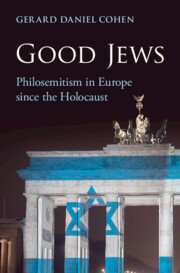
The Holocaust is now widely recognized as a central event in twentieth-century Europe. But how did the genocide of the Jews affect European attitudes towards Jews, Judaism and Jewishness after 1945? While many histories of antisemitism exist, Good Jews offers an investigation of philosemitism – defined as a politics of post-Holocaust friendship. Gerard Daniel Cohen presents a critical exploration of the languages of philosemitism in mainstream European politics and culture from 1945 to the present day, with particular emphasis on Germany and France. Within this framework Cohen explores how the 'Jewish question', or the problem of Jewish difference and incorporation in Western countries during the postwar decades, has been distinctively foregrounded in the language of philosemitism. Ultimately, Good Jews demonstrates that philosemitic Europe is not an idealised love story, but a reflection of European attitudes towards Jews from the Holocaust to the present.
Palestinian doctors became a dynamic, vocal, influential, and fascinating professional community over the first half of the twentieth century, growing from roughly a dozen on the eve of World War I to 300 in 1948. This study examines the social history of this group during the late Ottoman and British Mandate periods, examining their social and geographic origins, their professional academic training outside Palestine, and their role and agency in the country's medical market. Yoni Furas and Liat Kozma examine doctors' interactions with the rural and urban society and their entangled relationship with the British colonial administration and Jewish doctors. This book also provides an in-depth description of how Palestinian doctors thought and wrote about themselves and their personal, professional, and collective ambitions, underlining the challenges they faced while attempting to unionize. Furas and Kozma tell Palestine's story through the acts and challenges of these doctors, writing them back into the local and regional history.
Who was God for Schoenberg? And what did Schoenberg believe was the necessary human response? Schoenberg’s spiritual and intellectual path was long and winding, often iconoclastic, shaped by antisemitism and personal losses, and always characterized by a deeply personal quest for a transcendent truth – an Ideal or Idea [Gedanke] – that was at the same time intuitively known but inexpressible by human means. The path ultimately led him to a passionate Zionism, an unshakeable belief in ‘one, eternal, all-powerful, invisible and unrepresentable God’, and a corresponding ascetic spirituality that survived both inward anguish and political persecution.
The chapter explores the meanings of the word “philosemitism” before the Holocaust (late nineteenth century to 1945) and since then. It states the book’s main argument: the valorization of Jews in European liberalism from the Holocaust to the present. The chapter also includes a discussion of the existing literature on philosemitism.