To save content items to your account,
please confirm that you agree to abide by our usage policies.
If this is the first time you use this feature, you will be asked to authorise Cambridge Core to connect with your account.
Find out more about saving content to .
To save content items to your Kindle, first ensure no-reply@cambridge.org
is added to your Approved Personal Document E-mail List under your Personal Document Settings
on the Manage Your Content and Devices page of your Amazon account. Then enter the ‘name’ part
of your Kindle email address below.
Find out more about saving to your Kindle.
Note you can select to save to either the @free.kindle.com or @kindle.com variations.
‘@free.kindle.com’ emails are free but can only be saved to your device when it is connected to wi-fi.
‘@kindle.com’ emails can be delivered even when you are not connected to wi-fi, but note that service fees apply.
Examines an important novelistic genre of the early German Democratic Republic for what it tells us about the country's aspirations to remake labor affectively and thus to build a socialist society.
In a series of socialist realist novels written in the early 1950s, East German authors sought to capture "the new feeling of work" under socialism, to portray the collective enthusiasm of building a new world out of the ruins of fascism and war. In the GDR, this construction literature received an ambiguous reception even at the time; in the West it was dismissed as propaganda; and it is now largely forgotten. Why revisit it now? Drawing on the theorization of living labor elaborated in Oskar Negt and Alexander Kluge's work, particularly their monumental treatise History and Obstinacy, and on contemporary Marxist feminist accounts of social reproduction theory, this book argues that East German construction literature provides us with a set of case studies in the social reorganization of work and the emotions and infrastructures that attend to it, even as these novels attempt to contain these transformations through socialist realist aesthetic strategies. The much-bemoaned awkwardness of these novels, then, is perhaps not only to be found in their didacticism but in the limits of that didacticism, where they seek both to portray and to disavow the transformation of work and the working class in the GDR. This book confronts the question: what was socialist affective labor and what could it have been?
An in-depth investigation of the Romanian secret police's file on Müller, winner of the 2009 Nobel Prize for Literature, re-creating a 'file story' of her surveillance.
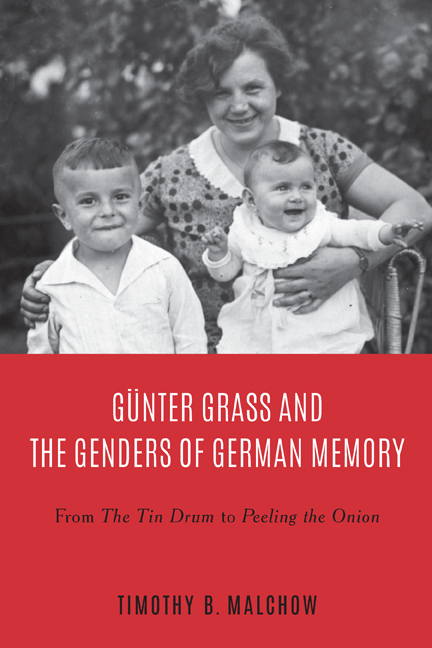
The first book to examine the connection between gender and memory in Grass's oeuvre, which is especially timely in light of current concerns about male privilege.
Recommend this
Email your librarian or administrator to recommend adding this to your organisation's collection.