This series contains original works that challenge and enlighten historians of economics. For the profession as a whole, it promotes better understanding of the origin and content of modern economics.
General Editors:
Harro Maas, Université de Lausanne, Switzerland
To save content items to your account,
please confirm that you agree to abide by our usage policies.
If this is the first time you use this feature, you will be asked to authorise Cambridge Core to connect with your account.
Find out more about saving content to .
To save content items to your Kindle, first ensure no-reply@cambridge.org
is added to your Approved Personal Document E-mail List under your Personal Document Settings
on the Manage Your Content and Devices page of your Amazon account. Then enter the ‘name’ part
of your Kindle email address below.
Find out more about saving to your Kindle.
Note you can select to save to either the @free.kindle.com or @kindle.com variations.
‘@free.kindle.com’ emails are free but can only be saved to your device when it is connected to wi-fi.
‘@kindle.com’ emails can be delivered even when you are not connected to wi-fi, but note that service fees apply.
This book covers a broad range of topics in the history of economics that have relevance to economic theories. The author believes that one of the tasks for a historian of economics is to analyze and interpret theories currently outside the mainstream of economic theory, in this case non-Walrasian economics. By doing so, he argues, new directions and new areas for research can be developed that will extend the current theories. Familiar topics covered include: the division of labor, economies of scale, wages, profit, international trade, market mechanisms, and money. These are considered in the light of the well-known non-Walrasian schools of thought: the classical, Marxian, Austrian, and Cambridge schools.
This book is a comprehensive investigation of the work of Joseph Alois Schumpeter (1883–1950), one of the great economists of the twentieth century. In this study, Yuichi Shionoya highlights Schumpeter's methodological views and emphasizes his ideal of a universal social science. Taking on board all aspects of his work, he reconstructs a system which encompasses theory (economic statics, economic dynamics, economic sociology) and metatheory (philosophy of science, history and sociology of science). The originality of Schumpeter's work - which the author calls the two-structure approach to the evolution of mind and society - is examined in the light of the intellectual field in Germany and Austria in the early twentieth century. This book is a major contribution to the history of economic thought.
Focusing on the period of Milton Friedman's collaboration with Anna J. Schwartz, from 1948 to 1991, this 1996 work examines the history of debates between Friedman and his critics over money's causal role in business cycles. Professor Hammond shows that critics' reactions were grounded in two distinctive features of Friedman and Schwartz's way of doing economic analysis - their National Bureau business cycle methods and Friedman's Marshallian methodology. With the post-war dominance of Cowles Commission methods and Walrasian methodology, Friedman and Schwartz's monetary economics appeared to contemporary critics to be 'measurement without theory'. Drawing extensively upon unpublished materials, Professor Hammond's treatment offers new insights on Milton Friedman's attempts to settle debates with his critics and his eventual recognition of the methodological impediments. The book will interest monetary economists and macroeconomists, as well as historians of economics and methodologists.
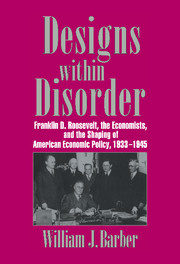
More than any of his predecessors in the White House, Franklin D. Roosevelt drew heavily on the thinking of economists as he sought to combat the Great Depression, to mobilize the American economy for war, and to chart a new order for the post-war world. Designs Within Disorder, published in 1996, is an inquiry into the way divergent analytic perspectives competed for official favour and the manner in which the President opted to pick and choose among them when formulating economic policies. During the Roosevelt years, two 'revolutions' were underway simultaneously. One of them involved a fundamental restructuring of the American economy and of the role government was to play in it. A second was an intellectual revolution which engaged economists in reconceptualizing the nature of their discipline. Most of the programmatic initiatives Roosevelt put in place displayed a remarkable staying power for over half a century.
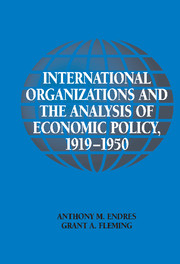
This 2002 book expands our understanding of the distinctive policy analysis produced between 1919 and 1950 by economists and other social scientists for four major international organizations: the League of Nations, the International Labor Organization, the Bank for International Settlements, and the United Nations. These practitioners included some of the twentieth century's eminent economists, including Cassel, Haberler, Kalecki, Meade, Morgenstern, Nurkse, Ohlin, Tinbergen, and Viner. Irving Fisher and John Maynard Keynes also influenced the work of these organizations. Topics covered include: the relationship between economics and policy analysis in international organizations; business cycle research; the role and conduct of monetary policy; public investment; trade policy; social and labor economics; international finance; the coordination problem in international macroeconomic policy; full employment economics; and the rich-country-poor-country debate. Normative agendas underlying international political economy are made explicit, and lessons are distilled for today's debates on international economic integration.
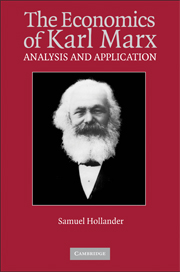
Presents an account and technical assessment of Marx's economic analysis in Capital, with particular reference to the transformation and the surplus-value doctrine, the reproduction schemes, the falling real-wage and profit rates, and the trade cycle. The focus is on criticisms that Marx himself might have been expected to face in his day and age. In addition, it offers a chronological study of the evolution of that analysis from the early 1840s through three 'drafts': documents of the late 1840s, the Grundrisse of 1857–1858, and the Economic Manuscripts of 1861–1863. It also provides three studies in application, focusing on Marx's 'evolutionary' orientation in his evaluation of the transition to communism and his rejection of 'egalitarianism' under both capitalist and communist regimes; his evolving perspective on the role of the industrial 'entrepreneur'; and his evolving appreciation of the prospects for welfare reform within capitalism.