Studies in Celtic History aims to provide a forum for new research into all aspects of the history of Celtic-speaking peoples throughout the whole of the medieval period. The term `history' is understood broadly: any study, regardless of discipline, which advances our knowledge and understanding of the history of Celtic-speaking peoples will be considered. Studies of primary sources, and of new methods of exploiting such sources, are encouraged.
To save content items to your account,
please confirm that you agree to abide by our usage policies.
If this is the first time you use this feature, you will be asked to authorise Cambridge Core to connect with your account.
Find out more about saving content to .
To save content items to your Kindle, first ensure no-reply@cambridge.org
is added to your Approved Personal Document E-mail List under your Personal Document Settings
on the Manage Your Content and Devices page of your Amazon account. Then enter the ‘name’ part
of your Kindle email address below.
Find out more about saving to your Kindle.
Note you can select to save to either the @free.kindle.com or @kindle.com variations.
‘@free.kindle.com’ emails are free but can only be saved to your device when it is connected to wi-fi.
‘@kindle.com’ emails can be delivered even when you are not connected to wi-fi, but note that service fees apply.
Ireland has the most substantial corpus of annalistic chronicles for the early period in western Europe. They are crucial sources for understanding the Gaelic world of Ireland and Scotland, and offer insights into contacts with the wider Christian world. However, there is still a high degree of uncertainty about their development, production, and location prior to 1100, which makes it difficult to draw sound conclusions from them. This book analyses the principal Irish chronicles, especially the "Annals of Ulster", "Annals of Tigernach", and the "Chronicum Scotorum", identifying their inter-relationships, the main changes to the texts, and the centres where they were written in the tenth and eleventh centuries - a significant but neglected period. The detailed study enables the author to argue that the chroniclers were in contact with each other, exchanging written notices of events, and that therefore the chronicle texts reflect the social connections of the Irish ecclesiastical and secular elites. The author also considers how the sections describing the early Christian period (approximately 431 to 730 AD) were altered by subsequent chroniclers; by focussing on the inclusion of material on Mediterranean events as well as on Gaelic kings, and by comparing the chronicles with other contemporary texts, he reconstructs the chronicles' contents and chronology at different times, showing how the accounts were altered to reflect and promote certain views of history. Thus, while enabling readers to evaluate the sources more effectively, he also demonstrates that the chronicles were sophisticated and significant documents in themselves, reflecting different facets of contemporary medieval society and their shifting attitudes to creating and changing accounts of the past. Dr Nicholas Evans is an Honorary Research Fellow at the University of Glasgow.
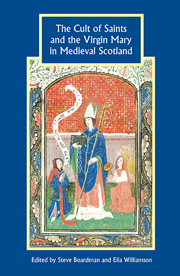
Of all the Celtic countries, Scotland has lacked the kind of scholarly attention that has been lavished fruitfully on Wales, Ireland, Cornwall and Brittany. And yet of all of them, Scotland offers the widest range of interfaces with broader work on the cult of saints. The papers presented here cover this territory very effectively.... [the book] brings together excellent studies that successfully explore the wide ramifications of the topic. Anyone with an interest in saints' cults will want this book. DAUVIT BROUN, Professor of Scottish History, University of Glasgow. This volume examines the phenomena of the cult of saints and Marian devotion as they were manifested in Scotland, ranging from the early medieval period to the sixteenth century. It combines general surveys of the development of the study of saints in the early and later middle ages with more focused articles on particular subjects, including St Waltheof of Melrose, the obscure early medieval origins of the cult of St Munnu, the short-lived martyr cult of David, duke of Rothsay, and the Scottish saints included in the greatest liturgical compendium produced in late medieval Scotland, the Aberdeen breviary. The way in which Marian devotion permeated late medieval Scottish society is discussed in terms of the church dedications of the twelfth and thirteenth-century aristocracy, the ecclesiastical landscape of Perth, the depiction of Mary in Gaelic poetry, and the pervasive influence of the familial bond between holy mother and son in representations of the Scottish royal family. Dr Steve Boardman is Reader in History, University of Edinburgh; Eila Williamson gained her PhD from the University of Glasgow. Contributors: Helen Birkett, Steve Boardman, Rachel Butter, Thomas Owen Clancy, David Ditchburn, Audrey-Beth Fitch, Mark A. Hall, Matthew H. Hammond, Sim Innes, Alan Macquarrie
Much of our knowledge of early medieval Ireland comes from a rich literature written in a variety of genres and in two languages, Irish and Latin. Who wrote this literature and what role did they play within society? What did the introduction and expansion of literacy mean in a culture where the vast majority of the population continued to be non-literate? How did literacy operate in and intersect with the oral world? Was literacy a key element in the formation and articulation of communal and elite senses of identity? This book addresses these issues in the first full, inter-disciplinary examination of the Irish literate elite and their social contexts between ca. 400-1000 AD. It considers the role played by Hiberno-Latin authors, the expansion of vernacular literacy and the key place of monasteries within the literate landscape. Also examined are the crucial intersections between literacy and orality, which underpin the importance played by the literate elite in giving voice to aristocratic and communal identities. This study places these developments within a broader European context, underlining the significance of the Irish experience of learning and literacy. Elva Johnston is lecturer in the School of History and Archives, University College Dublin.
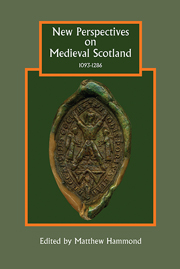
The years between the deaths of King Mael Coluim and Queen Margaret in 1093 and King Alexander III in 1286 witnessed the formation of a kingdom resembling the Scotland we know today, which was a full member of the European club of monarchies; the period is also marked by an explosion in the production of documents. This volume includes a range of new studies casting fresh light on the institutions and people of the Scottish kingdom, especially in the thirteenth century. New perspectives are offered on topics as diverse as the limited reach of Scottish royal administration and justice, the ties that bound the unfree to their lords, the extent of a political community in the time of King Alexander II, a view of Europeanization from the spread of a common material culture, the role of a major Cistercian monastery in the kingdom and the broader world, and the idea of the neighbourhood in Scots law. There are also chapters on the corpus of charters and names and the innovative technology behind the People of Medieval Scotland prosopographical database, which made use of over 6000 individual documents from the period. Matthew Hammond is a Research Associate at the University of Glasgow. Contributors: John Bradley, Stuart Campbell, David Carpenter, Matthew Hammond, Emilia Jamroziak, Cynthia Neville, Michele Pasin, Keith Stringer, Alice Taylor.