


5.1 Conceptual Background, Terminology, and Measures
The terms “language proficiency” and “ability” are often used interchangeably in the literature (see Chapter 1, “The Language Continuum” for a detailed discussion of the issue). The focus in this chapter is on the relationship between cognitive control and language proficiency and language use in monolingual and bilingual children with different language abilities. While we use the term language ability in reference to children’s language and communication skills that are typically measured with standardized language tests with the goal of detecting the presence or absence of a language disorder, we discuss language proficiency with regards to bilingual children’s functional language use, that is their overtly observable language performance (Jilka, Reference Jilka, Dogil and Reiterer2009). This use of terminology is consistent with Birdsong’s (Reference Birdsong2014) definition, which specifies proficiency as individual language skills used across different domains (e.g., conversations, listening to speech). These skills have been assessed with both subjective (questionnaires, “can do” lists) and objective measures (standardized language tests). The problems related to the use of standardized tests as a measure of language proficiency rather than language ability have been discussed in the previous Chapters 1 and 3, “The Language Continuum” and “Methodological Issues,” so here, we only reiterate the findings of Bedore and colleagues, whose research has shown that tests often used interchangeably to measure children’s various language skills were developed for other purposes. Tests of language proficiency have not been designed to identify children with language disorders, and tests that were developed to determine the presence of language disorders do not provide appropriate measures to quantify language proficiency (Bedore et al., Reference Bedore, Peña, Summers, Boerger, Resendiz, Greene and Gillam2012). A further problem in the literature is that language talent is often measured by the number of languages a person acquires and how native-like their accent in their second language (L2) is rather than by their ease of L2 acquisition.
Nevertheless, our goal in this chapter is to examine the associations between the different language skills and children’s cognitive control skills. To do so, we first examine the interactions between language ability and proficiency (e.g., language proficiency in children with language talent) and then, we discuss appropriate measures for children with different language skills. Even though the term bilingual is often used synonymously with multilingual in the bilingualism literature (see Higby et al., Reference Higby, Kim and Obler2013), we distinguish between these terms in this chapter because the brain networks of people who speak at least three or more languages differ from those who speak only two languages (Cenoz et al., Reference Cenoz, Hufeisen, Jessner, Cenoz, Hufeisen and Jessner2003b), and this may affect their cognitive control skills. Moreover, in this chapter, it is also important to distinguish between multilingualism and language talent because many multilingual individuals speak their languages at varying proficiency levels across different contexts, and not all individuals who speak three or more languages exhibit language talent. Even among children with language disorders, there are some who grow up speaking three languages (e.g., English at school, Spanish and French at home).
In the L2 acquisition literature, language talent is defined as aptitude, in reference to unusual cognitive strengths that an individual demonstrates during language acquisition across different settings (Robinson, Reference Robinson2005). Studies interested in language talent typically take an individual-differences approach to identify the specific characteristics in aptitude in individuals with and without language talent and to determine those aptitude components that predict more efficient language acquisition and higher language proficiency. This question can be examined by exploring individual differences in information processing during the performance of L2 tasks with varying cognitive demands. Studies taking this approach typically include traditional measures of phonetic and grammatical sensitivity, rote memory, lexical access, as well as more recently, working memory tests, measures of emotional responses to learning (e.g., anxiety level), emotional intelligence, motivation, and self-regulation (Moyer, Reference Moyer2014; Sparks et al., Reference Sparks, Humbach, Patton and Ganschow2011; Wen & Skehan, Reference Wen and Skehan2011).
In children at the other end of the language ability continuum, those with DLD, measuring language proficiency is very challenging, and it typically requires a within-subject approach. It is important to distinguish between errors that are related to the child’s language disorder and their level of functional language use. When working with children with DLD, the measures of proficiency cannot be substituted with measures of ability. For example, using a standardized vocabulary test to assess a bilingual child’s language proficiency is not appropriate in children with DLD because the results may reflect the child’s limitations related to the disorder. Language proficiency in children with DLD may be better determined based on the outcomes of semi-structured interviews conducted in both languages of the child by bilingual speech-language pathologists. A set of conversational topics could be used to elicit speech samples that offer a view of the communicative exchanges relevant to the child’s social-interactive and academic experiences.
5.2 The Relationship between Language Proficiency, Exposure, and Language Use
This section is focused on the utilization of subjective and objective methods of language proficiency with regards to language exposure and the frequency of language use. While some scholars make no distinction between the terms exposure and language use, interpreting both terms as the time that a person is engaged with a specific language (Bedore et al., Reference Bedore, Peña, Griffin and Hixon2016), others differentiate between active use of language, such as engaging in conversation, and passive exposure to language, such as having a certain language spoken in the vicinity (Hoff et al., Reference Hoff, Core, Place, Rumiche, Señor and Parra2012; for more details, see Chapter 6, “Impact of Language Input on Cognitive Control”).
In a recent study, we examined whether the measures of language proficiency that have been used interchangeably in the literature provide similar outcomes in groups of bilingual students (young adults) experiencing different degrees of exposure to English in their daily lives (Gehebe et al., Reference Gehebe, Wadhera and Marton2023). We defined exposure within the theoretical framework of Grosjean (Reference Grosjean1989), who described a continuum of language modes referring to different activation levels of language. Language modes are highly influenced by various contextual factors, such as the conversational partner or the language context of the activity. The central notion in Grosjean’s theory is that, regardless of modality, bilingual individuals activate both of their languages immediately when they are exposed to any activities involving elements of either language. Therefore, we used the term language exposure in reference to the time during which individuals focus their attention on processing either spoken or written language. We compared language proficiency by using objective and subjective measures in three groups. Our results showed that participants with high English exposure (80–95 percent daily) exhibited similar proficiency levels with each type of language measure (i.e., subjective questionnaires and “can do” lists or objective vocabulary tests and sentence completion tasks). Conversely, the different measures of proficiency showed only a moderate correlation in participants with medium (50–70 percent daily) and low exposure (20–40 percent daily). It appears that these subjective and objective measures target distinct language skills that may undergo varying levels of development in individuals with medium and low language exposure. Therefore, the use of both subjective and objective measures is necessary in bilingual speakers with medium or low language exposure. These findings suggest complex interactions between language proficiency and exposure across different modalities.
Several studies have also shown a strong relationship between language proficiency and the frequency of language use (Luk & Bialystok, Reference Luk and Bialystok2013; Ribot et al., Reference Ribot, Hoff and Burridge2018). Luk and Bialystok performed a factor analysis to examine the factors contributing to the bilingual experience. The two strongly related and most relevant factors were language proficiency and the frequency of language use. Consistent with these findings are the results of Ribot and colleagues (Reference Ribot, Hoff and Burridge2018), who studied preschool-age Spanish–English bilingual children. Their results revealed that children’s frequency of language use affected their language proficiency level as measured by an expressive vocabulary test. Those children who used one of their languages more frequently showed greater expressive vocabulary in that language. This finding adds further information to the existing literature on the positive relationship between expressive vocabulary and the diversity of language input (Chondrogianni & Marinis, Reference Chondrogianni and Marinis2011; Hoff, Reference Hoff2003).
5.3 Language Proficiency and Cognitive Control
In this chapter, we sidestep the debate prevalent in the literature regarding the “bilingual cognitive advantage” because the majority of those studies focused on performance differences between bilingual and monolingual individuals, and the bilingual groups often involved individuals with differing proficiency levels. Here, we are interested specifically in the interactions between language proficiency variations and performance differences in cognitive control. Both behavioral and neurophysiological studies suggest that language proficiency modulates the engagement of cognitive control processes. Thus, bilingual individuals with higher language proficiency outperform their peers with lower language proficiency in cognitive control tasks, such as tasks of cognitive flexibility and interference control (Abutalebi et al., Reference Abutalebi, Della Rosa, Ding, Weekes, Costa and Green2013; Ibrahim et al., Reference Ibrahim, Shoshani, Prior and Share2013; Kheder & Kaan, Reference Kheder and Kaan2021). For example, bilingual listeners’ processing of auditorily presented sentences often involves phonetic and phonological similarities between the target and distractor languages, but the extent of interference experienced by the speakers is modulated by their level of language proficiency (Kim et al., Reference Kim, Marton, Obler, Sekerina, Spradlin and Valian2019). Unfortunately, most of the studies examining this relationship involved adults, so there are few studies in children. Yet, the results appear to be consistent across age groups.
Iluz-Cohen and Armon-Lotem (Reference Iluz-Cohen and Armon-Lotem2013) studied cognitive control in subgroups of four–seven-year-old, English–Hebrew-speaking bilingual children, balanced across high proficient bilingual, L2-dominant, L1-dominant, and low proficient in both languages. Children with high language proficiency outperformed their peers with low language proficiency in resisting interference and task switching but not in concept generation. The results suggest that the modulatory effect of language proficiency may vary, depending on the target function. One critical issue related to this study is that there was no differentiation between language proficiency and language ability. Children’s language skills were measured with standardized language tests in both English and Hebrew. Children in the first three groups performed within the typical range in at least one of their languages, so those were classified as bilingual children with average language ability who differed in language proficiency. The fourth group, performing below average in both languages, was thus considered to exhibit low proficiency in addition to low language ability. Despite confounding issues with the low proficiency/ability group, this study remains important as one of the first studies in children to call attention to the modulating role of language proficiency in cognitive control.
Similar results have been reported by Marton (Reference Marton, Sekerina, Spradlin and Valian2019), who measured language proficiency as a continuous variable in eight–eleven-year-old bilingual children, all of whom had English as their primary language while their non-English language varied (Spanish, Russian, Hebrew, Urdu, and Portuguese). Cognitive control was measured with a verbal categorization task, including different conditions (e.g., targeting proactive interference). Language proficiency was positively correlated with a number of cognitive control skills. More proficient bilingual children performed faster and more accurately than their less proficient and monolingual English-speaking peers in resisting proactive interference (i.e., interference from previous memory traces; see Figure 5.1). Highly proficient bilingual children showed smaller intrusion costs (the difference in response to neutral vs. interfering distractor items) than children with lower language proficiency. In tasks that measured performance monitoring and implicit learning, children with higher language proficiency performed faster than their low proficient peers but showed similar performance patterns in accuracy. Another component that further affected the relationship between language proficiency and cognitive control was the frequency of language use. Even among the highly proficient bilingual children, there were variations in language use. Some of these children used both of their languages 50 percent of the time on a daily basis, whereas others used their non-English language as little as 10 percent of the time. The former group showed better resistance to interference and more efficient performance monitoring than the latter group. Hence, this study also confirmed that the relationship between language proficiency and cognitive control is influenced by children’s bilingual language use, by the target cognitive control function, and by the type of measurement.
Conflict paradigm: Verbal categorization task
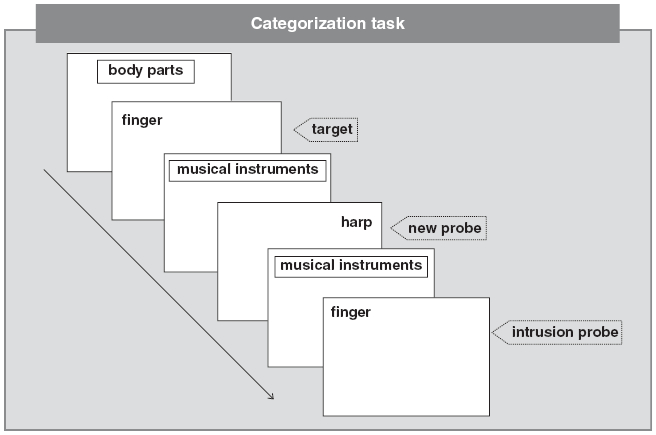
Based on these findings, Marton (Reference Marton, Sekerina, Spradlin and Valian2019) further examined how language proficiency and processing speed interact with different cognitive control functions using path analysis (Loehlin, Reference Loehlin2004). The results showed that language proficiency and cognitive control interact in multiple ways. Language proficiency had a direct effect on children’s intrusion errors and on their processing speed in a task measuring interference control, but in a monitoring task, the effect of language proficiency was mediated by the speed of processing (see details about this analysis in Chapter 8). These findings strengthen the notion that language proficiency, processing speed, and cognitive control show complex interactions, and future research is needed to further our understanding about this relationship.
The link between language proficiency and processing speed was also studied in ten–eleven-year-old multilingual children in tasks targeting attention control (Videsott et al., Reference Videsott, Della Rosa, Wiater, Franceschini and Abutalebi2012). All the children went to schools where they were taught in Italian half of the time and in German for the other half, with Ladin as a support language. Thus, all children spoke all three languages with varying proficiency levels across languages. Children’s multilingual competence affected each component of the attention network (i.e., alerting, orienting, and executive control), and the highly proficient children exhibited faster overall performance than their peers with lower proficiency. Taken together, the existing studies involving children suggest that cognitive control functions are modulated by language proficiency. Depending on the target cognitive control function, language proficiency may have a direct effect on cognitive control, or its effect may be mediated by processing speed.
5.4 Language Ability and Cognitive Control
5.4.1 Language Talent and Cognitive Control
Children with language talent are not often identified as gifted in the bilingualism literature. Instead, they are characterized as bilingual children with high language proficiency. More attention has been given to language talent in the second language acquisition rather than the bilingualism literature, even though the definitions of talent and proficiency remain inconsistent. While some scholars have suggested that motivation, practice, and experience contribute to the degree of language proficiency but not to talent (Jilka, Reference Jilka, Dogil and Reiterer2009), others have linked talent and the core concept of foreign language aptitude to different learning contexts, attitude, and experience (Moyer, Reference Moyer2014; Wen & Skehan, Reference Wen and Skehan2011).
In the last two decades, research on language learning aptitude has expanded and has become associated with information processing. At the lower level of information processing, it is phonetic and phonemic coding and production that have been linked to language learning aptitude in individuals with a language talent, whereas at the higher level, working memory, attention control, and implicit learning have been related to the construct of aptitude (Mercer & Ryan, Reference Mercer and Ryan2010; Wen & Skehan, Reference Wen and Skehan2011). Similar to the positive findings on the relationship between working memory and language acquisition and processing in monolingual children (e.g., Archibald, Reference Archibald2017; Baddeley, Reference Baddeley2003; Gathercole & Baddeley, Reference Gathercole and Baddeley1993), individuals with language talent, who have acquired multiple languages, have also exhibited more efficient working memory performance and superior attention control compared to their peers (Dörnyei & Skehan, Reference Dörnyei, Skehan, Doughty and Long2003). Earlier studies have already shown better performance in students with language talent in verbal working memory measures, such as nonword repetition and auditory digit span (Papagno & Vallar, Reference Papagno and Vallar1995), and the results have shown correlations with enhanced word-learning skills (Baddeley et al., Reference Baddeley, Gathercole and Papagno1998). Thus, children with language talent exhibited more efficient word learning than typically developing children. More recent research has integrated these findings at a conceptual level with advanced language aptitude, including phonological coding, grammatical sensitivity, and attention control. Future synthesis of these constructs at the conceptual level still requires empirical evidence. Therefore, more research is needed to compare language learning aptitude in typical bilingual children and in children with language talent.
Another critical component of cognitive control is monitoring because it helps to prevent and/or reduce interference between the competing language systems in multilingual individuals. Children with language talent exhibited enhanced monitoring skills measured by an attentional network task, and these behavioral findings were complemented by changes in brain structures (Della Rosa, Reference Della Rosa, Videsott, Borsa, Canini, Weekes, Franceschini and Abutalebi2013). In a longitudinal study with nine-year-old children speaking German, Italian, Ladin, and English, Della Rosa and colleagues found brain adaptations in the lower parietal region (LIPL) that has been called the “language talent area” in the literature. These plastic changes in the LIPL region have been linked to improved attention, memory, and phonological categorization that support monitoring and control of the competing languages. The study confirmed that children with language talent are not only able to acquire multiple languages, but also exhibit specific changes in the brain that are associated with potential cognitive benefits, such as enhanced attention control.
Taken together, very few studies have differentiated between language talent and high language proficiency in bilingual and multilingual individuals. Most studies that attempted to do so were theoretical in nature. Hence, there is scarcity in empirical studies examining the interaction between language proficiency and ability, particularly in children. In future studies, the differentiation between language ability and proficiency in multilingual children may help us to clarify some questions related to the existence of the bilingual cognitive advantage.
5.4.2 Developmental Language Disorder and Cognitive Control
5.4.2.1 Cognitive Control in Monolingual Children with DLD
Information processing limitations have been widely researched in children with DLD, and weaknesses were reported across modalities and domains. It is important to study cognitive control in children with DLD because it plays a critical role in working memory updating and language processing (Van Dyke & Johns, Reference Van Dyke and Johns2012), as well as in children’s academic performance (St Clair-Thompson & Gathercole, Reference St Clair-Thompson and Gathercole2006). Major weaknesses in information processing and cognitive control have been associated with difficulties in working memory, attention skills, and inhibitory control. Working memory research of the past two decades has shown extensive growth, including the child language disorder literature. Given the magnitude of the working memory literature and the consistency in findings across studies including children with DLD, we summarize here only the main outcomes. Working memory studies focusing on children with DLD have been framed using various theoretical accounts, such as the resource theories (e.g., Just & Carpenter, Reference Just and Carpenter1992), decay theories (e.g., Baddeley, Reference Baddeley2003), and interference theories (e.g., Oberauer et al., Reference Oberauer, Lewandowsky, Farrell, Jarrold and Greaves2012). The employment of these different conceptual approaches resulted in the use of various methodologies across modalities and domains. In the verbal domain, both preschool and school-age children have been tested using nonword repetition, digit- and word span, sentence span, and N-back tasks. There is converging evidence in the literature that children with DLD perform more poorly than their typically developing peers on these verbal working memory measures (e.g., Archibald & Gathercole, Reference Archibald and Gathercole2006a; Ladányi & Lukács, Reference Ladányi and Lukács2019; Marton & Schwartz, Reference Marton and Schwartz2003; Montgomery, Reference Montgomery2003) and produce different error patterns than their peers (e.g., more interference errors; Marton, Reference Marton2006; Marton et al., Reference Marton, Kelmenson and Pinkhasova2007). Fewer studies have examined visuospatial working memory in children with DLD, and the findings are not as robust as in the verbal working memory literature, but the overall results indicate weaknesses in this domain too, regardless of age (Hick et al., Reference Hick, Botting and Conti‐Ramsden2005; Marton, Reference Marton2008; Vugs et al., Reference Vugs, Cuperus, Hendriks and Verhoeven2013). Taken together, the findings across studies suggest a critical working memory problem in children with DLD that is not modality or domain specific.
Another extensively studied area of cognitive control in the DLD literature is attention control. Given that attention is not a unitary construct, it is unsurprising that children with DLD exhibit weaknesses in certain attention skills but not in others. In both simple nonverbal vigilance tasks and in tasks measuring attention shifting, children with DLD performed similarly to their age-matched peers (Henry et al., Reference Henry, Messer and Nash2012; Im-Bolter et al., Reference Im‐Bolter, Johnson and Pascual‐Leone2006; Marton et al., Reference Marton, Campanelli, Scheuer, Yoon and Eichorn2012). In sustained attention, however, the outcomes were different. Children with DLD (4–7 years old) exhibited difficulties in visual sustained attention using the visual Continuous PerformanceTask with epoch (i.e., first through fifth minute of testing) and rate manipulations (i.e., fast and slow stimulus presentation rates; Finneran et al., Reference Finneran, Francis and Leonard2009). Children with DLD produced fewer hits and more false alarms than their typically developing peers. Thus, children with DLD were less attentive but more impulsive than their peers, particularly with the fast rate of stimulus presentation. A slightly different result was found by Marton and colleagues (Reference Marton, Campanelli, Scheuer, Yoon and Eichorn2012) with older children (10–14 years old) using a different visual sustained attention task in which children had to detect target sequences in a stream of digits that were presented in pseudo-random order on a computer screen. The number of hits were similar for the children with DLD and their peers, but the number of correct rejects differed. Children with DLD rejected fewer error items, suggesting that these children had difficulty deciding whether an item was relevant or not, even though they were attending to the stimuli. Based on these two studies (Finneran et al., Reference Finneran, Francis and Leonard2009; Marton et al., Reference Marton, Campanelli, Scheuer, Yoon and Eichorn2012), attentional focus shows improvement with age in children with DLD during the school years, but sustained attention remains problematic because of these children’s difficulties in distinguishing relevant information.
Spaulding and colleagues (Reference Spaulding, Plante and Vance2008) studied sustained attention in four–six-year-old children with DLD across different stimulus conditions: visual, nonverbal auditory, and linguistic. Unlike the other studies (Finneran et al., Reference Finneran, Francis and Leonard2009; Marton et al., Reference Marton, Campanelli, Scheuer, Yoon and Eichorn2012), Spaulding and colleagues found no group difference in visual attention, but they did identify weaknesses in the nonverbal auditory and the linguistic attention tasks in children with DLD. All three studies used different tasks to examine visual attention; while the Finneran and Marton studies used more abstract stimuli and had more complex conditions, the Spaulding study employed a more holistic and more child-friendly task. Given the group differences in nonverbal auditory and linguistic attention in the latter study, all studies reported difficulties in sustained attention in children with DLD, but the findings indicate that children’s performance may differ across modalities and domains and is highly influenced by the nature of the task. Age-related differences may also contribute to the mixed results in attention control.
In line with the findings of Spaulding and colleagues were the outcomes from an audio-visual speech perception study in an eye-tracking experiment that examined five–nine-year-old children’s attention to people’s mouths as they were talking. Children with DLD paid significantly less attention to an individual’s mouth than their peers. Moreover, typically developing children spent more time attending to a person’s mouth than to their eyes, whereas children with DLD looked at mouths and eyes equally, showing no preference to either (Pons et al., Reference Pons, Sanz‐Torrent, Ferinu, Birulés and Andreu2018). Even though several studies identified weaknesses in attention control in children with DLD, taken together, these difficulties are less general than the working memory problems. As we have shown, children with DLD perform similarly to their peers in simple attention tasks, such as vigilance, or in tasks with less complex conditions, but they do exhibit problems with more complex tasks, particularly in the auditory modality.
The third cognitive control construct related to information processing problems in children with DLD is inhibitory control, including both distractor and proactive interference (i.e., resisting environmental or memory trace distractions), as well as response inhibition (Friedman & Miyake, Reference Friedman and Miyake2017). Distractor interference has been studied in both auditory and visual modalities, in verbal and nonverbal domains, and in preschool and school-age children with DLD. Proactive interference has been studied only in school-age children with visual verbal tasks.
Spaulding (Reference Spaulding2010) investigated resistance to distractor interference in preschool-age children with verbal and nonverbal auditory stimuli (i.e., distracting sentences and environmental sounds), as well as with visual distractors. All children were susceptible to distraction, but this negative effect on performance was greater for children with DLD than for their typically developing peers. A comparison across modalities and domains revealed that typically developing children performed better on the task with linguistic distractors than on the others, whereas children with DLD performed similarly across modalities and domains. These children showed difficulty suppressing any irrelevant information regardless of the nature of the stimuli.
Im-Bolter and colleagues (Reference Im‐Bolter, Johnson and Pascual‐Leone2006) used a mental attention memory task to measure distractor interference in the verbal domain. Their task design included three conditions with different degrees of interference. The highest degree of interference was targeted with a modified Stroop task. All children, aged seven–twelve years, performed more poorly as the degree of interference increased, but children with DLD exhibited more difficulty than their typically developing peers across task conditions. Interestingly, with the increase in interference, the group differences decreased, meaning that the typically developing children also showed significant difficulties at the highest levels of interference.
For a visual nonverbal task in children aged ten–fourteen with DLD, we also found weaknesses in resisting the distraction from irrelevant items. In this task, children had to find a matching pair of a visual stimulus (abstract shapes) among similar items. Children with DLD performed more poorly than their age-matched and their younger, language-matched peers (Marton et al., Reference Marton, Campanelli, Scheuer, Yoon and Eichorn2012). The language matched children were two–three years younger than the children with DLD. Therefore, this finding suggests more robust difficulties in children with DLD.
Based on the findings on resistance to distractor interference, we designed a series of studies examining proactive interference across groups of children with different neurocognitive disorders and adults with acquired language disorders using a verbal conflict paradigm, in which previous target items became distractors (Marton et al., Reference Marton, Campanelli, Eichorn, Scheuer and Yoon2014, Reference Marton, Eichorn, Campanelli and Zakarias2016, Reference Marton, Kövi and Egri2018; see Figure 5.1). Here, we report only on proactive interference in school-age children with DLD. Children with DLD failed to suppress previous memory traces and did not remove irrelevant information from their working memory. Different explanations may be offered for this finding, however, the most likely one is related to the activation and binding theory of Oberauer and Lange (Reference Oberauer and Lange2009). Children with DLD responded to the interfering items based on their familiarity. Familiarity arises from an item’s activation level, and if children with DLD do not update their working memory regularly during task performance and keep previous items active during subsequent trials, then those previous items interfere with the current targets. This explanation would be in line with the neural network model of perseveration by Morton and Munakata (Reference Morton and Munakata2002). It also suggests that proactive interference occurs when the working memory representations of previous items are stronger than those of the current item.
While group differences in resistance to interference are common in the literature, differences in response inhibition, the active suppression of an automatic or prepotent response, are not. Although preschool-age children with DLD differed from their age-matched peers in response inhibition on a Go-NoGo task (Spaulding, Reference Spaulding2010), school-age children with DLD showed similar error rates and reaction times to their age-matched peers (Epstein et al., Reference Epstein, Shafer, Melara and Schwartz2014). Likewise, children with DLD performed similarly to their peers on a Stop-Signal task that also measured response inhibition in the presence of an auditory cue. Children were instructed to press a button to indicate the direction (right or left) of an arrow presented on the computer screen but never when accompanied by an auditory beep signal. The delay between the visual and the auditory stimuli was adjusted using a staircase procedure, where correct answers increased the delay (making the task more difficult), and incorrect answers decreased the delay (Marton et al., Reference Marton, Campanelli, Scheuer, Yoon and Eichorn2012). These findings suggest that even though younger children with DLD perform more poorly than their peers in response inhibition, this group difference disappears by school-age. The difference in performance accuracy between interference control and response inhibition in school-age children with DLD may be related to distinct developmental patterns of each skill. Age, however, is not the only contributing factor. Findings with typically developing children suggest that cognitive flexibility plays a major role in the interaction between the different inhibitory functions (Blackwell et al., Reference Blackwell, Chatham, Wiseheart and Munakata2014).
Overall, the findings in the DLD literature suggest that in addition to the language problems, children with language disorders also exhibit weaknesses in different cognitive control functions, particularly in working memory, sustained attention, and interference control. The results, however, are highly influenced by the nature of the task, including task conditions; item and response types; as well as by participants’ age and prior experience.
5.4.2.2 Cognitive Control in Bilingual Children with DLD
Most studies on bilingual language disorders have focused on children’s language performance to examine whether bilingualism has a negative effect on language acquisition or on the severity of the language disorder (Gutiérrez-Clellen et al., Reference Gutiérrez-Clellen, Simon-Cereijido and Leone2009; Rothweiler et al., Reference Rothweiler, Chilla and Clahsen2012). Converging evidence has shown no negative effects. The literature on cognitive control in bilingual children with DLD, however, is scarce and inconsistent. The two critical questions in this literature are whether bilingualism attenuates the effects of DLD in cognitive control in bilingual children with DLD and whether cognitive control performance contributes to the diagnosis of DLD in bilingual children.
To answer the first question, Engel de Abreu and colleagues (Reference Engel de Abreu, Cruz-Santos and Puglisi2014) used a series of cognitive control tasks to compare three groups of eight-year-olds: Portuguese and Luxembourgish bilingual children with DLD; Portuguese and Luxembourgish typically developing bilingual children; and Portuguese typically developing monolingual children. The bilingual children with DLD showed weaknesses in verbal working memory but not in visuospatial working memory or visual selective attention. In resisting distractor interference, measured by a flanker task, the bilingual typically developing children outperformed both their monolingual peers and the bilingual children with DLD. Moreover, the bilingual children with DLD did not differ from the monolingual typically developing children in interference control. These latter results are promising because monolingual children with DLD typically show weaknesses in resisting distractor interference. Hence, these results and the good visuospatial working memory outcomes in bilingual children with DLD suggest that bilingualism may attenuate the effects of DLD, but we have to be cautious with any conclusions because the study did not involve monolingual children with DLD. Therefore, no direct comparison between monolingual and bilingual children with DLD can be made based on these findings.
Our preliminary findings are in agreement with these results (Marton et al., Reference Marton, Gehebe and Pazuelo2019). We studied cognitive control in monolingual and bilingual children, with and without DLD, using tasks with minimal language demands (visual N-back task and visual cue-based retrieval task with abstract shapes; see Figure 2.1 in Chapter 2). The results indicate a complex interaction between bilingualism and language impairment. In simple task conditions (smaller set sizes, less interference), bilingualism had a positive effect on children’s performance; bilingual children with DLD performed as well as monolingual typically developing children and better than monolingual children with DLD. In tasks with more complex conditions, bilingual and monolingual children with DLD performed similarly to each other and more poorly than their typically developing peers. Hence, in simple tasks, bilingualism had a positive effect on performance in children with DLD but in more difficult task conditions, language disorder had a stronger effect than bilingualism.
To answer the second question, whether cognitive control performance may be used for diagnostic purposes in bilingual children with DLD, Laloi and colleagues (Reference Laloi, de Jong and Baker2017) examined response inhibition in six–eight-year-old monolingual and bilingual children with and without DLD. The outcomes suggest no strong link between response inhibition and language, particularly not in older children. Therefore, tasks of response inhibition are inadequate for diagnosing DLD in bilingual children. This is not surprising based on the findings on response inhibition in typically developing bilingual children and monolingual children with DLD. Bilingual and monolingual typically developing children perform similarly on response inhibition (i.e., no bilingual advantage). Likewise, monolingual school-age children with and without DLD show similar performance (Bialystok & Viswanathan, Reference Bialystok and Viswanathan2009; Bonifacci et al., Reference Bonifacci, Giombini, Bellocchi and Contento2011; Marton et al., Reference Marton, Campanelli, Scheuer, Yoon and Eichorn2012).
In our ongoing research (including over 100 school-age children), we select tasks of working memory updating and interference control with no or minimal language demands (i.e., abstract shapes) to distinguish between emerging bilingual students and bilingual children with DLD. We use diffusion models to identify the underlying processes that are reflected in variations in reaction time and accuracy in these cognitive control tasks. Preliminary findings from two recent studies are encouraging because distinct performance patterns are emerging for the different groups (unpublished data). While bilingual typically developing children perform the most efficiently on the selected cognitive control tasks compared to monolingual children with and without DLD and to bilingual children with DLD, the least efficient performance is exhibited by monolingual children with DLD. These children show complex patterns of weaknesses, including difficulties in encoding the cognitive control tasks, problem-solving and decision-making, and strategy use.
5.5 Conclusions
Cognitive control shows a complex interaction with both language proficiency and ability. Most cognitive control skills, such as working memory, attention, and inhibitory control are positively linked to language ability and proficiency. Thus, better language abilities and higher bilingual language proficiencies are associated with superior cognitive control performance, whereas language disorder and low bilingual language proficiency are linked to lower performance on cognitive control tasks. However, not all cognitive control components show this pattern. For example, response inhibition does not have a close link to language skills; children with different language abilities and proficiencies may perform similarly in response inhibition. Age, prior experience, and variation in task types may all influence these relationships.

 Open access