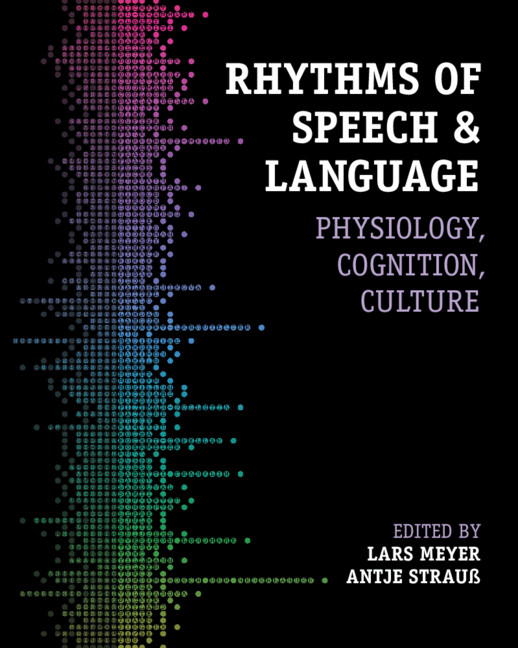
Rhythms of Speech and Language

-
Select format
-
- Publisher:
- Cambridge University Press
- Publication date:
- 23 April 2026
- 07 May 2026
- ISBN:
- 9781009295888
- 9781009295840
- 9781009295857
- Open access funder:
- Max Planck Society
- Creative Commons:
-
This content is Open Access and distributed under the terms of the Creative Commons Attribution licence CC-BY-NC 4.0.


https://creativecommons.org/creativelicenses - Dimensions:
- (254 x 203 mm)
- Weight & Pages:
- 2.008kg, 900 Pages
- Dimensions:
- (254 x 203 mm)
- Weight & Pages:
- 1.888kg, 900 Pages
Open AccessYou have digital access to this book
Show more authors 
You have digital access to this book
Book description
This book showcases the current state of the art of research on rhythm in speech and language. Decades of study have revealed that bodily rhythms are crucial for producing and understanding speech and language, and for understanding their evolution and variability across populations-not only adults, but also developmental and clinical populations. It is also clear that there is perplexing dimensionality and variability of rhythm within and across languages. This book offers the scientific foundation for harmonizing physiological universality and cultural diversity, fostering collaborative breakthroughs across research domains. Its fifty chapters cover physiology, cognition, and culture, presenting knowledge from neuroscience, cognitive science, psychology, phonetics, and communication research. Ideal for academics, researchers, and professionals seeking interdisciplinary insights into the essence of human communication. This title is also available as open access on Cambridge Core.
Contents
Full book PDFContents
-
21 - Preserving Prosody in Temporal Distortions of Speech
pp 367-382 -
-
-
- You have access
- Open access
- HTML
- Export citation
-
-
22 - Rhythmic Alternation and Balance: A New Metric
pp 383-402 -
-
-
- You have access
- Open access
- HTML
- Export citation
-
-
Section 4 - Diversity of Rhythm from Oral Speech to Music
pp 403-550 -
-
- You have access
- Open access
- HTML
- Export citation
-
-
23 - Time, Cohesion, Style: Rhythm Formants in Oral Narrative
pp 405-427 -
-
-
- You have access
- Open access
- HTML
- Export citation
-
-
25 - Rhythmic Stimulation of Linguistic Performance: A Common Structure?
pp 457-470 -
-
-
- You have access
- Open access
- HTML
- Export citation
-
-
26 - Characterizing Rhythmic Regularity in Speech and Song
pp 471-488 -
-
-
- You have access
- Open access
- HTML
- Export citation
-
-
27 - Beats in Time across Music and Language
pp 489-510 -
-
-
- You have access
- Open access
- HTML
- Export citation
-
-
28 - Shared Mechanisms for the Processing of Rhythm in Music and Speech
pp 511-532 -
-
-
- You have access
- Open access
- HTML
- Export citation
-
-
29 - Interaction Phonology: Rhythmic Coordination as Scaffold for Communicative Alignment
pp 533-550 -
-
-
- You have access
- Open access
- HTML
- Export citation
-
-
Section 5 - Rhythm across Languages
pp 551-626 -
-
- You have access
- Open access
- HTML
- Export citation
-
-
30 - Duration-Based and Acoustic Speech Rhythm Metrics
pp 553-565 -
-
-
- You have access
- Open access
- HTML
- Export citation
-
-
31 - The Role of Prosodic Durational Variation in the Temporal Coordination of Utterances
pp 566-577 -
-
-
- You have access
- Open access
- HTML
- Export citation
-
-
34 - Revisiting Rhythm in Romance Languages
pp 610-626 -
-
-
- You have access
- Open access
- HTML
- Export citation
-
-
Section 6 - Rhythm in Language Acquisition
pp 627-740 -
-
- You have access
- Open access
- HTML
- Export citation
-
-
35 - Rhythm and Language Acquisition: A Temporal Sampling Perspective
pp 629-644 -
-
-
- You have access
- Open access
- HTML
- Export citation
-
-
38 - Rhythmic Structure in Cross-Modal Infant-Directed Communication
pp 687-706 -
-
-
- You have access
- Open access
- HTML
- Export citation
-
-
39 - Prosody as an Entry Point into Language Structure in Early Language Acquisition
pp 707-715 -
-
-
- You have access
- Open access
- HTML
- Export citation
-
-
40 - Acquisition of Similar versus Different Speech Rhythmic Class
pp 716-727 -
-
-
- You have access
- Open access
- HTML
- Export citation
-
-
41 - Speech Rhythms and Pupil Size
pp 728-740 -
-
-
- You have access
- Open access
- HTML
- Export citation
-
-
Section 7 - Rhythm in Speech and Language Disabilities
pp 741-871 -
-
- You have access
- Open access
- HTML
- Export citation
-
-
42 - Speech Rhythm in Hearing Loss and Cochlear Implant Listening
pp 743-765 -
-
-
- You have access
- Open access
- HTML
- Export citation
-
-
43 - Melodic Intonation Therapy: The Ingredients That Make It Work
pp 766-784 -
-
-
- You have access
- Open access
- HTML
- Export citation
-
-
45 - Rhythmic Processes in Stuttering and Parkinson’s Disease
pp 801-817 -
-
-
- You have access
- Open access
- HTML
- Export citation
-
-
46 - Speech Rhythm in Stuttering: Perception and Production
pp 818-854 -
-
-
- You have access
- Open access
- HTML
- Export citation
-
References
Metrics
Altmetric attention score
Full text views
Full text views helpTotal number of HTML views: 0
Total number of PDF views: 0 *
 Loading metrics...
* Views captured on Cambridge Core between #date#. This data will be updated every 24 hours.
Usage data cannot currently be displayed.
Accessibility standard: WCAG 2.0 A
Why this information is here
This section outlines the accessibility features of this content - including support for screen readers, full keyboard navigation and high-contrast display options. This may not be relevant for you.
Accessibility Information
The HTML of this book conforms to version 2.0 of the Web Content Accessibility Guidelines (WCAG), ensuring core accessibility principles are addressed and meets the basic (A) level of WCAG compliance, addressing essential accessibility barriers.
Content Navigation
Table of contents navigation
Allows you to navigate directly to chapters, sections, or non‐text items through a linked table of contents, reducing the need for extensive scrolling.
Index navigation
Provides an interactive index, letting you go straight to where a term or subject appears in the text without manual searching.
Reading Order and Textual Equivalents
Single logical reading order
You will encounter all content (including footnotes, captions, etc.) in a clear, sequential flow, making it easier to follow with assistive tools like screen readers.
Full alternative textual descriptions
You get more than just short alt text: you have comprehensive text equivalents, transcripts, captions, or audio descriptions for substantial non‐text content, which is especially helpful for complex visuals or multimedia.
Visualised data also available as non‐graphical data
You can access graphs or charts in a text or tabular format, so you are not excluded if you cannot process visual displays.
Visual Accessibility
Use of colour is not sole means of conveying information
You will still understand key ideas or prompts without relying solely on colour, which is especially helpful if you have colour vision deficiencies.