To save content items to your account,
please confirm that you agree to abide by our usage policies.
If this is the first time you use this feature, you will be asked to authorise Cambridge Core to connect with your account.
Find out more about saving content to .
To save content items to your Kindle, first ensure no-reply@cambridge.org
is added to your Approved Personal Document E-mail List under your Personal Document Settings
on the Manage Your Content and Devices page of your Amazon account. Then enter the ‘name’ part
of your Kindle email address below.
Find out more about saving to your Kindle.
Note you can select to save to either the @free.kindle.com or @kindle.com variations.
‘@free.kindle.com’ emails are free but can only be saved to your device when it is connected to wi-fi.
‘@kindle.com’ emails can be delivered even when you are not connected to wi-fi, but note that service fees apply.
Several studies on the treatment of coronavirus disease 2019 (COVID-19) are being conducted, and various drugs are being tried; however, the results have not been uniform. Steroids have been widely used in the treatment of COVID-19, but their effects are controversial. As immunosuppressive and anti-inflammatory agents, steroids are considered to reduce lung damage by regulating various inflammatory responses. We report a case of severe acute respiratory syndrome coronavirus-2 pneumonia manifesting as a cryptogenic organizing pneumonia-like reaction and discuss its treatment, clinical course, and favorable outcomes after steroid administration.
Presenteeism is an expensive and challenging problem in the healthcare industry. In anticipation of the staffing challenges expected with the COVID-19 pandemic, we examined a decade of payroll data for a healthcare workforce. We aimed to determine the effect of seasonal influenza-like illness (ILI) on absences to support COVID-19 staffing plans.
Design:
Retrospective cohort study.
Setting:
Large academic medical center in the United States.
Participants:
Employees of the academic medical center who were on payroll between the years of 2009 and 2019.
Methods:
Biweekly institutional payroll data was evaluated for unscheduled absences as a marker for acute illness-related work absences. Linear regression models, stratified by payroll status (salaried vs hourly employees) were developed for unscheduled absences as a function of local ILI.
Results:
Both hours worked and unscheduled absences were significantly related to the community prevalence of influenza-like illness in our cohort. These effects were stronger in hourly employees.
Conclusions:
Organizations should target their messaging at encouraging salaried staff to stay home when ill.
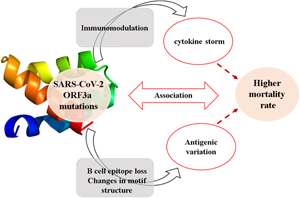
Severe acute respiratory syndrome coronavirus 2 (SARS-CoV-2) has recently caused acute respiratory distress syndrome affecting more than 200 countries with varied mortality rate. Successive genetic variants of SARS-CoV-2 become evident across the globe immediately after its complete genome sequencing. Here, we found a decent association of SARS-CoV-2 ORF3a mutation with higher mortality rate. Extensive in silico studies revealed several amino acid changes in ORF3a protein which ultimately leads to diverse structural modifications like B cell epitope loss, gain/loss of phosphorylation site and loss of leucine zipper motif. We could further relate these changes to the enhanced antigenic diversity of SARS-CoV-2. Through protein−protein network analysis and functional annotation studies, we obtained a close federation of ORF3a protein with host immune response via divergent signal transduction pathways including JAK-STAT, chemokine and cytokine-related pathways. Our data not only unveil the fairly appreciable association of ORF3a mutation with higher mortality rate, but also suggest a potential mechanistic insight towards the immunopathogenic manifestation of SARS-CoV-2 infection.
Since the beginning of 2020, the coronavirus disease (COVID-19) pandemic has dramatically influenced almost every aspect of human life. Activities requiring human gatherings have either been postponed, canceled, or held completely virtually. To supplement lack of in-person contact, people have increasingly turned to virtual settings online, advantages of which include increased inclusivity and accessibility and a reduced carbon footprint. However, emerging online technologies cannot fully replace in-person scientific events. In-person meetings are not susceptible to poor Internet connectivity problems, and they provide novel opportunities for socialization, creating new collaborations and sharing ideas. To continue such activities, a hybrid model for scientific events could be a solution offering both in-person and virtual components. While participants can freely choose the mode of their participation, virtual meetings would most benefit those who cannot attend in-person due to the limitations. In-person portions of meetings should be organized with full consideration of prevention and safety strategies, including risk assessment and mitigation, venue and environmental sanitation, participant protection and disease prevention, and promoting the hybrid model. This new way of interaction between scholars can be considered as a part of a resilience system, which was neglected previously and should become a part of routine practice in the scientific community.
The outbreak of pneumonia known as coronavirus disease (COVID-19) has occurred in China since December 2019 and spread rapidly across the world. Pediatric medical workers have a serious imbalance doctor–patient ratio in China; they have accumulated experience during the fight against COVID-19; however, some flaws were revealed in their current medical system. Meanwhile, these problems were also reported in other countries. Thus far, the outbreak of COVID-19 is still rampant across the world. The experience from anti-COVID-19 could be useful and teach us to provide better medical services for Chinese children and prepare for similar public emergencies in the future. Furthermore, it also provides guidance for pediatric medical staff in managing COVID-19 in other developing countries.
Long-term care facilities (LTCFs) and their populations have been greatly affected by the coronavirus disease 2019 (COVID-19) pandemic. In this review, we summarize the literature to describe the current epidemiology of COVID-19 in LTCFs, clinical presentations and outcomes in the LTCF population with COVID-19, containment interventions, and the role of healthcare workers in SARS-CoV-2 transmission in these facilities.
Based on the public data from the health departments of Tianjin and Shenzhen, we conducted a comparative analysis of the coronavirus disease 2019 (COVID-19) epidemic situation between these 2 cities. The aim of this study was to evaluate the role of public data in epidemic prevention and control of COVID-19, providing a scientific advice for the subsequent mitigation and containment of COVID-19 prevalence.
The 2019 coronavirus disease (COVID-19) pandemic has stressed the health care system in Italy as well as around the world, with hospitals implementing their surge capacity to increase the number of available beds for patients positive to the virus.
At the end of March, the Piemonte (Northern Italy) Government decided to build a temporary rapid-assembly emergency hospital for the treatment of mild and moderate COVID-19 patients, converting an existing concert hall in the city of Turin. The decision was prompted not only by the urgent need of hospital beds, but also by a forward-looking approach for the months immediately after the emergency, when it will be essential for conventional hospitals to return to a normal configuration.
This paper documents the temporary hospital project, describing the site, the layout and the equipment, the idea behind structural choices, and the staff involved. The aim of the work is to share the experience and to provide some practical recommendations to other professionals who are fighting the COVID-19 pandemic worldwide.
The 2019 coronavirus disease (COVID-19) has spread to most countries around the world, infecting millions of people and resulting in the pandemic. This presents great challenges for dental professionals. It is necessary to explore preventive measures for COVID-19 in dental treatments.
Methods:
In this paper, we outline several measures designed to prevent COVID-19 in dental treatments, such as 3-level pre-examination triage and 2-body temperature tests, 3-level protection for medical personnel, gargling before oral treatment, implementing the 4-hand operation, suctioning saliva during oral treatment, using a rubber dam, and strict enforcement of hand hygiene. These measures include recommendations for medical staff and give practical advice for managing treatment.
Results:
The epidemic has been brought under control, and routine oral examination and treatments have gradually been resumed from March 9, 2020, in Hunan Province, China. From January 24 to March 8, 2020, a total of 4272 patients received oral therapy during the COVID-19 epidemic in our hospital. We followed these guidelines during the COVID-19 epidemic, and none of the clinical dental staff, other workers, or patients were infected with COVID-19.
Conclusions:
These preventive measures for COVID-19 in dental treatments can be used as a reference for oral clinics and stomatological hospitals.
We aimed to investigate knowledge, attitudes, and practices regarding the new coronavirus in a sample of the general Pakistani population.
Methods:
This survey was carried out through The University of Faisalabad (TUF), Pakistan, between February 2020 and April 2020. The questionnaire was circulated on various online platforms to gather information. The data were analyzed on SPSS-22.
Results:
Out of 2121 respondents (13.7% were male, and 86.3% were females), 7.4% were married, 4.5% had a high income, and 5.8% had fewer family members. Coronavirus disease (COVID-19) knowledge scores were significantly low in the < 21 years age group as compared to the 21 to 25 years age group (P < 0.001) and > 25 years age group (P < 0.001). The males, married community, high income people, and few family members groups had significantly higher coronavirus knowledge than their respective groups (P = 0.033; P = 0.001; P < 0.001; P = 0.042, respectively).
Conclusion:
Our findings suggest that the knowledge score among our study population was not up to the mark. However, a positive correlation between the correct knowledge and appropriate attitude and practice was found among study participants. Older age groups and the high income group were associated with adequate knowledge scores.
The outbreak of the novel coronavirus severe acute respiratory syndrome-coronavirus-2 has raised major health policy questions and dilemmas. Whilst respiratory droplets are believed to be the dominant transmission mechanisms, indirect transmission may also occur through shared contact of contaminated common objects that is not directly curtailed by a lockdown. The conditions under which contaminated common objects may lead to significant spread of coronavirus disease 2019 during lockdown and its easing is examined using the susceptible-exposed-infectious-removed model with a fomite term added. Modelling the weekly death rate in the UK, a maximum-likelihood analysis finds a statistically significant fomite contribution, with 0.009 ± 0.001 (95% CI) infection-inducing fomites introduced into the environment per day per infectious person. Post-lockdown, comparison with the prediction of a corresponding counterfactual model with no fomite transmission suggests fomites, through enhancing the overall transmission rate, may have contributed to as much as 25% of the deaths following lockdown. It is suggested that adding a fomite term to more complex simulations may assist in the understanding of the spread of the illness and in making policy decisions to control it.
Cardiac injury is associated with poor prognosis of 2019 novel coronavirus disease 2019 (COVID-19), but the risk factors for cardiac injury have not been fully studied. In this study, we carried out a systematic analysis of clinical characteristics in COVID-19 patients to determine potential risk factors for cardiac injury complicated COVID-19 virus infection.
Methods
We systematically searched relevant literature published in Pubmed, Embase, Europe PMC, CNKI and other databases. All statistical analyses were performed using STATA 16.0.
Results
We analysed 5726 confirmed cases from 17 studies. The results indicated that compared with non-cardiac-injured patients, patients with cardiac injury are older, with a greater proportion of male patients, with higher possibilities of existing comorbidities, with higher risks of clinical complications, need for mechanical ventilation, ICU transfer and mortality. Moreover, C-reactive protein, procalcitonin, D-dimer, NT-proBNP and blood creatinine in patients with cardiac injury are also higher while lymphocyte counts and platelet counts decreased. However, we fortuitously found that patients with cardiac injury did not present higher clinical specificity for chest distress (P = 0.304), chest pain (P = 0.334), palpitations (P = 0.793) and smoking (P = 0.234). Similarly, the risk of concomitant arrhythmia (P = 0.103) did not increase observably either.
Conclusion
Age, male gender and comorbidities are risk factors for cardiac injury complicated COVID-19 infection. Such patients are susceptible to complications and usually have abnormal results of laboratory tests, leading to poor outcomes. Contrary to common cardiac diseases, cardiac injury complicated COVID-19 infection did not significantly induce chest distress, chest pain, palpitations or arrhythmias. Our study indicates that early prevention should be applied to COVID-19 patients with cardiac injury to reduce adverse outcomes.
To examine how food insecurity is related to emerging adults’ food behaviours and experiences of neighbourhood safety and discrimination and to identify resources needed to support their health during the COVID-19 outbreak.
Design:
Rapid response online survey. Participants completed the six-item US Household Food Security Survey Module, a brief measure of food insufficiency, and measures of food behaviours, neighbourhood safety and discrimination. Open-ended questions were used to assess changes in eating behaviours during COVID-19 and needed resources.
Setting:
C-EAT (COVID-19 Eating and Activity over Time) study invitations were sent by email and text message to a longitudinal cohort.
Participants:
A total of 218 emerging adults (mean age = 24·6 (sd 2·0) years, 70·2 % female) completed a survey in April–May 2020 during a stay-at-home order in Minnesota.
Results:
The past year prevalence of food insecurity was 28·4 %. Among food-insecure respondents, 41·0 % reported both eating less and experiencing hunger due to lack of money in the past month. Food-insecure respondents were less likely than those who were food secure to have fruits/vegetables at home and more likely to have frequent fast-food restaurant meals, feel unsafe in their neighbourhood and experience discrimination during the stay-at-home order. Food-insecure adults reported changes including eating more food prepared at home, eating more take-out restaurant meals and purchasing more energy-dense snacks as a result of events related to COVID-19. Resources most needed to support their health included eligibility for more food assistance and relief funds.
Conclusions:
Food-insecure emerging adults experience many barriers to maintaining healthful eating patterns during COVID-19.
Although handwashing is an effective way to prevent infections, there is scarce evidence on predictors of handwashing during a pandemic. This paper aims to identify behavioural and demographic predictors of handwashing. The study surveyed 674 adults in Malaysia in May 2020 regarding whether the time spent on social media predicted handwashing contingent on gender and number of children. More time spent on social media was positively associated with handwashing for males with three or more children. However, for males without children, social media use was negatively associated with handwashing. The association was not significant for males with one or two children. For females, more time spent on social media was significantly linked to more handwashing only for females with one child. Gender, a traditional predictor of handwashing, was a useful predictor only for those who spent more than three hours per day on social media and had at most one child. Number of children was a novel negative predictor for males who did not use social media and who averaged one hour per day on social media, a positive predictor for males who spent lots of time on social media, but not a predictor for females. In sum, social media use predicts handwashing, and is thus a helpful variable for use in targeted health communication during a pandemic – particularly through social media. Further, more conventional predictors like gender and number of children exhibit contingency effects with social media use.