Contents
Research Article
Homology of Deleted Products of Contractible 2-Dimensional Polyhedra. II
-
- Published online by Cambridge University Press:
- 20 November 2018, pp. 842-854
-
- Article
-
- You have access
- Export citation
-
The deleted product space X* of a space X is X × X — △. In (4), I computed the homology groups of the deleted product of a polyhedron in a subcollection
 (see §2 of this paper for the definition of ) of the finite, contractible, 2-dimensional polyhedra. In the present paper, I show that there is an infinite subcollection
 of such that the deleted product of each member of has the homotopy type of the 2-sphere.
 (see §2 of this paper for the definition of
 of
A Note Concerning Simultaneous Integral Equations
-
- Published online by Cambridge University Press:
- 20 November 2018, pp. 855-861
-
- Article
-
- You have access
- Export citation
Rings in which all Subrings are Ideals. I
-
- Published online by Cambridge University Press:
- 20 November 2018, pp. 862-871
-
- Article
-
- You have access
- Export citation
Direct Sums of Partial Algebras and Final Algebraic Structures
-
- Published online by Cambridge University Press:
- 20 November 2018, pp. 872-887
-
- Article
-
- You have access
- Export citation
The Coarseness of the Complete Graph
-
- Published online by Cambridge University Press:
- 20 November 2018, pp. 888-894
-
- Article
-
- You have access
- Export citation
-
The coarseness, c(G), of a graph G is the maximum number of edge-disjoint, non-planar subgraphs of G. We consider only the complete graph, Kp , on p vertices here. For p = 3r, Erdös conjectured that the coarseness was
 , but it has been shown (1) that
 1
where square brackets denote integer part.
 , but it has been shown (1) that

Endomorphism Rings of Quasi-Injective Modules
-
- Published online by Cambridge University Press:
- 20 November 2018, pp. 895-903
-
- Article
-
- You have access
- Export citation
-
Y. Utumi (14 and 15) obtained some interesting results on self-injective rings. He showed that, if R is right self-injective, then so is R/J, where J is the Jacobson radical of R. Also, if R is right self-injective and regular, then R is left self-injective
 for any set of orthogonal idempotents
 is an essential extension of
 . This note extends these results to endomorphism rings of quasi-injective modules.
 for any set of orthogonal idempotents
 is an essential extension of
 . This note extends these results to endomorphism rings of quasi-injective modules.
An Integral Representation for the Product of Spectral Measures
-
- Published online by Cambridge University Press:
- 20 November 2018, pp. 904-912
-
- Article
-
- You have access
- Export citation
-
Let
 be a Hilbert space with inner product (•, •) and let E(•) and E0(•) be spectral measures in corresponding to self-adjoint operators
 and
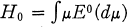 . In this paper we consider the set function ƒ(I × J) = E(I)E0(J) defined on the semiring of bounded rectangles, and obtain an integral representation for this set function for disjoint I, J under the hypotheses that H — H0 is a type of Carleman operator.
 be a Hilbert space with inner product (•, •) and let E(•) and E
 and
 . In this paper we consider the set function ƒ(I × J) = E(I)E
Rings Satisfying (x, y, z) = (y, z, x)
-
- Published online by Cambridge University Press:
- 20 November 2018, pp. 913-918
-
- Article
-
- You have access
- Export citation
-
Let R be a ring satisfying the identity
1

for all x, y, z ϵ R, where (x,y,z) = (xy)z — x(yz). If R also satisfies the identity (x, x, x) = 0 for all x ϵ R, then R is alternative. It is known that if R satisfies (1), it need not be an alternative (see 6). Thus, the class of rings satisfying (1) is a non-trivial extension of the class of alternative rings. P. Jordan remarked that (x, x, x)2 = 0 is an identity in R (see 9).
Extreme Points in Spaces of Analytic Functions
-
- Published online by Cambridge University Press:
- 20 November 2018, pp. 919-928
-
- Article
-
- You have access
- Export citation
On Some Methods for Construction of B.I.B. Designs
-
- Published online by Cambridge University Press:
- 20 November 2018, pp. 929-938
-
- Article
-
- You have access
- Export citation
An Axiomatic Line Geometry
-
- Published online by Cambridge University Press:
- 20 November 2018, pp. 939-952
-
- Article
-
- You have access
- Export citation
A Decomposition of Measures
-
- Published online by Cambridge University Press:
- 20 November 2018, pp. 953-959
-
- Article
-
- You have access
- Export citation
-
Let X be a set,
 a σ-ring of subsets of X, and let μ be a measure on . Following (1), we define μ to be semifinite if

We show (Theorem 1) that every measure can be reduced to a semifinite measure for many practical purposes. In many cases, this reduction can be made even more significantly (Theorems 2 and 3). Finally, necessary and sufficient conditions that a semifinite measure be c-finite are given as a corollary to Theorem 3.
 a σ-ring of subsets of X, and let μ be a measure on
Some Moment Problems in a Finite Interval
-
- Published online by Cambridge University Press:
- 20 November 2018, pp. 960-966
-
- Article
-
- You have access
- Export citation
-
Let the sequence {λi} (i ≧ 0) satisfy the following conditions.
1.

2.

3.

We shall deal with the following moment problems: what are the conditions, necessary and sufficient, on a sequence {μn} (n ≧ O) in order that it should possess the representation
1.1


On Packings of Unequal Spheres in Rn
-
- Published online by Cambridge University Press:
- 20 November 2018, pp. 967-969
-
- Article
-
- You have access
- Export citation
-
Suppose that a sequence of spheres
 is packed in order of decreasing diameters into the unit cube In of Rn . In recent work (2), I have shown that for n = 2, there exist positive constants K2, s ( = 0.97) such that the area of
 has an asymptotic lower bound K2(d(Sm))s . Although the methods used were complicated and possibly only viable in two dimensions, it is intuitively clear that such a result should also be true in higher dimensions.
 is packed in order of decreasing diameters into the unit cube I
 has an asymptotic lower bound K
On a Condition of J. Ohm for Integral Domains1
-
- Published online by Cambridge University Press:
- 20 November 2018, pp. 970-983
-
- Article
-
- You have access
- Export citation
Projective Systems on Trees and Valuation Theory
-
- Published online by Cambridge University Press:
- 20 November 2018, pp. 984-1000
-
- Article
-
- You have access
- Export citation
On Subsemigroups of the Projective Group on the Line
-
- Published online by Cambridge University Press:
- 20 November 2018, pp. 1001-1011
-
- Article
-
- You have access
- Export citation
Simultaneous Unitary Invariants for Sets of Matrices
-
- Published online by Cambridge University Press:
- 20 November 2018, pp. 1012-1019
-
- Article
-
- You have access
- Export citation
On the Distribution of nθ Modulo 1
-
- Published online by Cambridge University Press:
- 20 November 2018, pp. 1020-1024
-
- Article
-
- You have access
- Export citation
-
In recent work of E. Arthurs and L. A. Shepp on a problem of H. Dym concerning the existence of an ergodic stationary stochastic process with zero entropy (cf. 1), the function dθ(n) was introduced as follows:
For an irrational number θ, let

be the sequence of points {lθ}, 1 ≦ l ≦ n, (where {x} denotes x — [x], the fractional part of x) and define*
dθ (n) = max(ai — a i-1), 1 ≦ in + 1.
A Study of Tensors which Characterize a Hypersurface of a Finsler Space
-
- Published online by Cambridge University Press:
- 20 November 2018, pp. 1025-1036
-
- Article
-
- You have access
- Export citation